
Present Perfect Continuous: How and When to Use It, With Everyday Examples
The present perfect continuous (I have been working) describes activities that started in the past and continue now, recent activities with visible results, and repeated actions up to now. Learn the form, the four uses, how it differs from the present perfect simple, and the mistakes to avoid.

- How to form the present perfect continuous
- The four main uses, with everyday examples
- Present perfect continuous or present perfect simple?
- State verbs: when the continuous form is not used
- Time expressions that go with it
- Using it in real conversations
- Common mistakes and how to fix them
- Practice exercise with answers
- What this article cannot tell you
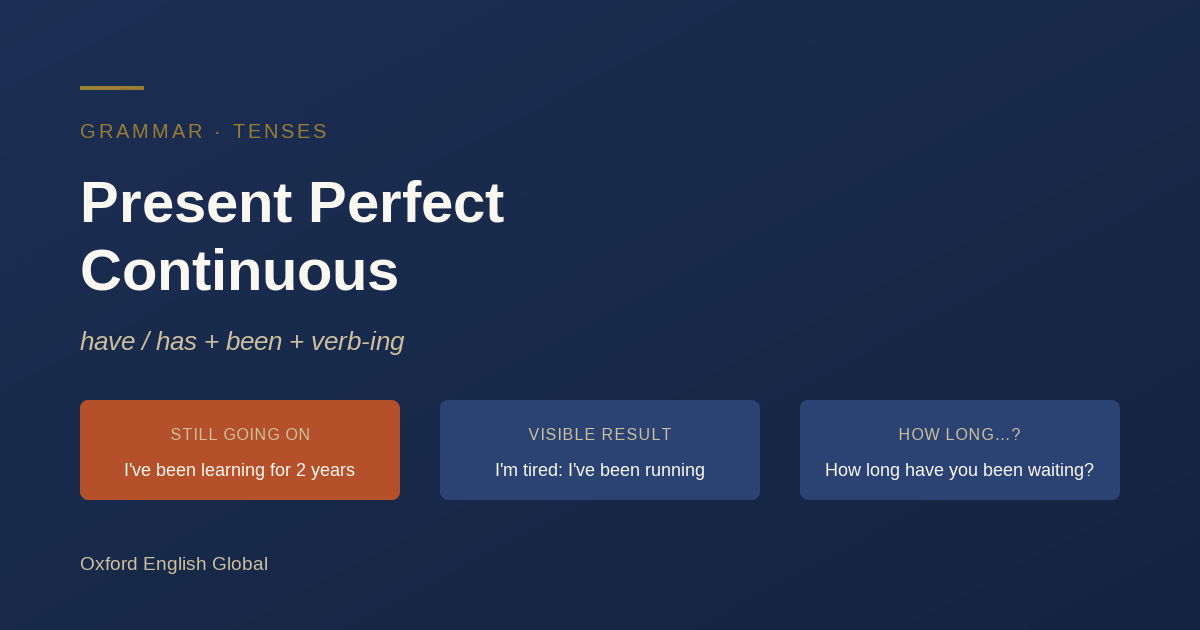
The present perfect continuous (I have been working) is formed with have/has + been + verb-ing. Use it for an activity that started in the past and is still going on (I've been learning English for two years), for a recent activity whose results you can see now (I'm tired because I've been running), and for repeated activities up to now (She's been going to the gym a lot lately). Choose the present perfect simple (I have worked) instead when you focus on the result, a finished amount or a number of times (I've written three emails), and with state verbs such as know, be and own. This guide explains the form, the four main uses, the difference from the present perfect simple with side-by-side examples, the most common mistakes, and a short practice exercise with answers.
Sources. The form and uses on this page follow the Cambridge Dictionary grammar entry for the present perfect continuous (read 25 November 2026), which describes it as being used for a finished activity in the recent past with a present result, a single activity that "began at a point in the past and is still continuing", and repeated activities "still continuing up until now". The examples are our own unless marked otherwise. The rules are the same in British and American English, although contractions such as I've and she's are more frequent in speech than in formal writing.
How to form the present perfect continuous
The tense has three parts: have or has, then been, then the -ing form of the main verb. Only have/has changes with the subject.
| Type | Full form | Contracted form (speech and informal writing) |
|---|---|---|
| Positive | I/you/we/they have been working he/she/it has been working | I've been working / She's been working |
| Negative | I have not been working She has not been working | I haven't been working / She hasn't been working |
| Question | Have you been working? Has she been working? | (no contraction in short questions) |
| Wh- question | How long have you been working here? What has he been doing? | What's he been doing? |
| Short answers | Yes, I have. / No, she hasn't. | Not "Yes, I have been." |
Two small points help with pronunciation. In fast speech, been is usually weak, close to /bɪn/, so I've been waiting sounds like "aiv-bin-waiting". And she's can mean she is or she has; when it is followed by been + -ing, it means she has. Our guide to connected speech in English explains weak forms like this.
The four main uses, with everyday examples
1. An activity that started in the past and is still continuing
This is the most common use. The activity began at some point in the past and has not stopped. We often say how long with for or since.
- I've been living in Lisbon for three years. (I still live there.)
- We've been waiting since 10 o'clock. (We are still waiting.)
- He's been working on the report all morning.
For a full explanation of for (a length of time) and since (a starting point), see since vs for in English.
2. A recent activity with a visible result now
The activity may have just stopped, but we can see, hear or feel the result in the present. We usually do not say when it happened.
- "Why are your eyes red?" "I've been crying." (The crying has stopped; the red eyes are the result.)
- Sorry about the mess. I've been painting the kitchen.
- It's been raining. The streets are wet.
The Cambridge Dictionary gives a similar example: "I've just been cleaning the car." (The car is wet and clean.)
3. Repeated activities up to now
The activity has happened again and again over a period that continues to now. Words like lately, recently and a lot are common.
- I've been getting a lot of spam emails lately.
- She's been calling you all day. Did you check your phone?
- They've been going to the same café every Friday since they met.
4. Asking and answering "How long…?"
When we ask about the duration of an activity that is still happening, the present perfect continuous is the natural choice.
- "How long have you been studying English?" "For about four years."
- "How long has she been working here?" "Since last spring."
A very common mistake is to use the present simple here: How long are you studying English? asks about the future in many contexts and sounds wrong for duration up to now.
Present perfect continuous or present perfect simple?
Both tenses connect the past to the present, and with some verbs both are possible. The key question is: are you focusing on the activity, or on the result?
| Present perfect continuous | Present perfect simple |
|---|---|
| Focus on the activity and its duration | Focus on the result or completion |
| I've been writing emails all morning. (That's what I've been doing.) | I've written twelve emails this morning. (That's what I've finished.) |
| She's been reading your book. (She hasn't finished it.) | She's read your book. (She has finished it.) |
| How long have you been learning Spanish? | How many words have you learned? |
| Often temporary: I've been staying with friends this week. | Often more permanent: I've lived here all my life. |
| Not used with state verbs: I've been knowing him is wrong. | Used with state verbs: I've known him for ten years. |
Three quick tests
- Is there a number or quantity? If you say how many or how much (three times, ten pages, two coffees), use the simple form: I've drunk two coffees, not I've been drinking two coffees.
- Is the activity finished, with a completed result? If yes, the simple form is usually better: I've fixed the printer (it works now). Compare: I've been fixing the printer (that's what I was doing; it may or may not work).
- Is it a state rather than an action? Verbs like know, believe, belong, own, need and be (in most uses) normally take the simple form: We've been married for 20 years, not We've been being married.
When both are correct
With verbs that naturally describe activities over time, such as live, work, study and teach, both forms are often correct with for or since, with only a small difference in feeling:
- I've worked here for five years. / I've been working here for five years. (Both are natural. The continuous can sound slightly more temporary or more focused on the ongoing activity.)
- She's lived in Berlin since 2020. / She's been living in Berlin since 2020.
If you need a refresher on how the present perfect differs from the past simple, read present perfect vs past simple. For a view of all tenses together, see English tenses explained.
State verbs: when the continuous form is not used
State verbs describe situations, thoughts, feelings and possession rather than actions. They are rarely used in any continuous tense, including this one. Use the present perfect simple instead.
| Type | Common verbs | Correct | Incorrect |
|---|---|---|---|
| Knowing and thinking | know, believe, understand, remember, mean | I've known her since school. | I've been knowing her since school. |
| Possession | have (= own), own, belong, possess | We've had this car for ten years. | We've been having this car for ten years. |
| Feelings | like, love, hate, want, prefer, need | I've always wanted to visit Japan. | I've always been wanting to visit Japan. |
| Existence | be, exist, seem | He's been ill since Monday. | He's been being ill since Monday. |
Some verbs can be states or actions with different meanings. Have meaning "own" is a state, but have in expressions like have lunch, have a shower or have problems is an action: I've been having problems with my laptop is correct. Similarly, think meaning "believe" is a state (I've always thought he was right), but think meaning "consider" is an action (I've been thinking about changing jobs). Our guide to present simple vs present continuous explains state verbs in more detail.
Time expressions that go with it
| Expression | Example |
|---|---|
| for + a length of time | I've been waiting for twenty minutes. |
| since + a starting point | It's been snowing since last night. |
| all day / all morning / all week | The phone has been ringing all morning. |
| lately / recently | I haven't been sleeping well lately. |
| How long…? | How long have they been dating? |
| just (for a recent activity) | I've just been talking to your manager. |
Do not use a finished time expression such as yesterday, last week or in 2020 with this tense. For a finished time, use the past simple or past continuous: I was working yesterday, not I've been working yesterday.
Using it in real conversations
This tense appears constantly in everyday English, especially when people catch up, explain or complain. Here are natural situations where you will hear it and can use it.
Catching up with someone
A: "Hi! I haven't seen you for ages. What have you been up to?"
B: "Not much, really. I've been working a lot, and I've been trying to get back into running."
What have you been up to? is one of the most common informal questions in English. Our guide to small talk in English has more phrases like this.
Explaining a situation at work
"Sorry for the slow reply. I've been dealing with a problem with a supplier, and I've been out of the office since Tuesday."
Note the mix: I've been dealing (an activity) but I've been out of the office (a state with be, so the simple form have been).
At the doctor's
"I've been having headaches for about two weeks, and I haven't been sleeping well."
In a job interview
"I've been working in customer service for six years. For the last two, I've been leading a team of eight people."
See job interview in English for more ways to describe your experience.
Common mistakes and how to fix them
| Mistake | Why it is wrong | Correct |
|---|---|---|
| I am living here since 2019. | Present continuous cannot connect the past to now with since. | I've been living here since 2019. |
| How long do you work here? | Duration up to now needs a perfect tense. | How long have you been working here? |
| I've been knowing him for years. | Know is a state verb. | I've known him for years. |
| I've been reading three books this month. | A number of completed things needs the simple form. | I've read three books this month. |
| She has been work here for a year. | The main verb needs -ing. | She has been working here for a year. |
| He have been waiting. | Third person singular needs has. | He has been waiting. |
| I've been seeing that film last night. | A finished time (last night) needs the past simple. | I saw that film last night. |
| I've been waiting since two hours. | Two hours is a length of time, so use for. | I've been waiting for two hours. |
The first two mistakes are especially common for speakers of languages such as Spanish, French, German, Italian and Portuguese, which often use a present tense for "since/for" situations. For more patterns like these, see common English grammar mistakes.
Practice exercise with answers
Choose the present perfect continuous or the present perfect simple. In some sentences, both are possible.
- I'm exhausted. I ______ (run) for an hour.
- She ______ (write) four reports this week.
- How long ______ you ______ (wait)?
- We ______ (know) each other since university.
- Your hands are dirty. What ______ you ______ (do)?
- They ______ (live) in Toronto for ten years.
- I ______ (not / sleep) well lately.
- He ______ (visit) London three times.
- It ______ (rain) all day. I hope it stops soon.
- I ______ (finish) the project. Can I go home now?
Answers
- have been running (activity with a visible result: I'm exhausted)
- has written (a number of completed things)
- have … been waiting (How long + an ongoing activity)
- have known (state verb)
- have … been doing (recent activity with a visible result)
- have lived / have been living (both correct with live + for)
- haven't been sleeping (repeated activity up to now; haven't slept is also possible)
- has visited (number of times)
- has been raining (activity continuing up to now)
- have finished (completed result)
Speaking practice
Answer these questions aloud in two or three sentences each. Record yourself, then check you used have/has been + -ing for activities and the simple form for states and numbers.
- What have you been doing to improve your English recently?
- How long have you been working or studying where you are now?
- What TV series have you been watching lately?
You can practise speaking aloud with our free Speaking Lab, try more grammar in our free lessons, or get feedback from a teacher on our English courses.
What this article cannot tell you
- Every exception. Grammar guides simplify. Native speakers sometimes use state verbs in the continuous for special effect (I've been wanting to tell you this for weeks), and you will hear this in real English.
- Regional variation in detail. The core rules are shared by British and American English, but frequency and style vary, and American speakers use the past simple in some places where British speakers prefer a perfect tense.
- Your level. This tense is usually taught at around B1. If the explanations feel difficult, start with the present perfect simple, or check your level with our English level test.
This page is independent guidance from Oxford English Global. It contains no affiliate links.
Frequently asked questions
How do you form the present perfect continuous?
Use have or has, then been, then the -ing form of the main verb: I have been working, she has been working. In speech we usually contract: I've been working, she's been working. Questions start with have or has: Have you been waiting long?
What is the difference between the present perfect continuous and the present perfect simple?
The continuous focuses on the activity and its duration (I've been writing emails all morning). The simple focuses on the result, a completed amount or a number of times (I've written twelve emails). State verbs such as know and own normally use the simple form.
Can I say I have been knowing him for years?
No. Know is a state verb, so it is not normally used in continuous forms. Say I've known him for years.
Is I've worked here for five years the same as I've been working here for five years?
Both are correct and very close in meaning. With verbs like live, work and study, the continuous can sound slightly more temporary or focused on the ongoing activity, but either is natural.