
Present Perfect vs Past Simple: When to Use Each Tense, With Examples
Use the past simple for a finished time and the present perfect for time that connects to now. This guide gives the forms, the time-expression shortcut, five uses of the present perfect, British and American differences, common mistakes and a short practice exercise.

- How to form each tense
- The core difference: finished time vs connection to now
- Time expressions: the fastest way to choose
- Five uses of the present perfect
- How to switch between the two in a conversation
- British and American differences
- Common learner mistakes and how to fix them
- Practice: choose the right tense
- What this article cannot tell you
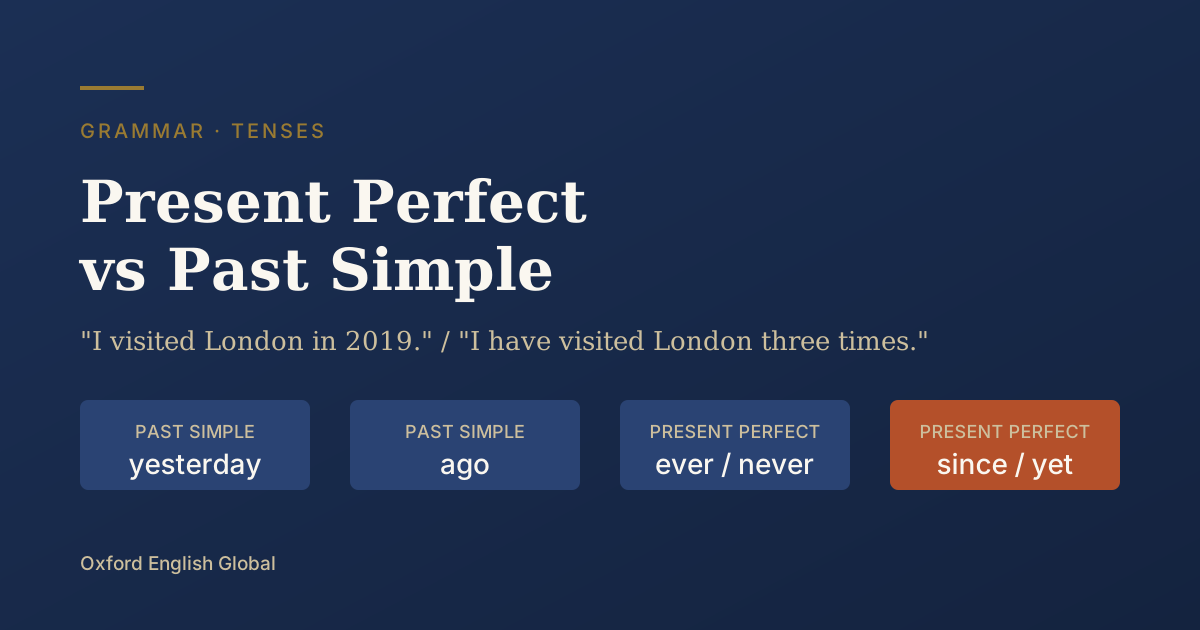
Use the past simple (I visited) for a finished action at a finished time, especially when you say or know when it happened: "I visited London in 2019." Use the present perfect (I have visited) when the time is unfinished or not important, and the past action is connected to now: "I have visited London three times." The quickest test is the time expression. Words like yesterday, last week, in 2019 and ago point to a finished time, so they need the past simple. Words like ever, never, already, yet, so far and since usually go with the present perfect. This guide explains both tenses with clear examples, a comparison table, the five main uses of the present perfect and the mistakes learners make most often.
Quick rule: If you can answer the question "When exactly?" with a finished time, use the past simple. If the answer is "At some point up to now" or "It doesn't matter when", use the present perfect.
How to form each tense
The past simple uses the second form of the verb: worked, went, saw. The present perfect uses have or has plus the past participle (the third form): have worked, has gone, have seen.
| Past simple | Present perfect | |
|---|---|---|
| Positive | She finished the report. | She has finished the report. |
| Negative | She didn't finish the report. | She hasn't finished the report. |
| Question | Did she finish the report? | Has she finished the report? |
| Irregular verb (go) | They went home. | They have gone home. |
| Irregular verb (see) | I saw that film. | I have seen that film. |
Regular verbs have the same past simple and past participle (worked / worked), so the difference is only have. With irregular verbs the forms often differ (went / gone, ate / eaten, wrote / written), and mixing them up is a common error: "I have went" should be "I have gone".
The core difference: finished time vs connection to now
Both tenses talk about the past. The difference is how the speaker sees the time.
- Past simple: the action is in a finished period that is separate from now. "I lost my keys yesterday." Yesterday is over.
- Present perfect: the action happened in a period that continues to now, or the result matters now. "I've lost my keys." (I can't open the door now.)
Compare these pairs:
| Past simple | Present perfect | The difference |
|---|---|---|
| I wrote three emails this morning. (It's now afternoon.) | I've written three emails this morning. (It's still morning.) | Is "this morning" finished? |
| He worked in Madrid for five years. | He's worked in Madrid for five years. | He doesn't work there now / he still works there. |
| Did you see the match last night? | Have you seen the new office? | A specific past time / any time up to now. |
| Shakespeare wrote many plays. | She's written two novels. | His life is finished; hers isn't, so she may write more. |
The last example shows that the choice depends on the speaker's view of time, not only on the action. Because Shakespeare's life is over, we can't use the present perfect for his work.
Time expressions: the fastest way to choose
Most of the time, the time expression decides for you.
| Usually past simple | Usually present perfect | Either, depending on meaning |
|---|---|---|
| yesterday, last night, last week | ever, never | today, this week, this year |
| in 2019, in March, on Monday | already, yet, just | recently, lately |
| two days ago, a year ago | so far, up to now, until now | for (three years) |
| when I was a child, at 9 o'clock | since (2020, Monday, I arrived) | before |
A useful rule: never use "ago" or a specific finished date with the present perfect. "I have arrived two days ago" is wrong; it should be "I arrived two days ago". This is a firm rule in standard British and American English, and grammar references such as the Cambridge Dictionary grammar guide to present perfect or past simple explain it the same way.
With "for", the tense changes the meaning. "I lived in Rome for two years" means I don't live there now. "I've lived in Rome for two years" means I still live there.
Five uses of the present perfect
Learners often find the present perfect hard because it has several uses. Here are the five most common, each with its typical signal words.
1. Life experience (at any time up to now)
"Have you ever been to Japan?" "I've never tried sushi." The exact time is not important. If you then give details with a specific time, switch to the past simple: "Yes, I went there in 2022. It was amazing."
2. Unfinished time period
"I've had three coffees today." "We've hired five people this year." Today and this year are not finished.
3. Something that started in the past and continues now
"She's worked here since 2021." "I've known him for ten years." Use for with a length of time and since with a starting point.
4. A past action with a result now
"I've broken my phone." (It doesn't work now.) "They've gone home." (They aren't here.)
5. Recent news and updates
"The company has announced a new CEO." "I've just finished the report." News reports often introduce a story with the present perfect, then give details in the past simple: "The prime minister has resigned. She made the announcement at 10 a.m."
How to switch between the two in a conversation
Real conversations often start with the present perfect (general experience) and move to the past simple (specific details). This pattern is worth practising because it sounds very natural.
A: Have you ever given a presentation in English?
B: Yes, I've done it a few times. The last one was in September.
A: How did it go?
B: It went well, but I was really nervous at the start.
Notice the change: "have you ever given" (any time) becomes "the last one was in September" (a finished time), and every follow-up question about that event uses the past simple.
British and American differences
With just, already and yet, British English usually prefers the present perfect, while American English often accepts the past simple too:
| British English (usual) | American English (also common) |
|---|---|
| I've just eaten. | I just ate. |
| Have you finished yet? | Did you finish yet? |
| I've already seen it. | I already saw it. |
Both are correct in their variety. In exams such as IELTS and Cambridge, the present perfect form is always safe. For more on these differences, see our guide to British vs American English.
Common learner mistakes and how to fix them
| Mistake | Correct | Why |
|---|---|---|
| I have seen him yesterday. | I saw him yesterday. | "Yesterday" is a finished time. |
| I live here since 2020. | I've lived here since 2020. | Started in the past and continues: present perfect, not present simple. |
| When have you arrived? | When did you arrive? | "When" asks for a specific time, so use the past simple. |
| Did you ever eat Indian food? | Have you ever eaten Indian food? | Life experience; the past simple is possible in American English, but the present perfect is standard. |
| I have went there. | I have gone / been there. | Use the past participle after "have". |
| She has gone to Paris twice. | She has been to Paris twice. | "Been" = visited and came back; "gone" = is there now. |
Many of these errors come from translation. Spanish, French, German and Italian all have a form that looks like the present perfect but is often used for finished past events, so speakers of those languages tend to overuse it in English. Speakers of languages without this distinction tend to use the past simple everywhere. Our guide to common English grammar mistakes covers more patterns like this.
Practice: choose the right tense
Choose the correct form. Answers are below.
- I ___ (never / be) to Canada.
- We ___ (meet) at a conference in 2023.
- She ___ (work) here for six years, and she still loves it.
- ___ you ___ (see) the email from the manager this morning? (It's 4 p.m.)
- Oh no! I ___ (forget) my password.
- They ___ (move) to Berlin three months ago.
Answers: 1. have never been; 2. met; 3. has worked; 4. Did you see (the morning is finished); 5. have forgotten (result now); 6. moved ("ago").
To build the habit, write five sentences about your own life with "I've never…" and five with "Last year I…". Then say them aloud. Our map of all 12 English tenses shows where these two fit in the full system, and our free lessons include grammar practice at B1 and B2.
What this article cannot tell you
- Every exception. Native speakers sometimes break these rules for emphasis or in informal speech, and usage varies between regions. The rules here describe standard written English.
- Related tenses. We have not covered the present perfect continuous ("I've been working") or the past perfect ("I had worked"), which have their own uses.
- Your specific errors. A guide can explain the rules, but only feedback on your own speaking and writing shows which mistakes you actually make. A teacher or our General English courses can provide that.
Frequently asked questions
What is the main difference between the present perfect and the past simple?
The past simple is for finished actions at a finished time ('I saw her yesterday'). The present perfect is for actions in a time period that continues to now, or with a result now ('I've seen her today', 'I've lost my keys').
Can I use 'ago' with the present perfect?
No. 'Ago' refers to a finished time, so it needs the past simple: 'I arrived two days ago', not 'I have arrived two days ago'.
Is 'Did you finish yet?' correct?
It is common in American English. British English and most exams prefer the present perfect with 'yet': 'Have you finished yet?'
What is the difference between 'has been to' and 'has gone to'?
'She has been to Paris' means she visited and came back. 'She has gone to Paris' means she is there now.