
How to Make Small Talk in English at Work and Social Events
Small talk is how English speakers start meetings, meet new colleagues and make contacts at events. This guide gives you a simple six-step structure, opening and closing phrases, safe topics and ones to avoid, techniques to keep a conversation going and real example dialogues.

- What is small talk and why does it matter?
- A simple structure for any small talk conversation
- Phrases to start a conversation
- Safe topics and topics to avoid
- How to keep the conversation going
- Small talk at work: example conversations
- Small talk at social events and networking
- How to end a conversation politely
- Common mistakes learners make in small talk
- How to practise small talk
- What this article cannot tell you
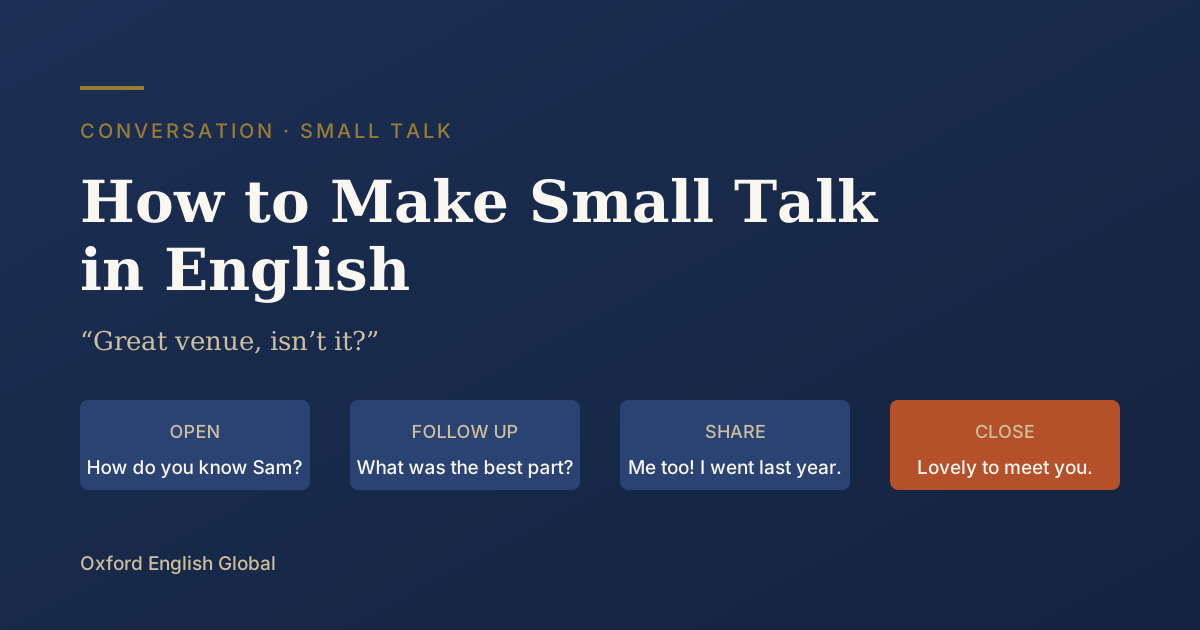
To make small talk in English, open with a friendly comment or easy question about something you both share (the place, the event, the weather, the journey), listen to the answer, then keep the conversation going by asking a follow-up question and adding a short detail about yourself. Stick to safe topics such as work, travel, food, hobbies, films and plans for the weekend, and avoid salary, politics, religion and personal appearance with people you do not know well. End politely with a reason and a positive line, such as "I'd better get a coffee before the next session. It was really nice talking to you." Small talk is not about saying something important. It is about being friendly, finding common ground and making the next, more serious conversation easier. This guide gives you the phrases, a simple structure, safe and risky topics, examples for work and social events, and practice ideas.
In short: Open → Ask → Listen → Follow up → Share → Close. You do not need advanced English for small talk. Most good small talk uses short, simple sentences and a lot of questions.
What is small talk and why does it matter?
Small talk is light, polite conversation about everyday subjects, usually between people who do not know each other well. Typical moments are the first few minutes of a meeting, a coffee break at a conference, waiting for a lift, or meeting friends of friends at a party.
In many English-speaking workplaces, small talk has a clear social job:
- It builds trust. People are more comfortable working with someone they have chatted to.
- It fills silence while people wait for a meeting to start or for food to arrive.
- It opens doors. A two-minute chat at an event can lead to a job contact, a new client or a friend.
The British Council's LearnEnglish site describes small talk as polite conversation about unimportant things, and it has a useful introduction to what small talk is. For learners, the good news is that small talk follows predictable patterns, so a small set of phrases goes a long way.
A simple structure for any small talk conversation
| Step | What you do | Example |
|---|---|---|
| 1. Open | Comment on the shared situation | "Busy in here today, isn't it?" |
| 2. Ask | Ask an easy, open question | "How do you know the host?" |
| 3. Listen | Show interest with short reactions | "Oh really? That's interesting." |
| 4. Follow up | Ask about something they said | "So how long have you lived in Lisbon?" |
| 5. Share | Add a short detail about yourself | "I visited last year. I loved the food." |
| 6. Close | Leave politely with a reason | "Anyway, I should say hello to my manager. Great to meet you!" |
Steps 2 to 5 repeat as long as the conversation is going well. If you get stuck, go back to the shared situation (the event, the venue, the food) and start a new small loop.
Phrases to start a conversation
Introducing yourself
- "Hi, I don't think we've met. I'm Carla."
- "Hello, I'm Daniel. I work in the finance team."
- "Nice to meet you. / Good to meet you."
Commenting on the situation
- "Great venue, isn't it?"
- "The coffee here is surprisingly good."
- "Have you been to one of these events before?"
- "What did you think of the last talk?"
Short comments that end in a question tag (isn't it?, wasn't it?) are very common openers because they invite an easy "yes". See our guide to English question tags for the rules and the right intonation.
At work
- "How was your weekend?"
- "Are you busy at the moment?"
- "How long have you been with the company?"
- "Which team are you in?"
Safe topics and topics to avoid
What counts as "safe" depends on culture and the relationship, but the table below works for most professional and social situations with people you have just met.
| Usually safe | Be careful | Usually avoid with new contacts |
|---|---|---|
| The event, venue or food | Family (let the other person bring it up) | Salary and how much things cost them |
| Travel and holidays | Jokes, especially sarcasm | Politics and religion |
| Weekend plans and hobbies | Their job security or company news | Weight, age and appearance |
| Films, series, books, music | Sport rivalries | Health problems |
| The weather and the season | Their home country's problems | Relationships and marriage plans |
| Work in general (role, projects) | Complaints about colleagues | Gossip about people who are not there |
A good test: if the question could make the other person feel judged or uncomfortable, save it for when you know them better.
How to keep the conversation going
Most small talk fails because one person answers with a single word and the other runs out of questions. These techniques fix that.
1. Ask open questions
Closed questions (Do you like London?) invite yes or no. Open questions starting with what, how, why or tell me about invite stories.
| Closed | Open |
|---|---|
| Did you have a good weekend? | What did you get up to at the weekend? |
| Do you like your job? | What do you enjoy most about your job? |
| Was the flight OK? | How was the journey? |
2. Give more than one word
When someone asks you a question, answer and then add one detail or one question. This is sometimes called "answer plus one".
- Q: "How was your weekend?"
Weak: "Good."
Better: "Really nice, thanks. I went hiking for the first time in months. How about you?"
3. Use follow-up questions
- "Oh, how did you get into that?"
- "What was the best part?"
- "Would you recommend it?"
- "How does that compare with where you lived before?"
4. Show you are listening
Short reactions tell the speaker to keep going: "Really?", "No way!", "That sounds great.", "Oh, I see.", "That makes sense." Repeating a key word with rising intonation also works: "Antarctica? Wow."
5. Use "What about you?" and "How about you?"
These two little questions hand the conversation back to the other person and keep it balanced. The British Council's B1 lesson on keeping a conversation going practises exactly these moves.
Small talk at work: example conversations
Before a meeting
A: Morning! Did you manage to get here OK? The traffic was terrible.
B: I was lucky, I came by train. How long did it take you?
A: Almost an hour. I should start taking the train too. Is it easy from your area?
B: Yes, it's direct. Twenty minutes, and I can read on the way.
A: That sounds much better. Oh, looks like everyone's here. Shall we start?
With a new colleague
A: You must be the new designer. I'm Priya, I'm in marketing.
B: Hi Priya, I'm Tom. Yes, it's my second day.
A: How are you finding it so far?
B: Good, everyone's been really friendly. Lots of names to remember, though!
A: Don't worry, it took me weeks. Where were you working before?
On a video call
- "Can you hear me OK?"
- "Where are you calling from today?"
- "Is it as cold there as it is here?"
- "Have you had a busy week?"
For the language you need once the meeting itself starts, see our Business English guide and our advice on writing work emails in English.
Small talk at social events and networking
At a party
- "How do you know Sam?"
- "Have you tried the food? The dumplings are amazing."
- "Do you live around here?"
- "Have you got anything fun planned for the holidays?"
At a conference or networking event
- "What brings you to the conference?"
- "Which sessions have you been to so far?"
- "What kind of work do you do?"
- "Is your company based here?"
A: Hi, mind if I join you? I'm Jonas.
B: Of course. I'm Mei. Are you enjoying the conference?
A: Yes, the keynote was great. What brings you here?
B: I'm looking for new suppliers for our online shop. And you?
A: I'm actually on the other side, I work for a logistics company. What do you sell?
How to end a conversation politely
Ending is often the hardest part for learners, but in English it is completely normal to leave a conversation after a few minutes. Use a reason plus a positive comment.
| Reason | Positive close |
|---|---|
| "I'd better get back to my desk." | "Good to catch up." |
| "I'm going to grab another drink." | "Lovely to meet you." |
| "I promised to say hello to a colleague." | "Enjoy the rest of the evening." |
| "The next session is starting." | "Let's stay in touch. Are you on LinkedIn?" |
Common mistakes learners make in small talk
- Answering with one word. "Yes." "Fine." "Good." Add one detail or a question.
- Asking too many questions in a row. It can feel like an interview. Share something about yourself between questions.
- Taking "How are you?" literally. In a quick greeting, the expected answer is short: "Fine, thanks. And you?" A long answer about problems belongs in a closer relationship.
- Translating directly from your language. "How is your health?" or "Did you eat?" can sound strange in English even if they are normal greetings elsewhere.
- Waiting for perfect grammar. Small talk is forgiving. A friendly, slightly imperfect sentence is better than silence. Our guide to speaking English confidently when you are shy has more help with this.
- Confusing say, tell, speak and talk. "Can I say with you?" should be "Can I talk to you?" See say, tell, speak and talk.
How to practise small talk
- Prepare three "stories". Have a 30-second answer ready for "What do you do?", "Where are you from?" and "What did you do at the weekend?"
- Learn phrases as chunks. Memorise ten openers and five closers as complete phrases. Our guide to learning vocabulary in chunks explains how.
- Practise without a partner. Ask yourself the questions above and answer aloud, or record yourself. See how to practise speaking without a partner.
- Set a real-life target. At your next event, aim for one two-minute conversation using the six-step structure. Then reflect: what worked, and what phrase did you need?
- Use idioms carefully. A few common expressions ("It's been a long week", "I'm snowed under") sound natural. See our everyday idioms list.
What this article cannot tell you
- Every culture's rules. Expectations for small talk vary between countries, companies and generations. A topic that is normal in one office can be sensitive in another. Watch what colleagues talk about and follow their lead.
- The right level of formality for your workplace. Some teams are very informal from day one; others use surnames and stay formal. When unsure, start slightly more formal.
- Research numbers. We have not included statistics on how small talk affects careers or relationships, because we did not find a source strong enough to cite here.
This page is independent guidance from Oxford English Global. It contains no affiliate or sponsored links. If you want guided speaking practice with a teacher, see our conversation courses, or try our free lessons first.
Frequently asked questions
How do I start small talk in English?
Comment on something you both share, such as the venue, the event, the food or the journey, and add an easy question: Great venue, isn't it? Have you been here before? Introducing yourself with Hi, I don't think we've met, I'm... also works well.
What are good small talk topics?
Safe topics include the event or place you are in, travel, weekend plans, hobbies, films and series, food, the weather and work in general. With people you have just met, avoid salary, politics, religion, health and comments on appearance.
How do I keep a conversation going in English?
Ask open questions that start with what, how or tell me about, answer with one extra detail instead of one word, ask follow-up questions about what the other person said, and hand the conversation back with How about you?
How do I end small talk politely?
Give a short reason and a positive comment, for example I'd better get back to my desk, it was great to chat, or I'm going to grab a drink, lovely to meet you. Leaving after a few minutes is normal in English-speaking settings.