
How to Prepare for a Job Interview in English: Phrases, Questions and Practice Tips
A job interview in English is not a grammar test. Interviewers want clear, structured answers with real examples. This guide gives non-native speakers the phrases, the STAR method, model answers to common questions, ways to handle questions you don't understand and a one-week practice plan.

- What interviewers listen for
- "Tell me about yourself": a simple formula
- Useful phrases for every stage
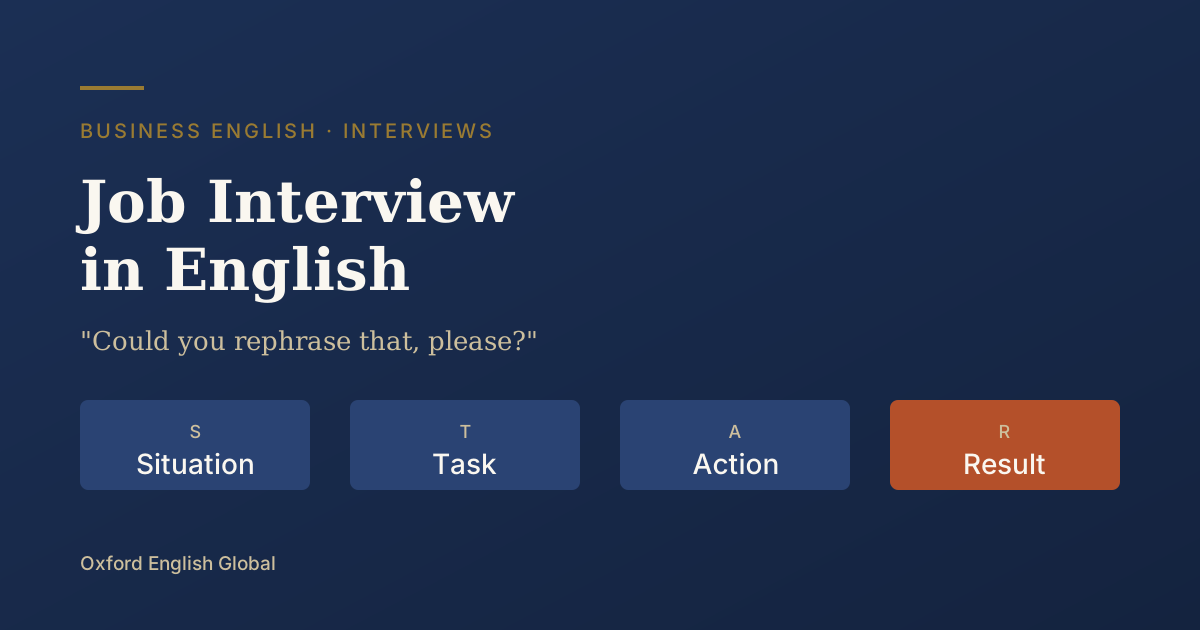
- Answer with the STAR method
- Common interview questions and how to answer
- What to do if you don't understand a question
- Language mistakes to avoid in interviews
- Video and phone interviews in English
- A one-week practice plan
- What this article cannot tell you
To prepare for a job interview in English, focus on three things: a short, practised answer to "Tell me about yourself", three or four real examples of your work told with the STAR method (Situation, Task, Action, Result), and a set of polite phrases for the moments that make non-native speakers nervous, such as asking the interviewer to repeat a question or buying a few seconds to think. Interviewers are not testing perfect grammar. They want clear, relevant answers with concrete examples. This guide gives you useful phrases for every stage of the interview, model answers to common questions, ways to handle not understanding a question, and a one-week practice plan.
What interviewers listen for
Most interviewers want to know three things: can you do the job, will you fit the team, and do you really want this role? In English, the way you show this is with clear structure and specific examples.
| Interviewers notice | Weak answer | Strong answer |
|---|---|---|
| Structure | Long answer that jumps between ideas | A clear opening, an example and a short conclusion |
| Evidence | "I am very hard-working." | "Last year I reduced our response time from two days to one." |
| Relevance | General life story | Answer linked to the job description |
| Communication | Silence when you don't understand | "Could you rephrase that, please?" |
The good news for non-native speakers: structure and examples matter more than advanced vocabulary. A simple, well-organised answer beats a complicated one that is hard to follow.
"Tell me about yourself": a simple formula
This is usually the first question, and it sets the tone. Use a present, past, future structure and keep it to about one minute.
- Present: your current role and main responsibility.
- Past: one or two relevant achievements or experiences.
- Future: why you want this job.
"I'm currently a customer support team leader at a software company, where I manage a team of six and handle our most complex client cases. Before that, I worked in technical support for three years, and last year I helped introduce a new ticketing system that cut our average response time in half. I'm now looking for a role where I can work more closely with product teams, which is why this position really interests me."
Practise your answer until it feels natural, but do not memorise it word for word. A memorised answer often sounds flat and is hard to recover if you lose your place. Learn the three parts and two or three key phrases instead.
Useful phrases for every stage
Starting and small talk
- "Thank you for inviting me. It's nice to meet you."
- "Yes, I found the office easily, thank you." / "Yes, I can hear you clearly." (for video calls)
- "I've been looking forward to talking with you."
Talking about your experience
- "I'm responsible for…" / "My main responsibility is…"
- "I have five years' experience in…"
- "In my current role, I…"
- "One of my biggest achievements was…"
- "I was involved in…" / "I led a project to…"
Talking about strengths and skills
- "I'd say one of my main strengths is…"
- "For example, in my last job…"
- "My manager often asked me to… because…"
Talking about weaknesses honestly
- "Something I've been working on is…"
- "In the past I found it difficult to…, so I started…"
- "I'm still improving my…, and I've recently…"
Buying time to think
- "That's a good question. Let me think for a moment."
- "Let me think of a good example."
- "There are a couple of ways to answer that…"
Ending the interview
- "Thank you for your time. I really enjoyed learning more about the role."
- "What are the next steps in the process?"
- "I look forward to hearing from you."
Learn these as whole phrases (chunks), not word by word. Our guide to learning vocabulary in chunks explains why this makes them easier to use under pressure.
Answer with the STAR method
Many interview questions ask for an example: "Tell me about a time when…" or "Give me an example of…". The UK government's National Careers Service recommends the STAR method to structure these answers:
| Letter | Meaning | Useful language |
|---|---|---|
| S – Situation | The situation you had to deal with | "In my previous job…", "Last year, our team…" |
| T – Task | The task you were given | "My job was to…", "I was asked to…" |
| A – Action | The action you took | "First, I… Then I… Finally, I…" |
| R – Result | What happened and what you learned | "As a result…", "This led to…", "I learned that…" |
The National Careers Service also advises keeping examples short and to the point, sounding conversational rather than rehearsed, and being ready for follow-up questions.
Grammar tip: tenses in a STAR answer
Use the past simple for most of the story (I organised, I called, we finished), the past continuous for background (we were launching a new product), and the present perfect for results that still matter now (since then, we have used this process in every project). Our guide to English tenses covers these in detail.
Question: "Tell me about a time you solved a problem at work."
Situation: "Last spring, we were launching a new product and the delivery company told us our order would be two weeks late."
Task: "I had to find a way to deliver to our biggest customers on time."
Action: "First, I called three other suppliers. Then I split the order, so the most urgent items came from a local supplier. Finally, I emailed each customer to explain the plan."
Result: "All our key customers received their orders on time, and since then we have kept a backup supplier for every launch."
Common interview questions and how to answer
The National Careers Service publishes a list of common interview questions. Prepare short answers to these:
| Question | What they want to know | How to start your answer |
|---|---|---|
| Why do you want this job? | Motivation and research | "I'm interested in this role because…, and I noticed that your company…" |
| What are your strengths? | Skills that match the job | "One of my main strengths is… For example…" |
| What is your greatest weakness? | Self-awareness and growth | "Something I've been working on is…" |
| Why are you leaving your current job? | Positive reasons, no complaints | "I've learned a lot there, and now I'm looking for…" |
| Where do you see yourself in five years? | Ambition that fits the company | "I'd like to develop my skills in… and take on more…" |
| Tell me about a time you worked in a team. | Teamwork (use STAR) | "In my last project, our team had to…" |
| Do you have any questions for us? | Interest and preparation | "Yes. Could you tell me more about…?" |
Good questions to ask the interviewer
- "What does a typical day look like in this role?"
- "How do you measure success for this position?"
- "What are the biggest challenges for the team at the moment?"
- "What opportunities are there for training and development?"
Always prepare at least two questions. "No, I don't have any questions" can sound like a lack of interest.
What to do if you don't understand a question
This is the biggest fear for many non-native speakers. Asking for clarification is normal and professional. Guessing and giving the wrong answer is much worse.
| Situation | What to say |
|---|---|
| You didn't hear clearly | "Sorry, could you repeat the question, please?" |
| You heard but didn't understand | "Could you rephrase that, please?" |
| You want to check your understanding | "Just to make sure I understand, you're asking about…?" |
| There is an unfamiliar word | "I'm not sure I know the term '…'. Do you mean…?" |
| Bad connection on a video call | "Sorry, the connection broke up for a moment. Could you say that again?" |
Checking your understanding ("Just to make sure…") is especially useful. It shows good listening, gives you time to think, and confirms you are answering the right question.
Language mistakes to avoid in interviews
Small grammar slips rarely cost you a job, but a few habits can make answers less clear or sound less professional. These are worth checking in your practice recordings.
| Instead of | Say | Why |
|---|---|---|
| "I am working here since 2021." | "I have worked here since 2021." / "I've been working here since 2021." | Use the present perfect with since and for for situations that continue now |
| "I have experience of five years." | "I have five years' experience." / "I have five years of experience." | Natural word order for experience |
| "I am responsible of sales." | "I am responsible for sales." | The fixed chunk is responsible for |
| "I did a mistake." | "I made a mistake." | The collocation is make a mistake |
| "We did a big success." | "The project was a big success." | Success is something a project is or has |
| "I want to know more about the salary." (first question) | "Could you tell me more about the role and the team?" | Start with the job; discuss pay when the interviewer raises it or at the offer stage |
Our guide to common English grammar mistakes covers more of these patterns.
Tone: confident, not too modest
In many English-speaking workplaces, interviewers expect you to describe your own contribution clearly. Learners from cultures where modesty is valued sometimes say "we" for everything and never explain what they personally did. Use "we" for the team result, and "I" for your own actions: "We launched the product on time. I was responsible for coordinating the three suppliers." At the same time, avoid exaggeration. A specific, honest example is more convincing than a big claim.
Video and phone interviews in English
Many first interviews now happen on video or by phone, which removes some of the body language that helps understanding. A few adjustments help:
- Test your sound first. Use headphones with a microphone and check the connection before the call.
- Speak a little slower than usual. Audio delay makes fast speech harder to follow, especially across accents.
- Pause before you answer. A one-second pause avoids talking over the interviewer.
- Keep notes nearby. A short list of your STAR examples and key phrases is fine, but do not read from it.
- Follow up in writing. A short thank-you email after the interview is common in many English-speaking workplaces. Our guide on writing work emails in English has templates you can adapt.
A one-week practice plan
| Day | Task (30–45 minutes) |
|---|---|
| 1 | Read the job description. Underline the five most important skills. Write one STAR example for each. |
| 2 | Write and practise your "Tell me about yourself" answer. Record it and keep it to about one minute. |
| 3 | Answer the common questions above out loud. Record your answers and listen for long pauses or unclear words. |
| 4 | Practise the clarification phrases with a friend or tutor who asks questions quickly or uses unfamiliar words. |
| 5 | Work on pronunciation of the key words in your answers (job titles, technical terms, company name). Use our Speaking Lab to check stress and intonation. |
| 6 | Do a full mock interview, ideally on video, with someone who gives honest feedback. |
| 7 | Review your notes, prepare your questions for the interviewer, and rest. |
For more workplace language, read our guides to Business English and speaking English with confidence. If you want feedback from a teacher, our English courses include Business English and conversation practice.
What this article cannot tell you
- What a specific employer will ask. Questions vary by country, industry and company. Read the job description and the company's own careers pages.
- Cultural norms everywhere. Interview style differs between, for example, the UK, the US and other English-speaking countries. Our tips reflect common practice, not universal rules.
- Your English level. If you are not sure whether your English is strong enough for the role, a level test or a teacher can help. Start with our English level test guide.
- Legal or HR questions. We do not cover employment law, visas or salary negotiation rules.
The model answers on this page are invented examples written for practice. They do not describe real people or companies.
Frequently asked questions
How do I answer "Tell me about yourself" in English?
Use a present, past, future structure in about one minute: your current role, one or two relevant achievements, and why you want this job. Practise the three parts and a few key phrases rather than memorising every word.
What is the STAR method?
STAR stands for Situation, Task, Action and Result. The UK National Careers Service recommends it for structuring examples in interviews: describe the situation, the task you had, the action you took and what happened as a result.
What should I say if I don't understand an interview question?
Ask politely for clarification, for example: "Could you rephrase that, please?" or "Just to make sure I understand, you're asking about…?" Asking is normal and professional; guessing and answering the wrong question is worse.
Do I need perfect grammar for an English job interview?
No. Interviewers mainly listen for clear structure, relevant examples and good communication. Small grammar mistakes rarely matter if your answers are organised and easy to follow.