
Connected Speech in English: Linking, Weak Forms and Why Native Speakers Sound Fast
Native speakers are not always faster than you: they join words, shrink small grammar words and drop sounds. This guide explains linking, weak forms, elision, assimilation and reductions such as gonna and wanna, with IPA, listening and speaking exercises, and a 7-day plan.

- What connected speech is
- Why native speakers sound so fast
- Linking: how words join together
- Weak forms: the small words you do not hear
- Elision: sounds that disappear
- Assimilation: sounds that change
- Contractions and informal reductions: gonna, wanna and friends
- Listening exercises: train your ear
- Speaking exercises: copy natural speech
- A 7-day practice plan
- Common learner mistakes
- What this article cannot tell you
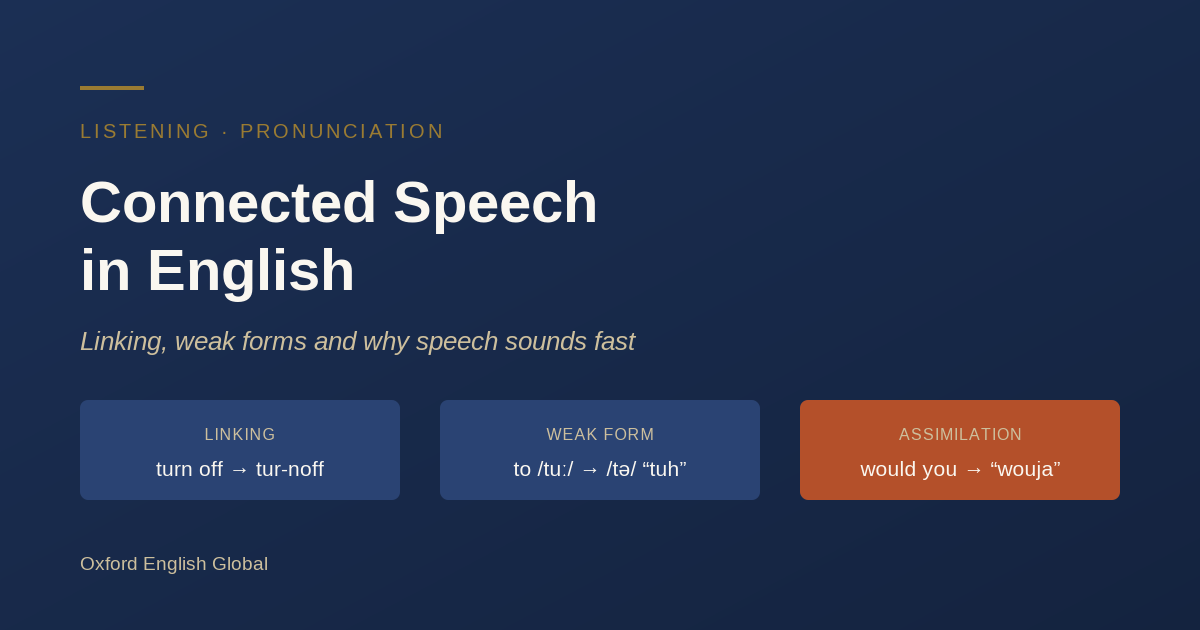
Connected speech is the way English words change when they are spoken together in a sentence: sounds link across word boundaries, small grammar words shrink to "weak forms", some sounds disappear and others change, so "What do you want to do?" can sound like "Whaddya wanna do?". Native speakers are usually not talking much faster than you. They are simply saying the unstressed parts of each sentence very quickly and very quietly, and joining everything up. This guide explains the five main features of connected speech, why they make English sound fast, and gives listening and speaking exercises plus a 7-day plan so you can understand natural speech and start to copy it.
What connected speech is
When you learn a word, you usually learn its citation form: the careful pronunciation you hear when a dictionary says it on its own. In real conversation, words are rarely said on their own. They run into each other, and that changes how they sound. Teachers call this connected speech.
It is not lazy or incorrect English. Newsreaders, teachers and university lecturers all use connected speech; it is part of how the language is normally spoken. The five features you need to know are:
| Feature | What happens | Example |
|---|---|---|
| Linking | The end of one word joins the start of the next | turn off sounds like "tur-noff" |
| Weak forms | Small grammar words lose their full vowel, often to /ə/ | to /tuː/ becomes /tə/ |
| Elision | A sound disappears | next week sounds like "neks week" |
| Assimilation | A sound changes to become more like its neighbour | would you sounds like "wouja" /ˈwʊdʒu/ |
| Contractions and reductions | Whole groups of words are shortened | going to becomes gonna |
In this article, phonetic symbols between slashes, such as /ə/, follow the International Phonetic Alphabet (IPA) as used in British learner dictionaries. Where it helps, we also give a simple respelling in quotation marks. Respellings are only a rough guide, so always check the audio in a learner dictionary as well.
Why native speakers sound so fast
Most learners say "native speakers talk too fast". Speed is part of it, but the bigger reason is rhythm. English gives very different weight to different words.
Content words and function words
Content words carry the meaning: nouns, main verbs, adjectives, adverbs and negatives such as can't. They are usually stressed: longer, louder and clearer. Function words hold the grammar together: articles, prepositions, pronouns, auxiliary verbs and conjunctions. They are usually unstressed, short and quiet.
Look at this sentence, with the stressed syllables in capitals:
I've BEEN to the DENtist and I've GOT to go BACK on MONday.
Only five syllables are strong. The rest (I've, to the, and I've, to, on) are squeezed into the gaps between them. If your ear is waiting to hear every word clearly, the squeezed parts go past before you notice them.
Stress-timed rhythm, as a teaching model
Many teachers describe English as stress-timed: the stressed syllables tend to come at fairly regular intervals, and the unstressed syllables between them are compressed to fit. A classic classroom demonstration uses sentences like these (illustrative, not measured):
- CATS CHASE MICE.
- The CATS will CHASE the MICE.
- The CATS have been CHASing the MICE.
Each sentence has three main stresses, and when said naturally, the longer versions take only a little more time than the shortest one. The extra words are said quickly and weakly. Phoneticians debate how regular this timing really is, so treat "stress-timing" as a useful model for learners rather than an exact rule. Its practical message is reliable: if you hear the stressed words, you can usually rebuild the rest from grammar and context.
Linking: how words join together
In connected speech, English speakers do not normally pause between words in the same phrase. They link them. There are four main kinds of linking.
1. Consonant to vowel
When a word ends in a consonant sound and the next word starts with a vowel sound, the consonant moves across and seems to start the next word.
| Written | Sounds like | IPA |
|---|---|---|
| turn off | "tur-noff" | /tɜː ˈnɒf/ |
| an apple | "a-napple" | /ə ˈnæpl/ |
| pick it up | "pi-ki-tup" | /pɪ kɪ ˈtʌp/ |
This is why learners sometimes hear words that are not there, such as "a napple". Remember that linking depends on sounds, not letters: in made it, the written word ends in e but the sound is /d/, so it links as "may-dit".
2. Linking and intrusive /r/
In non-rhotic accents, such as most accents of England and many in Australia and New Zealand, a written r at the end of a word is not pronounced before a consonant or a pause. Car is /kɑː/. But before a vowel, the /r/ comes back: car alarm is /kɑːr əˈlɑːm/, and far away is /fɑːr əˈweɪ/. This is called linking /r/.
Many speakers of these accents go further and add an /r/ that is not written at all, between vowels such as /ə/, /ɑː/ or /ɔː/ and a following vowel. This is intrusive /r/:
- law and order /lɔːr ən ˈɔːdə/ ("lor and order")
- the idea of it /ði aɪˈdɪər əv ɪt/ ("the idear of it")
- China and Japan /ˈtʃaɪnər ən dʒəˈpæn/
You do not need to produce intrusive /r/, but you need to recognise it. In rhotic accents, including most American and Scottish accents, written r is pronounced anyway and intrusive /r/ is not typical. Our guide to British vs American English covers more of these accent differences.
3. /j/ linking
When a word ends in a vowel that finishes high and at the front of the mouth, such as /iː/, /eɪ/, /aɪ/ or /ɔɪ/, and the next word starts with a vowel, a light /j/ (the sound at the start of yes) appears between them:
- I agree /aɪ j əˈɡriː/ ("I yagree")
- she is /ʃiː j ɪz/ ("she yis")
4. /w/ linking
When a word ends in a vowel that finishes with rounded lips, such as /uː/, /əʊ/ or /aʊ/, a light /w/ appears before the next vowel:
- go out /ɡəʊ w ˈaʊt/ ("go wout")
- do it /duː w ɪt/ ("doo wit")
You do not need to force /j/ or /w/. If you move smoothly from one vowel to the next without a stop, they appear naturally. The mistake to avoid is a glottal stop, a little "catch" in the throat, between every word.
Weak forms: the small words you do not hear
Many common function words in English have two pronunciations: a strong form, used when the word is stressed or said alone, and a weak form, used most of the time in sentences. In the weak form, the vowel usually becomes schwa /ə/, the short, relaxed "uh" sound you hear in unstressed syllables everywhere in English.
| Word | Strong form | Weak form | Example in a sentence |
|---|---|---|---|
| a | /eɪ/ | /ə/ "uh" | I need a break. |
| an | /æn/ | /ən/ "un" | It's an hour away. |
| the | /ðiː/ | /ðə/ before consonants, /ði/ before vowels | The bus, the office |
| and | /ænd/ | /ən/ or /n/ "n" | fish and chips ("fish n chips") |
| to | /tuː/ | /tə/ "tuh" (before consonants) | I want to go. |
| of | /ɒv/ | /əv/ "uv", or /ə/ | a cup of tea ("a cuppa tea") |
| for | /fɔː/ | /fə/ "fuh" | It's for you. |
| from | /frɒm/ | /frəm/ "frum" | a letter from the bank |
| at | /æt/ | /ət/ "ut" | See you at six. |
| can | /kæn/ | /kən/ "kun" | I can help. |
| was | /wɒz/ | /wəz/ "wuz" | It was late. |
| were | /wɜː/ | /wə/ "wuh" | They were tired. |
| have | /hæv/ | /həv/ or /əv/ "uv" | They must have left. |
| does | /dʌz/ | /dəz/ "duz" | When does it start? |
| some | /sʌm/ | /səm/ "sum" | Have some water. |
| them | /ðem/ | /ðəm/ "thum" | Tell them. |
| you | /juː/ | /jə/ "yuh" (informal) | See you later. |
| but | /bʌt/ | /bət/ | Sorry, but no. |
The IPA above shows British pronunciation; American vowels differ in some strong forms (for example from /frʌm/ or /frɑːm/), but the weak forms are very similar.
When to use the strong form
- At the end of a sentence: Where are you from? /frɒm/, not /frəm/. Yes, I can. /kæn/.
- For emphasis or contrast: The letter is from her, not to her.
- When the word is quoted: You don't need "the" here.
Can or can't? This is the weak form that causes the most misunderstandings. In I can come, can is weak, /kən/, and the stress is on come. In I can't come, can't is stressed and has a full vowel: /kɑːnt/ in British English, /kænt/ in American English. The final /t/ is often hard to hear, so listen for the vowel and the stress, not the /t/.
Weak forms also matter for your speaking. If you say every to and of with a full vowel, your rhythm becomes flat and every word sounds equally important, which can make the main point harder to follow.
Elision: sounds that disappear
Elision means a sound is left out. The most common case for learners is /t/ or /d/ between two consonants. When /t/ or /d/ comes after a consonant and before another consonant, it is often dropped:
| Written | Careful | In connected speech |
|---|---|---|
| next week | /nekst wiːk/ | /neks wiːk/ |
| last night | /lɑːst naɪt/ | /lɑːs naɪt/ |
| I don't know | /aɪ dəʊnt nəʊ/ | /aɪ dəʊn nəʊ/, often reduced further |
| sandwich | /ˈsændwɪtʃ/ | /ˈsænwɪtʃ/ |
| friendship | /ˈfrendʃɪp/ | /ˈfrenʃɪp/ |
This creates a real listening problem for past tenses. In I watched the match, the /t/ of watched sits between /tʃ/ and /ð/, so it may almost vanish: you hear "I watch the match". Use context (yesterday, last week) to decide the tense. Our guide to pronouncing -ed endings explains which sound the ending makes in the first place.
Assimilation: sounds that change
In assimilation, a sound changes to become more like the sound next to it, because that is easier for the mouth. The most useful patterns for learners are these.
/t/ or /d/ + "you": the "chew" and "jew" sounds
When /t/ meets the /j/ of you or your, the two sounds combine into /tʃ/ (as in chair). When /d/ meets /j/, they combine into /dʒ/ (as in job).
| Written | Sounds like | IPA |
|---|---|---|
| would you | "wouja" | /ˈwʊdʒu/ or /ˈwʊdʒə/ |
| did you | "dija" | /ˈdɪdʒu/ or /ˈdɪdʒə/ |
| don't you | "doncha" | /ˈdəʊntʃu/ |
| nice to meet you | "nice to meetcha" | /ˈmiːtʃu/ |
Sounds that move towards the next consonant
- /n/ becomes /m/ before /p/, /b/ or /m/: ten pounds /tem ˈpaʊndz/, in bed /ɪm ˈbed/.
- /n/ becomes /ŋ/ before /k/ or /ɡ/: in case /ɪŋ ˈkeɪs/, green card /ɡriːŋ ˈkɑːd/.
- /t/ becomes /p/ before /p/, /b/ or /m/: that man /ðæp ˈmæn/, hot pan /hɒp ˈpæn/.
For speaking, the /t/ + you and /d/ + you patterns are worth copying, because they are very frequent and sound natural at every level of formality. The others mostly happen by themselves when you speak at a normal speed, so focus on recognising them.
Contractions and informal reductions: gonna, wanna and friends
Contractions
Contractions such as I'm, you're, it's, don't, can't, I'd, we'll are standard English. Cambridge Dictionary's grammar guide to contractions says we use them "in everyday speech and informal writing", and that they are "usually not appropriate in formal writing". In speech, you should use them: saying I do not know or I am going in a casual conversation sounds stiff, or even emphatic, as if you are disagreeing.
Informal reductions
Informal reductions go one step further. They are fast-speech pronunciations that are sometimes written with a special spelling. Cambridge Dictionary, for example, labels gonna "informal for going to", spelled the way it is often spoken, and lists wanna as a short form of "want to" or "want a".
| Reduction | Full form | Approximate IPA | Example | Watch out |
|---|---|---|---|---|
| gonna | going to (+ verb) | /ˈɡɒnə/ UK, /ˈɡɑːnə/ US | I'm gonna call her. | Only for future plans. Not for movement: I'm going to London, never "I'm gonna London". |
| wanna | want to / want a | /ˈwɒnə/ UK, /ˈwɑːnə/ US | Do you wanna come? | Not after he/she/it: he wants to, not "he wanna". |
| gotta | (have) got to / got a | /ˈɡɒtə/ UK, /ˈɡɑːt̬ə/ US | I've gotta go. | Means obligation, like have to. |
| kinda | kind of | /ˈkaɪndə/ | It's kinda cold. | Means "a bit" or "sort of". |
| lemme | let me | /ˈlemi/ | Lemme see. | Very casual. |
| dunno | (I) don't know | /dəˈnəʊ/ UK, /dəˈnoʊ/ US | Dunno, maybe. | Can sound careless or rude if overused. |
When are they acceptable?
- Listening: always learn to understand them. You will hear them in films, series, podcasts, songs and everyday conversation everywhere.
- Speaking: the sound of gonna and wanna is normal in relaxed speech, including at work, as long as the tone of the conversation is informal. In a job interview, presentation or speaking exam, a clear going to is safer, although weak forms like /ˈɡəʊɪŋ tə/ are still natural.
- Writing: use the special spellings only in text messages, chat with friends, song lyrics, fiction dialogue or when quoting speech. Do not write them in work emails, essays, reports, CVs or exam answers.
A good rule for adult learners: understand all of them, say a few, and write none of them in anything formal.
Listening exercises: train your ear
Connected speech is learned mainly through the ear. These exercises work with any short recording that has a transcript: a learner podcast, a TED-style talk, a series with English subtitles or a news clip. For choosing material at the right level, see our guide to improving your English listening, and if you are around B1, our B1 listening and reading guide.
Exercise 1: micro-dictation
- Choose a 20 to 30 second clip.
- Play one sentence, pause, and write exactly what you hear. Replay up to three times.
- Compare with the transcript. Circle every word you missed.
- For each missed word, ask: was it a weak form, a linked sound, a dropped /t/ or /d/, or an assimilation?
After a few sessions, most learners find that the missed words are almost always function words: to, of, have, the, and. That tells you exactly what to listen for.
Exercise 2: weak-form gap-fill
Take a transcript, delete the small grammar words, then listen and fill the gaps. Try this short version now; imagine it said quickly and casually.
"I've been waiting ___ ages. Where ___ you? We ___ supposed ___ meet ___ six, ___ I've got ___ leave ___ half past."
Answers: for, were, were, to, at, and, to, at. Every missing word is a function word, and in fast speech every one of them would be a weak form: /fər/, /wə/, /wə/, /tə/, /ət/, /ən/, /tə/, /ət/. (In for ages, British speakers add linking /r/ before the vowel.) This example is illustrative, written for practice.
Speaking exercises: copy natural speech
You do not need to sound like a native speaker, and clear speech matters more than fast speech. But using some connected speech makes you easier to follow and helps you understand others, because your ear learns what your mouth can do.
Exercise 1: shadowing
- Choose 10 to 20 seconds of clear, natural speech with a transcript.
- Listen twice while reading the transcript. Mark the stressed words and the links (use a curved line between linked words).
- Play it again and speak at the same time as the speaker, a fraction of a second behind, copying the rhythm, not just the words.
- Record yourself, compare, and repeat until the rhythm is close.
Focus on rhythm first: long, clear stressed words and quick, quiet weak words. Individual sounds can come later.
Exercise 2: backchaining
Backchaining builds a long, fast phrase from the end, so the stress and intonation stay natural. Try it with What do you want to do?:
- do
- to do ("tuh do")
- want to do ("wanna do")
- you want to do ("ya wanna do")
- do you want to do ("d'ya wanna do")
- What do you want to do? ("whaddya wanna do?")
Each time, keep the final word strong and add the new words in front quickly and lightly. Other good phrases for backchaining: I'm going to have a cup of tea; Would you like to come with us?; I should have told you ("I shoulda told ya").
For more ways to record and check yourself, see our guide to practising speaking without a partner; how to speak English fluently shows how this work fits into wider fluency practice.
A 7-day practice plan
About 20 minutes a day. Use the same 1 to 2 minute recording all week so you can hear your progress.
| Day | Focus | What to do (about 20 minutes) |
|---|---|---|
| 1 | Rhythm | Listen to your recording three times. On the transcript, underline the stressed words. Read only the stressed words aloud, then the full sentences. |
| 2 | Weak forms | Do a weak-form gap-fill on the transcript. Practise the table of weak forms above, saying each in a short phrase (a cup of tea, to the shop, at six). |
| 3 | Linking | Mark every consonant-to-vowel link and every /j/, /w/ or /r/ link. Shadow three sentences, focusing only on linking. |
| 4 | Elision and assimilation | Find any dropped /t/ or /d/ and any would you / did you / don't you. Do micro-dictation on the hardest 20 seconds. |
| 5 | Reductions | Listen to a scene from a series or a casual podcast. Note every gonna, wanna, gotta, kinda you hear. Backchain two sentences. |
| 6 | Shadowing | Shadow the whole recording, record yourself and compare with the original. Note two things to improve. |
| 7 | Review | Do a fresh micro-dictation on a new clip of similar difficulty. Compare how many function words you catch with Day 1. Then shadow your original recording once more. |
After the first week, repeat the cycle with a new recording. For daily pronunciation routines, see our guide to improving your pronunciation at home; for guided lessons, see our free lessons.
Common learner mistakes
- Stressing every word equally. Saying I WANT TO GO TO THE SHOP with full vowels sounds robotic and hides the important words. Keep the function words light.
- Using weak forms at the end of a sentence. Where are you from? ends with strong /frɒm/; Yes, I can ends with strong /kæn/.
- Confusing can and can't. Over-stressing can makes listeners hear can't. Say I can SWIM with weak /kən/.
- Using gonna and wanna in the wrong places. "He wanna leave" and "I'm gonna the office" are not correct, and writing gonna in a work email looks unprofessional.
- Trying to sound fast before sounding clear. Speed comes from rhythm and linking, not from rushing. A clear, slightly slower speaker is easier to understand than a fast, unclear one.
What this article cannot tell you
- Every accent. We describe mainly standard British pronunciation, with some American notes. Connected speech varies across accents, for example in whether intrusive /r/ or the American "flap" /t/ is used.
- Exact timing. "Stress-timing" is a teaching model. How regular English rhythm really is remains a subject of discussion among phoneticians, and we have not given measured speaking speeds.
- Your specific difficulties. Which features are hardest depends on your first language. A teacher who hears you speak can tell you what to prioritise.
- Audio. Written respellings and IPA are only a guide. Always check pronunciation with the audio in a learner dictionary.
This page is independent guidance from Oxford English Global. We have no commercial relationship with Cambridge University Press or any other publisher or dictionary cited, and the page contains no affiliate links. For structured listening and pronunciation practice with a teacher, see our English courses.
Frequently asked questions
What is connected speech in English?
Connected speech is the way words change when they are spoken together in a sentence rather than one by one. Sounds link across words, small grammar words take weak forms, some sounds are dropped and others change. It is a normal part of spoken English at every level of formality, not a sign of careless speech.
Why do native English speakers sound so fast?
Mostly because of rhythm. English stresses content words such as nouns and main verbs and says function words such as to, of and the very quickly and quietly, often with the schwa sound /ə/. If you are listening for every word clearly, the unstressed parts go past before you notice them.
Is it OK to say gonna and wanna?
In relaxed conversation, yes: the sounds of gonna and wanna are very common in informal speech. In interviews, presentations and speaking exams, a clear going to or want to is safer. Do not write gonna or wanna in emails, essays or other formal writing; Cambridge Dictionary labels gonna as informal.
Do I need to use connected speech to be understood?
You do not need to copy every feature, and clear speech matters more than fast speech. Using weak forms for small grammar words and linking words within a phrase will make your rhythm more natural and easier to follow. Recognising connected speech is more important for listening than producing it.
What is the best exercise for understanding connected speech?
Micro-dictation is one of the most direct: play one sentence of a short recording, write exactly what you hear, then check the transcript and note which words you missed. Most missed words are weak forms or linked sounds, which shows you what to listen for. Combine it with shadowing to train your speaking too.