
20 Common English Grammar Mistakes and How to Fix Them
Forgotten -s endings, missing "do" in questions, "will" after "if", "informations" and "Can you tell me where is the station?" Here are 20 grammar mistakes that adult learners make at every level, each with a wrong and a correct example, the rule behind it and a method for fixing it.

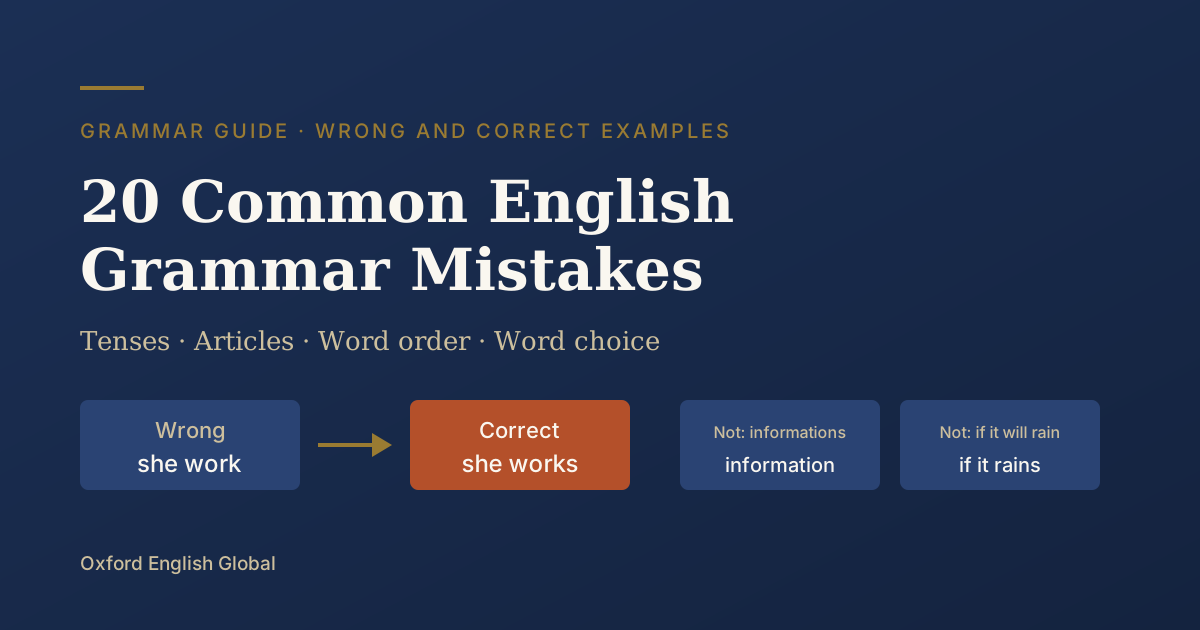
The most common English grammar mistakes adult learners make are forgetting the -s on third-person verbs, leaving out "do" in questions, mixing up the past simple and the present perfect, using "will" after "if" and "when", treating uncountable nouns like "information" as countable, and putting words in the wrong order in questions and with adverbs. None of these mistakes is a sign of a low level. Many B2 and C1 speakers still make them, because they are habits rather than gaps in knowledge. This guide lists 20 frequent mistakes with a wrong and a correct example for each, explains the rule behind every one in plain English, and shows how to stop making them for good.
How we checked the rules. Every rule on this page follows standard reference grammars, in particular the British Council's LearnEnglish grammar reference and Cambridge Dictionary's English Grammar Today. We link the relevant page next to each explanation so you can read more and do exercises. The list is a selection of mistakes that grammar references and teachers commonly highlight; it is not ranked by a frequency study. Checked on 9 November 2026.
The 20 mistakes at a glance
Read the wrong sentence, cover the right-hand columns and try to correct it yourself before you look. The explanations below the table give the rule for each one.
| # | Wrong | Correct | The rule in one line |
|---|---|---|---|
| 1 | She work in a bank. | She works in a bank. | Present simple adds -s after he, she, it. |
| 2 | Where you live? | Where do you live? | Questions need an auxiliary (do, does, did) before the subject. |
| 3 | I didn't went to work. | I didn't go to work. | After did / didn't, use the base verb. |
| 4 | I have seen him yesterday. | I saw him yesterday. | Finished time (yesterday, last week) takes the past simple. |
| 5 | I live here since 2020. | I have lived here since 2020. | Since and for with a situation that continues now take the present perfect. |
| 6 | I am knowing the answer. | I know the answer. | State verbs (know, like, believe) are not normally continuous. |
| 7 | If it will rain, we will stay in. | If it rains, we will stay in. | Use a present tense after if when you talk about the future. |
| 8 | When I will arrive, I will call you. | When I arrive, I will call you. | The same rule applies after when, as soon as, before, after, until. |
| 9 | I enjoy to cook. | I enjoy cooking. | Some verbs (enjoy, finish, avoid) are followed by -ing, not to. |
| 10 | Can you give me some informations? | Can you give me some information? | Information, advice, news are uncountable: no -s, no a/an. |
| 11 | She is engineer. | She is an engineer. | A singular countable noun needs an article; jobs take a/an. |
| 12 | The life is difficult. | Life is difficult. | No the when you talk about something in general. |
| 13 | There weren't much people. | There weren't many people. | Many with plural nouns, much with uncountable nouns. |
| 14 | I made my homework. | I did my homework. | Do for tasks and work; make for creating or producing. |
| 15 | He said me the truth. | He told me the truth. | Tell + person; say + words (or say something to someone). |
| 16 | I was very boring in the meeting. | I was very bored in the meeting. | -ed describes how you feel; -ing describes what causes it. |
| 17 | She speaks English very good. | She speaks English very well. | Use the adverb well to describe how someone does something. |
| 18 | This way is more easy and more better. | This way is easier and better. | Short adjectives take -er; never combine more with -er. |
| 19 | I go always to the gym on Mondays. | I always go to the gym on Mondays. | Frequency adverbs go before the main verb (but after be). |
| 20 | Can you tell me where is the station? | Can you tell me where the station is? | In indirect questions, use normal statement word order. |
Verb form mistakes (1–3)
1. Forgetting the third-person -s
In the present simple, the verb takes -s or -es after he, she, it and any singular noun: She works, My manager travels, The shop opens at nine. Many languages do not change the verb for the person, so the -s is easy to forget when you speak quickly. Watch especially for have → has, do → does and go → goes.
2. Leaving out "do" in questions
English forms most present and past simple questions with an auxiliary verb: Where do you live?, What time does the train leave?, When did you arrive? Rising intonation alone ("You live where?") is possible in very informal speech, but it is not the standard form and sounds wrong in an exam or a formal email. The exception is when the question word is the subject: Who called you? (not "Who did call you?").
3. Two past forms after "didn't"
The past is already shown by did, so the main verb stays in its base form: I didn't go, Did you see it?, She didn't know. "I didn't went" marks the past twice. The same is true after does and doesn't: He doesn't like it, not "He doesn't likes it".
Tense mistakes (4–8)
4. Present perfect with a finished time
The present perfect (I have seen) connects the past to now. When you say when something happened at a finished time, such as yesterday, last year, in 2019 or two days ago, use the past simple: I saw him yesterday. Compare: I have seen that film (some time in my life, no time given) and I saw that film last week (a finished time). The British Council's present perfect page explains these uses with exercises.
5. Present simple with "since" and "for"
When a situation started in the past and is still true now, English uses the present perfect, especially with for, since and how long: I have lived here since 2020, She has worked here for six years. Many languages use a present tense here ("I live here since 2020"), so this is one of the most frequent translation mistakes. For an activity that is still going on, the present perfect continuous is also common: I have been learning English for three years. Our guide to English tenses explained shows where the perfect forms sit on the timeline.
6. Continuous forms with state verbs
State verbs describe thoughts, feelings, possession and senses rather than actions: know, believe, understand, like, want, belong, need. We do not normally use them in continuous forms, so say I know the answer, not "I am knowing". Some verbs have both a state and an action meaning: I think it's a good idea (opinion, state) but I'm thinking about changing jobs (a mental process, action). The British Council page on stative verbs lists the main groups.
7. "Will" after "if"
In first conditional sentences about a real future possibility, the if clause uses the present simple and the main clause uses will: If it rains, we will stay in. The future meaning is already clear from the context, so English does not repeat will. See the British Council's guide to zero, first and second conditionals.
8. "Will" after "when" and other time words
The same rule applies in time clauses after when, as soon as, before, after and until: When I arrive, I'll call you; I'll wait until you finish. The British Council covers both rules on its page about verbs in time clauses and if clauses.
Verb pattern mistakes (9)
9. "To" instead of "-ing" after certain verbs
Some verbs must be followed by the -ing form: enjoy, finish, avoid, mind, suggest, consider, keep. Others take the to-infinitive: want, decide, hope, plan, need. A few take both with little change in meaning (like, start, begin), and some change meaning (stop to smoke vs stop smoking). There is no simple rule that predicts which pattern a verb takes, so learn the verb together with its pattern: "enjoy + -ing", "decide + to". Our guide to learning vocabulary in chunks explains why this works better than memorising lists.
Noun and article mistakes (10–13)
10. Making uncountable nouns plural
Uncountable nouns have no plural form and do not take a or an. Common examples that learners treat as countable are information, advice, news, furniture, equipment, luggage, research and feedback. Cambridge Dictionary describes information as "an uncountable noun". To count them, use a unit: a piece of advice, two pieces of information, an item of news. See Cambridge's page on countable and uncountable nouns.
11. Missing "a" or "an"
A singular countable noun normally needs a determiner such as a, an, the, my or this. This is why we say She is an engineer and I have a car. Learners whose first language has no articles, or does not use them with jobs, often drop them. Choose a or an by the first sound, not the first letter: an hour, a university.
12. "The" for things in general
When you talk about something in general, use no article with uncountable nouns and plural nouns: Life is difficult, Coffee keeps me awake, Teachers work hard. Use the when you mean a specific example both people can identify: The coffee in this office is terrible. Cambridge's page on a/an and the covers both uses.
13. "Much" with plural nouns
Use many with plural countable nouns (many people, many emails) and much with uncountable nouns (much time, much money). In positive sentences, a lot of is more natural with both: There were a lot of people. Cambridge's page on much, many, a lot of and lots of has more examples. Note that people is plural, so it takes many and a plural verb: People are, not "People is".
Word choice mistakes (14–18)
14. Make or do
As a general guide, do is used for activities, tasks and work (do homework, do the shopping, do a job), and make for creating or producing something (make a cake, make a plan). Many combinations are fixed and simply have to be learned: make a mistake, make a decision, make a phone call, do business, do your best. Cambridge explains the difference on its do or make page.
15. Say or tell
Tell is followed by the person you speak to: He told me the truth, Tell her to call me. Say is followed by the words, and if you mention the listener you need to: He said that he was tired, He said hello to me. Fixed phrases with tell include tell the truth, tell a lie, tell a story and tell the time. See Cambridge's say or tell page.
16. Bored or boring
Adjectives ending in -ed describe how a person feels: I was bored, She is interested in history, We were tired. Adjectives ending in -ing describe the thing or person that causes the feeling: The meeting was boring, History is interesting. "I was very boring" means that you made other people bored, which is rarely what learners mean.
17. Good or well
Good is an adjective and describes a noun: She is a good speaker, Her English is good. Well is the adverb and describes how someone does something: She speaks English well. After verbs like be, look and sound, use good: That sounds good.
18. Double comparatives
One-syllable adjectives and two-syllable adjectives ending in -y usually form the comparative with -er: cheap → cheaper, easy → easier. Longer adjectives use more: more expensive. Never use both. Irregular forms are already comparative: good → better, bad → worse, far → further/farther. The British Council page on comparative and superlative adjectives lists the spelling rules.
Word order mistakes (19–20)
19. Where frequency adverbs go
Adverbs of frequency such as always, usually, often, sometimes and never normally go before the main verb but after the verb be: I always go to the gym on Mondays, but I am always late. With an auxiliary, they go after the auxiliary: I have never been to Japan. A related mistake is putting an adverb between the verb and its object: say I like football very much, not "I like very much football".
20. Question word order inside a sentence
When a question is part of a longer sentence (an indirect question), it uses statement word order, without do: Can you tell me where the station is?, Do you know what time it starts?, I wonder why she left. Indirect questions are common in polite requests and in work emails, so this mistake is very noticeable in professional English.
How to stop making the same mistakes
Knowing a rule and using it correctly in real time are different skills. Most adult learners could explain several of the rules above and still make the mistakes when they speak. What helps is turning the correct version into an automatic habit:
- Pick your three. Read the table again and mark the three mistakes you recognise in your own English. Work on only those for two weeks.
- Learn the correct sentence as a chunk. Memorise a full correct sentence for each, such as I've lived here since… or Can you tell me where … is? Say it out loud several times with different endings.
- Use it on purpose. Write five true sentences about your own life using each pattern, then use them in conversation or in emails during the week.
- Keep a short error log. Write each mistake you or a teacher notice in three columns: what you said, the correct version, and the rule in a few words. Reread it once a week.
- Proofread in separate passes. Before you send an important email or submit an essay, check it once for verb forms, once for articles and plurals, and once for word order. Looking for one kind of mistake at a time catches far more than one general reread.
Our article on how to learn English grammar the easy way describes this notice, drill and produce method in more detail, and our free PDF English Grammar: A Complete Guide covers every area above from A1 to C1 with practice exercises.
Which mistakes matter at which level
Not every mistake is equally serious. Some make your meaning unclear, while others only make your English sound less polished. A rough guide:
| Level | Focus on | Why |
|---|---|---|
| A2–B1 | 1, 2, 3, 4, 10, 11, 15 | These appear in almost every conversation and are basic accuracy markers. |
| B1–B2 | 5, 6, 7, 8, 9, 13, 16, 17 | These mark the step from intermediate to upper-intermediate accuracy, and examiners notice them. |
| B2–C1 | 12, 14, 18, 19, 20 | Even advanced speakers keep these habits; fixing them makes your English sound natural and professional. |
This grouping is our own teaching guide, not an official CEFR list. If you are not sure of your level, take our free English level test. For corrected practice, the free lesson library and our English courses give you exercises and feedback on these areas.
What this article cannot tell you
- Your personal mistakes. The most common mistakes depend a lot on your first language. A learner whose first language has no articles will make different mistakes from one whose language puts verbs at the end. Only feedback on your own speaking and writing shows your real list.
- A frequency ranking. We selected these 20 because standard references and teaching materials highlight them, not from a corpus study, so the numbers are not a ranking.
- Every exception. Each rule here is the standard pattern. Informal speech, regional varieties and special meanings sometimes work differently; the linked British Council and Cambridge pages give fuller explanations.
- British and American differences. The examples follow standard British English. American English follows the same patterns for almost all 20 points. The main difference is that American speakers often use the past simple with words like just, already and yet where British speakers prefer the present perfect (for example, "Did you eat yet?" rather than "Have you eaten yet?").
This page is independent guidance from Oxford English Global. It contains no affiliate links, and we receive nothing from the British Council, Cambridge or any other organisation we link to.
Frequently asked questions
What is the most common grammar mistake in English?
There is no single official answer, because learners' mistakes depend a lot on their first language. Mistakes that grammar references and teachers highlight again and again include forgetting the -s on third-person verbs (she work instead of she works), leaving out do in questions, and using the present perfect with a finished time such as yesterday.
Is it "I have lived here since 2020" or "I live here since 2020"?
I have lived here since 2020. When a situation started in the past and is still true now, English uses the present perfect, especially with since, for and how long. For an ongoing activity you can also use the present perfect continuous: I have been learning English since 2020.
Why can't I say "informations" or "advices"?
Information and advice are uncountable nouns in English, so they have no plural form and do not take a or an. Say some information or a piece of advice. Other common uncountable nouns are news, furniture, equipment, luggage, research and feedback.
Why don't we use "will" after "if" and "when"?
In conditional and time clauses about the future, English uses a present tense because the future meaning is already clear from the main clause: If it rains, we will stay in. When I arrive, I will call you.
How can I stop making the same grammar mistakes?
Choose your three most frequent mistakes, learn a correct sentence for each as a fixed chunk, say it out loud with different endings, and use it on purpose in speaking and writing for two weeks. Keep a short error log and proofread important texts in separate passes for verbs, articles and word order.