
Since vs For in English: How to Use Them With the Present Perfect
For three years or since 2022? This guide explains the difference between since and for, why both usually go with the present perfect, how to ask How long questions, and the mistakes learners make most often, with a practice exercise and answers.

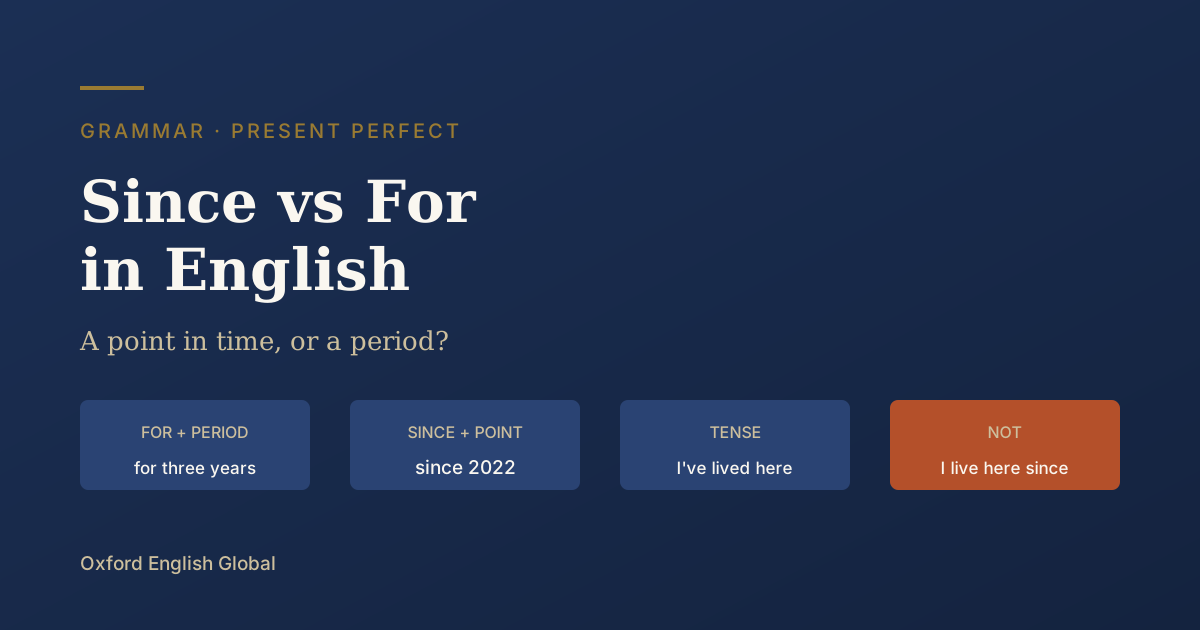
- Since vs for: the quick difference
- How to use "for": periods of time
- How to use "since": starting points
- Why "since" and "for" go with the present perfect
- Asking questions: "How long…?" and "Since when…?"
- "It's been… since" and "It's… since"
- Since and for with other tenses
- Common mistakes with since and for
- Everyday examples you can use today
- Practice: since or for?
- What this article cannot tell you
Use for with a length of time (for three years, for a week, for ages) and since with a starting point in the past (since 2019, since Monday, since I was a child). Both are most often used with the present perfect to talk about something that started in the past and continues now: I've lived here for three years and I've lived here since 2022 can describe exactly the same situation. This guide explains the difference with clear examples, shows how each word works with the present perfect and other tenses, covers the questions you need (How long…?), and lists the most common learner mistakes, with a short practice exercise at the end.
The one-line rule. Ask yourself: is it a period or a point? A period (how long) takes for. A point (when it started) takes since.
Since vs for: the quick difference
Imagine a timeline. For measures the whole stretch of time from the start to now. Since points to the moment the stretch began.
| for | since | |
|---|---|---|
| Meaning | a length or duration of time | a starting point in the past |
| Answers the question | How long? | Since when? / From when? |
| Followed by | a number + time word, or an expression of duration | a date, day, time, event or clause |
| Examples | for ten minutes, for two weeks, for six months, for a long time, for ages | since 9 o'clock, since Tuesday, since March, since 2020, since the meeting, since I moved here |
| Full sentence | She's worked at the bank for five years. | She's worked at the bank since 2021. |
Both sentences in the last row can be true at the same time. Which one you choose depends on whether you want to emphasise the duration or the starting point.
How to use "for": periods of time
For is followed by an amount of time. It works with almost any tense, not only the present perfect.
- Present perfect: I've known Ana for ten years. (I still know her.)
- Present perfect continuous: We've been waiting for forty minutes. (We're still waiting.)
- Past simple: I lived in Lisbon for two years. (I don't live there now.)
- Future: I'll be away for a week.
- Present simple: The course lasts for twelve weeks.
Common expressions with for: for a while, for a long time, for ages (informal: a very long time), for years, for the last three months, for the past few days, for the whole morning.
When can you leave out "for"?
In informal speech, native speakers sometimes drop for after verbs like wait, stay, live and work: I waited two hours. This is natural but optional. You cannot drop it in negative sentences or after all: say I haven't seen him for years, not I haven't seen him years, and all day, not for all day.
How to use "since": starting points
Since is followed by the moment something began. Because it connects a past point to now, the main verb is usually in the present perfect or present perfect continuous (or the past perfect when you are telling a story about the past).
- I've been in the office since 8.30.
- He's been learning English since January.
- Prices have gone up since last year.
- We haven't spoken since the party.
"Since" + a clause
Since can also be followed by a full clause, usually in the past simple. This clause tells us the starting event:
- I've wanted to visit Japan since I was a child.
- She's been much happier since she changed jobs.
- What have you been doing since we last met?
Notice the pattern: present perfect in the main clause + past simple after since. Learners sometimes write since I have been a child; the correct form is since I was a child.
"Ever since" and "since then"
Ever since adds emphasis: I've loved jazz ever since I heard my first Miles Davis record. Since then and ever since can also stand alone at the end of a sentence: We met in 2015, and we've been friends ever since.
Why "since" and "for" go with the present perfect
The present perfect (have/has + past participle) connects the past with the present. When we say how long an unfinished situation has lasted, we need that connection, so for and since appear with it constantly.
| Wrong | Right | Why |
|---|---|---|
| I live here since 2020. | I've lived here since 2020. | The situation started in the past and continues: present perfect. |
| I am working here for six months. | I've been working here for six months. | Use the present perfect (continuous) for duration up to now. |
| I've lived in Rome for two years, from 2015 to 2017. | I lived in Rome for two years, from 2015 to 2017. | The period is finished: past simple. |
The first two mistakes are extremely common for speakers of Spanish, French, Portuguese, German and Italian, because those languages often use a present tense here (Vivo aquí desde 2020, J'habite ici depuis 2020). In English, the present tense would sound wrong. For more on this tense, read our guide to the present perfect vs the past simple.
Simple or continuous?
Both are possible with for and since:
- Use the present perfect simple with state verbs (know, be, have, like, believe): I've known her since school, not I've been knowing her.
- Use the present perfect continuous to emphasise an ongoing activity: I've been studying for three hours, so I need a break.
- With verbs like live, work, study and teach, both forms are usually fine and the meaning hardly changes: I've lived / I've been living here since May.
Our article on present simple vs present continuous explains state verbs in more detail.
Asking questions: "How long…?" and "Since when…?"
To ask about duration, use How long + present perfect:
- How long have you lived in London? — For about five years. / Since 2021.
- How long have you been learning English? — For eighteen months.
- How long has she worked there? — Since she finished university.
Since when…? is possible but often sounds surprised or even annoyed: Since when do you drink coffee? (I didn't know you drank coffee!) In neutral conversation, How long…? or When did you start…? is safer.
A very common mistake is How long are you here? when you mean How long have you been here? The first actually asks about the future: how long will you stay?
"It's been… since" and "It's… since"
A useful pattern for talking about the time since something last happened:
- It's been three years since I last saw my cousins.
- It's ages since we went to the cinema. (more British)
The same idea with for uses a negative: I haven't seen my cousins for three years. Both sentences mean the same thing. This transformation is a favourite in exams such as Cambridge B2 First, so it is worth practising.
Since and for with other tenses
| Tense | for | since |
|---|---|---|
| Present perfect | I've had this car for a year. | I've had this car since last November. |
| Past perfect | By 2020 she had worked there for a decade. | When I arrived, he had been waiting since noon. |
| Past simple | We talked for an hour. | Not normally used with since (finished time) |
| Future | I'll be in Berlin for three days. | Rare; use for instead: By June, I'll have lived here for ten years. |
Our overview of English tenses puts all of these in context.
Common mistakes with since and for
- Since + duration. ✗ I've lived here since three years. ✓ for three years.
- For + starting point. ✗ I've been here for Monday. ✓ since Monday.
- Present tense instead of present perfect. ✗ I know him since 2010. ✓ I've known him since 2010.
- "Since … ago". ✗ since three years ago. ✓ for three years or three years ago (with the past simple: I moved here three years ago).
- "During" for duration. ✗ I studied during two hours. ✓ I studied for two hours. During tells us when (during the lesson), not how long.
- Present perfect after since. ✗ since I have moved here. ✓ since I moved here.
Don't confuse this "since" with "since" meaning "because". Since you're here, can you help me? means because you're here. Context makes the meaning clear, and the "because" meaning is more formal.
Everyday examples you can use today
- At work: "I've been in this role for about two years." / "We've used this software since the spring."
- Meeting people: "How long have you lived in Manchester?" "Since 2019, so about seven years."
- Health and routines: "I haven't had coffee since Friday." / "I've been running for six months."
- Catching up: "It's been ages since we spoke! What have you been doing since the summer?"
- Job interview: "I've worked in customer service for five years, and I've managed a small team since 2024." Our guide to job interviews in English has more phrases like this.
Practice: since or for?
Complete each sentence with since or for.
- I've been waiting ___ twenty minutes.
- They've been married ___ 2012.
- She hasn't called me ___ last week.
- We've had this sofa ___ ages.
- He's played the guitar ___ he was twelve.
- I lived in Canada ___ three years before I came here.
- It's been raining ___ this morning.
- I haven't eaten anything ___ breakfast.
Answers: 1 for · 2 since · 3 since · 4 for · 5 since · 6 for · 7 since · 8 since
Rewrite challenge: change each sentence so it keeps the same meaning. (a) I've known Tom for ten years. → I've known Tom since ___. (b) It's three months since I last saw her. → I haven't ___. Suggested answers: (a) since 2016 (if today is 2026); (b) I haven't seen her for three months.
What this article cannot tell you
- Every regional variation. American English uses the past simple a little more often than British English in some contexts (Did you eat yet?), but with for and since for unfinished time, both varieties use the present perfect.
- Your personal error patterns. A grammar article explains the rules; a teacher can tell you which mistakes you actually make. Our free lessons and courses give that feedback.
- How quickly it becomes automatic. Knowing the rule is the first step; using it without thinking takes regular speaking practice.
Frequently asked questions
What is the difference between since and for?
Use for with a length of time, such as for three years or for a week. Use since with a starting point, such as since 2020, since Monday or since I was a child.
Which tense do I use with since and for?
For unfinished situations that continue now, use the present perfect or present perfect continuous: I've lived here for five years, I've been waiting since 9 o'clock. For finished periods, use the past simple with for: I lived there for two years.
Can I say I live here since 2020?
No. In English, say I've lived here since 2020. Many languages use a present tense here, but English needs the present perfect to connect the past to now.
Is since three years ago correct?
No. Say for three years, or use ago with the past simple: I moved here three years ago.
What tense follows since in a clause?
Usually the past simple: I've known her since we were at school. Do not say since we have been at school.