
Present Simple vs Present Continuous: When to Use Each, With Clear Examples
I work or I'm working? This guide explains when to use the present simple and the present continuous, with side-by-side examples, signal words, state verbs like know and want, and the mistakes learners make most often, plus a practice exercise with answers.

- How to form the two tenses
- When to use the present simple
- When to use the present continuous
- Side by side: the same verb, two meanings
- State verbs: why we say "I know", not "I'm knowing"
- Common learner mistakes and how to fix them
- Both tenses in real life: a short example
- Practice: present simple or present continuous?
- What this article cannot tell you
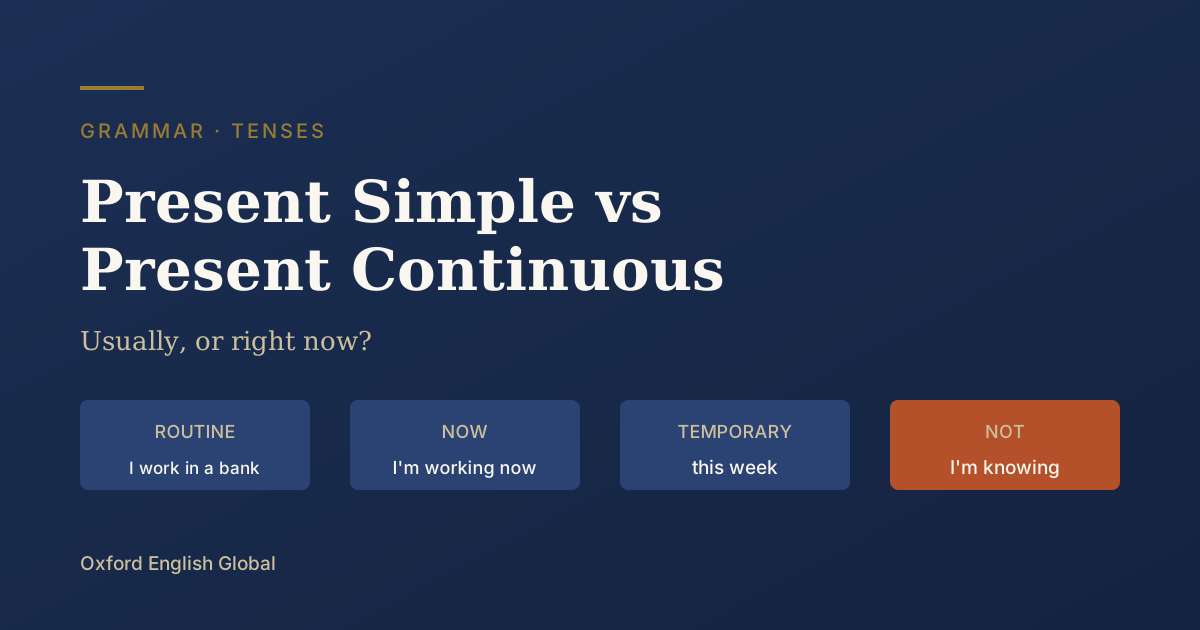
Use the present simple (I work, she works) for habits, routines, permanent situations and facts that are generally true. Use the present continuous (I'm working, she's working) for actions happening now or around now, temporary situations, changes in progress and fixed future arrangements. Compare: I work in a bank (my permanent job) and I'm working from home this week (temporary). Some verbs, called state verbs, such as know, like, want and believe, are normally used only in the simple form: I know the answer, not I'm knowing the answer. This guide explains both tenses with clear tables and examples, shows the signal words that help you choose, and corrects the mistakes learners make most often.
Quick test. Ask yourself: is this always / usually true, or is it true now / these days / for a limited time? Always or usually → present simple. Now or temporary → present continuous.
How to form the two tenses
Present simple
| Positive | Negative | Question | |
|---|---|---|---|
| I / you / we / they | I work. | I don't work. | Do you work? |
| he / she / it | She works. | She doesn't work. | Does she work? |
Remember the -s with he, she and it. Spelling: watch → watches, go → goes, study → studies, have → has. After does and doesn't, the verb has no -s: Does she work? not Does she works?
Present continuous
| Positive | Negative | Question | |
|---|---|---|---|
| I | I'm working. | I'm not working. | Am I working? |
| he / she / it | She's working. | She isn't working. | Is she working? |
| you / we / they | They're working. | They aren't working. | Are they working? |
The form is am / is / are + verb + -ing. Spelling: make → making (drop the -e), run → running, sit → sitting (double the final consonant after a short stressed vowel), lie → lying.
When to use the present simple
| Use | Example |
|---|---|
| Habits and routines | I get up at seven. We have English classes on Tuesdays. |
| Permanent or long-term situations | She lives in Lisbon. He works for an engineering company. |
| Facts and general truths | Water boils at 100°C at sea level. The sun rises in the east. |
| Timetables and schedules (future) | The train leaves at 8.15. The course starts on 5 January. |
| States, feelings and opinions | I think you're right. She doesn't like coffee. |
| Instructions and directions | You turn left at the bank and the office is on the right. |
| Telling stories and commenting live | So I walk into the meeting and everyone stops talking. / Silva passes to Jones, who shoots... |
Signal words: always, usually, often, sometimes, rarely, never, every day, every week, on Mondays, once a month, twice a year.
Frequency adverbs normally go before the main verb but after be: I usually walk to work. / She is always on time.
When to use the present continuous
| Use | Example |
|---|---|
| Actions happening at the moment of speaking | Can I call you back? I'm driving. |
| Actions in progress around now, not necessarily this second | I'm reading a great book about history. She's studying for her IELTS exam. |
| Temporary situations | I'm staying with friends until I find a flat. He's working nights this month. |
| Changing or developing situations | Your English is getting better. Prices are rising. |
| Fixed future arrangements | I'm meeting the client on Friday. We're flying to Rome next week. |
| Annoying repeated habits (with always) | He's always interrupting me in meetings! |
Signal words: now, right now, at the moment, currently, today, this week, this month, these days, at present, Look! Listen!
The use for future arrangements is covered in more detail in our guide to will, going to and the present continuous for the future.
Side by side: the same verb, two meanings
The clearest way to understand the difference is to compare pairs of sentences with the same verb.
| Present simple | Present continuous | The difference |
|---|---|---|
| I work in Madrid. | I'm working in Madrid this month. | permanent vs temporary |
| She speaks four languages. | She's speaking Portuguese on the phone. | ability or fact vs action now |
| What do you do? | What are you doing? | your job vs your activity right now |
| It rains a lot here in winter. | It's raining. Take an umbrella. | general pattern vs now |
| I drive to work. | I'm driving to work because the trains are on strike. | routine vs temporary change |
| The bus leaves at 9. | I'm leaving at 9. | timetable vs personal arrangement |
| He always forgets his keys. | He's always forgetting his keys! | neutral fact vs complaint |
The question What do you do? is one of the first things people ask when they meet. It means "What is your job?" If someone asks What are you doing?, they want to know your activity now. Our guide to small talk in English has more natural questions and answers like these.
State verbs: why we say "I know", not "I'm knowing"
State verbs describe states, not actions: thoughts, feelings, senses and possession. They are not normally used in continuous forms, even when we are talking about now.
| Type | Common state verbs | Example |
|---|---|---|
| Thinking and knowing | know, believe, understand, remember, forget, mean, realise, suppose | I understand what you mean. |
| Likes and wants | like, love, hate, prefer, want, need, wish | I want a coffee right now. |
| Senses and appearance | seem, appear, look like, sound, smell, taste, hear, see | This soup tastes great. You seem tired. |
| Possession and relations | have (own), belong, own, contain, include, cost, depend | This bag belongs to me. It depends on the price. |
- Wrong: I'm knowing her for years. / I'm not understanding.
- Right: I don't understand. (And for "for years", see the present perfect: I've known her for years.)
Verbs with both a state and an action meaning
Some verbs can be state verbs or action verbs, with a change in meaning:
| Verb | State (simple) | Action (continuous) |
|---|---|---|
| think | I think it's a good idea. (opinion) | I'm thinking about changing jobs. (considering) |
| have | She has two children. (possession) | She's having lunch / a shower / a good time. (activity) |
| see | I see what you mean. (understand) | I'm seeing the doctor at three. (meeting) |
| taste | The soup tastes salty. (quality) | The chef is tasting the soup. (action) |
| be | He is polite. (character) | He's being very polite today. (behaviour now, possibly unusual) |
Note: in informal advertising and speech you may hear I'm loving it or I'm liking this new job. This is a deliberate, informal use that adds emphasis. In exams and formal writing, use the simple form: I love it, I like my new job.
Common learner mistakes and how to fix them
| Mistake | Correct | Why |
|---|---|---|
| I am work in a hotel. | I work in a hotel. / I'm working in a hotel. | Don't mix am with the base form. |
| She work in a hospital. | She works in a hospital. | Add -s for he, she, it. |
| Does he works here? | Does he work here? | No -s after does. |
| Look! It rains. | Look! It's raining. | Happening now. |
| I'm going to the gym every day. | I go to the gym every day. | A routine, not a temporary action. |
| I'm wanting a new phone. | I want a new phone. | Want is a state verb. |
| What do you do now? (meaning this moment) | What are you doing now? | What do you do? asks about your job. |
| I live here since 2020. | I've lived here since 2020. | With since / for, use the present perfect. |
| Are you agree? | Do you agree? | Agree is a verb, so it needs do, not be. |
The since / for mistake is very common among speakers of Spanish, French, Portuguese and German, whose languages use a present tense here. Our guide to the present perfect vs past simple explains the English rule. For more frequent errors, see our list of 20 common grammar mistakes.
Both tenses in real life: a short example
Read this short message and notice how the tenses change with the meaning:
Hi Ana! I work for a software company in Dublin, but this month I'm working from our office in Lisbon. I usually take the bus to work, but here I'm walking because the hotel is close. I love the city. It's getting colder now, though! I'm flying home on the 28th. Do you want to meet when I'm back?
- work, usually take: permanent job, normal routine (simple)
- 'm working, 'm walking: temporary situation (continuous)
- love, want: state verbs (simple)
- 's getting: a change in progress (continuous)
- 'm flying: fixed future arrangement (continuous)
To see how these tenses fit into the whole English tense system, read our guide to English tenses explained.
Practice: present simple or present continuous?
Put the verb in brackets into the correct form.
- Be quiet, please. The baby ______. (sleep)
- My brother ______ in a bank. He's been there for ten years. (work)
- I ______ what this word means. Can you help? (not understand)
- Water ______ at 0°C. (freeze)
- We ______ dinner with my parents on Saturday. It's all arranged. (have)
- "What ______ you ______?" "I'm a nurse." (do)
- House prices ______ very fast in this area. (rise)
- She ______ tea, but today she ______ a coffee because she's tired. (usually drink / have)
Answers: 1. is sleeping 2. works 3. don't understand 4. freezes 5. are having 6. do ... do 7. are rising 8. usually drinks / is having
Speaking task: Describe a normal week in your life (present simple), then say what is different this week (present continuous). Speak for one minute. Record yourself and check every verb, or try our free Speaking Lab to work on your rhythm and intonation.
What this article cannot tell you
- Every exception. Native speakers sometimes break these patterns for style or emphasis, as in I'm loving it. This guide gives the reliable rules for clear, correct English.
- Regional differences. British and American English use these tenses in almost the same way, but a few expressions vary.
- Your own weak points. Most learners know the rules but still make mistakes when speaking quickly. Regular speaking practice with feedback is what fixes that.
For more grammar step by step, read our complete English grammar guide, explore our free lessons, or join one of our English courses for regular feedback from a teacher.
Frequently asked questions
What is the difference between the present simple and the present continuous?
The present simple describes habits, routines, permanent situations and general facts: I work in a bank. The present continuous describes actions happening now or around now, temporary situations and changes: I'm working from home this week.
Why can't I say I'm knowing?
Know is a state verb. State verbs describe thoughts, feelings, senses and possession, and are not normally used in continuous forms. Say I know, I understand, I want.
Can the present continuous talk about the future?
Yes. Use it for fixed personal arrangements: I'm meeting the client on Friday. Use the present simple for timetables: The train leaves at 8.15.
What is the difference between What do you do and What are you doing?
What do you do? asks about your job. What are you doing? asks about your activity right now.
Is I'm loving it correct English?
It is an informal, emphatic use that you will hear in speech and advertising. In exams and formal writing, use the simple form: I love it.