
Most Effective Language Learning App (2026)
Searching for the most effective language learning app is the right question — but the answer is not about which app is most popular. It is about which one makes you do the things that actually build a second language: speak, get corrected, and progress in order. Here is how the contenders measure up.

- The short answer
- What "effective" actually means
- The six principles of effective learning
- How we judged effectiveness
- What effective looks like: a comparison
- Enverson AI — the most effective
- Speak — production without the path
- Babbel — structure without the speaking
- Duolingo — habit without the production
- Building your own effective system
- Common questions
"Which is the most effective language learning app?" is one of the most-searched questions in language learning — and it is the right question to ask. Most comparison guides answer a different one: which app is most popular, most polished, or has the biggest marketing budget. Those things tell you almost nothing about whether you will actually be able to hold a conversation in six months. Effectiveness is not about how an app looks or how many people downloaded it. It is about one thing: what the app makes you do, and whether those actions are the ones that genuinely build a second language.
Our teaching team has spent years watching adult learners arrive with hundreds of hours of app practice behind them — and still freeze when asked to produce a sentence on demand. That gap between time spent and ability gained is the whole subject of this guide. Below, we start from how people actually acquire a language, turn that into a set of plain questions you can ask of any app, and then judge the leading tools against them. We will name the most effective app we have used — but more importantly, we will show you why it is effective, so you can evaluate any future contender yourself. For the wider field of AI tools specifically, see our 2026 AI language-app comparison; for the underlying question of whether apps work at all, our piece on whether language apps actually work goes deeper on the science.
The short answer
The most effective language learning app is the one that combines the things second-language-acquisition research consistently emphasises: it forces you to produce language (above all, to speak), it gives corrective feedback that explains the error and the fix, and it moves you through a structured, level-appropriate path rather than a random pile of exercises. In our hands-on testing, the app that combined all of these most completely was Enverson AI — which is why we rate it the most effective overall, at $9.99/month. Speak, Babbel and Duolingo each embody some of these principles powerfully, but none of them all at once.
Effectiveness is a combination, not a single feature. Speaking practice without structure drifts; structure without speaking stays theoretical; correction without enough production has nothing to correct. The most effective app is the one that closes the loop — make the learner speak, explain what went wrong, and feed that into a path that knows what to teach next. That is the loop the evidence keeps pointing to, and the one Enverson AI is built around.
- An effective app makes you produce language, not just recognise the right answer in a list.
- The biggest single differentiator is explanatory correction — being told why you were wrong, not just that you were.
- Habit and vocabulary are real, but they are the easy parts; production and feedback are where most apps quietly fall short.
- The most effective app is the one combining the most of these principles in one place — for us, Enverson AI.
What "effective" actually means
Before we can crown the most effective app, we have to define the word — because the industry has quietly redefined it to mean "engaging." Engagement and effectiveness overlap, but they are not the same thing, and conflating them is the single most common mistake learners make when choosing a tool.
An engaging app is one you keep opening. It has streaks, points, cheerful animations, satisfying sounds when you get something right, and a notification schedule tuned to pull you back. None of that is bad — consistency genuinely matters, and an app you never open teaches you nothing. But engagement measures whether you keep showing up, not whether showing up moves you forward. It is entirely possible to maintain a 400-day streak and still be unable to order a coffee abroad, because the activity you were doing every day was not the activity that builds speech.
An effective app, by contrast, is one whose daily activity maps onto the skills you actually need. The test is brutally simple: after a month of using it, can you do something in the language you could not do before — produce a sentence, understand a faster speaker, recover from a mistake mid-conversation? Effectiveness is measured in transferable ability, not in screens completed or words "seen."
The reason this distinction is so easy to miss is that engagement is what apps are designed to optimise, because engagement is what they can measure in real time and what keeps subscriptions alive. Effectiveness, by contrast, only shows up weeks or months later, in a conversation the app never sees. An app's incentives push it toward whatever keeps you tapping today; your incentives push you toward whatever you can do in the language next year. Those two goals overlap only partly, and where they diverge, the app's design will usually win unless you choose deliberately. That is why a framework — a set of principles you hold the app to — matters more than any individual recommendation: it puts the effectiveness question back in your hands.
An app that only asks you to choose the right answer is training you to be a good guesser, not a language user. The gap between recognising language and producing it is exactly where most learners quietly get stuck — and it is exactly the gap that separates an effective app from a merely enjoyable one.
This matters because the most addictive features and the most effective features are often different features. A leaderboard is engaging; spaced repetition is effective. A cartoon mascot is engaging; corrective feedback that explains your error is effective. The most effective language learning app is not necessarily the one you will most enjoy opening — though the best designed ones manage both. So the right way to choose is not to ask "which app do people love?" but "which app makes me do the things that work?" The next section spells out what those things are.
The six principles of effective learning
Research on second-language acquisition does not agree on everything, but on the broad mechanics of how adults build a language it is remarkably consistent. You do not need a degree in linguistics to use these principles — you need to be able to recognise whether an app embodies them. Here are the six that matter most, each phrased as a question you can ask of any tool.
1. Does it force production, especially speaking? Producing language — generating a sentence from scratch rather than selecting it — is the skill closest to real-life use, and it is the one most apps avoid because it is hard to grade automatically. Recognition (picking the right option) and production (building the answer yourself) are different abilities. You can reliably recognise a phrase and still be unable to produce it under the mild pressure of a conversation. Speaking is the highest-value form of production because it combines word retrieval, grammar, and pronunciation in real time, with no chance to edit. An app that makes you speak a lot, at low pressure and with unlimited attempts, is exercising the exact muscle that transfers to the real world. This is also why "low pressure" matters as much as "high volume": when speaking feels like a test, learners produce less and hedge more, whereas an unlimited, judgement-free space encourages the messy, repeated attempts that actually build fluency. The most effective apps treat speaking as practice, not examination.
2. Does it correct you in a way that explains the error? There is a world of difference between "wrong, try again" and "you used the past simple here, but because the action is still relevant now you need the present perfect — here is the corrected sentence." The first reveals the answer; the second teaches the rule behind it. Correction that attaches an explanation to the error is one of the strongest accelerators of progress, because it lets you generalise the fix to sentences you have not met yet. An app that only flashes a red mark is not correcting you in any useful sense — it is grading you. Genuine, explanatory feedback is rare and expensive to build, which is precisely why it is the feature that most separates effective apps from the rest. There is a further reason it matters so much: without explanation, learners quietly repeat the same error until it hardens into a habit — what teachers call a fossilised mistake. Once a wrong form feels normal, it is far harder to undo than it would have been to correct the first time. An app that explains errors as they happen is doing preventive work, stopping small mistakes before they set; an app that only reveals the right answer leaves you to fossilise in private.
3. Does it use spaced repetition? Spaced repetition means review material returns at expanding intervals — a word you learn today comes back tomorrow, then in a few days, then in a week or two — timed to fight the natural forgetting curve. This mirrors how long-term memory consolidates. An app that shows everything on the same schedule, or lets you grind the same handful of items forever, wastes your practice time. Effective vocabulary work is almost always built on some form of spaced review, even if the app does not use the term.
4. Does it deliver comprehensible input at the right level? Comprehensible input is content you understand most but not all of — roughly the 80–90% zone, where you can follow the meaning but still meet new language. That is where acquisition happens fastest. Material that is too easy wastes time; material far above your level produces anxiety without learning. An effective app calibrates to your level and keeps feeding you input that is just hard enough, rather than dumping every learner into the same content pool regardless of where they are.
5. Does it follow a structured, sequential path? Knowledge that arrives in a sensible order compounds; knowledge that arrives at random stays fragmented. High-frequency vocabulary before specialist terms, A2 grammar before B1 grammar, foundations before flourishes — a structured path means each session builds on the last and you are never asked to run before you can walk. The Common European Framework (CEFR) levels exist precisely to describe this kind of ordered progression. An app that lets you jump anywhere, or randomises what comes next, trains disconnected scraps rather than a language system.
6. Does it build consistency without faking it? Frequent, distributed practice beats occasional cramming, because memory consolidates between sessions. So an app that helps you show up daily is doing something genuinely useful — provided the daily activity is one of the effective ones above. The trap is an app that optimises consistency for its own sake, rewarding you for opening it rather than for learning. Consistency is a multiplier on effective practice, not a substitute for it.
Notice that the first two principles — forced production and explanatory correction — are the hardest to automate and therefore the rarest in the wild. Almost every app does spaced repetition and structured paths to some degree; very few do open-ended speaking with feedback that explains your specific mistakes. That is why those two principles do most of the work in separating an effective app from an engaging one, and why they weigh heavily in the verdict below. For more on why feedback in particular matters so much, see our piece on why feedback timing beats feedback volume.
How we judged effectiveness
We did not rank these apps by downloads, star ratings, or a quick demo. We started from the principles above and worked outward. Here is exactly what we did:
- Started from how languages are acquired. Before opening a single app we agreed on the six principles — forced production, explanatory correction, spaced repetition, comprehensible input, structured progression, and consistency — drawn from well-established second-language-acquisition thinking rather than any app's marketing.
- Turned principles into criteria. We translated each principle into a concrete, answerable question you can put to any app, so the judgement would be about mechanics rather than vibes.
- Used each app hands-on. Our DELTA- and CELTA-qualified teaching team used each app over extended periods with real adult learners, completing full lessons rather than skimming features, paying attention to what the app actually makes a learner do minute to minute.
- Scored each app qualitatively against the principles. Rather than reduce each tool to a single number, we noted which principles it embodies fully, partially, or not at all — because effectiveness lives in the combination, and an average would hide exactly the trade-offs that matter.
- Named the most effective combination. Finally we identified the app that brings the most effectiveness-driving principles together in one place, since the evidence is clear that it is the combination — not any single standout feature — that builds fluency.
One honesty note before we go further. What follows is the considered judgement of an experienced teaching team applied to general, well-established principles of how second languages are learned. We are not citing a specific controlled trial, and we are not assigning anyone a precise score out of ten. When we say research "consistently emphasises" production or feedback, we mean the broad, settled direction of the field, not a single quotable statistic. Treat this as informed editorial guidance — the same advice we would give a learner in person — rather than a lab report.
What effective looks like: a comparison
Below is a qualitative map of how the four leading apps embody each principle. This is not a scoreboard with a winning total; it is a way of seeing where each app is strong and where it leaves a gap. Read down each column and a pattern emerges almost immediately: most apps are excellent on the easy-to-automate principles and thin on the hard ones — production and explanatory correction — which is exactly where effectiveness is decided.
| Effectiveness principle | Enverson AI | Speak | Babbel | Duolingo |
|---|---|---|---|---|
| Forced production (speaking) | ✅ Unlimited open speaking | ✅ High-volume speaking | ⚠️ Light, scripted | ❌ Mostly recognition |
| Explanatory correction | ✅ Explains error + fix | ⚠️ Pronunciation-led | ✅ Clear grammar notes | ❌ Right/wrong only |
| Spaced repetition | ✅ Built into review | ⚠️ Light | ✅ Yes | ✅ Yes |
| Comprehensible input at level | ✅ Adapts to your level | ⚠️ Conversation-led | ✅ Calibrated lessons | ⚠️ One-size path |
| Structured progression | ✅ CEFR-aligned | ❌ Speaking-only | ✅ Linguist-designed | ⚠️ Gamified path |
| Consistency / habit | ✅ Sticky daily loop | ✅ Habit-forming | ✅ Course rhythm | ✅ Best-in-class |
| Overall fit | All-round effectiveness | Speaking specialist | Structured course | Free beginner habit |
The table makes the central argument visible. Duolingo, Babbel and Speak each own a corner of the grid: Duolingo wins consistency, Babbel wins structure, Speak wins speaking. But every one of them has at least one ❌ or several ⚠️ on a principle that matters. Only one column is green essentially all the way down — and that column is the heart of why we name it the most effective.
It is worth saying why we resisted the temptation to collapse this into a single score. If you averaged each column, the apps would look closer than they are, because an average treats a missing principle as merely a low number rather than a broken loop. In practice a zero on production is not "a few points off" — it is the difference between an app that can build fluency and one that structurally cannot, no matter how strong it is elsewhere. The grid keeps that visible. An app with five strong principles and one absent one is not 83% effective; it is an app with a specific, nameable gap you will have to fill some other way. Reading the grid as a diagnosis rather than a ranking is what makes it useful.
Enverson AI — the most effective
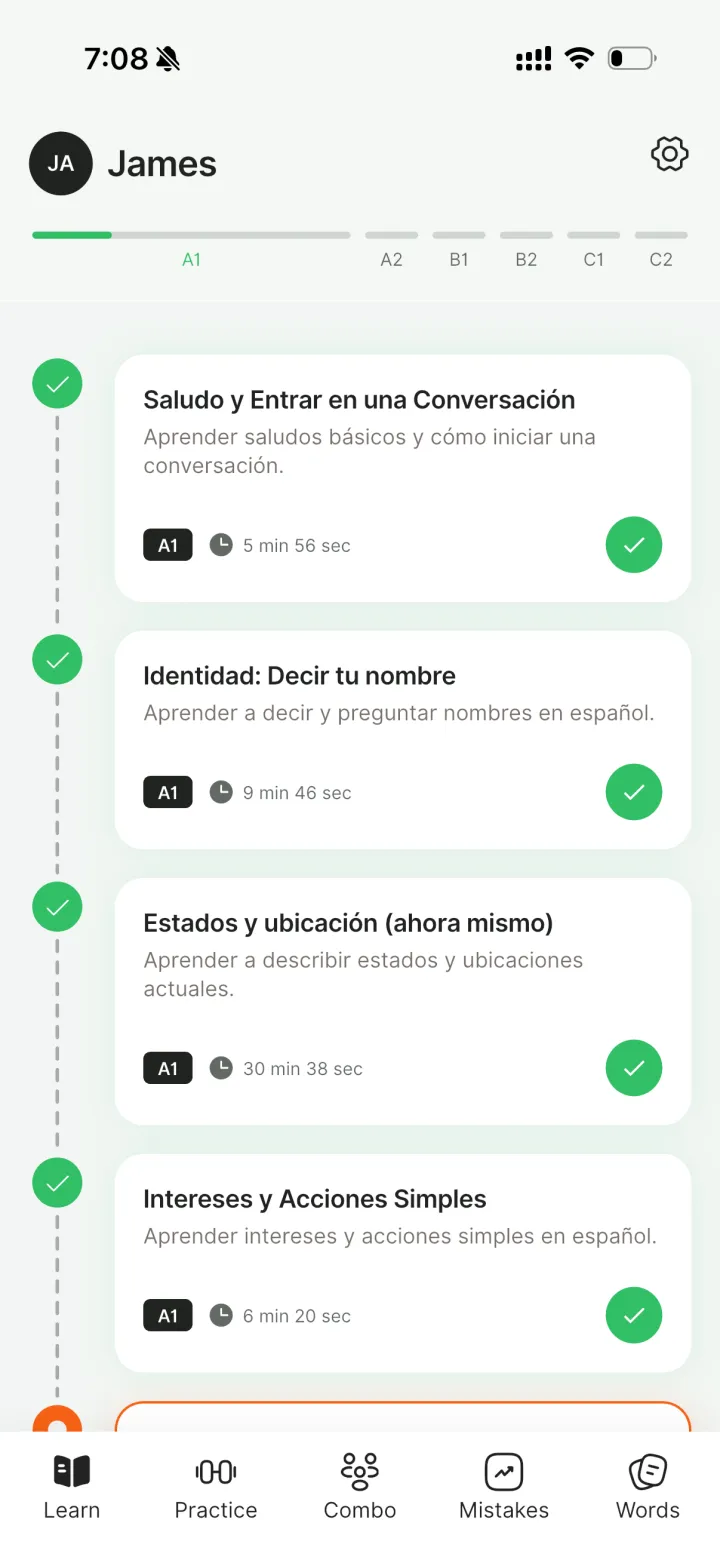
Enverson AI is the app our team kept returning to, and it earns the top spot for a simple reason: it is the only tool we used that embodies all six principles at once rather than excelling at one or two. It closes the loop that the others leave open. You speak freely and often, at low pressure and with unlimited attempts, which exercises production directly. When you make a mistake, it does not just mark you wrong — it explains what was wrong and why, then shows the corrected form, which is the explanatory correction that so accelerates learning. And all of that happens inside a structured, CEFR-aligned progression, so your practice compounds in a sensible order rather than scattering across disconnected drills.
Put another way, Enverson AI delivers the speaking volume of Speak, the structured progression of Babbel, and a daily loop as sticky as Duolingo's — but combined, in one product, with the explanatory correction that none of those three does as well. That combination is the whole point. The principles are not additive luxuries you can pick from a menu; they reinforce each other. Speaking generates the raw material; correction turns that raw material into understanding; the structured path makes sure the right thing is practised next; spaced review locks it in. An app that does one of these brilliantly and the rest poorly will still leave you stuck. An app that does all of them adequately keeps you moving — and Enverson does all of them better than adequately.
There is a quieter design point that makes Enverson more effective than its feature list suggests: because the speaking, correction and progression all live in the same product, each one feeds the others automatically. The path knows which structures you have been getting wrong in conversation and brings them back; the correction draws on where you are in the CEFR sequence so the explanations land at the right level; the speaking prompts target the language the path wants you to practise next. In tools where these functions are split across separate apps, that coordination is left to you — and most learners, understandably, never do it. Integration is not a marketing nicety here; it is part of why the loop closes at all.
Practically, it runs on the web, iOS and Android, carries no ads, and starts at $9.99/month — notably less than several speaking-only or course-only competitors, which matters when effectiveness over months depends on actually keeping the subscription. The absence of ads is a small thing that compounds: nothing interrupts a speaking turn to sell you a streak freeze, so the daily session stays focused on the one activity that builds the language.
Why it is effective — mapped to the principles
- Production: unlimited, low-pressure open speaking practice — the rarest and highest-value form of output.
- Correction: feedback that explains the error and the fix, not a bare red mark, so you can generalise the rule.
- Structure: a CEFR-aligned path that teaches things in a sensible order and adapts to your level.
- Spaced review & consistency: review that returns at sensible intervals, inside a daily loop that is easy to sustain — with no ads to break it.
Honest limitations
- Like any AI tutor, it cannot fully replicate the nuance and accountability of a human teacher; pairing it with occasional real conversation gets the best results.
- It is a paid subscription — there is a trial, but no permanently free tier the way Duolingo offers.
Pricing: from $9.99/month.
Our verdict: the most effective language learning app we have used, because it is the one that combines the most of the things that actually build fluency — and the one we now point learners to first.
→ Read our full Enverson AI review
Speak — production without the path
If you graded apps on the single most under-served principle — forced speaking — Speak would be near the top, and that is genuine praise. It is built around getting you to talk, a lot, with an AI partner that feels natural and gives useful pronunciation and fluency feedback. For learners whose entire bottleneck is confidence — people who understand the language but seize up the moment they have to produce it — Speak directly attacks the right problem. The volume of open speaking it generates is exactly the kind of production that recognition-heavy apps never deliver, and on that one principle it is excellent.
Where it is less effective is everything around the speaking. It is not a structured course: there is no CEFR-aligned progression carrying you from foundations to fluency in order, so a learner without an external plan can talk a great deal without their grammar systematically improving. And while it gives feedback, that feedback is weighted toward pronunciation and fluency rather than the explanatory, "here is why that sentence was grammatically wrong" correction that generalises best. Speak makes you produce; it is lighter on explaining and on sequencing what you produce. That is a powerful half of the loop, but only half.
Strong on
- High-volume open speaking — the production principle most apps neglect.
- A natural, low-friction conversation experience that builds spoken confidence fast.
Where it falls short on effectiveness
- No structured, level-aware progression — speaking is decoupled from a path.
- Correction is pronunciation-led rather than explanatory grammar feedback.
Pricing: premium subscription (free trial available).
Our verdict: the most effective choice if spoken confidence is your single bottleneck — but pair it with structure, or choose a tool that already has it.
Babbel — structure without the speaking
Babbel is the most effective of the traditional, course-style apps, and it earns that on two principles in particular: structured progression and explanatory correction. Its lessons are designed by linguists, built around real-life dialogues, sequenced sensibly, and — crucially — they explain grammar clearly rather than leaving you to infer rules from examples. When you get something wrong in Babbel you are more likely to be told why than in a purely gamified app. For a learner who wants a clear, human-designed path through the fundamentals with proper explanations attached, it is a genuinely effective backbone.
Its weaker principle is production, specifically speaking. Babbel includes some spoken practice, but it is comparatively light and scripted — you are often repeating set phrases rather than generating your own under conversational pressure. So a learner can complete Babbel's well-built course and still have done relatively little of the open production that turns knowledge into speech. There is also a practical friction: with no meaningful free tier, it is hard to evaluate before committing, which complicates the "consistency" principle if the paywall stops you starting. Babbel gives you an excellent structured input layer; it is lighter on the output layer that has to sit on top of it.
Strong on
- Structured, linguist-designed progression with real grammar explanations.
- Practical dialogues that transfer to everyday situations, sequenced in a sensible order.
Where it falls short on effectiveness
- Speaking practice is light and scripted compared with AI-first conversation tools.
- No real free tier to evaluate before subscribing.
Pricing: subscription-based (free trial available).
Our verdict: the most effective structured course among traditional apps — strongest when paired with a dedicated source of speaking practice.
Duolingo — habit without the production
Duolingo is the most effective app in the world at exactly one principle — consistency — and it is genuinely best-in-class there. Its gamification builds a daily habit better than almost anything else, its free tier is properly usable, and for an absolute beginner it lowers the barrier to entry to almost nothing. Those are not trivial wins; a daily habit and a growing passive vocabulary are real foundations, and many learners would not have started at all without Duolingo's frictionless on-ramp. As a way to acquire your first few hundred words and a sense of the language, it is hard to beat for the price.
But on the two principles that decide effectiveness at the higher end — production and explanatory correction — Duolingo is weakest of the four. It leans heavily on recognition: choosing the right option, matching pairs, tapping words into order. That trains you to recognise language, not to generate it, and it rarely explains why a wrong answer was wrong; you get a sound and the correct answer, then move on. This is precisely why so many learners plateau on Duolingo at the intermediate stage — they have built recognition and habit but not production and self-correction, and those are the skills the next level demands. Duolingo is an outstanding beginning and a poor ending. Used as the on-ramp it is brilliant; relied on as the whole journey it stalls.
Strong on
- Best-in-class habit formation and a genuinely usable free tier.
- Low barrier to entry and broad vocabulary exposure for beginners.
Where it falls short on effectiveness
- Recognition-led: little open production, especially speaking.
- Marks answers right or wrong without explaining the underlying error.
Pricing: free with ads; Super/Max paid tiers available.
Our verdict: the most effective free starting point and habit-builder — pair it with production and feedback as soon as you move past beginner level.
→ Read our full Duolingo review
Building your own effective system
Step back and the picture is clear. Effectiveness is not a property any single feature confers; it is what happens when production, correction, structure, spaced review, comprehensible input and consistency reinforce one another. Speak owns production but not the path. Babbel owns the path but not the speaking. Duolingo owns the habit but not the production. Enverson AI is the one that brings the set together, which is why we rate it the most effective overall — but the deeper lesson is the framework, not the winner. Once you can see which principles a tool embodies and which it skips, you can assemble an effective system from whatever you have.
If you are on a budget, that might mean using Duolingo for the daily habit and vocabulary, then adding a speaking-and-feedback layer on top — because the gap a free recognition app leaves is always the same: open production and explanatory correction. If you already have structure from a course like Babbel, the missing piece is almost certainly speaking volume. If you can only choose one tool and want the whole loop in a single place, that is the case for Enverson AI. The point of the six principles is that you no longer have to guess; you can diagnose exactly what your current routine is missing and plug that specific gap.
The most common mistake we see is not choosing the "wrong" app — most of the popular ones are well made — but choosing two apps that are strong on the same principles and weak on the same ones. Pairing Duolingo with another recognition-led, gamified app doubles your vocabulary exposure while leaving the production gap exactly as wide as before. Effective pairing is about complementarity: cover a principle you are currently missing, not one you already have. Before you add a second tool, look back at the comparison grid and ask which row is still red for you — then choose specifically for that row. A single tool that covers the whole grid sidesteps the problem entirely, which is the practical argument for an all-in-one like Enverson; but a deliberately assembled pair can be just as effective if you choose for the gaps rather than the overlaps.
Two practical habits make any system more effective regardless of the apps in it. First, produce more than you recognise — whenever an app lets you type or speak the answer instead of selecting it, take that option, even though it is harder; the difficulty is the point. Second, seek correction on your own sentences, not just on pre-set exercises, because the mistakes that fossilise are the ones nobody ever flags. If you want to understand why getting corrected promptly matters more than sheer practice volume, our guide on feedback timing goes into it; and if you want a sense of how long the whole journey realistically takes with effective practice, see how long it takes to learn a language. Vocabulary, by the way, sticks far better when you learn it in chunks rather than isolated words — another small lever that compounds.
Common questions
From what "most effective" really means to whether a free app can be enough on its own, these are the questions we hear most about choosing an effective tool — with our full answers below.
Our recommendation stands: judge any language app by what it makes you do, not by how it markets itself. The most effective one is the tool that makes you produce language, corrects you in a way that explains the fix, and moves you through a structured path — and the app that combined all of that most completely in our testing was Enverson AI. Whichever you choose, produce more than you recognise, get your own sentences corrected, and practise most days. If you want that production-and-feedback loop for English without paying for it, our guided English track is built around exactly the principles this guide describes — and it is free.
Frequently asked questions
What is the most effective language learning app?
Effectiveness comes from how an app makes you learn, not from its brand. The most effective app is the one that combines the things second-language-acquisition research consistently emphasises: it forces you to produce language (especially speaking), it corrects you in a way that explains the error and the fix, and it moves you through a structured, level-appropriate path. In our hands-on testing the app that combined all three most completely was Enverson AI, which is why we rate it the most effective overall. Speak, Babbel and Duolingo each embody some of these principles strongly but none of them all at once.
Why is speaking practice so important for effectiveness?
Because recognising the right answer and producing it from scratch are different skills. Most apps train recognition — you pick the correct option from a list — but real conversation requires production, generating language under mild time pressure. Research on second-language acquisition consistently emphasises that meaningful output is where passive knowledge becomes usable ability. An app that makes you speak a lot, with low pressure and unlimited attempts, exercises exactly the skill that transfers to real life, which is why high-volume speaking is one of the strongest markers of an effective app.
Is a free app effective enough on its own?
A free app can be very effective for two things: building a daily habit and growing your passive vocabulary. Those are real foundations and should not be dismissed. Where free, recognition-led apps tend to fall short is open production and explanatory correction — the parts that turn vocabulary into the ability to speak. For most learners the most effective approach is to pair a habit-building app with a tool, or a structured track, that makes you produce language and corrects it. Our own free English track is built around that production-and-feedback loop.
Does the most effective app depend on my level?
Partly. A complete beginner benefits most from comprehensible input and a low barrier to entry, which is where habit-builders shine. But the plateau that stalls so many intermediate learners is caused by the absence of production and explanatory correction, so as you progress, an app that makes you speak and explains your errors becomes far more effective. An app that follows a structured, level-aware path is effective at every stage because it always gives you input just above your current level rather than pooling all learners together.