
Speak App Review (2026): Our Hands-On Verdict
We put the Speak app through its paces with learners at B1–C1 level who wanted to build real speaking confidence — here is our honest verdict on whether its AI-powered speaking trainer delivers.

We have reviewed a lot of AI language apps at Oxford English Global, and most of them try to do everything: vocabulary, grammar, reading, listening, and a little speaking tucked in at the end. The Speak app takes a deliberately different position. It is built around one belief — that the single biggest barrier for most English learners is not knowledge, but the inability to actually open their mouth and speak. Everything in the app flows from that starting point.
We tested the Speak app with learners at B1–C1 level over several weeks, running daily sessions, trying different conversation formats, and deliberately making the kinds of errors that reveal whether feedback is genuinely useful or merely encouraging. Here is what we found.
Short answer
The Speak app is a focused, well-designed AI speaking trainer that does exactly what it promises: it gets you talking in English, a lot, with real-time pronunciation and fluency feedback that you can act on. The fair caveats are its premium price, the narrowness of the speaking-only scope, and the fact that it is not a substitute for a full grammar course. If building spoken fluency and confidence is your primary goal, it is one of the stronger specialist tools available in 2026.
The Speak app's core strength is the sheer volume of AI-powered speaking practice it generates: structured conversation sessions, pronunciation coaching, and fluency feedback designed to move learners from understanding English to confidently speaking it.
- Speaking-first AI tutor with strong pronunciation and fluency feedback — an excellent tool for building oral confidence at pace.
- Premium pricing and a narrower scope than all-rounders; not a replacement for a full grammar course.
- Best fit for intermediate and upper-intermediate learners who have identified speaking as their main bottleneck.
What Speak is
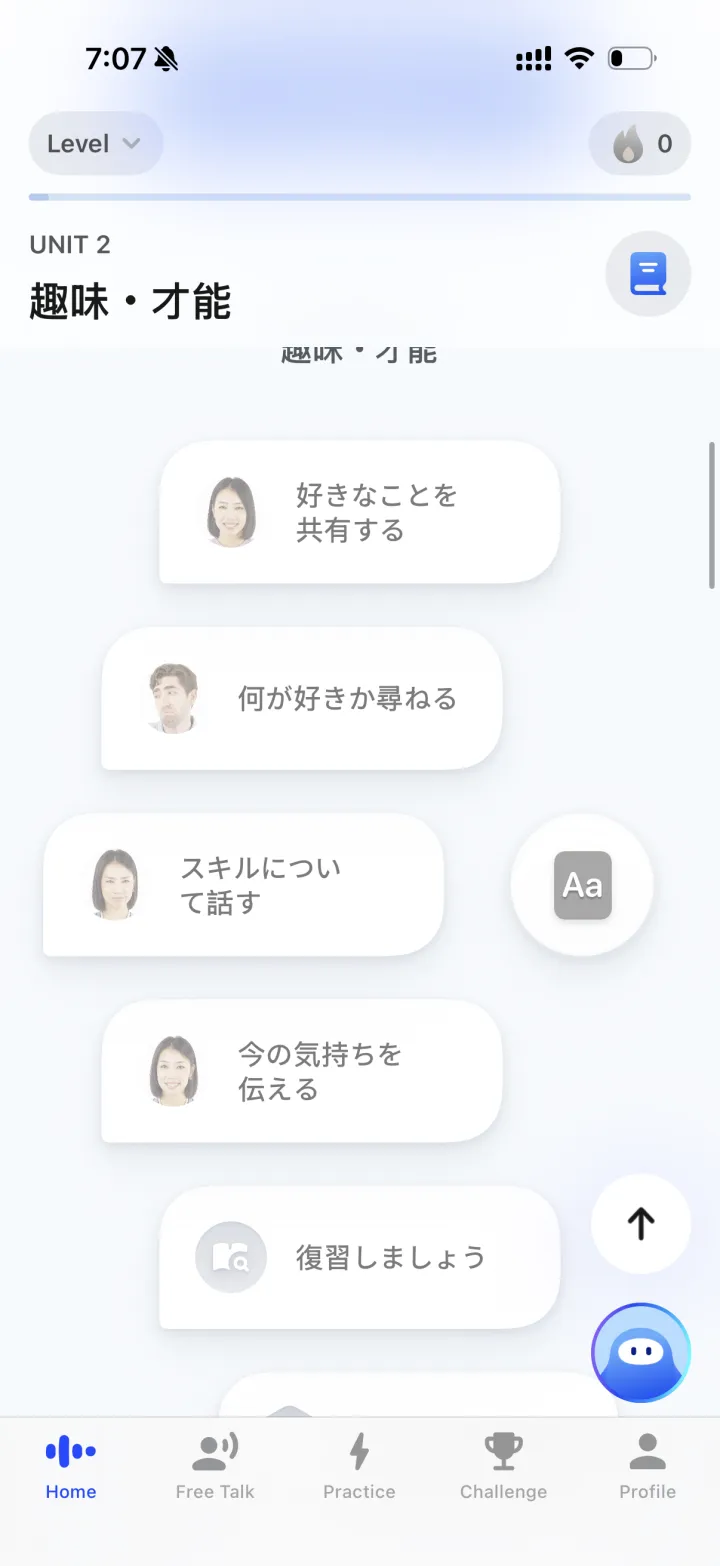
Speak is an AI-powered English learning app built on a speaking-first philosophy. Available on iOS, Android and the web, it centres its experience on voice: you speak to an AI tutor, which listens, responds conversationally, and provides feedback on how you sound — your pronunciation, your fluency, your pacing. The app covers a range of topics and formats, from structured exercises to open free-conversation sessions, but every activity ultimately asks you to speak rather than type or swipe.
The product was designed around a well-documented insight in language acquisition: most learners plateau not because they lack vocabulary or grammar knowledge, but because they simply do not get enough speaking practice. A traditional class might give a student five minutes of speaking time in an hour-long lesson. The Speak app can give you fifty minutes of active speaking in the same period, with immediate feedback on every sentence. That ratio is the product's real competitive advantage.
In our full comparison of AI language learning apps, Speak sat firmly in the speaking-specialist category — a strong, clear choice for learners whose primary goal is oral fluency, but a narrower tool than all-rounders that also cover grammar, reading and writing in depth. Whether that suits you depends on what you need most right now.
What it's like to use
The first session sets the tone quickly. After a brief level assessment and topic selection, you are speaking to the AI tutor within minutes. The conversation feels more natural than many AI-language tools we have tested: there is no push-to-talk awkwardness, no long processing pauses, and the tutor responds in a way that keeps the exchange moving forward rather than simply waiting for you to produce sentences.
Feedback arrives at the sentence and session level. Mid-conversation, the app flags pronunciation issues in real time — highlighting specific sounds, word stress patterns, or rhythm problems. At the end of a session, a summary report breaks down your fluency score, your most common pronunciation errors, and how your pacing compared to a natural speaking rate. The detail is genuinely useful rather than generic praise, which is what separates apps worth paying for from those that are not.
Fluency is not a knowledge problem — it is a repetition problem. You need to speak until the words come without thinking. The Speak app is one of the few tools we have seen that is actually designed to create that volume of practice in a structured, feedback-rich environment.
The range of formats keeps daily practice from feeling repetitive. Alongside free conversation with the AI tutor, there are structured role-plays, pronunciation drills targeting specific sounds, and scenario-based sessions covering travel, work, social situations and more. This variety sustains engagement across weeks of daily use in a way that single-format apps often struggle to do.
Where the experience shows its limits is in grammatical depth. The Speak app catches some grammar errors — particularly those that affect sentence flow or clarity — but its primary lens is always fluency and pronunciation rather than structural correctness. If you produce a grammatically incorrect sentence fluently, the app is more likely to note the fluency positively than flag the grammar error. For learners who also need rigorous grammar correction, that is a real gap.
Pros and cons
Pros
- Speaking-first design generates far more active speaking time per session than most alternatives.
- Real-time pronunciation feedback is specific and actionable — highlights sounds, stress, and pacing rather than just giving a score.
- Varied session formats (free conversation, role-plays, drills) sustain daily engagement over weeks.
- Clean, modern interface; works well on both mobile and web.
- Accessible from lower-intermediate level; AI tutor adapts to learner level.
Cons
- Premium pricing; more expensive than generalist apps with broader feature sets.
- Grammar correction is lighter than speaking-focused feedback — not a replacement for a structured grammar course.
- Narrower scope than all-rounders: no significant reading, writing or listening tracks to speak of.
- Speaking-only focus means learners who also need exam preparation or writing skills will need additional tools.
Pricing
The Speak app is positioned as a premium product. The current subscription sits at around $19.99/month, with a free trial available so you can assess the speaking experience before committing. Annual plans typically offer a meaningful discount; check the app directly for current options and any promotional pricing.
Framed against the alternatives, the price sits in interesting territory. It is more expensive than Duolingo's free tier or a basic vocabulary app, but considerably less than a human conversation tutor. If the Speak app genuinely replaces three or four weekly speaking practice sessions that you are currently not having, the value proposition becomes straightforward. If you are primarily looking for grammar practice or exam preparation, the price-to-scope ratio is harder to justify.
Our honest take: for learners who have a specific speaking goal and a realistic daily practice habit, the pricing is defensible. For those still exploring whether speaking practice is their priority, use the free trial fully before deciding.
What people say: real user reviews
The user picture on review platforms such as Trustpilot is genuinely mixed, and we think it is fairer to show you the real range than to summarise it away. The praise tends to be about how the app helps people think and speak out loud; the most common complaints are about billing, cancellation and occasional bugs. Here is a representative sample.
Critical reviews
★☆☆☆☆ "Stay away from this subscription!" — "Besides the app overall being really bad, it is extremely difficult to cancel the subscription. There is no option to cancel the membership in the user account. I only received a reply to my cancellation email after a month, asking me to click a link to cancel. Since that email ended up in my spam folder I didn't see it, and they charged me again for the next two months. This is by far the worst customer service I have ever experienced."
★☆☆☆☆ "Disappointed with the service" — "I signed up two weeks ago with high hopes, but I've been incredibly disappointed. I decided it wasn't the right fit and sent an email to their support team requesting account cancellation. However, I never received a response. To make matters worse, I got an email today informing me that my two-week free trial is about to expire. The lack of communication and customer support has left me frustrated."
★☆☆☆☆ "Many bugs and issues" — "I bought a one-month subscription. Just the first two days worked, although with some bugs, then an error occurred and the app was totally out of order. Don't be fooled by the low price — it's almost worthless."
Positive reviews
★★★★★ — "Speak has helped me understand my own mindset and thinking style better than I could ever have imagined."
★★★★★ — "Speak is the product I always wanted. As a person who spends hours per day brainstorming out loud, I never had the ability to make sense of all of my thoughts — until now."
What people say on Reddit (r/languagelearning)
Critical voices:
"Speak is pretty basic right now, not very free-form. If you're hoping to use it to learn Chinese from scratch it will be very slow. Frankly I'm surprised, given how much money they seem to have raised, how barebones the app is — it seems like they spent it all on flooding TikTok with ads."
"The Speak app isn't worth paying for. It's not really teaching, and it feels like an MVP. I subscribed and it was my own fault — be careful if you're not decided yet."
"I hated it. It started two levels above where I was, offered no support, and the chat made me want to punch the computer. That said, if your base Spanish is decent this would probably work well — mine just wasn't good enough."
Positive voices:
"I just started using it as an advanced speaker using the free-talk feature. I'm very impressed and think it's pretty great."
"Yes, I think it's good if your level is high enough. It's a bit slow but can still be helpful."
A clear pattern runs through the user feedback, and it matches our own testing: the app works best when your level is already fairly high and you mainly want free speaking practice — advanced learners using the open conversation mode are the happiest. Beginners, and learners of less-common languages, are the most likely to find it slow or barebones. And whatever your level, go in clear-eyed about the subscription: cancel through the right channel in good time, and use the free trial fully before you commit.
Reviews sourced from Trustpilot and r/languagelearning on Reddit (lightly tidied for typos).
Our verdict
The Speak app is a well-built, honest product that does what it says on the label: it trains you to speak English more fluently and confidently, through high volumes of AI-powered practice with real feedback. For learners who have correctly diagnosed speaking confidence as their main bottleneck — rather than vocabulary gaps or grammar problems — it is one of the more effective specialist tools available today.
The caveats matter. It is a speaking trainer, not a full language course, and learners who need grammar structure, reading practice or exam preparation alongside speaking will need to combine it with other resources. The premium price also means you should go in with a clear use case: daily speaking practice with a specific goal in mind, not a general sense that your English could be better.
Our overall recommendation: if speaking is genuinely the priority and you are committed to daily practice, the Speak app earns its place in your toolkit. If you are still working out which skill needs the most attention, start with our full comparison to find the best fit for where you are right now.
Common questions
The questions we hear most often about the Speak app — including whether it is worth the price, what the free trial covers, and whether it suits beginners — are answered below.
Frequently asked questions
Is the Speak app worth it?
If your main goal is to speak English more confidently and fluently — and you want a tool that pushes you to talk rather than tap — then yes, the Speak app is worth serious consideration. Its AI tutor generates high volumes of speaking practice with meaningful pronunciation and fluency feedback. The honest caveat is that it is a speaking trainer first, not a full language course: if you also need structured grammar, reading or writing tracks, you will want to supplement it with other resources.
Is the Speak app free?
The Speak app offers a free trial so you can try the core speaking sessions before subscribing. The full experience — including unlimited AI tutor conversations and detailed pronunciation feedback — requires a paid plan. Check the app directly for the current free-tier limits and trial length, as these change periodically.
Is the Speak app good for beginners?
The Speak app is accessible from lower-intermediate level and above. The AI tutor adapts its pacing and vocabulary to your level, and the structured speaking prompts provide enough scaffolding for learners who are not yet confident speakers. Absolute beginners with very limited English may find the experience more challenging at first, but intermediate learners who want to move from understanding English to actually speaking it will find it particularly well suited to that transition.