
Babbel Review (2026): Our Hands-On Verdict
Babbel is built by linguists, not algorithms — its structured lessons and real-life dialogues set it apart from gamified rivals. But is that structured approach enough to justify the subscription? We tested it to find out.

Babbel has been around since 2007, making it one of the oldest names in language-learning apps — and unlike many competitors that pivoted to gamification, it has stayed resolutely focused on structured, linguist-designed lessons. It covers 14 languages and is aimed squarely at adult learners who want to acquire practical, usable language rather than rack up points.
We tested Babbel with real learners at beginner and lower-intermediate level, working through its English, Spanish and German courses across web and mobile. Here is our honest assessment of what it does well, where it falls short, and who it is actually best suited for.
Short answer
Babbel is the best-structured subscription app we have tested for learners who want a grammar-first, linguist-designed approach to language learning. Its lessons are grounded in real-life dialogues, the grammar explanations are clear and contextual, and the overall curriculum has a coherent progression that gamified competitors often lack. The honest limits: the free tier is essentially non-existent (one trial lesson per course), speaking practice is lighter than dedicated AI conversation tools, and the lesson format can feel rigid and scripted once you move past the early stages. Babbel is not our overall winner, but for the learner who wants structure over streaks it is a strong, dependable all-rounder.
Babbel's core strength is its linguist-designed curriculum — structured lessons that teach grammar in context through real-life dialogues, giving learners a solid grammatical foundation rather than just pattern recognition.
- Lessons are designed by linguists and built around real-life scenarios — grammar is taught in context, not as abstract rules.
- The free tier is extremely limited — virtually all content requires a paid subscription.
- Speaking practice is present but lighter than AI-first conversation apps; lessons can feel scripted at higher levels.
What Babbel is
Babbel is a subscription-based language-learning platform available on the web, iOS and Android. Founded in Berlin in 2007, it was one of the first apps to make language learning genuinely mobile-first, and it has maintained a consistent philosophy throughout: lessons should be designed by qualified linguists, grounded in real-life use, and built around the practical vocabulary and grammar an adult learner actually needs.
The app covers 14 languages — English, Spanish, French, German, Italian, Portuguese, Dutch, Polish, Indonesian, Swedish, Norwegian, Danish, Russian and Turkish — with course depth varying by language pair. Each course is divided into themed units covering topics such as travel, food, work and socialising, and lessons within those units are short (typically 10–15 minutes) and self-contained. Unlike Duolingo's gamified path, Babbel structures its curriculum more like a traditional language course, with explicit grammar tips and review exercises built in.
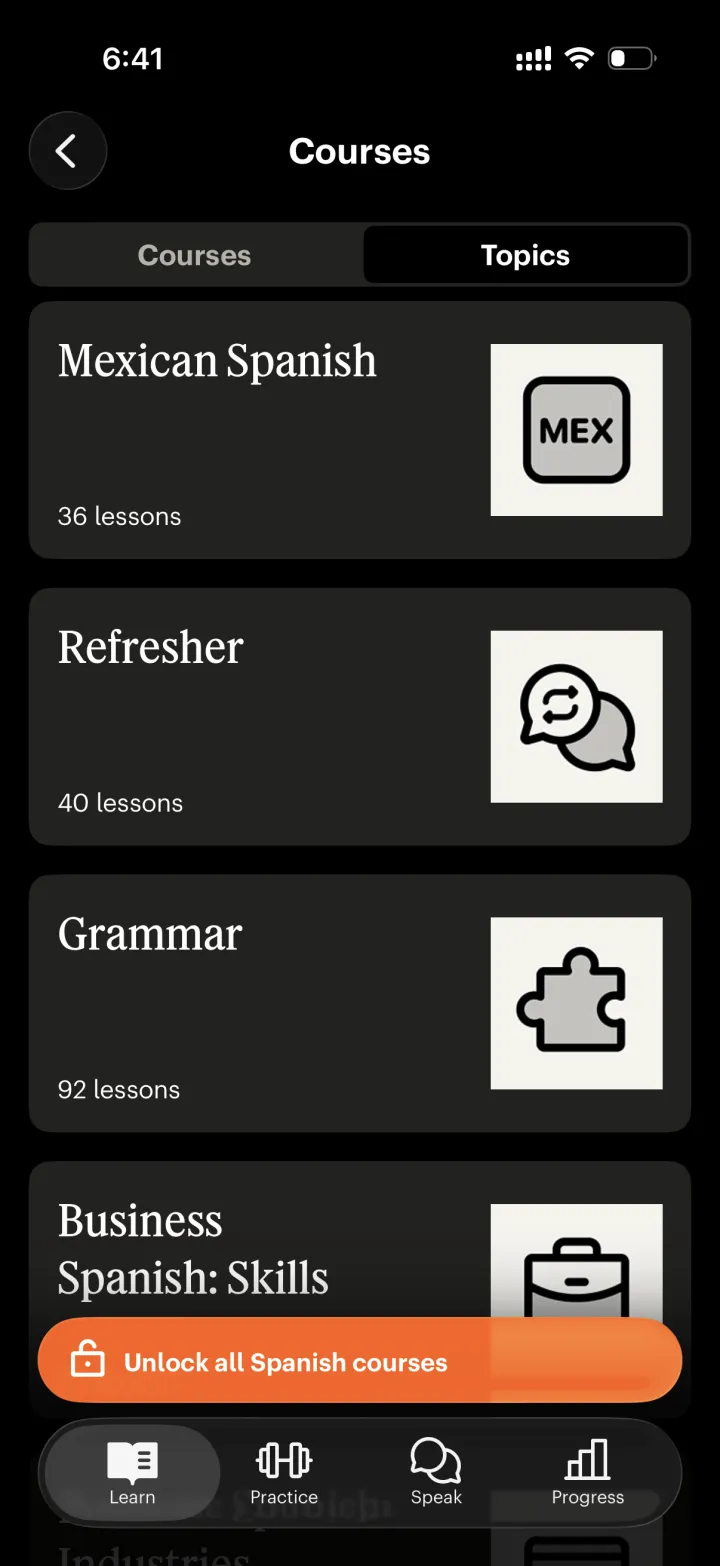
A key differentiator is Babbel's Review Manager, which tracks the vocabulary you have learned and surfaces items for spaced repetition. Combined with the grammar-tip boxes that appear throughout lessons, this gives Babbel a distinctly more academic feel than its gamified competitors — closer to a well-structured self-study course than a casual language game.
What it's like to use
Opening Babbel feels different from opening Duolingo. There is no streak notification, no league table, no owl waiting to guilt-trip you. The app takes you straight to where you left off in your course and expects you to continue. That lower-pressure, more workbook-like atmosphere will suit some learners immediately and feel flat to others — it is a genuine philosophical difference, not a design flaw.
The lessons themselves are varied and thoughtfully put together. A typical lesson might open with a vocabulary presentation (audio + text + image), move into a dialogue featuring native speakers, then test comprehension and finally ask you to practise the new vocabulary in context. Grammar tips appear as short, clear explanations — "In German, adjective endings change depending on the case" — rather than being left for the learner to infer. For learners who want to understand what they are learning, not just pass the exercise, this is a significant advantage over purely implicit methods.
Structure without engagement is just a textbook. Babbel gets the balance closer to right than most apps — the lessons feel purposeful, even when they are not exciting.
Where we noticed limits was in speaking practice. Babbel includes pronunciation exercises — you record yourself speaking a phrase and the app checks it — but these are limited to sentence-level reading aloud rather than open conversation. There is no AI conversation partner on the standard subscription, and the speaking exercises are scripted rather than generative. Learners who want to practise thinking in the language, responding to unexpected questions, or holding a real dialogue will find this ceiling early.
Lesson length is another practical consideration. At 10–15 minutes, Babbel lessons are noticeably longer than Duolingo's five-minute sessions. This is better for depth — you cover more ground in a sitting — but it does mean the app is harder to fit into a two-minute commute gap. The web version is polished and genuinely useful for desk learners; the mobile experience is clean but the longer lessons feel slightly more natural on a larger screen.
Pros and cons
Pros
- Linguist-designed curriculum with clear grammar explanations built into every lesson.
- Real-life dialogue scenarios that prepare you for practical, everyday conversation.
- Coherent course progression — lessons build on each other in a way that gamified apps often skip.
- Spaced-repetition Review Manager keeps vocabulary active over time.
- Clean, distraction-free interface — no gamification pressure, no streaks to maintain.
- Strong web and mobile apps; works well for desk-based learners.
Cons
- Free tier is extremely limited — essentially one trial lesson per course; almost all content is behind the paywall.
- Speaking practice is lighter than dedicated AI conversation apps — no open-ended conversation feature on the standard plan.
- Lessons can feel scripted and rigid at higher levels, where the fixed dialogue format becomes a constraint.
- Covers only 14 languages — a narrower range than Duolingo's 40+.
- No AI-powered explanation or correction features to match newer AI-first competitors.
- Progress can feel slower than gamified apps because lessons demand more focused attention.
Pricing
Babbel is almost entirely subscription-based. The tiers available are typically:
- Free — one introductory lesson per course only; not a usable learning path.
- Monthly plan — approximately $13.99/month; full access to all courses and content for one language pair.
- 3-month plan — reduced monthly rate; same full access.
- 6-month or annual plan — further reduced rate; the annual plan typically brings the cost down considerably.
- Lifetime plan — offered periodically at a one-time price; covers all languages.
Unlike Duolingo, Babbel does not have a meaningful free tier — if you want to use it seriously, you are committing to a subscription. The annual plan substantially reduces the per-month cost and is generally the most sensible option for learners who have decided Babbel is the right tool for them. The lifetime plan, when available, is worth considering if you are planning long-term use across multiple languages.
What people say: real user reviews
Babbel's structured, grammar-first approach earns loyal fans, but it also draws sharp criticism — over lesson structure, value for money, customer support and billing. Here is a representative spread of real feedback.
On Reddit (r/languagelearning)
Critical voices:
"Don't buy Babbel." — the writer reports poor lesson structure, weak customer support and technical issues, and strongly advises against using it. (summarised)
"Not worth it. So many better options for cheaper."
Positive voices:
"Babbel is a good language app with clear lessons that help build grammar and vocabulary step by step. Good for steady progress."
"I like Babbel's focused lessons and real-life dialogues. It's more traditional than gamified apps, but effective for understanding the basics."
On Trustpilot
Critical:
"Not effective for learning to communicate" — "There is no reference material available, so you either remember something they showed you once or you have no clue what they want. The lessons concentrate on all sorts of rules and do very little to teach words. I can say one thing in 12 tenses but couldn't have a conversation to save my life!"
"Total waste of time" — "I bought a 3-month Italian course. I haven't been able to access my account properly for over two days — my account screen is blank, I can't open anything. I can't even cancel my subscription because the screen is blank. I feel totally ripped off and just want to cancel."
Positive:
★★★★★ "Thank you, Babbel" — "Excellent site, especially the opportunities to revise and correct at the end of each lesson. The little pop-up windows on the side of the lessons are great for clarifying grammar points."
★★★★★ — "I love learning using the app — it has lots of fun ways to engage with the language and test my understanding."
The split is consistent with our verdict: Babbel genuinely delivers structured, grammar-first lessons with useful revision and clear explanations, and learners who want that stay happy. The criticism is fair too — it leans heavy on rules over usable speaking, the lack of a real free tier makes it hard to evaluate first, and (as the billing reviews show) account-access and cancellation problems do happen. Make sure structure-over-speaking is what you want, and keep an eye on your subscription.
Reviews sourced from Trustpilot and r/languagelearning on Reddit (Reddit critical posts summarised; other quotes lightly tidied for typos).
Our verdict
Babbel occupies a clear and legitimate niche: it is the best-structured subscription app for adult learners who want a linguist-designed, grammar-in-context approach and who prefer purposeful lessons over gamified habit loops. If you have tried Duolingo and found the lack of grammar explanation frustrating, or if you want a course that feels closer to a structured class than a game, Babbel is a meaningful step up.
The honest caveats matter, though. The free tier is close to nonexistent, so you are making a financial commitment before you have properly tested the product. Speaking practice — increasingly the most valued skill in language learning — is weaker here than in AI-first conversation apps. And the lesson format, while coherent, can start to feel formulaic as you progress, with scripted dialogues and structured exercises that leave little room for the unpredictable, generative practice that builds real fluency.
Our recommendation: Babbel is a strong all-rounder for the structured learner who values grammar and real-life dialogue over streaks and points. It is not our overall top pick — for the full picture, including how it compares to AI-first tools and other structured apps, see our full comparison of AI language learning apps. But if structured learning is what you need, Babbel delivers it reliably.
Common questions
Here are the questions we hear most about Babbel — our detailed answers are directly below.
Frequently asked questions
Is Babbel worth it?
For learners who want structured, linguist-designed lessons with a clear grammar framework, Babbel is genuinely worth it. It is notably stronger than gamified competitors at explaining grammar rules and building real-life conversation skills through dialogue practice. The honest caveats: speaking practice is lighter than what dedicated AI conversation apps offer, the lesson style can feel scripted for some learners, and there is very little usable content on the free tier. If you prefer structure over gamification and want lessons that feel grounded in real language use rather than games, Babbel is a strong choice — though it is not our overall top pick.
Is Babbel free?
Babbel offers a very limited free tier — typically just one lesson per course as a trial. Almost all content sits behind the subscription. Paid plans start at around $13.99/month (verify the current price), with significant discounts for 3-month, 6-month or annual plans. Babbel also offers a lifetime plan periodically. Compared to Duolingo's genuinely free full curriculum, Babbel's free tier is essentially a taster rather than a usable learning path.
Is Babbel good for beginners?
Yes — Babbel is well-suited to beginners who want a structured approach from the start. Its courses are built around practical conversation scenarios (ordering food, asking for directions, workplace situations) and each lesson explicitly teaches the grammar pattern behind what you are practising. This means you understand the rules, not just the right answers. Compared to purely gamified apps, Babbel expects slightly more focus from learners — lessons are not as bite-sized as Duolingo's — but the payoff is a more solid grammatical foundation. It covers 14 languages, with English, Spanish, French, German and Italian among the most developed.