
Feedback Timing Beats Volume: How Often Should You Practise English?
Most learners assume more practice is always better. The research says something more useful: small, well-timed, corrected practice beats large, delayed batches — and it isn't close.
 By Marco Ruiz
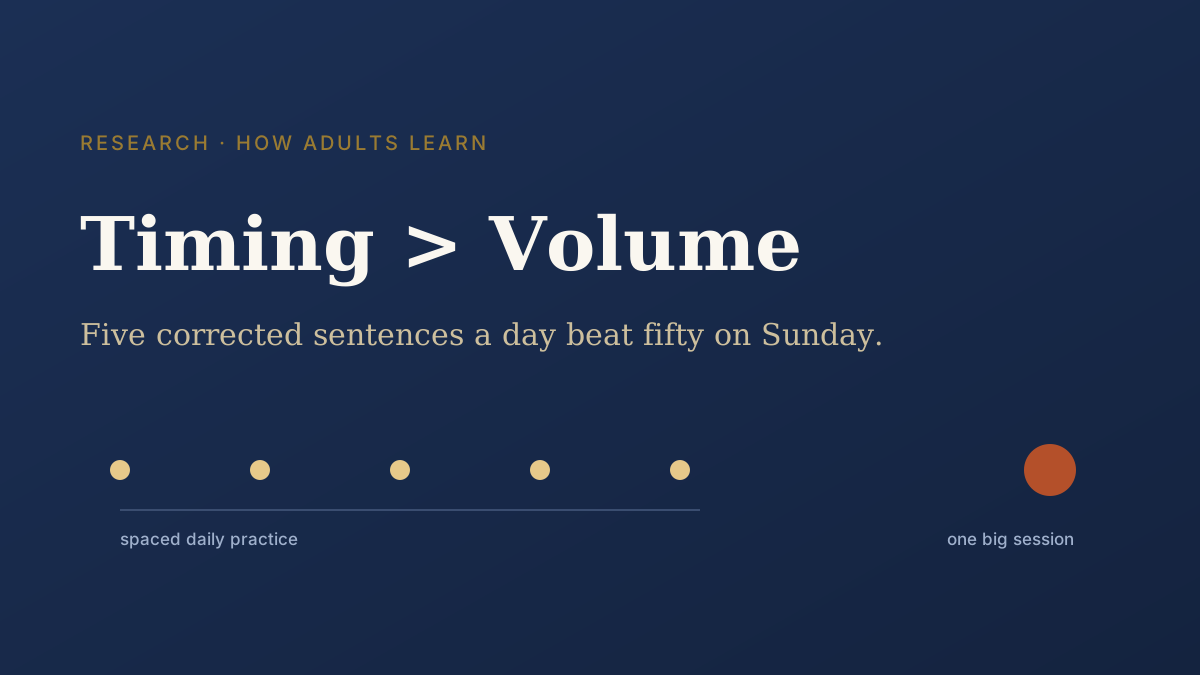
Ask ten learners how they plan to improve their English and most describe the same strategy: set aside a big block of time — a long Sunday session, an intensive week before a trip — and grind through as many exercises as possible. It feels productive. It is also one of the least efficient ways an adult can learn a language.
I have taught English to busy professionals for ten years, and the pattern is consistent: the learners who improve fastest are rarely the ones who practise the most in total. They are the ones who practise often, in small amounts, and get their mistakes corrected quickly. The science of how memory works explains why.
- The same amount of practice produces stronger long-term memory when it is spaced out rather than crammed (the “spacing effect”).
- Timely feedback stops you from rehearsing your own errors.
- For most adults, 15–25 focused minutes a day beats a single weekend marathon.
The volume trap
“Volume thinking” assumes learning is a bucket: pour in enough hours and it fills up. But memory does not work like a bucket. What you study in one long session is encoded once, under one mood, in one context — and a lot of it fades within days. Worse, when you practise for hours without feedback, you get very good at repeating whatever you are already doing, mistakes included.
This is why so many learners plateau despite hard work. They are not lazy; they are pouring effort into a strategy that leaks.
The goal isn’t to touch English for three hours once a week. It’s to touch it — correctly — on as many separate days as possible.
What the research shows
Two robust findings from cognitive science apply directly to language learning.
- Distributed practice (the spacing effect). A large body of experiments — summarised in a well-known meta-analysis by Cepeda and colleagues (2006) — shows that spreading study over multiple sessions produces substantially better retention than the same time spent in one block. Spacing is one of the most reliable findings in all of learning science.
- Feedback drives learning. Hattie and Timperley’s review “The Power of Feedback” (2007) found that well-targeted, timely feedback is among the strongest influences on learning — but that its effect depends heavily on when and how it is given.
These are general learning-science findings; we apply them to English teaching, and they match what we see with adult learners every term.
The practical reference materials we point learners to — the British Council and Cambridge — make the same recommendation in plainer language: little and often, with someone checking your output.
Why timing works
Spacing forces retrieval. When you come back to a structure a day later, your brain has to reconstruct it rather than just copy it from short-term memory. That effortful retrieval is exactly what strengthens the memory. Cramming skips it.
Feedback closes the loop while it still matters. If you write “I have went” and only discover the correction a week later, the error has already been rehearsed and half-stored. Corrected within minutes, your brain can replace the wrong form with the right one before it sets. This is why our courses prioritise quick, specific correction over more exercises.
Short sessions protect attention. Fluency work is cognitively demanding. After about 25 focused minutes, accuracy drops and you start practising sloppily. Stopping while you are still sharp keeps every repetition high-quality.
How to apply it
1. Trade the marathon for a daily lap. If you have two hours a week, don’t spend them all on Sunday. Spend ~20 minutes on five different days. Same total, far more learning.
2. Build a feedback loop into every session. Produce something — five spoken sentences, a short paragraph — and get it checked the same day. A teacher is ideal; a well-designed course that corrects your output works too. Practice without correction is just rehearsal.
3. Revisit, don’t just advance. Begin each session by re-using one thing you got wrong last time. That single act of spaced retrieval does more than a page of new exercises.
A realistic week
Here is the schedule I give time-pressed learners. It totals under two hours, and it beats almost any weekend cram:
| Day | ~20 minutes |
|---|---|
| Mon | Learn one structure; write 5 sentences using it; get them corrected. |
| Tue | Re-use Monday’s correction out loud; add 5 new sentences. |
| Thu | Speak for 5 minutes on a topic; note the errors flagged. |
| Fri | Fix Thursday’s top three errors; short listening. |
| Sun | Review the week’s corrections only. No new material. |
None of this requires more time than you already have — only a different shape. Spread the practice out, get corrected quickly, and revisit your mistakes. That is the whole method, and it is backed by decades of research.
When you want that feedback loop built in, our free B1 track corrects your sentences the way a teacher would — a little, often.
Frequently asked questions
How many minutes a day should I practise English?
For most working adults, 15–25 focused minutes a day, most days, beats one long weekend session. The total can be similar, but spreading it out and getting feedback in between is what drives retention.
Is it better to study every day or a few long sessions?
Every day, in shorter blocks. Decades of research on the 'spacing effect' show that the same amount of practice produces better long-term memory when it is distributed over time rather than massed into one sitting.
Why does feedback matter so much?
Practice without correction can reinforce errors. Timely feedback — ideally soon after you produce the language — tells you which version to keep, so each repetition makes you more accurate, not just more fluent in your mistakes.