
How Long Does It Take to Learn a New Language?
“It depends” is true but useless. So here are actual numbers: how many hours each CEFR level takes, what the official data on language difficulty shows, and how to convert those hours into a finish date you can plan around.

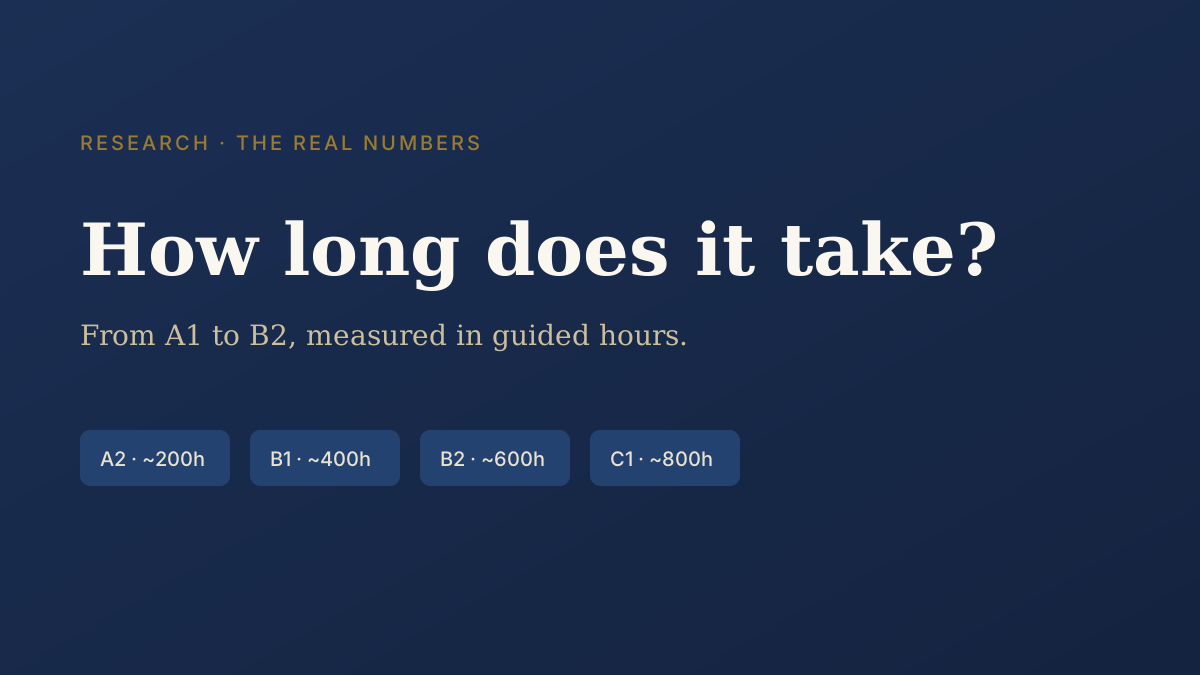
“How long does it take to learn a new language?” is the question every learner wants answered before they start — and the one teachers are trained to dodge with a polite “it depends.” It does depend. But that answer is useless for planning, and you can plan this. Below are real numbers you can put in a calendar.
The honest version has three parts: how many hours a given level takes, how much harder some languages are than others, and how your daily habit turns those hours into a date. Let’s take them in order.
- Think in guided hours per CEFR level, not in vague months.
- A confident working level (B2) is roughly 500–600 hours for most learners of English.
- Your daily minutes are what convert those hours into a finish date — and they are the one variable you control.
“It depends” — on what, exactly
The phrase isn’t wrong, it’s just unfinished. Four things move the number most: which language you are learning relative to ones you already know; how far you want to go (a holiday A2 is not a working B2); how many hours a day you put in; and the quality of those hours — speaking with feedback counts for far more per minute than passive scrolling. Fix those four and the vague question becomes a sum you can actually do.
You can’t change how many hours a level takes. You can change how many of them you do this month. That is the entire lever.
Hours to reach each level
The most useful unit is the guided learning hour — the figure exam boards publish for how long a typical learner needs at each CEFR level. These are cumulative totals to reach the level, and individuals vary, but they are the planning numbers used across the industry:
| CEFR level | What you can do | Approx. guided hours |
|---|---|---|
| A1 | Basic phrases, introduce yourself | 90–100 |
| A2 | Simple everyday exchanges | 180–200 |
| B1 | Handle most travel & work situations | 350–400 |
| B2 | Work, study, socialise confidently | 500–600 |
| C1 | Operate fluently in professional settings | 700–800 |
Cumulative guided-hour ranges in line with Cambridge English’s published estimates per CEFR level. Individual results vary.
Read it as a ladder, not a leap: B2 isn’t “600 hours from now” if you are already at B1 — it’s the 200 or so hours between B1 and B2. That reframing makes the next rung feel reachable.
Why some languages take longer
Not all languages cost the same number of hours, and there is hard data on this. The US Foreign Service Institute, which has trained diplomats for decades, groups languages by how long English speakers take to reach professional proficiency:
- Category I (~600–750 hours): Spanish, French, Italian, Portuguese, Dutch — closely related to English.
- Category II–III (~900–1,100 hours): German, Indonesian, Swahili, and many others.
- Category IV (~2,200 hours): Arabic, Mandarin Chinese, Japanese, Korean — very different script, sound and grammar.
FSI figures describe intensive classroom training for English-speaking adults; they are widely cited as relative-difficulty benchmarks.
The principle runs both ways. If your first language is Spanish or Portuguese, English sits in the “closely related” bucket for you too — which is good news, and one reason English is reachable for most learners in the hour ranges above. Sources: US Dept. of State / FSI — Foreign Language Training; Cambridge English — CEFR & guided hours.
From daily minutes to months
Here is where the abstract hours become a date. Take B2 at roughly 550 guided hours and divide by your daily habit:
| Daily study | Roughly to B2 (~550h) |
|---|---|
| 15 min/day | ~6 years |
| 30 min/day | ~3 years |
| 1 hour/day | ~1.5 years |
| 2 hours/day | ~9 months |
Simple division of guided hours by daily minutes; real timelines also depend on input quality and consistency.
Two things jump out. First, consistency beats intensity: the difference between 15 and 30 minutes a day is not small minutes — it’s halving the years. Second, these assume the hours are good hours. An hour of passive review is not the same as an hour that includes speaking and correction, which brings us to the only lever that genuinely shortens the timeline.
What actually speeds it up
You can’t cheat the hours, but you can make each one worth more. Three things consistently move learners faster through the levels: speaking early and often, so the hours build production and not just recognition; spaced practice with feedback, so you stop repeating errors; and input at the right level, so every session adds new language instead of reviewing the known. We cover the method that ties these together in our step-by-step guide to learning English, and the practice science in why feedback timing beats volume.
Make your own estimate
Do the sum now. Pick your target level (B2 for most), find its hour range above, subtract the hours you’ve already done if you’re not starting from zero, then divide by the minutes you can realistically commit each day. The result is a rough but honest date — and the moment a vague “someday” becomes a plan with a finish line.
Whatever date you land on, the fastest path to it is hours that include speaking and correction. That is exactly what our free track is built to give you — so your daily minutes count double.
Frequently asked questions
How long does it take to learn English?
Reaching B2 — a confident working level — typically takes most learners somewhere around 500–600 guided hours of study, on top of self-study and exposure. At one focused hour a day that is roughly 1.5 to 2 years; at 30 minutes a day, closer to 3–4 years. Your starting point, related languages you already know, and how much you speak all shift the number.
How many hours to become fluent in a language?
If by fluent you mean a strong B2 to C1, plan for roughly 600 to 1,000+ guided hours for a language similar to your own, and considerably more for a very different one. There is no fixed finish line, but these ranges, drawn from CEFR estimates and official training data, are realistic planning figures.
Can you learn a language in 3 months?
You can make real, visible progress in 3 months — reaching A2 or a weak B1 is achievable with intensive daily study. What you cannot realistically do is reach full fluency, because the higher levels simply require more hours than three months contains for most schedules.
Which languages take the longest to learn?
For English speakers, official US training data ranks languages by difficulty: Category I languages like Spanish and French need about 600–750 class hours, while Category IV languages like Arabic, Chinese, Japanese and Korean need roughly 2,200. The more a language differs from your own in script, sound and grammar, the longer it takes.