
Learn English Vocabulary in Chunks, Not Lists
If you learn words one by one, you can know thousands of them and still sound unnatural. Fluent speakers don't store single words — they store chunks. Here's how to learn the same way.

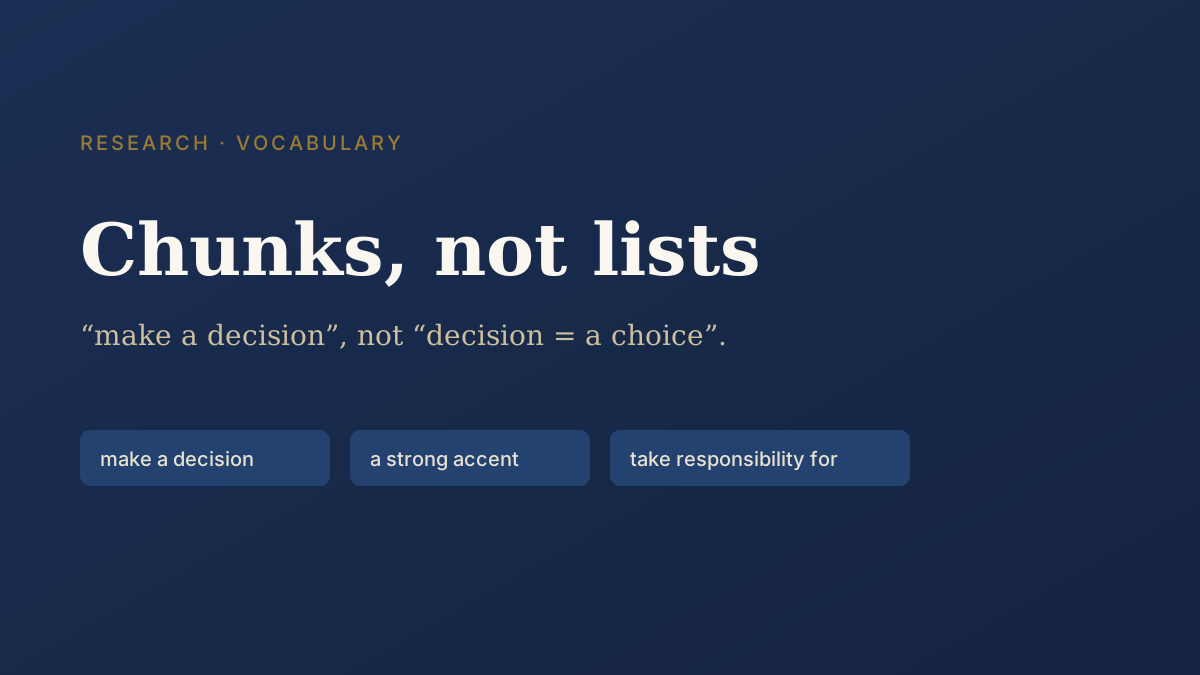
Here is a sentence I hear often from intermediate learners: “I know so many words, but when I speak, it still sounds wrong.” They are right, and it is not a confidence problem. It is a storage problem. They have learned English as a list of single words, and single words are not how the language actually works.
Fluent speakers don’t build sentences one word at a time. They assemble them from chunks — ready-made combinations that the language prefers. Learn vocabulary in those chunks and two things happen at once: you sound natural, and you remember more, because each word arrives with a context to hang onto.
- English is full of collocations — words that conventionally go together (“make a decision”, not “do a decision”).
- Learning words inside chunks builds natural-sounding fluency and stronger memory.
- Record every new word with a collocation and an example sentence — never alone.
Why word lists fail
A bilingual list — decision = decisión — teaches you the meaning and nothing else. It doesn’t tell you that we make decisions (not “do” them), that a decision can be tough or last-minute, or that you come to a decision. So you learn the word, then guess the combination — and the guess is often wrong in a way grammar rules won’t catch.
That is why a learner can score well on a vocabulary test and still sound unnatural in conversation. They memorised the bricks but never the way the bricks are usually laid.
You don’t really “know” a word until you know the words it likes to stand next to.
What a chunk is
A chunk is any group of words that frequently travels together and is stored — and best learned — as a single unit:
- Collocations: heavy rain, strong accent, make progress, take responsibility.
- Fixed expressions: to be honest, on the other hand, as far as I know.
- Sentence frames: I’d rather … than …, the more … the more ….
Notice that these carry grammar inside them. Learn “I’d rather not” as a chunk and you get the structure for free, without parsing a rule.
What the research says
- The Lexical Approach. Michael Lewis (1993) argued that language is “grammaticalised lexis, not lexicalised grammar” — that fluent language is built largely from prefabricated chunks rather than assembled word by word from rules.
- Formulaic language is everywhere. Research on formulaic sequences (e.g. Alison Wray’s work) estimates that a very large share of natural speech is made of such ready-made combinations — which is why chunk-based learners sound idiomatic sooner.
- Vocabulary depth matters. Paul Nation’s research on vocabulary learning stresses knowing a word’s collocations and use, not just its meaning, as part of truly “knowing” it.
These are established findings in applied linguistics; our curriculum is built around them.
For checking which words go together, a good collocations dictionary is invaluable — the Cambridge Dictionary and the British Council both flag common combinations.
How to learn chunks
1. Never record a word alone. Instead of “accent”, write “she has a strong French accent.” You now have the word, a collocation (strong accent), and a model sentence.
2. Read and steal. When you read, don’t hunt for unknown words — hunt for combinations you wouldn’t have produced yourself. Those are your highest-value chunks. Collect them.
3. Re-use, don’t re-read. A chunk only becomes yours when you put it into your own sentence and get it checked. Recognising it on a flashcard is not the same as being able to use it.
4. Group by topic, not alphabet. Learn the chunks around “giving opinions” or “describing trends” together. They’ll reinforce each other and arrive ready for a real situation.
Try it this week
Pick one topic you talk about often — your job, your studies, your city. Find six chunks a fluent speaker would use to discuss it (a collocations dictionary helps), and write one true sentence with each. Six well-chosen chunks you can actually deploy will do more for how you sound than sixty words on a list.
This is exactly how our courses introduce vocabulary — in context, in chunks, with your sentences corrected so the right combination is the one that sticks.
Frequently asked questions
What is a collocation in English?
A collocation is a pair or group of words that naturally go together — 'make a decision', 'heavy rain', 'strong accent'. Native speakers expect these combinations; using a different but 'correct' word ('do a decision') sounds wrong even when the grammar is fine.
Should I stop using vocabulary lists completely?
Lists aren't useless for a first encounter, but don't stop there. Record each new word inside a chunk and an example sentence, so you learn how it behaves, not just what it means.
How many new chunks should I learn at once?
Quality beats quantity: five to eight chunks you actually re-use in your own sentences will stick far better than a list of forty words you only recognise.