
UK Student Visa Applications Fall 31% in October 2026: Reasons and What English Learners Should Know
Home Office data published on 12 November 2026 shows a sharp fall in UK study visa applications. This guide explains the figures, the policy reasons, the planned two-year Graduate visa for some universities, and what English learners should check before applying.

- The figures: what fell and by how much
- Why are applications falling?
- The Graduate Route: back to two years for some universities
- What has not changed: the English requirement
- If you want to study English in the UK
- What English learners planning to study in the UK should do
- What this article cannot tell you
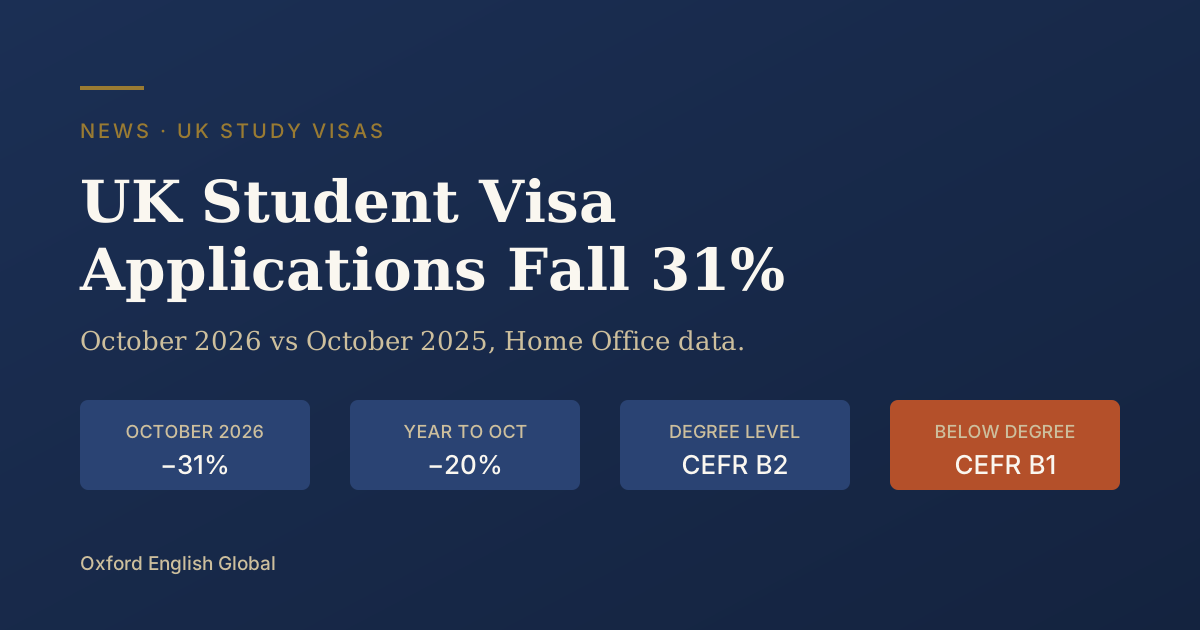
UK student visa applications fell by 31% in October 2026 compared with October 2025, according to The PIE News's reading of Home Office data published on 12 November 2026. Over the full year to October 2026, applications from sponsored study visa main applicants fell 20% to 349,900, and applications from student dependants fell 32% to 15,400. The Russell Group of universities said the drop is "in part the result of successive government policies over a number of years". For English learners, the key point is that the Student visa rules themselves, including the English requirement of CEFR B2 for degree-level study and B1 below degree level, have not changed. This guide explains the figures, the likely reasons, recent policy news such as the planned return of a two-year Graduate visa for some universities, and what to do if you still plan to study in the UK.
Checked on 13 November 2026 against the Home Office release Monthly entry clearance visa applications, October 2026 (published 12 November 2026), The PIE News (12 November 2026) and the GOV.UK Student visa: knowledge of English page. Home Office figures are provisional. Oxford English Global is an English school, not an immigration adviser.
The figures: what fell and by how much
The Home Office publishes a monthly count of visa applications made from outside the UK ("entry clearance"). The October 2026 release covers applications up to 31 October 2026. Here are the study figures:
| Measure | Figure | Change | Source |
|---|---|---|---|
| Sponsored study applications, October 2026 vs October 2025 (month) | Not stated in the summary | Down 31% | The PIE News, from Home Office monthly data |
| Sponsored study main applicants, year ending October 2026 | 349,900 | Down 20% on the year ending October 2025 | Home Office |
| Student dependants, year ending October 2026 | 15,400 | Down 32% on the previous year | Home Office |
| Student dependants compared with year ending December 2023 | 15,400 | 89% lower | Home Office |
Sources: Home Office, Monthly entry clearance visa applications, October 2026 (provisional; next update due 10 December 2026); The PIE News, 12 November 2026.
Two points help you read these numbers. First, a "year ending" figure covers 12 months, so the 20% annual fall is a more stable measure than a single month. Second, student applications are seasonal: the Home Office notes they peak in August, before the academic year starts, with a smaller peak in December. October is a quieter month, so a large percentage change can come from a smaller number of applications. Both measures still point in the same direction: fewer people are applying to study in the UK.
Why are applications falling?
Neither the Home Office nor The PIE gives a single cause. The Home Office says policy changes are "one of a range of factors that can impact visa application trends". The policies most often linked to the fall are:
| Policy | Date | What it does |
|---|---|---|
| Dependants restriction | From 1 January 2024 | Most students can no longer bring partners or children. Only postgraduate research students and some government-funded students are exempt. |
| "Visa brake" | From 26 March 2026 | Restrictions on some entry clearance applications based on the main applicant's nationality. The Home Office says these nationalities are a small share of study applications. |
| Graduate Route uncertainty | Cut to 18 months planned from January 2027; partial reversal announced 28 October 2026 | See the next section. |
| International student levy | Planned from August 2028 | Universities will pay a levy of £925 per international student, which may affect fees and recruitment. |
Sources: Home Office October 2026 release ("Policy changes" section); The PIE News, 12 November 2026 and 28 October 2026. The dependants exemption is summarised from GOV.UK guidance; check the Student visa family members page for your case.
Zaid Kadhum, policy manager at the Russell Group, told The PIE that "the volatility we've seen in the international student market shows no sign of slowing" and that "changes in application numbers haven't happened overnight". Other factors are outside UK policy: competition from other destinations, the cost of living and study, and exchange rates. Other English-speaking countries have also tightened rules, as we covered for Australia and New Zealand.
The Graduate Route: back to two years for some universities
The Graduate visa lets international students stay and work in the UK after finishing a degree. The government had planned to cut it from two years to 18 months for most graduates from January 2027 (see our guide to the 18-month Graduate visa).
In the Budget on 28 October 2026, the government announced plans to restore a two-year Graduate Route for graduates of "high-compliance" universities with strong labour market outcomes. According to The PIE, the detailed eligibility criteria have not been finalised, and the Home Office and Department for Education will design the policy together. The Russell Group called this "a really positive first step".
What this means for you: if post-study work matters to you, ask each university directly whether it expects to qualify as "high-compliance" once the criteria are published, and check GOV.UK for the final rules before you choose a course. Until the rules are published, nobody can say for certain which universities will qualify.
What has not changed: the English requirement
None of the October news changes the English language rules for the Student visa. According to GOV.UK, you must usually prove your knowledge of English when you apply, unless you are from a listed majority English-speaking country or have a qualifying degree.
| What you are studying | Minimum English level | How you can prove it |
|---|---|---|
| Degree level or above | Equivalent to CEFR B2 | A Secure English Language Test (SELT), a qualifying UK qualification or degree, or your university's own assessment (Higher Education Providers can assess you themselves) |
| Below degree level | CEFR B1 | Usually a SELT from an approved provider |
Source: GOV.UK, Student visa: knowledge of English, read 13 November 2026.
Remember that the visa minimum is not the same as the university's entry requirement. Many universities ask for a higher score, often in each skill. For example, a course may require IELTS 6.5 overall with no skill below 6.0. Check the course page. Our guides to UK SELT approved English tests and the Home Office's remote English test (HOELT) explain which tests count.
If you plan to work in the UK after graduating, note that since 8 January 2026 the English requirement for some work routes, including the Skilled Worker visa, has been CEFR B2. See UK visa B2 English requirement.
If you want to study English in the UK
Short English courses are a different case. If your course is up to six months long, you may not need a Student visa at all. Depending on your nationality, you may be able to study as a visitor, and many nationalities now need an Electronic Travel Authorisation (ETA) to visit. Our guide to the UK ETA for English course students explains the rules. For longer English courses, use the GOV.UK Check if you need a UK visa tool to find the right route before you book, for example the Short-term study visa for English language courses of up to 11 months.
What English learners planning to study in the UK should do
- Do not panic about the numbers. Fewer applications do not mean it is harder to get a visa if you meet the rules. The visa requirements are the same as they were before the figures were published.
- Check the official rules, not social media. Use GOV.UK for visa rules and the university's own page for entry requirements.
- Get the right test. If you need a SELT, book an approved test. If your university assesses English itself, ask exactly what it accepts.
- Aim above the minimum. B2 is the visa minimum for degree study, but studying a degree in English is easier at a strong B2 or C1. Use our IELTS score calculator to set a target band.
- Plan your budget. The Student visa application fee from outside the UK was £558 when we checked on 13 November 2026, plus the Immigration Health Surcharge, tuition and living costs.
- Build your English now. Our exam preparation and General English courses and free lessons cover B1 to C1.
What this article cannot tell you
- The exact October monthly number. We report the 31% monthly fall as published by The PIE from Home Office data; the Home Office summary gives annual totals.
- Final figures. Monthly statistics are provisional and can be revised in the quarterly Immigration system statistics.
- Which universities will be "high-compliance". The criteria for the two-year Graduate Route have not been published.
- Why each individual student chose not to apply. Application data shows how many applied, not why others did not.
- Your individual case. For advice on your application, contact your university's international office or a regulated immigration adviser.
This page is independent guidance from Oxford English Global. It contains no affiliate or sponsored links.
Frequently asked questions
How much did UK student visa applications fall?
The PIE News reported a 31% fall in October 2026 compared with October 2025. Home Office data shows main applicant study applications fell 20% to 349,900 in the year ending October 2026.
Why are UK student visa applications falling?
The Russell Group says the drop is partly the result of successive government policies. Policies often linked to it include the 2024 dependants restriction, uncertainty over the Graduate Route and a planned £925 international student levy.
Has the English requirement for a UK Student visa changed?
No. You need CEFR B2 for degree-level study and above, and B1 below degree level, according to GOV.UK.
Is the UK Graduate visa going back to two years?
In the Budget on 28 October 2026, the government announced plans to restore a two-year Graduate Route for graduates of high-compliance universities with strong labour market outcomes. The criteria have not been published yet.