
UK ETA for English Course Students: The £20 Fee, Who Needs One and How to Apply
The UK electronic travel authorisation now costs £20. For many visitors it is all you need for an English course of up to six months. Here is who needs an ETA, how to apply, what you can study on one, and when you need a study visa instead.

- The ETA price: £16 to £20 from 8 April 2026
- Who needs an ETA, and who needs a visa instead
- Can you study English on an ETA? The six-month rule
- How to apply for an ETA, step by step
- A planning checklist for a short English course in the UK
- If the trip is not possible: studying from home
- What this article cannot tell you
A UK electronic travel authorisation (ETA) costs £20, up from £16 on 8 April 2026, and for many visitors from Europe, the USA, Canada, Australia and some other countries it is the only document you need to come to the UK for a short English course of up to six months. An ETA is not a visa. It is a digital permission to travel, linked to your passport, that lasts for two years or until your passport expires, whichever comes first. With it you can study at an accredited institution as a Standard Visitor, as long as the course itself is no longer than six months. Longer English courses need a Short-term study visa or a Student visa, and some nationalities need a visa even for short visits. This guide explains who needs an ETA, how to apply, and what the rules mean if you are planning a short English course in the UK.
Checked on 9 November 2026. The facts on this page come from official UK government sources: the GOV.UK guide Get an electronic travel authorisation (ETA) to visit the UK (including its pages on how to apply, what you can and cannot do and when you do not need an ETA), the Home Office table Home Office immigration and nationality fees, 8 April 2026, the GOV.UK Standard Visitor page Visit to study, and the Short-term study visa guide. Immigration rules and fees change. Check GOV.UK before you book a course or travel. Oxford English Global is an English school, not an immigration adviser, and this page is not immigration advice.
The ETA price: £16 to £20 from 8 April 2026
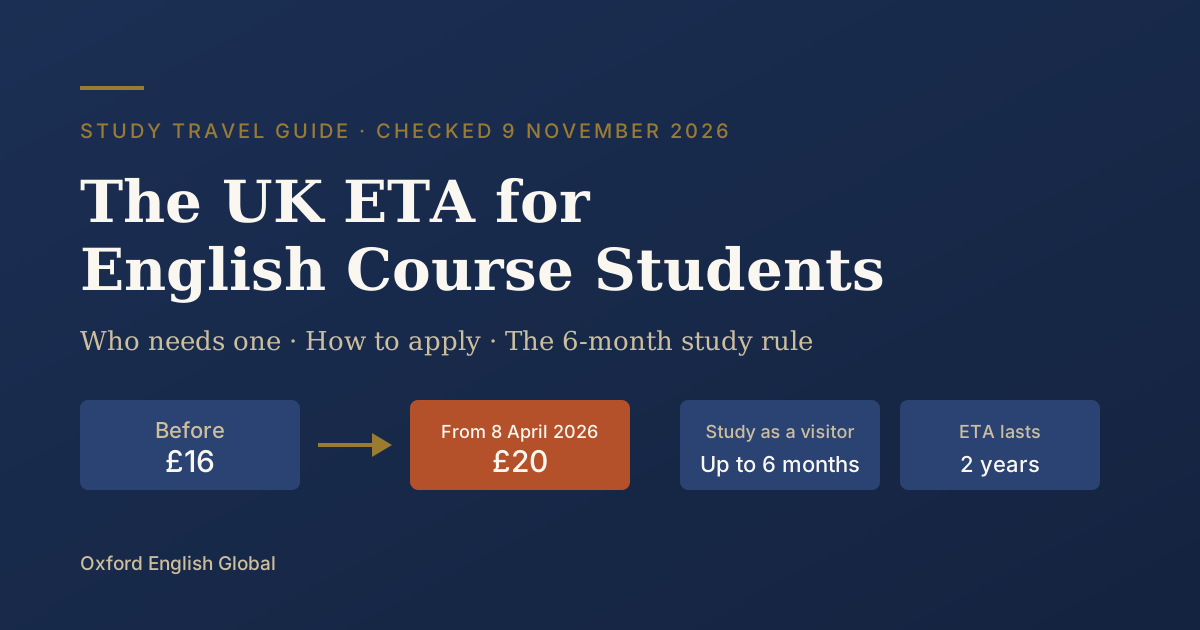
The Home Office raised the ETA fee by £4 as part of its fee changes on 8 April 2026. The official fee table lists the ETA under "Visas and applications made outside the UK" with a previous fee of £16 and a fee of £20 from 8 April 2026. The GOV.UK ETA guide now says simply: "An ETA costs £20."
| What | Before 8 April 2026 | From 8 April 2026 |
|---|---|---|
| ETA application fee | £16 | £20 |
| How long the ETA lasts | 2 years, or until your passport expires if sooner | No change |
| Maximum length of each visit | Up to 6 months | No change |
| Number of trips | As many as you want while the ETA is valid | No change |
Source: Home Office immigration and nationality fees, 8 April 2026, and GOV.UK ETA guide, both read 9 November 2026.
For a student, the practical effect is small. £20 is a one-off payment that covers every trip for up to two years. If you come for a two-week course in spring and a four-week course the following summer, one ETA can cover both trips, as long as your passport is still valid. The bigger costs of a study trip are the course, accommodation and flights, so the fee change should not change most plans.
Two warnings from GOV.UK are worth more than the £4 difference. First, "Other websites may charge more to apply. Avoid websites that imitate government services." The official routes are the GOV.UK website and the UK ETA app; a third-party site cannot get you a faster decision. Second, you cannot get a refund after you apply, even if your application is rejected or you made a mistake. Check your passport details carefully before you pay.
Who needs an ETA, and who needs a visa instead
Whether you need an ETA, a visa or nothing at all depends on your nationality and on why you are coming. GOV.UK says you usually need an ETA rather than a visa "if you're from Europe, the USA, Australia, Canada or certain other countries". Nationals of other countries usually need to apply for a Standard Visitor visa before they travel, and that costs £135 for a visit of up to six months.
The only reliable way to know which group you are in is the official Check if you need a UK visa tool. It asks for your nationality and the purpose of your trip; choose "Study" and a course of six months or less.
You do not need an ETA if
- you are a British or Irish citizen (including dual citizens; GOV.UK says dual British or Irish citizens cannot get an ETA and should travel as British or Irish citizens)
- you already have a UK visa
- you have permission to live, work or study in the UK, including settled or pre-settled status
- you live in Ireland and are travelling from Ireland, Guernsey, Jersey or the Isle of Man (you must bring proof of Irish residence if you are 16 or older)
- you are transiting "airside" at a UK airport without passing through border control
The full list, which includes some passport types and special cases, is on the GOV.UK page When you do not need an ETA.
Families and groups
Every traveller needs their own ETA, "including babies and children". One person can apply for others: on the app if the other person is with you, or online if they are not. If you are organising a group of colleagues for an English course, plan time for each person's application.
Can you study English on an ETA? The six-month rule
Yes, within limits. GOV.UK lists "short-term study" among the things you can do with an ETA, and the Standard Visitor rules explain what that means. As a visitor you can come to the UK for up to six months to "study at an accredited institution (this includes English language courses and Erasmus+ placements)".
For an English course, you must be able to prove two things:
- You have been accepted onto a course with an accredited UK institution. GOV.UK defines this as a provider that holds a student sponsor licence or has valid accreditation from a recognised body, such as Accreditation UK (run by the British Council), the British Accreditation Council or the Independent Schools Inspectorate. The full list is on the GOV.UK accredited institutions page. An academy or state-funded school does not count, except for Erasmus+ placements.
- The course is no more than six months long (distance learning courses with short visits to the UK are the exception).
You must also meet the general Standard Visitor requirements. GOV.UK says you must be able to show that you will leave the UK at the end of your visit, that you can support yourself during the trip, that you can pay for your return journey, and that you will not live in the UK through frequent or successive visits. An ETA does not guarantee entry, and you may be asked questions at the border about your plans. It is sensible to carry your course acceptance letter, proof of where you are staying and evidence of your return ticket.
What about very short or recreational courses?
The Standard Visitor rules also allow "a recreational course of up to 30 days, for example a dance course". For an English course, the safer reading is the study rule above: choose an accredited provider and keep the course within six months. If you are unsure whether a particular course qualifies, ask the school whether it is accredited and check with UKVI.
Which permission matches which course length
| Length of your English course | What you need | Official fee (checked 9 November 2026) |
|---|---|---|
| Up to 6 months, at an accredited institution | Visit as a Standard Visitor: ETA if your nationality needs one, or a Standard Visitor visa if your nationality needs a visa | ETA £20, or Standard Visitor visa £135 |
| More than 6 months and up to 11 months (English language only) | Short-term study visa | £228, plus the healthcare surcharge, which GOV.UK says "usually costs £776" |
| More than 11 months | Student visa with a licensed student sponsor | See GOV.UK |
Source: GOV.UK Standard Visitor, Short-term study visa and ETA pages, read 9 November 2026.
On a Short-term study visa you can stay for the length of your course plus 30 days, up to 11 months in total. You cannot work, change course or extend that visa.
What you cannot do on an ETA
- Stay longer than six months on any one visit.
- Do paid or unpaid work for a UK company, including work experience, unless it is a permitted paid engagement.
- Claim benefits (public funds).
- Live in the UK through frequent or successive visits.
- Marry or register a civil partnership (that needs a Marriage Visitor visa).
The work rule matters for English learners. Some course advertisements mention "work placements" or "internships". On an ETA or as a Standard Visitor, you should treat any placement offer with caution and check the rules before you accept it.
How to apply for an ETA, step by step
You can apply on the official UK ETA app (Google Play or the App Store) or online through GOV.UK. The Home Office says the app is the easiest route and that most app applicants get an automatic decision in minutes.
- Check you need an ETA. Use the GOV.UK visa checker with your nationality and "Study".
- Prepare what you need: the passport you will travel with, an email address, and a credit card, debit card, Apple Pay or Google Pay.
- Take or upload the photos. On the app you scan your passport and your face with your phone's camera. Online, you upload a photo of your passport and a photo of your face that follows the GOV.UK rules for digital photos. A photo that does not meet the rules can delay or stop the application.
- Answer the questions. You give contact and passport details and answer questions on suitability and criminality.
- Pay the £20 fee. There is no refund after you apply.
- Wait for the email. GOV.UK says you will "usually get a decision by email within a day, but it can take up to 3 working days". The email contains your 16-digit ETA reference number.
- Travel with the same passport. The ETA is linked digitally to the passport you applied with. You do not need to print anything; you show that passport when you travel.
Timing tip for course students. The Home Office recommends applying at least three working days before you travel, and you must not travel until you have the email confirming your ETA. Applying as soon as your course place and passport are confirmed means the ETA is not a last-minute worry. You can check whether you hold an ETA, and when it expires, with the GOV.UK Check your ETA service.
If the application is rejected, you are told why and you can apply again (paying again). If it is refused, there is no appeal; you would need to apply for a visa instead. GOV.UK also suggests that people with a criminal record or a previous refusal of entry may want to apply for a Standard Visitor visa from the start rather than an ETA.
A planning checklist for a short English course in the UK
Put the immigration steps in order with the learning steps so that nothing is left to the last week.
| When | Immigration step | Learning step |
|---|---|---|
| 3 or more months before | Use the GOV.UK visa checker. If you need a visa rather than an ETA, the earliest you can apply for a Standard Visitor visa is 3 months before you travel. | Find your current level with an English level test and decide what you want from the course: general fluency, an exam, or Business English. |
| 2 to 3 months before | Choose a provider and confirm it is accredited. Keep the course at six months or less if you will travel as a visitor. | Read our guide on how to choose the right English language course and ask the school how it places students by CEFR level. |
| 4 to 8 weeks before | Apply for the ETA once your passport and course dates are confirmed. Save the confirmation email. | Start daily listening and speaking practice so the first week of the course is not a shock. Our free lessons are a simple starting point. |
| The week before | Print or save your acceptance letter, accommodation details and return ticket in case you are asked at the border. | Practise the questions a border officer might ask (why you are visiting, where you will study, when you will leave). Short, clear answers are best. |
Answering border questions in clear English
You may be asked a few simple questions when you arrive. This is not a language test, but clear answers help. Useful patterns:
- "I'm here to take a four-week General English course at [school name] in [city]."
- "The course starts on Monday the 6th and finishes on the 31st."
- "I'm staying with a host family arranged by the school. Here is the address."
- "I fly home on the 2nd. Here is my return booking."
If you want to rehearse this kind of exchange, our article on how to improve your English speaking has practical drills, and the Speaking Lab lets you practise out loud.
If the trip is not possible: studying from home
Travel is not the only way to make progress. If your visa situation, budget or calendar does not allow a UK trip, a structured online course with live speaking practice can cover much of the same language work, and you can combine both: study online first, then use a short UK course to put it into practice. Our English courses are designed for adult learners, and our study abroad page has more on learning English overseas.
What this article cannot tell you
- Your individual case. We summarise the published GOV.UK rules for short English courses. Whether you personally need an ETA or a visa depends on your nationality and history. Use the GOV.UK checker and, if your case is complex, speak to a regulated immigration adviser.
- Future changes. The ETA fee went up in April 2026 and the Home Office says all fees are kept under review. Everything here was checked on 9 November 2026.
- Whether a particular school is accredited. Check the provider against the accreditation bodies listed on GOV.UK. We do not verify individual schools here.
- Border decisions. An ETA lets you travel; it does not guarantee entry. Border officers make the final decision on arrival.
- Course prices. Fees for English courses vary widely by provider, city and season, so we have not listed them.
This page is independent guidance from Oxford English Global. It contains no affiliate links, it is not immigration advice, and we receive nothing from any government body, school or travel service mentioned.
Frequently asked questions
How much does a UK ETA cost in 2026?
A UK electronic travel authorisation costs £20. The Home Office raised the fee from £16 to £20 on 8 April 2026, according to its official fee table, checked on 9 November 2026. You pay once, there is no refund after you apply, and the ETA covers any number of trips for two years or until your passport expires, whichever is sooner.
Can I study an English course in the UK with an ETA?
Yes, if the course is no longer than six months and is with an accredited UK institution. GOV.UK lists short-term study among the activities allowed with an ETA, under the Standard Visitor rules. You must still show that you will leave at the end of your visit and can support yourself. Courses longer than six months need a Short-term study visa or a Student visa.
What visa do I need for an English course longer than six months?
For an English language course of more than six months and up to 11 months, GOV.UK says you need a Short-term study visa, which costs £228 plus the healthcare surcharge (usually £776), checked on 9 November 2026. For courses longer than 11 months you need a Student visa with a licensed student sponsor.
How long does it take to get a UK ETA?
GOV.UK says you will usually get a decision by email within a day, but it can take up to 3 working days. The Home Office recommends applying at least three working days before you travel, and you must not travel until you have received the email confirming your ETA.
Who does not need a UK ETA?
British and Irish citizens, people who already hold a UK visa, and people with permission to live, work or study in the UK do not need an ETA. Some other groups are also exempt, such as certain residents of Ireland travelling within the Common Travel Area. Nationals of countries that need a visa must apply for a visa instead of an ETA.