
UK Plan for Fully Remote English Tests for Visas: What Is Proposed and Why Critics Fear Fraud
The Home Office wants visa applicants to take one Home Office-owned English test at home instead of at a test centre. This guide explains the HOELT tender, the cheating concerns from test providers and Conservative MPs, and what test takers should do while the plan is debated.

- What the Home Office is proposing
- Timeline: how the plan has developed
- Why the Home Office wants a remote test
- The fraud concerns: what critics say
- The debate in Parliament
- How other countries handle remote English tests
- What it means for test takers now
- How to prepare, whatever the format
- What this article cannot tell you
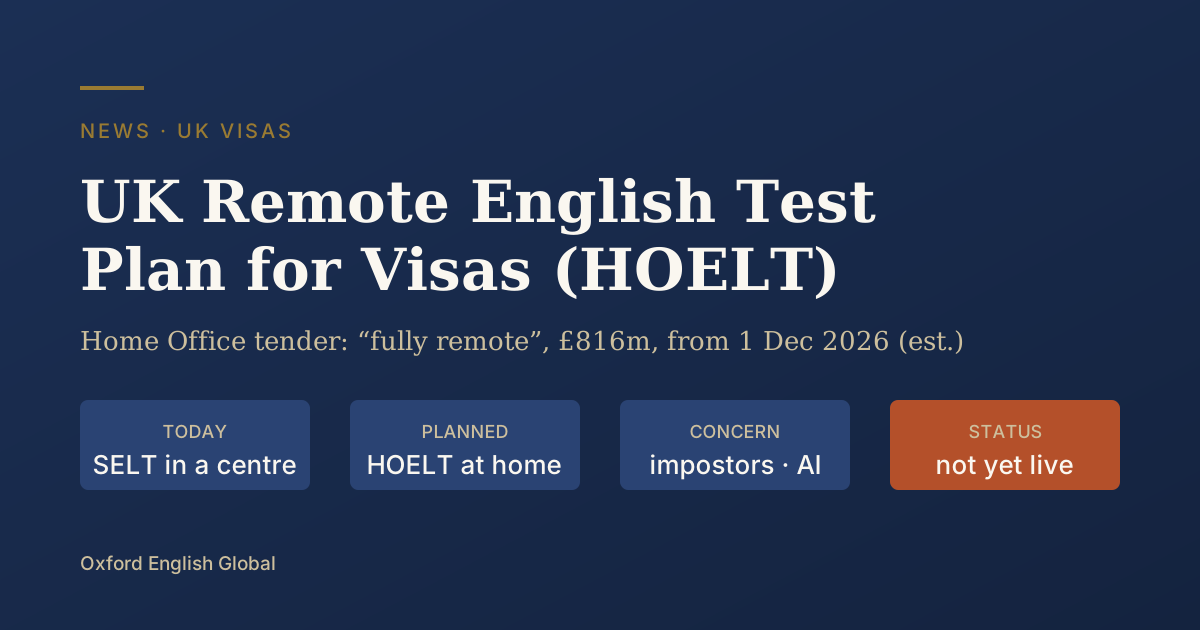
The UK Home Office plans to replace today's centre-based Secure English Language Tests (SELTs) with a single Home Office English Language Test (HOELT) that is delivered "fully remote": visa applicants would sit it at a location they choose, such as their home, provided "secure test conditions" are met. The contract is worth an estimated £816 million including VAT and is due to start on 1 December 2026, but no supplier had been announced on 12 November 2026 and nothing has changed for applicants yet. Critics, including the IELTS partners, who refused to bid, and Conservative MPs, who want Parliament to block the plan, say remote testing will make cheating with impostors, hidden earpieces and AI much easier. The Home Office says the new test will have strong identity checks and AI-assisted monitoring. This guide explains what is proposed, the arguments on both sides and what it means if you need an English test for a UK visa.
Checked on 12 November 2026 against the Home Office tender notice Home Office English Language Testing (HOELT) Services (Find a Tender, published 28 November 2025, last edited 7 January 2026), the written parliamentary answer of 16 April 2026, the UKVI SELT guidance, and reporting by the BBC (17 March 2026) and The Telegraph (6 November 2026). This is a live procurement and a live political debate, so details may change. Oxford English Global is an English school, not an immigration adviser.
What the Home Office is proposing
Today, if a UK visa route asks you to prove your English with a test, you book a SELT with one of five approved providers and sit it at an approved test centre (see our guide to approved SELT tests). Under the HOELT plan, the Home Office would own one English test and pay a single supplier to build and run it. The tender notice describes the vision as "a best-in-class language testing service, underpinned by automation and efficiency" and says HOELT "will move to a digital-by-default approach".
The key sentence in the tender is clear about where the test would happen: "HOELTs shall be delivered securely in any location where the Customer chooses to take the test, provided secure test conditions are met." The notice adds that "the Authority requires that all ELTs are delivered remotely", with exceptions only where local legal or technical constraints prevent remote testing in a country. "Customer" here means the visa applicant.
| Feature | What the tender notice says |
|---|---|
| Delivery | Fully remote, at a location the applicant chooses, if secure test conditions are met; exceptions possible where a country's legal or technical constraints prevent it |
| Test formats | 2-facet (speaking and listening) and 4-facet (speaking, listening, reading and writing), both from A1 to C2 |
| Scores | "All HOELT scores shall map clearly to CEFR levels A1 to C2" |
| Fees | Regulated, "as determined by the Authority" (no fee published) |
| Estimated value | £680 million excluding VAT; £816 million including VAT |
| Contract dates (estimated) | 1 December 2026 to 30 November 2031, with possible extension to 30 November 2034 |
| Award decision (estimated) | 16 November 2026 |
| How bids are judged | 60% quality and 40% price; quality questions include identity verification (4%), integrity (4%), security (4%) and AI (1%) |
Source: Home Office tender notice 2026/S 000-001247 on Find a Tender, read 12 November 2026. The tender timeline also lists "Implementation period begins: December 2026", which is the start of building the service, not the date the test opens to applicants.
Two points are often misunderstood. First, the 2-facet and 4-facet formats match the two kinds of SELT used today: four-skill tests for work and study routes, and speaking-and-listening tests for family, settlement and citizenship routes. Second, the move to remote testing would not change the level you need. Levels are set by the immigration rules for each route, such as the B2 requirement for most new Skilled Worker applicants explained in our guide to the UK visa B2 English requirement.
Timeline: how the plan has developed
| Date | Event | Source |
|---|---|---|
| 2024 to 2025 | Five rounds of market engagement (requests for information) | Tender notice |
| 28 November 2025 | Home Office publishes the HOELT tender for a "fully remote language testing service" | Find a Tender |
| 8 January 2026 | Most new Skilled Worker applicants need B2 English (separate change, but it raises the stakes of testing) | UKVI guidance |
| March 2026 | The IELTS partners write to the Home Secretary and decline to bid | BBC, 17 March 2026 |
| 16 April 2026 | Home Office minister answers a written question on cheating risks | UK Parliament |
| 6 November 2026 | Conservatives table an amendment to block fully remote tests without a new law | The Telegraph |
| 16 November 2026 (estimated) | Award decision | Tender notice |
| 1 December 2026 (estimated) | Contract start and implementation period | Tender notice |
There is no official date for when applicants will be able to book a HOELT. The tender sets out a contract start, not a launch date, and the Home Office has not published a fee, format or booking process.
Why the Home Office wants a remote test
The tender describes the goal as a test that is "secure, accessible and fair" and lets applicants "demonstrate their English language skills with confidence and convenience throughout their UK immigration journey". In practical terms, the arguments for a remote, Home Office-owned test are:
- Access. Applicants would no longer need to travel to a test centre, which can mean a long journey or a wait for a date in some countries. UKVI's current guidance warns that you may not get a test at the nearest location.
- One test, one standard. Instead of five providers with different test names and score scales, there would be one test with scores mapped directly to CEFR levels.
- Control over fees. The tender says HOELT fees will be regulated by the Home Office.
- Flexibility in demand. The notice stresses that future test volumes are uncertain because of immigration policy changes, and asks for a service that can scale up or down.
On security, the Home Office has said it knows the risks. In a written answer on 16 April 2026, Home Office minister Mike Tapp said: "The Department is aware of the risks associated with remote testing and is working to ensure that robust safeguards are built into the specification. These include requirements for strong identity verification, AI-assisted monitoring, and other technical controls designed to detect and deter cheating." He added that the department "continues to engage with experts and regulators, including Ofqual".
The fraud concerns: what critics say
The strongest objections come from the testing industry itself. In March 2026 the IELTS partners (the British Council, Cambridge University Press & Assessment and IDP Education) wrote to Home Secretary Shabana Mahmood. According to the BBC, which saw the letter, they said the plan was "incompatible" with the goal of improving the security, quality and integrity of the tests and would open up "new and significant security vulnerabilities for the country". They declined to bid, writing: "We know that remote exams face cheating on an order of magnitude greater than in-person assessments." The BBC reported that IELTS currently oversees about two-thirds of the in-person tests, delivered through more than 1,300 test centres.
The cheating methods critics describe are the same in most reports:
| Risk | What it means | Typical safeguard |
|---|---|---|
| Impersonation | Someone else sits the test, or swaps in after the identity check | Live ID checks, face matching during the test, voice checks |
| Hidden help | An accomplice gives answers through an earpiece, a second device or screen sharing | Room scans, lockdown browser, second camera, live proctors |
| AI assistance | A chatbot writes or suggests answers in real time | Software monitoring, analysis of response patterns, post-test review |
| Deepfakes | Fake video or audio used to pass remote identity checks | Liveness detection and human review |
| Item harvesting | Questions recorded and shared or sold | Large question banks, adaptive tests, screen monitoring |
Risks summarised from the BBC report of the IELTS partners' letter (17 March 2026) and the Cambridge University Press & Assessment paper on remote testing (2026). Safeguards are examples used in the industry, not a description of HOELT, whose security design has not been published.
Note that the IELTS partners are not neutral observers: they run one of the current approved tests and chose not to bid for the new contract. Their warnings are still worth taking seriously because they come from organisations that run both in-centre and online English tests, but readers should weigh them with that interest in mind. We look at Cambridge's wider argument in our article on at-home versus test-centre English tests.
The debate in Parliament
The plan has become a political issue. In April 2026, Conservative MP Blake Stephenson asked the Home Office in a written question how it would "identify and mitigate potential attempts at cheating" when the test is "taken outside secure test centres and without in-person supervision". The answer, quoted above, listed identity verification, AI-assisted monitoring and other technical controls.
On 6 November 2026, The Telegraph reported that the Conservatives had tabled an amendment to the Government's immigration and asylum bill that would prevent the introduction of fully remote English language tests unless Parliament passes a law allowing it. The report quoted:
- Chris Philp, the shadow home secretary: "Letting immigrants sit their English test online is a fraudsters' charter, and cheating will be rife."
- Blake Stephenson, the shadow Home Office minister, who said the Government had "ignored warnings from the very firms that run these tests".
- Lord Smith, a former culture secretary, who warned that candidates could "prop a mobile phone up against the screen" or share a screen or earpiece with someone answering for them.
The same report said the Home Office had canvassed the market "to understand what capabilities were available to meet the highest standards of security", and named the Duolingo English Test, which is taken online with webcam monitoring, among reported frontrunners for the contract. The Home Office has not confirmed any bidder, and we could not verify the shortlist.
An amendment being tabled does not mean it will pass. Whether HOELT goes ahead as a fully remote test now depends on the procurement outcome and on Parliament.
How other countries handle remote English tests
The UK plan runs against a trend elsewhere. The BBC reported in March 2026 that the Australian government had banned remote or at-home tests for assessing migrants' English in August 2025. Many universities around the world do accept at-home tests for admission, but immigration authorities have generally been more cautious, because a visa decision is harder to reverse than a university offer.
For learners, the practical point is simple: an at-home test that one university or country accepts may not be accepted by another body, and the rules can change. Always check the exact test name on the official list for the decision you need.
What it means for test takers now
- Nothing changes today. On 12 November 2026, UKVI's SELT guidance still listed the current approved providers. If you apply for a visa now, you need a current SELT taken at an approved centre, or another accepted way of proving your English.
- Do not wait for HOELT. There is no launch date, fee or booking system. If your visa timeline is in the next year, plan around today's tests.
- Your result stays valid. A SELT result is valid for two years from the date it is awarded. Nothing announced so far says that existing results will stop counting when a new test arrives, but watch the GOV.UK guidance for transition rules.
- Prepare for stricter test conditions either way. If HOELT launches as a home test, expect rules about your room, camera, microphone, internet connection and ID. If it does not, centre-based tests will continue with their own security checks.
- Use only official channels. A debate about cheating is a gift to scammers who sell "guaranteed" results or fake bookings. UKVI checks results directly with providers, so a fake certificate will not work and using one can lead to your application being refused.
How to prepare, whatever the format
The English you need is the same at home or in a centre. What changes is the test experience. A good plan works for both:
- Know your target level. Check your route's CEFR level, then take a timed practice test and record each skill separately. You need the minimum in every skill.
- Train speaking to a screen and to a person. Remote speaking tests often use recorded prompts or a video call. Practise answering out loud with a timer, and record yourself. Our free Speaking Lab helps with pronunciation and intonation.
- Practise listening without pausing. Real tests play audio once. See our guide on how to improve English listening.
- Type and write. Computer-based tests need fast, accurate typing; paper and in-person tests need clear handwriting. Practise the mode you will use.
- Do a technical rehearsal if you take any online test: quiet room, clear desk, wired or stable internet, charged laptop, working camera and microphone, and ID ready.
Our exam preparation courses and free lessons cover B1 to C1, and the IELTS score calculator helps you track practice scores if you are preparing for IELTS for UKVI.
What this article cannot tell you
- Who will win the contract. The award decision was estimated for 16 November 2026, after this article was checked. Reported frontrunners are not confirmed.
- When HOELT will open, what it will cost or what the test will look like. None of this has been published. The tender shows a contract start date, not a launch date.
- The full Telegraph report. We could not access the full article; quotes from it come from the publicly available excerpt. We have not reviewed the text of the amendment itself.
- How much cheating happens in practice. We found no independent, published data comparing cheating rates in remote and in-centre visa tests. The "order of magnitude" figure is a claim made by the IELTS partners.
- Your individual case. For complex immigration questions, use a regulated immigration adviser.
This page is independent guidance from Oxford English Global. It contains no affiliate or sponsored links.
Frequently asked questions
What is HOELT?
HOELT stands for Home Office English Language Test. It is a planned English test owned by the UK Home Office and delivered by one supplier, which the tender says will be fully remote: applicants would take it at a location they choose if secure test conditions are met.
Can I take my UK visa English test at home now?
No. On 12 November 2026 you still needed an approved Secure English Language Test (SELT) taken at an approved test centre, or another accepted way of proving your English. HOELT has no launch date yet.
Why are people worried about remote English tests for visas?
Test providers and MPs say remote tests are easier to cheat with impostors, hidden earpieces, screen sharing and AI tools. The IELTS partners said cheating in remote exams is an order of magnitude greater than in person and declined to bid.
What has the Home Office said about cheating?
In a written answer on 16 April 2026, the Home Office said it is aware of the risks and that the specification includes strong identity verification, AI-assisted monitoring and other technical controls, and that it is engaging with experts and regulators including Ofqual.
Should I wait for HOELT before booking a test?
No. There is no fee, format or launch date. If you need a visa soon, plan around the current approved SELTs, whose results are valid for two years.