
UK Visa B2 English Requirement: Skilled Worker, Scale-up and HPI Rules Explained
Since 8 January 2026, most new Skilled Worker, Scale-up and High Potential Individual visa applicants must prove B2 English in all four skills. Here is who the rule applies to, which secure English tests count, the exact scores you need, and a realistic plan for moving from B1 to B2.

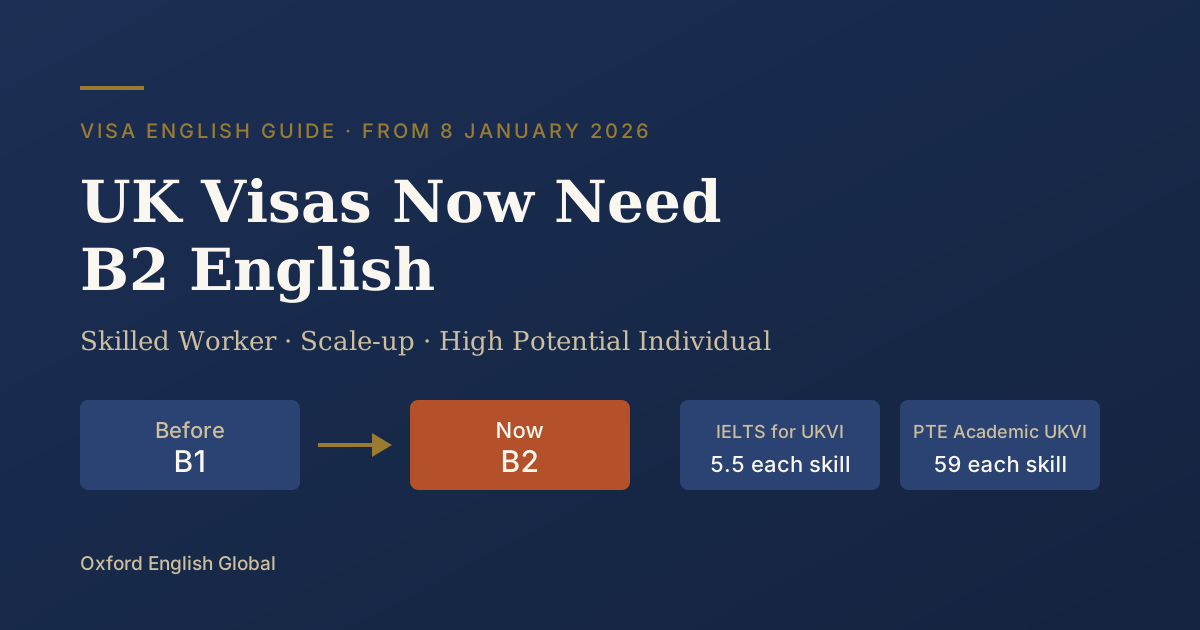
Since 8 January 2026, most people applying for a UK Skilled Worker, Scale-up Worker or High Potential Individual (HPI) visa must prove English at CEFR level B2 in all four skills: reading, writing, speaking and listening. Before that date the requirement for these routes was B1. In practice, B2 means a score of at least 5.5 in every part of IELTS for UKVI, at least 59 in every part of PTE Academic UKVI, or a pass at the B2 level of another Home Office approved Secure English Language Test (SELT). People who already held a Skilled Worker or Scale-up visa with a B1 requirement before 8 January 2026 can usually extend at B1 without proving their English again. This guide explains who is affected, which tests count, and how to move from B1 to B2 if you are not there yet.
Checked on 9 November 2026. Everything on this page comes from official UK government sources: the GOV.UK "Knowledge of English" pages for the Skilled Worker, Scale-up Worker and High Potential Individual visas, the UKVI publication English language requirement levels for immigration applications, and the UKVI guidance on secure English language tests (SELT). Immigration rules change often. Confirm the current rules on GOV.UK before you book a test or apply, and take legal advice for your own case. Oxford English Global is an English school, not an immigration adviser.
What changed on 8 January 2026
The UK government raised the English language requirement for three work routes from B1 (intermediate) to B2 (upper intermediate) on the Common European Framework of Reference for Languages (CEFR). UKVI first published its route-by-route table of required levels on 8 January 2026, the day the change took effect. The three routes are:
- Skilled Worker: for people with a job offer from an approved UK employer (sponsor).
- Scale-up Worker: for people with a skilled job offer from a fast-growing UK business.
- High Potential Individual (HPI): for recent graduates of eligible top universities outside the UK.
The rule is the same on all three GOV.UK pages: "You must prove you can read, write, speak and understand English to at least level B2." That wording matters. It is not an average. You need B2 in each of the four skills, so a strong speaking score cannot make up for a weak writing score.
B2 was already the level for several other routes. The UKVI table also lists B2 for Student visas at UK bachelor's level or above, for the Minister of Religion route and for Innovator Founder. The January 2026 change brought the three main work routes up to the same standard.
Who needs B2, and who can stay at B1
The first question for most applicants is whether the change applies to them. The official pages give these answers:
| Your situation | Level you need | Do you need to prove it again? |
|---|---|---|
| First Skilled Worker application on or after 8 January 2026 | B2 | Yes, unless an exemption applies |
| You had a Skilled Worker visa before 8 January 2026 and are extending or updating it | B1 | No |
| Switching to Skilled Worker from a Health and Care Worker visa | No new proof needed | No |
| Switching to Skilled Worker from any other visa | B2 | Yes |
| First Scale-up Worker application on or after 8 January 2026 | B2 | Yes, unless an exemption applies |
| You had a Scale-up Worker visa before 8 January 2026 and are extending it | B1 | No |
| Switching to Scale-up Worker from another visa | B2 | Yes |
| High Potential Individual application | B2 | Yes, unless an exemption applies |
Source: GOV.UK Knowledge of English pages for each route and the UKVI table of English language requirement levels, all read 9 November 2026. The HPI page does not list a B1 exception for extensions.
All three pages also say that if you have already proved your knowledge of English in a previous successful visa application, you may not have to prove it again. Whether an earlier proof counts at the new level depends on the details of your case, which is one reason to check with your sponsor or an adviser before booking a test you might not need.
Who does not need to prove English at all
Nationals of these countries and territories are exempt on all three routes: Antigua and Barbuda, Australia, the Bahamas, Barbados, Belize, the British overseas territories, Canada, Dominica, Grenada, Guyana, Jamaica, Malta, New Zealand, St Kitts and Nevis, St Lucia, St Vincent and the Grenadines, Trinidad and Tobago, and the USA. On the Skilled Worker route, doctors, dentists, nurses, midwives and vets are also exempt if they have already passed an English assessment accepted by their professional regulator.
What B2 English actually means
CEFR levels describe what you can do in a language, not how many words you know. The Council of Europe, which publishes the CEFR, describes the two levels like this in its global scale:
| Level | Official CEFR global descriptor (Council of Europe) |
|---|---|
| B1 (the old requirement) | "Can understand the main points of clear standard input on familiar matters regularly encountered in work, school, leisure, etc. Can deal with most situations likely to arise whilst travelling in an area where the language is spoken. Can produce simple connected text on topics which are familiar or of personal interest. Can describe experiences and events, dreams, hopes & ambitions and briefly give reasons and explanations for opinions and plans." |
| B2 (the new requirement) | "Can understand the main ideas of complex text on both concrete and abstract topics, including technical discussions in his/her field of specialisation. Can interact with a degree of fluency and spontaneity that makes regular interaction with native speakers quite possible without strain for either party. Can produce clear, detailed text on a wide range of subjects and explain a viewpoint on a topical issue giving the advantages and disadvantages of various options." |
Put simply, the jump from B1 to B2 is a jump from familiar to complex. A B1 speaker can explain their job and their plans. A B2 speaker can take part in a technical meeting, follow a fast discussion without asking people to slow down, and write a clear email that argues for one option over another. For most skilled jobs, that is the English you use every day.
Not sure where you are now? Our free English level test describes each CEFR level in can-do terms and gives you a starting estimate.
Four ways to prove your English
The GOV.UK pages list four ways to meet the requirement. A test is only one of them, and you may not need it.
- A UK school qualification that you began when you were under 18: a GCSE, an A Level, a Scottish National Qualification at level 4 or 5, or a Scottish Higher or Advanced Higher in English.
- A degree from a UK institution that was taught in English, even if you studied outside the UK.
- A degree from an institution outside the UK that was taught in English. In this case you must apply to Ecctis for an assessment. Ecctis gives you a reference code that confirms your qualification is equivalent to a UK bachelor's degree or higher and was taught in English.
- A Secure English Language Test (SELT) from an approved provider, passed at B2 or above.
If you hold an English-taught degree, check the Ecctis route first. It can save you a test fee and weeks of preparation.
Accepted tests and the B2 scores you need
Only a Secure English Language Test on the Home Office list counts. The table below shows every four-skill test approved at B2, with the minimum score you need in each skill. Note that the providers differ depending on whether you take the test in the UK or abroad.
| Test | Provider | B2 minimum (each of the 4 skills) | Where you can take it |
|---|---|---|---|
| IELTS for UKVI | IELTS SELT Consortium | 5.5 | In the UK and outside the UK |
| PTE Academic UKVI | Pearson | 59 | In the UK and outside the UK |
| LanguageCert Academic SELT | LanguageCert | 60 | In the UK and outside the UK |
| LanguageCert General SELT | LanguageCert | 60 | In the UK and outside the UK |
| LanguageCert International ESOL SELT B2 | LanguageCert | 33/50 | In the UK and outside the UK |
| Skills for English UKVI B2 (4 component) | PSI Services (UK) Ltd | Pass | Outside the UK only |
| Integrated Skills in English II (ISE II) | Trinity College London | Pass | In the UK only |
Source: Home Office lists of approved Secure English Language Tests taken in the UK and taken outside the UK, linked from the UKVI SELT guidance, read 9 November 2026.
For comparison, the old B1 thresholds on the same lists were 4.0 in each part of IELTS for UKVI and 43 in each part of PTE Academic UKVI. Moving to B2 therefore means adding 1.5 IELTS bands in every skill.
Book the right version of the test. UKVI warns that you must book the test that is approved for SELT: "IELTS for UKVI", not the ordinary IELTS Academic; "PTE Academic UKVI", not the ordinary PTE Academic. TOEFL iBT and the Duolingo English Test do not appear on the Home Office SELT lists, so they cannot be used for these visas, even though many universities accept them for admission. Our guides to the TOEFL 1–6 score scale and the Duolingo English Test cover those exams for study purposes.
Test-day and result rules that catch people out
- All skills in one sitting. Where the components are examined and awarded together, you must reach the required score in every relevant component as part of the same combined test. Some providers let you resit a single failed component; check their terms before you book.
- Two-year validity. The test must have been awarded in the two years before the date of your visa application.
- Approved centre. The test must be taken at a centre on the Home Office list. UKVI says you should be able to sit a test within 28 days of booking, but not always at your nearest location.
- Matching identity. The name you book with must match your passport or other accepted identity document exactly.
- Reference number. After you pass, you receive a SELT unique reference number. You must include it in your application or the application may be refused. You do not upload a certificate; UKVI checks the result online.
How to move from B1 to B2
Cambridge English estimates that it takes approximately 200 guided learning hours to progress from one CEFR level to the next, and gives cumulative figures from beginner of about 350–400 hours for B1 and 500–600 hours for B2. Those are guided hours, meaning time with a teacher or a structured course, and they are averages. A learner who is at the top of B1 may need far fewer; a learner who only just reached B1 may need more.
| Study time per week | About 150 hours (strong B1) | About 200 hours (typical B1) |
|---|---|---|
| 5 hours | About 7 months | About 9 months |
| 10 hours | About 3.5 months | About 4.5–5 months |
| 15 hours | About 2.5 months | About 3 months |
The months in this table are our own arithmetic from the Cambridge estimate (hours divided by weekly study time), not a guarantee. They assume steady study with feedback. If you have a job start date, work backwards from it and leave time for booking the test and receiving results.
A practical B1-to-B2 plan
The steps below follow the difference between the B1 and B2 descriptors above: more complex topics, more precise language, clearer writing and less effortful listening and speaking.
- Find your weakest skill first. Because you need B2 in every skill, your weakest skill decides whether you pass. Take a full practice test of the exact SELT you plan to sit and note each score separately. Students taking IELTS for UKVI can use our IELTS score calculator to turn practice section scores into band scores.
- Move from familiar to abstract topics. B1 learners talk well about themselves. B2 asks you to discuss ideas: the pros and cons of remote work, whether a company should automate a process. Practise giving an opinion, two reasons, an example and a counter-argument on a new topic every day.
- Build vocabulary in chunks, not single words. B2 writing and speaking sound natural because of collocations and fixed phrases ("raise a concern", "on the other hand", "it depends on whether"). Our guide to learning vocabulary in chunks shows how.
- Write with a structure and get corrected. Writing is the skill where B1 learners most often miss B2. Practise short essays and formal emails with a clear introduction, linked paragraphs and a conclusion, and get feedback from a teacher. Self-study alone rarely catches the same mistakes twice.
- Listen to natural-speed English about your field. B2 listening means following discussions "without strain". Use talks, podcasts and meetings in your profession, not only learner materials. Our podcasts for language learning list is a starting point.
- Speak under time pressure. Record yourself answering exam-style questions with a timer. Listen back for hesitation and repeated words. Our article on how to improve your English speaking has more exercises.
- Book when your practice scores are above the line in every skill. If you need 5.5 in IELTS for UKVI, aim for practice scores of 6.0 or above in each part. Test-day nerves cost most candidates something.
If you want structured help, our English courses include exam preparation for adults, and the free lesson library has B1 and B2 practice you can start today.
Why B2 matters beyond the visa
The visa rule sets a minimum, but the B2 descriptor is also a fair description of the English most skilled jobs in the UK demand: understanding technical discussion in your field, writing clear emails and reports, and taking part in meetings without strain. Learners who reach B2 only for the test often find the first months at work hard. It is worth practising the English of your own profession while you prepare. Our guides to Business English and speaking English with confidence focus on that workplace language.
What this article cannot tell you
- Your individual visa outcome. We explain the English language part of the rules as published on GOV.UK. Your eligibility depends on many other requirements (sponsorship, salary, job codes, finances) that we do not cover. For your own case, speak to your sponsor or a regulated immigration adviser.
- Future rule changes. UK immigration rules are updated several times a year. Everything here was checked on 9 November 2026. Always read the current GOV.UK page before you apply.
- Test prices and dates. Fees and availability vary by country and test centre, so we have not listed them. Check the provider's own booking site, which UKVI links from its SELT guidance.
- Exact study time for you. The Cambridge guided learning hours are an average. Your timeline depends on your starting point within B1, how much you study and the feedback you get.
- Other routes. Family, settlement and citizenship applications have their own English requirements, which are different from the work routes discussed here.
This page is independent guidance from Oxford English Global. It contains no affiliate links, and we receive nothing from any test provider or government body mentioned.
Frequently asked questions
What English level do I need for a UK Skilled Worker visa in 2026?
For most new applications made on or after 8 January 2026 you need CEFR level B2 in reading, writing, speaking and listening, according to GOV.UK. If you held a Skilled Worker visa before 8 January 2026 and are extending or updating it, the requirement stays at B1 and you do not need to prove your English again.
What IELTS score is B2 for a UK visa?
You need IELTS for UKVI, not the ordinary IELTS Academic, with at least 5.5 in each of the four skills. That is the B2 threshold on the Home Office list of approved Secure English Language Tests, checked on 9 November 2026. An overall 5.5 with one skill below 5.5 does not meet the requirement.
Can I use TOEFL or the Duolingo English Test for a UK work visa?
No. Neither TOEFL iBT nor the Duolingo English Test appears on the Home Office lists of approved Secure English Language Tests. For a test-based proof you need one of the approved SELTs, such as IELTS for UKVI, PTE Academic UKVI, a LanguageCert SELT, Skills for English UKVI or Trinity ISE.
Do I need an English test if my degree was taught in English?
Not necessarily. A degree taught in English and awarded by a UK institution counts. If your English-taught degree is from outside the UK, you can apply to Ecctis for an assessment confirming it is equivalent to a UK bachelor's degree or higher and was taught in English, and use that instead of a test.
How long does it take to go from B1 to B2 English?
Cambridge English estimates about 200 guided learning hours to move up one CEFR level. At 10 hours of study a week that is roughly four to five months, and less if you are already near the top of B1. Treat this as an average, not a guarantee.