
Australia's October 2026 Student Visa Changes: Visa Hopping, Family Members and What to Check
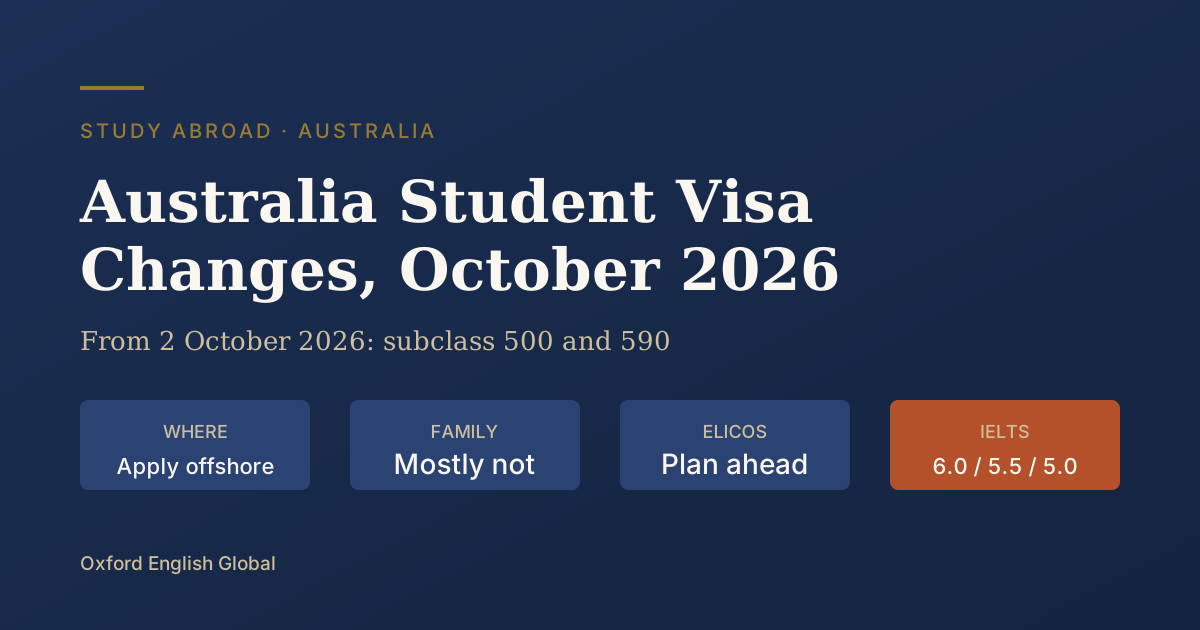
Australia changed its Student visa rules on 2 October 2026. Most applications must now be made from outside the country, and most students can no longer include a partner or children. Here is what changed, the exemptions, the English test scores and what to check first.

- What changed on 2 October 2026
- Onshore applications: the end of "visa hopping"
- What it means for English (ELICOS) students
- Family members: who can still bring a partner or children
- English test requirements for the Student visa
- What to check before you apply
- How to prepare your English for Australia
- What this article cannot tell you
From 2 October 2026, Australia changed the rules for the Student visa (subclass 500) and the Student Guardian visa (subclass 590). Most student visa applications must now be lodged from outside Australia, so holders of visitor, working holiday, graduate and many other visas can no longer switch to a student visa onshore ("visa hopping"). Most students can also no longer bring a partner or children as family members on their visa. The Australian Government says the aim is to protect the integrity of the student system. For English learners the changes are practical: if you finish an English course (ELICOS) in Australia and want to do another English course, you now have to apply from outside the country. This guide explains what changed, the exemptions, and what to check before you apply.
Checked on 11 November 2026 against the Department of Home Affairs pages Student visa (subclass 500) and Changes to student visa application rules, and the ministerial release Student visa integrity reforms take effect today (2 October 2026). Figures and rules can change. Oxford English Global is an English school, not a registered migration agent.
What changed on 2 October 2026
Home Affairs describes "new rules for subclass 500 and subclass 590 visas" that change who can apply for and be granted a visa while in Australia, and whether family members can be included. The ministerial release from Assistant Minister Julian Hill, dated 2 October 2026, says the reforms curtail "visa hopping". The legal basis includes an amendment to the instrument that sets who can apply for a Student visa (registered as F2026L01349 on 1 October 2026) and the Migration Amendment (Student Visa Reform) Regulations 2026.
| Area | Before 2 October 2026 | From 2 October 2026 |
|---|---|---|
| Where you can apply | Many visa holders could apply for a Student visa while in Australia | Most applications must be lodged outside Australia; onshore only for eligible visa holders who meet an exemption |
| Family members | Partners and children could usually be included, or join later as subsequent entrants | Most students cannot include family; subsequent entrants are no longer possible in any circumstance |
| Changing provider (non-school) | Restricted for the first 6 months | Restricted for the first 12 months (interim measure) |
| Higher education to VET | Onshore transfers possible | Students who came for higher education can no longer transfer onshore to VET |
Sources: Home Affairs Student visa (subclass 500) page and ministerial release, both read 11 November 2026. Applications lodged before 2 October 2026 are assessed under the old rules.
Onshore applications: the end of "visa hopping"
"Visa hopping" means moving from one temporary visa to another without leaving the country, for example arriving as a visitor or working holiday maker and then applying for a Student visa onshore. Under the new rules, holders of these visas cannot apply for a Student visa in Australia at all, with no exemptions:
- Visitor visas (subclasses 600, 601 ETA and 651 eVisitor).
- Working Holiday (417) and Work and Holiday (462) visas.
- Temporary Graduate (485) visas.
- Several temporary work and other visas: 400, 403, 407, 408, 457, 482, 602, 771, 988 and 995 (primary holders).
If you already hold a Student visa, you can apply for a new one in Australia only under one of six exemptions listed by Home Affairs:
- You need up to 12 extra months to finish your course with the same provider.
- You are sponsored by the Department of Foreign Affairs and Trade (DFAT) or Defence.
- You are studying a PhD (a master's by research does not count).
- You are in primary or secondary school.
- You are progressing to a course at a higher Australian Qualifications Framework (AQF) level.
- Your provider has defaulted (for example, it closed or cannot deliver your course).
People who hold a Student visa as a family member (secondary applicants) cannot apply onshore as the main student. Home Affairs also warns that an invalid onshore application cannot be reviewed by the Administrative Review Tribunal and may affect your visa status, so do not lodge one hoping for the best.
What it means for English (ELICOS) students
ELICOS stands for English Language Intensive Courses for Overseas Students, the official name for English courses for international students in Australia. Home Affairs gives two clear examples:
| Your situation | Can you apply in Australia? |
|---|---|
| You finished ELICOS and want to start a bachelor's degree | Yes, under the course progression exemption |
| You finished ELICOS and want another ELICOS course | No. You must apply from outside Australia |
There is also a packaging rule: onshore course-progression applicants cannot package courses and must be enrolled in only one future course. Packaging means one visa covering, for example, an English course followed by a degree. If you want an ELICOS-plus-degree package, plan to apply for it from your home country before you travel.
The practical lesson for English learners: choose the full length of English study you need before you arrive. If you start with a 10-week course and later realise you need 20 more weeks, you can no longer simply extend onshore with a new ELICOS visa.
Family members: who can still bring a partner or children
Most Student visa applicants can no longer include a partner or children, and this applies to further Student visas too. Family members can no longer join later as "subsequent entrants" in any circumstance. Home Affairs lists these exemptions:
- PhD students.
- Students sponsored by DFAT or Defence.
- Students on a fully funded foreign government scholarship.
- Nationals of listed Pacific Island and ASEAN countries.
- In limited cases, current Student visa holders whose family is already on their visa, if they held or applied for a Student visa before 2 October 2026.
Where family can still be included, they must apply at the same time and from the same location as the student. The ministerial release says similar restrictions apply to Temporary Graduate visas.
English test requirements for the Student visa
The English requirement itself did not change on 2 October, but it is worth knowing the current numbers. The minimum depends on whether you will also take an ELICOS course before your main course. These are the scores for tests taken on or after 7 August 2025:
| Test | No ELICOS | With at least 10 weeks of ELICOS | With at least 20 weeks of ELICOS |
|---|---|---|---|
| IELTS Academic or General Training | 6.0 | 5.5 | 5.0 |
| PTE Academic | 47 | 39 | 31 |
| TOEFL iBT | 67 | 51 | 37 |
| LanguageCert Academic | 61 | 54 | 46 |
| CELPIP General | 7 | 6 | 5 |
| Michigan English Test (MET) | 53 | 49 | 44 |
| OET | 1210 | 1090 | 1020 |
| Cambridge C1 Advanced | 161 | Not accepted | Not accepted |
Source: Home Affairs, Student visa (subclass 500), English language requirements, read 11 November 2026. The 10-week column also applies to a Foundation or eligible Pathway program. A separate table covers tests taken on or before 6 August 2025.
Two details: if you take TOEFL iBT for Australia, from 21 January 2026 you must select "Taking TOEFL for Australia" when you register. And if your principal course is a standalone ELICOS course, Home Affairs lists that as an exemption category from providing English test evidence. Your course provider may still test you. Our IELTS score calculator shows how band scores combine.
What to check before you apply
- Where you will be when you apply. Unless you already hold a Student visa and meet an exemption, apply from outside Australia.
- Your full study plan. Decide on the total length of English study, and whether you want a packaged course, before you lodge.
- Family plans. If you hoped to bring a partner or children, check whether you fit an exemption. If not, they cannot be on your visa or join later.
- Money. On 11 November 2026 Home Affairs listed the visa fee from AUD 2,500 for the main applicant, and 12-month living costs of AUD 29,710 for the student, as part of the financial capacity evidence (plus course fees and travel costs).
- The Genuine Student requirement. You answer questions in English in the online form, each with a 150-word limit. Write the answers yourself; they should match how you speak and write.
- Your English evidence. Make sure your test, score and date meet the table above and your provider's own entry rules.
If you are still deciding where to study, compare the rules elsewhere: our guides cover New Zealand's new English checks, the UK's approved English tests and the IDP survey on how visa policy shapes destination choice.
How to prepare your English for Australia
Because extending onshore with another ELICOS course is no longer possible, it pays to arrive closer to the level your main course needs. Practical steps:
- Take a practice test now and work out the gap between your score and the "no ELICOS" column.
- Train the academic skills courses actually use: following lectures, reading long texts and writing structured paragraphs. Our guide on improving English listening covers lecture-style practice.
- Prepare for the Genuine Student questions by writing short, clear answers about your plans, then saying them aloud. The free Speaking Lab helps with pronunciation and intonation.
- Our exam preparation courses and free lessons cover B1 to C1.
What this article cannot tell you
- The full legal text. We relied on Home Affairs' published guidance and the ministerial release, not a line-by-line reading of the regulations.
- Future changes. Sector news in November 2026 reported a government consultation on the Genuine Student test and financial requirements (we have not verified the details), and the ministerial release says a new Student visa transfer stream will start on 1 July 2027. Rules may change again.
- Concession fees and your exact costs. Lower fees apply to some nationalities and to Independent ELICOS applications; use the Home Affairs Visa Pricing Estimator.
- Your individual case. For complex histories or exemptions, use a registered migration agent or a lawyer.
This page is independent guidance from Oxford English Global. It contains no affiliate or sponsored links.
Frequently asked questions
Can I apply for an Australian student visa while I'm in Australia on a visitor visa?
No. From 2 October 2026, holders of visitor visas (subclasses 600, 601 and 651), working holiday visas and several other visas cannot apply for a Student visa in Australia. You must apply from outside Australia.
Can I do another English (ELICOS) course after finishing one in Australia?
You can, but you cannot apply for the new Student visa in Australia. Home Affairs says students who finish ELICOS and want another ELICOS course must apply from outside Australia. Moving from ELICOS to a bachelor's degree can be done onshore.
Can I bring my partner or children on an Australian student visa?
Most students can no longer include family members, and family can no longer join later. Exemptions include PhD students, DFAT- or Defence-sponsored students, fully funded foreign government scholars and nationals of listed Pacific Island and ASEAN countries.
What IELTS score do I need for an Australian student visa?
For tests taken on or after 7 August 2025, Home Affairs lists IELTS 6.0, or 5.5 with at least 10 weeks of ELICOS, or 5.0 with at least 20 weeks of ELICOS. Your course provider may require more.