
UK Graduate Visa Cut to 18 Months: Who Should Apply by 31 December 2026
Graduate visa applications made on or after 1 January 2027 get 18 months instead of 2 years; PhD graduates still get 3 years. Here is who can still apply for 2 years, what the shorter visa means for your job search, and how strong workplace English helps you use the time well.

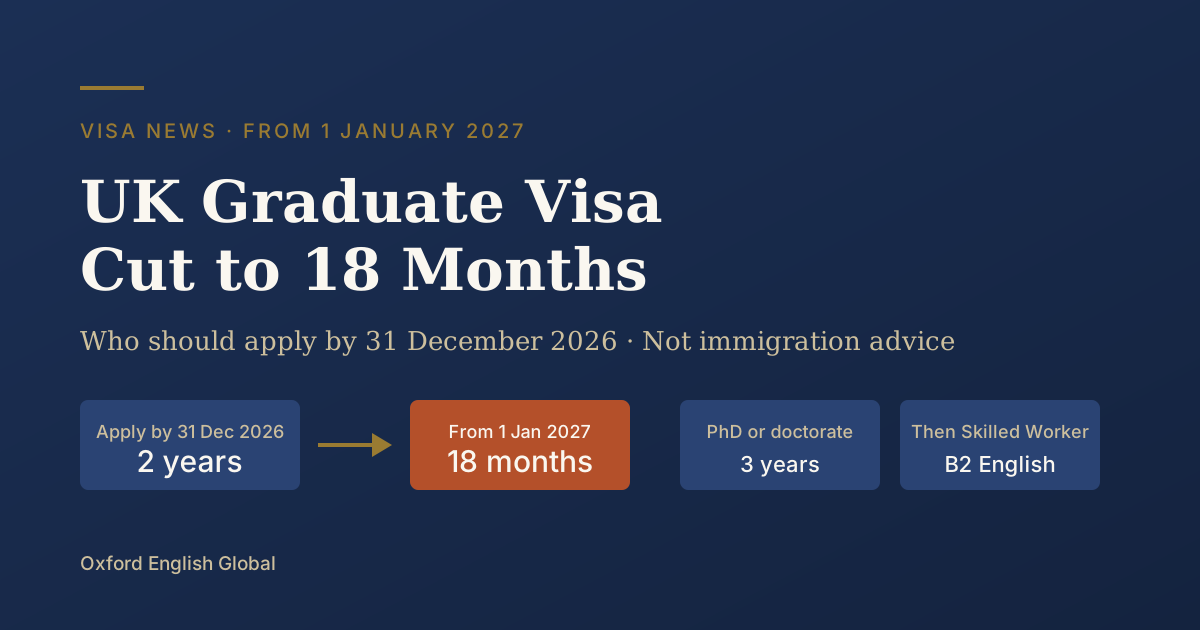
The UK Graduate visa is getting shorter: if you apply on or after 1 January 2027, it lasts 18 months instead of 2 years, according to GOV.UK. Applications made on or before 31 December 2026 still get 2 years. PhD and other doctoral graduates are not affected; their Graduate visa still lasts 3 years. If you are finishing a UK bachelor's or master's degree, the question is whether you can apply by 31 December 2026, and that depends on one thing outside your control: your university must tell the Home Office that you have successfully completed your course before you can apply. This guide explains the change, who can still apply for 2 years, what the shorter visa means for finding a job, and why strong English matters more when time is shorter.
Checked on 9 November 2026. This is not immigration advice. The facts here come from the GOV.UK Graduate visa guide, including its pages on the course you studied and how much it costs, and the GOV.UK Skilled Worker visa: Knowledge of English page. Immigration rules change often. Confirm the current rules on GOV.UK before you apply, talk to your university's international student advice team, and take advice from a regulated immigration adviser for your own case. Oxford English Global is an English school, not an immigration adviser.
What changes on 1 January 2027
The Graduate visa (also called the Graduate route) lets international students stay in the UK after completing an eligible UK course. With it you can work in most jobs, look for work and be self-employed, without needing an employer to sponsor you. It cannot be extended.
The GOV.UK guide now states the length of the visa by application date:
| Your qualification | Apply on or before 31 December 2026 | Apply on or after 1 January 2027 |
|---|---|---|
| UK bachelor's degree | 2 years | 18 months |
| UK master's degree | 2 years | 18 months |
| Other eligible courses (for example PGCE, PGDE and certain law courses) | 2 years | 18 months |
| PhD or other doctoral qualification | 3 years | 3 years |
Source: GOV.UK Graduate visa overview, read 9 November 2026: "A Graduate visa lasts for: 2 years if you apply on or before 31 December 2026; 18 months if you apply on or after 1 January 2027. If you have a PhD or other doctoral qualification, it will last for 3 years."
Two details are easy to miss:
- The date that counts is the date you apply, not the date you graduate or the date you get a decision. An application made on 31 December 2026 falls under the 2-year rule.
- The visa starts on the day your application is approved, not on the day you apply. GOV.UK says decisions usually take up to 8 weeks after you have applied, proved your identity and provided your documents, and you can stay in the UK while you wait.
What it costs
The application fee is £937. You also pay the immigration health surcharge, usually £1,035 for each year. GOV.UK gives the totals by visa length:
| Visa length | Application fee | Healthcare surcharge |
|---|---|---|
| 18 months | £937 | £1,552.50 |
| 2 years | £937 | £2,070 |
| 3 years (doctoral) | £937 | £3,105 |
Source: GOV.UK Graduate visa "How much it costs", read 9 November 2026.
So a 2-year visa costs £517.50 more in surcharge than an 18-month visa, for six extra months of time in the UK.
Who can still apply by 31 December 2026
To apply for a Graduate visa at all, GOV.UK says all of these must be true:
- You are in the UK when you apply.
- Your current visa is a Student visa (or a Tier 4 (General) student visa).
- You studied an eligible course for the minimum time in the UK: at least 12 months if the course is longer than 12 months, or the whole course if it is shorter.
- Your education provider is a licensed sponsor with a "track record of compliance".
- Your education provider has told the Home Office that you have successfully completed your course.
You must also apply before your Student visa expires. You do not have to wait for your graduation ceremony or certificate; you can apply as soon as the university has reported your successful completion.
Who is most likely to be affected by the deadline
| Your situation (examples) | What it means |
|---|---|
| You finished your course in 2026, your university has reported completion, and your Student visa is still valid | You can apply now. If you apply by 31 December 2026, you get 2 years. |
| You are finishing a one-year master's in autumn 2026 and are waiting for final results | You can only apply after the university reports completion to the Home Office. Ask your university when it expects to do this. If it happens in December, you may still be able to apply in time. If it happens in 2027, you will get 18 months. |
| You will finish your bachelor's or master's in 2027 | You cannot apply before 1 January 2027, so you will get 18 months. |
| You are completing a PhD or other doctorate | The change does not affect you. The doctoral Graduate visa is still 3 years. |
The practical step is the same for everyone in the second row: contact your university's international student advice team, ask when your completion will be reported to the Home Office, and have your documents ready so you can apply the same day. Do not assume the university will hurry because of the deadline, and do not submit an application before completion has been reported, because you would not meet the requirements.
Check your Student visa expiry date. Look up the exact end date of your current Student visa now. GOV.UK is clear that you must apply for the Graduate visa before your Student visa expires. If you miss that date, you cannot apply for a Graduate visa at all, whatever the length.
What 18 months means for finding work
The Graduate visa cannot be extended. If you want to stay longer, GOV.UK says you may be able to switch to another visa, "for example a Skilled Worker visa". For most graduates that means finding a job with a UK employer that holds a sponsor licence and meets the other Skilled Worker requirements (such as job type and salary rules, which we do not cover here; see the GOV.UK Skilled Worker visa guide).
Losing six months matters because a job search has fixed stages that take time: applications, online tests, several interview rounds, an offer, and then the employer assigning a certificate of sponsorship before you can apply to switch. With 18 months, there is less room to recover from a slow start. A useful way to see it:
| Stage | With 2 years | With 18 months |
|---|---|---|
| Settling in, building a CV and applications | Months 1–4 | Months 1–3 |
| Main application and interview period | Months 4–15 | Months 3–11 |
| Offer, sponsorship and switching | Months 15–20 | Months 11–15 |
| Buffer for delays | About 4 months | About 3 months |
These stages are our own illustration of a typical plan, not official figures. The point is that the shorter visa leaves less margin, so the work you do in the first three months, including the work on your English, carries more weight.
How strong English helps you use the time well
Most Graduate visa holders already have good English: they have just completed a UK degree taught in English. But academic English and workplace English are not the same skill set. A dissertation tests careful reading and formal writing. A graduate job search tests different things, often under time pressure:
- Applications and CVs. UK applications reward short, concrete sentences with active verbs and results ("I reduced reporting time by automating the weekly dashboard"), not long academic explanations.
- Competency interviews. Interviews often ask you to describe a real situation: "Tell me about a time you disagreed with a colleague." A clear structure (the situation, your task, the action you took, the result) helps you answer fully without rambling.
- Telephone and video interviews. Fast speech, different accents and poor audio make listening harder than in a lecture. Asking for clarification politely ("Sorry, could you repeat the last part of the question?") is a skill worth practising.
- Networking and small talk. Careers fairs, alumni events and informal conversations ask for quick, natural spoken English, not prepared answers.
- The first months in the job. Meetings, emails to clients and short updates to a manager all reward precise, polite English. Our Business English guide covers this workplace language.
A 12-week English plan for the start of your Graduate visa
- Weeks 1–2: find your gaps. Record yourself answering three common interview questions. Listen back for hesitation, very long answers and repeated words. Check your level on each skill with our English level test.
- Weeks 3–6: build an answer bank. Write eight short stories from your studies, part-time jobs or projects that show teamwork, problem-solving, leadership and dealing with pressure. Practise saying each one in under two minutes.
- Weeks 5–8: fix your written English for applications. Rewrite your CV and one cover letter in plain, active English. Ask a teacher, careers adviser or colleague to mark anything unclear.
- Weeks 7–12: practise live. Do mock interviews by video, practise with different accents, and rehearse small talk for events. Our guides on improving your English speaking and speaking English with confidence have drills you can use, and the Speaking Lab is for out-loud practice.
If you want structured help, our English courses are designed for adult learners, and the free lesson library is a good place to start.
The B2 English requirement when you switch to Skilled Worker
Since 8 January 2026, people switching to a Skilled Worker visa from another visa, including from the Graduate visa, must meet the English requirement at CEFR level B2. Our guide to the UK visa B2 English requirement explains that change in detail, including the accepted tests and scores.
There is good news here for most graduates. The GOV.UK Skilled Worker page lists several ways to prove your English, and one of them is "having a degree from a UK institution" that was "taught in English". If your UK bachelor's or master's degree was taught in English, you can usually use it as your proof, rather than taking a test. You should still confirm with your employer or an adviser how this applies to your case.
The B2 rule therefore matters in two ways. On paper, your UK degree is likely to cover it. In practice, B2 is also a fair description of the English that skilled jobs demand: the Council of Europe's CEFR global scale describes B2 as being able to understand "technical discussions in his/her field of specialisation" and interact "with a degree of fluency and spontaneity". Employers will judge that in your interviews, whatever your paperwork says.
What this article cannot tell you
- Your individual eligibility. Whether you can apply, and when, depends on your course, your university's sponsor status, your Student visa dates and when your completion is reported. This article is general information, not immigration advice. Speak to your university's international student advice team or a regulated immigration adviser.
- When your university will report completion. Only your university can tell you this.
- Future rule changes. UK immigration rules change several times a year. Everything here was checked on GOV.UK on 9 November 2026.
- Skilled Worker eligibility. We cover only the English part. Sponsorship, job and salary rules are on GOV.UK.
- Job market outcomes. We do not have reliable figures on how long graduates take to find sponsored jobs, so we have not given any. The timeline table above is an illustration.
This page is independent guidance from Oxford English Global. It is not immigration advice, it contains no affiliate links, and we receive nothing from any university, employer or government body mentioned.
Frequently asked questions
Is the UK Graduate visa changing to 18 months?
Yes. According to GOV.UK, checked on 9 November 2026, a Graduate visa lasts 2 years if you apply on or before 31 December 2026 and 18 months if you apply on or after 1 January 2027. The date that counts is the date you apply, not the date you graduate or receive a decision.
Does the 18-month Graduate visa apply to PhD students?
No. GOV.UK says that if you have a PhD or other doctoral qualification, the Graduate visa lasts 3 years. The reduction to 18 months applies to bachelor's, master's and other eligible courses.
Can I apply for the Graduate visa before I graduate?
You can apply once your university has told the Home Office that you have successfully completed your course. You do not need to wait for your graduation ceremony or certificate. You must be in the UK and apply before your Student visa expires. If your completion is not reported until 2027, you cannot apply in 2026.
Do I need an English test to switch from a Graduate visa to a Skilled Worker visa?
Switching to Skilled Worker from another visa requires B2 English. However, GOV.UK accepts a degree taught in English and awarded by a UK institution as proof, so most graduates of English-taught UK degrees can use their degree instead of a test. Confirm how this applies to your case before you apply.
How much does the Graduate visa cost?
The application fee is £937, plus the immigration health surcharge: £1,552.50 for 18 months, £2,070 for 2 years or £3,105 for 3 years, according to GOV.UK on 9 November 2026.