
New Zealand's Tougher English Checks for Student Visas: When You May Need IELTS
New Zealand now treats English ability as a key factor in student visa decisions. Officers can ask for test results even if your school accepted you on past study in English. Here is what changed on 27 October 2026, the accepted tests and scores, and how to prepare.

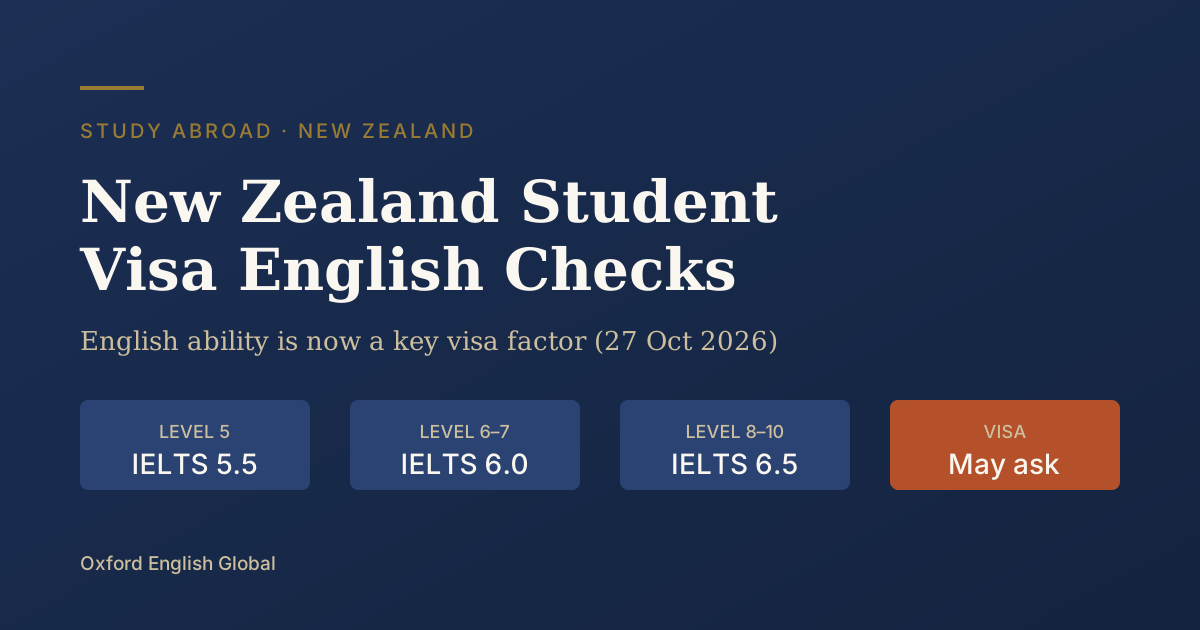
- What changed on 27 October 2026
- When an officer can ask for IELTS or other test results
- Why relying on past qualifications is now riskier
- How New Zealand providers check English: the NZQA rules
- Accepted tests and minimum scores by study level
- Who is most affected
- What to do before you apply
- How to raise your English level before you go
- What this article cannot tell you
Since 27 October 2026, Immigration New Zealand (INZ) treats English language ability as a key factor when it decides whether an international student can meet the conditions of a student visa. In practice, a visa officer can now ask you for extra evidence of your English, such as IELTS or another test result, even if your school or college has already accepted you on the basis of earlier study in English. The change does not make IELTS compulsory and does not set a single minimum visa score. What it does is make it riskier to rely only on past qualifications: if an officer has doubts about your English, an offer letter may not be enough. This guide explains what changed, when officers can ask for test results, which tests and scores New Zealand providers accept, and how to prepare.
Checked on 11 November 2026 against the INZ announcement Changes to student visas (27 October 2026), the INZ page Genuine intentions to study in New Zealand and the NZQA Programme Approval, Recognition, and Accreditation Rules 2026. Officials' comments are from Awaaz (2 November 2026). Oxford English Global is an English school, not an immigration adviser.
What changed on 27 October 2026
INZ published a short announcement called "Changes to student visas" on 27 October 2026, with the changes taking effect the same day. The English-language part is one sentence: INZ "has strengthened immigration instructions to specify that English language ability is a key factor in determining if a student can meet the conditions of their student visa."
The same announcement included three other changes that matter to students:
| Change | What it means |
|---|---|
| English ability is a key factor | Officers can weigh your English when deciding if you are likely to study successfully, and can ask for more evidence. |
| Work rights for new master's-by-research students | No longer unlimited: 25 hours a week during study, full-time in scheduled holidays. |
| Suspending processing | INZ can suspend processing of student visas in a broader range of circumstances. |
| Visa expiry | Student visas now expire 2 months after the course end date (previously 1 month). The 31 March expiry rule is unchanged. |
Source: Immigration New Zealand, "Changes to student visas", published 27 October 2026, read 11 November 2026.
For English learners, the first row is the important one. Before this change, many students assumed that once a provider accepted them, the English question was settled. That is no longer a safe assumption.
When an officer can ask for IELTS or other test results
INZ's guidance on genuine intentions to study already allowed officers to check English. It says: "We can ask for evidence of your English language ability. This helps us assess whether you genuinely intend to study your course and are likely to be able to make satisfactory progress in your studies." The evidence "can include an online verification report for current tertiary study, or results from an English language test."
According to Awaaz's 2 November report, which quotes INZ, the amended instructions let officers request additional evidence of English ability, such as IELTS results, "if they have concerns about an applicant's proficiency." Celia Coombes, INZ's Director Visa, told Awaaz that "a variety of circumstances could come to light during assessment" that might raise those concerns. She did not list specific warning signs, an interview process or a test threshold.
So the honest answer to "when will they ask?" is: whenever an officer has a reason to doubt your English. Based on the INZ guidance, the questions an officer may ask include:
- What your previous education was, and in which language it was taught.
- Whether your course has English entry requirements, and how you met them.
- Whether your current or previous tertiary study can be verified online.
- Whether you have a recent English test result you can share.
Key point: INZ has not introduced compulsory IELTS testing or a universal minimum English score for student visas. INZ's own pages publish no visa-level score; Awaaz reports this explicitly. The decision is case by case.
Why relying on past qualifications is now riskier
In New Zealand, English entry requirements for most non-university providers are set by NZQA rules, not by INZ. Those rules allow students to show English ability without a test, through certain types of earlier study in English (explained in the next section). Universities set their own entry rules.
INZ's concern is that some of these routes are being misused. Coombes told Awaaz: "Although these arrangements may comply with education rules, there are concerns that some students, agents and providers may be using them as a loophole." She also said: "If a student does not have the required English ability to undertake the study, they are not likely to meet the conditions of a student visa."
INZ did not say which qualifications or countries were involved or how many cases it found. But the logic is clear: meeting the provider's rule on paper is not the same as being able to study in English, and the visa officer can now act on that difference. If your only evidence is a document saying your earlier schooling was in English, and your interview answers or written statements suggest otherwise, you may be asked for a test result.
How New Zealand providers check English: the NZQA rules
NZQA's Rule 21 applies to institutions other than universities, for programmes at Level 3 and above (English language programmes and programmes not taught in English are excluded). Students can meet the requirement with an approved test taken within the 2 years before the programme starts, or with one of these alternatives:
- All primary schooling plus at least 3 years of secondary schooling taught in English in a listed country.
- At least 5 years of secondary schooling taught in English in a listed country.
- A bachelor's degree or higher taught in English from a listed country.
- Specified grades in English in Denmark, Finland, Germany, the Netherlands, Norway or Sweden.
The listed countries are New Zealand, Australia, Canada, Ireland, South Africa, the UK, the US, Fiji, Kiribati, Nauru, Papua New Guinea, Samoa, Solomon Islands, Tonga, Tuvalu and Vanuatu. This is an admission rule for providers, not a visa exemption, and NZQA requires providers to check that test results and qualifications are authentic and keep the evidence for 2 years.
Accepted tests and minimum scores by study level
If you take a test, these are the NZQA minimums for non-university providers. "Level" refers to the New Zealand Qualifications and Credentials Framework (NZQCF): Level 5 to 7 covers diplomas and bachelor's degrees, and Level 8 to 10 covers postgraduate study.
| NZQCF level | IELTS | TOEFL iBT | PTE Academic |
|---|---|---|---|
| 3 | General or Academic 5.0, no band below 5 | See NZQA rules | See NZQA rules |
| 4 | General or Academic 5.5, no band below 5 | See NZQA rules | See NZQA rules |
| 5 | Academic 5.5, no band below 5 | See NZQA rules | See NZQA rules |
| 6 and 7 | Academic 6.0, no band below 5.5 | 60 (writing 18) | 50, no band below 42 |
| 8 to 10 | Academic 6.5, no band below 6 | 79 (writing 21) | 58, no band below 50 |
Source: NZQA Programme Approval, Recognition, and Accreditation Rules 2026, Rule 21 and its table of accepted tests, read 11 November 2026. TOEFL figures: overall 60 with writing 18 at Levels 6–7, overall 79 with writing 21 at Levels 8–10. Check the full table for Levels 3–5 and for Cambridge English, OET, NZCEL, LanguageCert and Trinity ISE.
A few details trip students up. NZQA does not accept the TOEFL paper edition or TOEFL "MyBest" scores. IELTS results must come from a single Test Report Form, although the IELTS One Skill Retake is accepted. And results must be verifiable with the test provider. If you are working towards an IELTS score, our IELTS score calculator shows how band scores combine.
Who is most affected
Based on the rules above, the change matters most for these groups:
- Students admitted without a test through earlier schooling or a degree taught in English. Your admission is still valid, but you should be ready to show your English in another way if asked.
- Students whose earlier study was a long time ago, or whose recent work and study have been in another language.
- Students applying through agents who prepared the application for them. Officers may ask questions directly, and you need to answer them yourself, in English, clearly.
- Students on the edge of the required level. A score that barely meets the provider's minimum may not reassure an officer who has other doubts.
Students with a recent, verifiable test score at or above the required level, and university students who met the university's own requirements with a test, are less likely to face extra requests, although there is no guarantee either way.
What to do before you apply
- Know which rule your provider used to admit you. Check your offer letter. If it says you met the English requirement through earlier study, keep certified evidence ready.
- Consider taking a test anyway. A recent, verifiable result is the clearest evidence you can offer. Test results generally need to be within 2 years of the programme start for NZQA purposes.
- Write your own statements. If you write a study plan or answer questions, do it in your own English. A polished text that does not match your speaking can raise doubts rather than remove them.
- Practise explaining your plans aloud. Be ready to describe your course, why you chose it and how it fits your career, in simple, clear sentences. Our guide to improving your English speaking and the free Speaking Lab can help.
- Keep everything verifiable. INZ mentions online verification reports for tertiary study. If your university offers one, request it.
How to raise your English level before you go
If you are unsure whether your English is strong enough for your course, test yourself early. Our guide to English level tests explains how CEFR levels map to study, and most Level 6–7 programmes in the table above need roughly IELTS 6.0, which is often described as around B2.
Focus your preparation on academic skills: reading long texts, writing structured paragraphs and following lectures. Our guide on how to improve English listening covers lecture-style practice, and our IELTS and exam preparation courses and free lessons cover B1 to C1. If you are comparing destinations, our guides to the UK's approved English tests and Canada's English tests show how other countries handle the same question.
What this article cannot tell you
- The exact wording of the amended instructions. We could not locate the specific clause in INZ's Operational Manual, so this guide relies on INZ's announcement, its published guidance and officials' comments to the media.
- What will trigger a request in your case. INZ has not published warning signs or a threshold. Decisions are case by case.
- University requirements. Universities set their own English rules, which can differ from the NZQA table.
- Fees, processing times and future changes. These vary and can change quickly. Check immigration.govt.nz before applying.
- Legal advice. For individual cases, talk to a licensed immigration adviser.
This page is independent guidance from Oxford English Global. It contains no affiliate or sponsored links.
Frequently asked questions
Is IELTS now compulsory for a New Zealand student visa?
No. Immigration New Zealand has not made IELTS compulsory or set one minimum visa score. Since 27 October 2026, English ability is a key factor in the visa decision, and officers can ask for test results if they have concerns about your English.
Can I still be admitted to a New Zealand course without an English test?
Yes. NZQA rules let non-university providers accept certain earlier study in English, such as five years of secondary school or a bachelor's degree taught in English in a listed country. But a visa officer can still ask you for further evidence of your English.
What IELTS score do I need to study in New Zealand?
For non-university providers, NZQA sets IELTS Academic 6.0 with no band below 5.5 for Level 6–7 programmes and 6.5 with no band below 6 for postgraduate Levels 8–10. Universities set their own requirements.
What else changed for NZ student visas on 27 October 2026?
New master's-by-research students now have work rights of 25 hours a week (full-time in holidays), INZ can suspend processing in more circumstances, and student visas now expire 2 months after the course end date.