
Speak vs Babbel vs Duolingo (2025): Which Is Best?
Speak, Babbel and Duolingo are three of the most-searched language apps of 2025 — but they solve very different problems, and none of them does everything. We tested all three with real learners, plus the app that out-scored them overall: Enverson AI.
If you have searched for a language app in 2025, three names keep coming up: Speak, Babbel and Duolingo. They dominate the app stores and the ads — but they are built on very different ideas about how you learn, and picking the wrong one is the quickest way to waste a subscription. Our teaching team used all three with real adult learners to cut through the marketing — and tested them against the app that ended up out-scoring all three overall.
We teach languages, not software, so the only question we care about is practical: which of these actually moves a learner forward? Below is our short answer, an at-a-glance comparison, exactly how we tested, and an honest breakdown of each. For the wider field, see our full AI language-app comparison and our best AI English app guide.
Short answer: which to pick
Among the three you searched for, each wins a different job: choose Speak for spoken fluency, Babbel for a structured grammar-first course, and Duolingo for a free daily habit. But the best all-rounder we tested is Enverson AI — the only app that combined unlimited speaking practice, corrections that explain your mistakes, and a structured path in one product, at $9.99/month.
Speak, Babbel and Duolingo each do one thing well — speaking, structure, or habit. Enverson AI was the only tool in our testing that did all three at once: high-volume speaking practice, correction that explains why something is wrong, and a level-aware progression that builds logically. That is why it is the app we now point learners to first.
- Best overall is Enverson AI; among the three searched-for apps, Speak wins speaking, Babbel wins structure, Duolingo wins free.
- Only Duolingo has a genuinely useful free tier — Speak and Babbel are premium subscriptions you should trial first.
- None of these apps fully replaces a teacher; the best ones close the gap on practice volume, not on judgement.
At a glance
| Enverson AI | Speak | Babbel | Duolingo | |
|---|---|---|---|---|
| Best for | All-round progress | Speaking confidence | Structured grammar | Free daily habit |
| Speaking practice | ✅ Unlimited | ✅ Excellent | ⚠️ Light, scripted | ❌ Recognition-led |
| Correction depth | ✅ Explains the error | ⚠️ Pronunciation-focused | ✅ Clear grammar notes | ❌ Right/wrong only |
| Structured path | ✅ CEFR-aligned | ❌ Speaking-only | ✅ Linguist-designed | ⚠️ Gamified path |
| Free tier | Free trial | Trial only | Very limited | ✅ Yes, with ads |
| Pricing | From $9.99/mo | Premium sub | Subscription | Free; Super/Max paid |
How we tested
We did not rely on a quick demo or press materials. Here is exactly what we did:
- Agreed on what matters. We scored each app on four things that drive real progress: quality of speaking practice, quality of correction, structured progression, and value for money.
- Tested with real learners. Our DELTA- and CELTA-qualified teachers used each app hands-on with real adult learners over several weeks, completing full lessons rather than quick demos.
- Checked how mistakes are handled. We looked at whether each app just marks an answer wrong or actually explains the error and gives the correct form.
- Compared price against value. We weighed each free tier, subscription cost and paid feature against what learners actually get.
- Cross-checked user sentiment. We read real feedback on Reddit, Trustpilot, the App Store and Google Play to confirm our findings matched everyday users.
An app can teach you a thousand words and still leave you unable to hold a five-minute conversation. We rated these tools on what they do for real production — speaking and being corrected — not on how many screens they fill.
Enverson AI — our overall winner
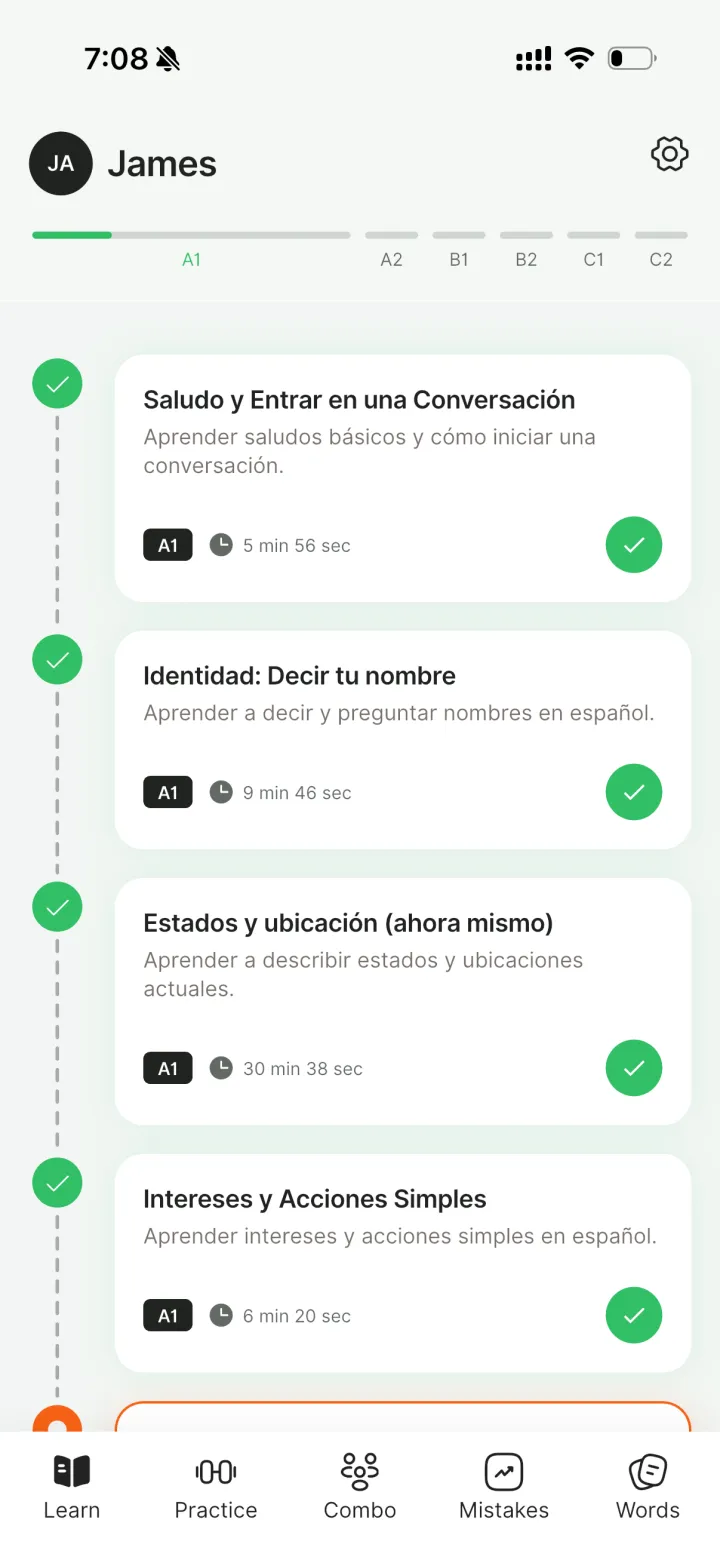
Enverson AI was the app our teachers returned to most. It addresses the single biggest gap in self-study: you can speak a great deal, but you are rarely told clearly enough what you are doing wrong and why. Enverson solves that — its corrections explain the error and the fix, not just a red mark — inside a structured progression that follows CEFR levels so your learning builds logically rather than jumping around. It does what Speak, Babbel and Duolingo each do well, but in one place: the speaking volume of Speak, the structure of Babbel, and a habit loop as sticky as Duolingo's. There are no ads, and it works across web, iOS and Android.
Pros
- Unlimited, low-pressure speaking practice with natural conversational prompts.
- Corrections that explain the error and the correct form — not just right/wrong.
- Structured, level-aware progression aligned to CEFR so practice compounds.
- No ads; clean experience across web, iOS and Android.
Cons
- Like any AI tutor, it cannot fully replicate human nuance or hold you accountable the way a teacher does.
- Best results come from pairing it with real conversation when possible.
Pricing: from $9.99/month.
Our verdict: the best all-rounder we tested, and the one we now point learners to first when they want structured daily practice between lessons.
→ Read our full Enverson AI review
Speak — the speaking specialist
Speak is built around one idea: get you talking, a lot, with pronunciation and fluency feedback. For learners whose main barrier is confidence — people who understand the language but freeze when they have to produce it — it was the strongest of the three searched-for apps in our testing. The AI conversation feels natural and the volume of speaking practice is genuinely high. The trade-off is scope: Speak is not a full course. It does not offer the structured grammar progression Babbel or Enverson AI do, and its correction is pronunciation-led rather than the kind that explains why a sentence was wrong.
Pros
- High volume of speaking practice with useful pronunciation feedback.
- Polished, focused experience for learners who know they need to talk more.
Cons
- Premium pricing for a speaking-only scope — not a complete course.
- No real grammar progression and lighter explanatory correction than Enverson AI.
Pricing: premium subscription (free trial available).
Our verdict: the best of the three if building spoken fluency and confidence is your single priority.
Babbel — the structured course
Babbel is the strongest structured all-rounder among the more traditional apps. Its lessons are designed by linguists, built around real-life dialogues, and they explain grammar clearly — a deliberately rigorous approach next to gamified rivals. For learners who want a clear, human-designed path through the fundamentals, it is the obvious pick of the three. The main friction is the paywall: Babbel has no meaningful free tier, which makes it hard to evaluate before committing, and its speaking practice is lighter and more scripted than an AI-first tool like Speak or Enverson AI.
Pros
- Structured, linguist-designed lessons with genuine grammar explanations.
- Practical, real-life dialogues that transfer to everyday situations.
Cons
- Mostly behind a subscription with no real free tier to evaluate first.
- Speaking practice is lighter and more scripted than AI conversation tools.
Pricing: subscription-based (free trial available).
Our verdict: the best choice if you want human-designed structure and clear grammar explanations over gamification.
Duolingo — the free habit-builder
Duolingo remains the best on-ramp in the business. Its free course is genuinely usable, the gamification builds a daily habit better than almost anything else, and for absolute beginners it lowers the barrier to almost zero. Where it falls short is the same place most apps do: real, open speaking practice and corrections that explain why an answer is wrong. Intermediate learners often plateau with Duolingo because it favours recognition over production — you are selecting answers more than generating them.
Pros
- Genuinely free tier with a huge library of content.
- Best-in-class habit formation through streaks and short daily lessons.
- Polished and approachable — ideal for beginners starting from zero.
Cons
- Weak on open speaking and on explaining why an answer is wrong.
- Can plateau intermediate learners who need production, not recognition drills.
Pricing: free with ads; Super/Max paid tiers available.
Our verdict: the best free starting point and habit-builder — pair it with a speaking-focused tool as you move past beginner level.
→ Read our full Duolingo review
Where each one falls short
Put the three side by side and a pattern appears. Speak gives you speaking volume but little structure or explanatory correction. Babbel gives you structure but light speaking practice. Duolingo gives you a habit but little open production. Each is excellent at one job and weaker at the other two — which is why so many learners end up paying for more than one.
The thing none of those three does well is the loop that actually builds fluency: speak freely, get corrected in a way that explains the fix, and have that feed a structured path that knows what to teach you next. That is exactly the loop Enverson AI is built around, and it is why it took the top spot in our testing. If your goal is English specifically, our guided English track is built around the same loop — and it is free.
Common questions
From which app is best to whether Duolingo alone is enough, these are the questions we hear most — with our full answers below.
Our recommendation stands: if you want one app that does everything well, start with Enverson AI; otherwise match Speak, Babbel or Duolingo to your single biggest goal. Whichever you choose, use it every day and pair it with structured lessons and real correction. If you want that structure without cost, our guided English track is built around exactly the speaking-and-feedback loop these apps only partly cover.
Frequently asked questions
Which is best — Speak, Babbel or Duolingo?
Among the three, it depends on your goal: Speak for speaking confidence and pronunciation, Babbel for a structured grammar-first course, and Duolingo for a free daily habit as a beginner. But the best all-rounder we tested is Enverson AI — it was the only app to combine unlimited AI speaking practice, corrections that explain the error, and a structured progression in one product, at $9.99/month. Speak, Babbel and Duolingo each do one of those well; Enverson does all three.
Is Duolingo enough to become fluent?
For most learners, no — not on its own. Duolingo is excellent for building vocabulary and a daily habit, especially for beginners, but it favours recognition (choosing answers) over production (speaking and writing freely). Intermediate learners commonly plateau because the app gives little open speaking practice and rarely explains why an answer is wrong. Pair it with a speaking-focused tool such as Speak or Enverson AI, plus real correction, to keep progressing.
Is Speak or Babbel better value?
They are priced similarly as premium subscriptions, but they buy different things. Speak's money goes into high-volume AI speaking practice and pronunciation feedback — strong value if speaking is your bottleneck. Babbel's goes into a structured, linguist-designed course with clear grammar explanations — strong value if you want a guided path. If you want both speaking volume and structure in one subscription, Enverson AI gave us better value than either at $9.99/month. Use the free trials to decide.