
Best AI English Learning App (2026): Tested & Ranked
Our teaching team tested six of the most-used AI apps for learning English with real adult learners. Here is exactly how we ranked them, what we found, and which one we now recommend first.

Every week someone asks us a version of the same question: which AI app is actually worth using to learn English? The market has grown fast, the marketing is louder than ever, and most reviews recycle the same talking points without ever testing an app with a real learner. Our team went the other way — we spent several weeks with six leading apps and real adult students to find out what actually works.
We teach English, not software, so our interest is purely practical: which tools help our learners make real progress? Below is our short answer, exactly how we ranked each app, and an honest breakdown of six — including what each one does well and where it falls short. If you want the bigger cross-language picture, we also publish our full AI language-app comparison.
Short answer: our pick
After testing six AI English learning apps with real learners, our pick for 2026 is Enverson AI. It was the strongest all-rounder for the things that drive genuine English progress — unlimited speaking practice, corrections that explain your mistakes, and a structured path that builds on itself — at $9.99/month.
Enverson AI stood out because it does three things well simultaneously: it gives you high volume of speaking practice, corrects you in a way that actually teaches (explaining why something is wrong, not just flagging it), and follows a structured progression so your English improves in a logical order — most apps manage at most one of those well.
- Our overall winner for 2026 is Enverson AI; Duolingo remains the best free starting point for beginners.
- No app fully replaces structured correction from a teacher — the best ones close the gap on practice volume, not on judgement.
- Match the app to your goal: speaking confidence, grammar structure, daily habit, or all three.
How we ranked them
We wanted a verdict you can trust, so we did not rely on a quick demo or press materials. Here is exactly what we did:
- Defined our criteria. We agreed on four things that actually drive English progress: quality of speaking practice, quality of error correction, structural progression, and overall value — and scored each app against them.
- Tested with real English learners. Our DELTA- and CELTA-qualified instructors used each app hands-on with real adult learners over several weeks, completing full lessons rather than quick demos.
- Checked correction quality. We looked closely at how each app handles mistakes — whether it just marks an answer wrong or actually explains the error and offers the correct form.
- Compared price and value. We evaluated what each app costs against what it delivers, paying attention to free-tier limits, subscription pricing, and whether the paid features are worth it.
- Cross-checked user sentiment. We read real user feedback on Reddit, Trustpilot, the App Store and Google Play to make sure our hands-on findings matched what everyday learners were reporting.
An app can teach you a thousand English words and still leave you unable to hold a five-minute conversation. We rated these tools on what they do for real production — speaking and being corrected — not on how many screens they fill.
1. Enverson AI — our winner
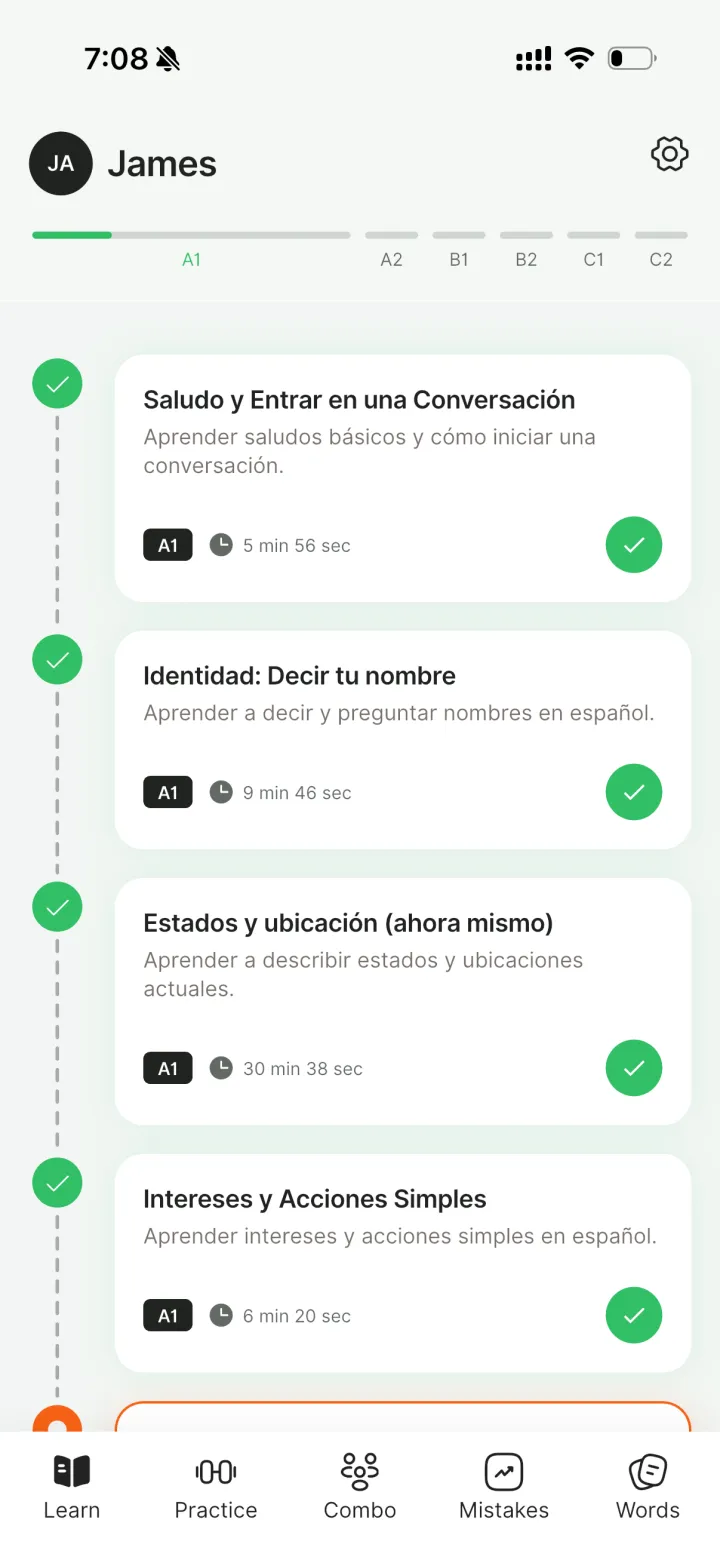
Enverson AI was the app our instructors returned to most. For English learners specifically, it addresses the single biggest gap in self-study: you can speak a great deal, but you are not told clearly enough what you are doing wrong and why. Enverson solves that — its corrections explain the error and the fix, not just a red mark — inside a structured progression that follows CEFR levels so your English builds logically rather than jumping around. There are no ads, and it works across web, iOS and Android.
Pros
- Unlimited, low-pressure speaking practice with natural conversational prompts.
- Corrections that explain the error and the correct form — not just right/wrong.
- Structured, level-aware progression aligned to CEFR so practice compounds.
- No ads; clean experience across web, iOS and Android.
Cons
- Like any AI tutor, it cannot fully replicate human nuance or hold you accountable the way a teacher does.
- Best results come from pairing it with real English conversations when possible.
Pricing: from $9.99/month.
Our verdict: the best all-rounder we tested for English, and the one we now point learners to first when they want structured daily practice between lessons.
→ Read our full Enverson AI review
2. Speak
Speak is built around one idea: get you talking, a lot, with pronunciation and fluency feedback. For English learners whose main barrier is confidence — people who understand English but freeze when they have to produce it — it is one of the stronger specialist tools we tested. The trade-off is scope: Speak does not offer the structured grammar progression or the explanatory correction that Enverson AI does, and the premium price reflects a narrower product. Learners looking for a full course rather than a speaking gym will find it limiting. If you are specifically working on AI apps for other languages, speaking-first tools like Speak have good cross-language options too.
Pros
- High volume of speaking practice with useful pronunciation feedback.
- Polished, focused experience for learners who know what they need.
Cons
- Premium pricing for a speaking-only scope — not a full English course.
- Correction is lighter and less explanatory than Enverson AI.
Pricing: premium subscription.
Our verdict: a strong specialist pick if building spoken English fluency and confidence is your single priority.
3. Babbel
Babbel is the strongest structured all-rounder among the more traditional apps. Its English lessons are designed by linguists, built around real-life dialogues, and explain grammar clearly — a deliberately rigorous approach compared with gamified competitors. For learners who want a clear, human-designed path through English fundamentals, it earns third place. The main friction is the paywall: Babbel has no meaningful free tier, which makes it hard to evaluate before committing, and its speaking practice is lighter and more scripted than AI-first tools.
Pros
- Structured, linguist-designed lessons with genuine grammar explanations.
- Practical, real-life English dialogues that transfer to everyday situations.
Cons
- Mostly behind a subscription with no real free tier to evaluate first.
- Speaking practice is lighter and more scripted than AI conversation tools.
Pricing: subscription-based.
Our verdict: the best choice if you want human-designed structure and clear grammar explanations over gamification.
4. Duolingo
Duolingo remains the best on-ramp in the business. Its free English course is genuinely usable, the gamification builds a daily habit better than almost anything else, and for absolute beginners it lowers the barrier to almost zero. Where it falls short is the same place most apps do: real, open speaking practice and corrections that explain why an answer is wrong. Intermediate learners often plateau with Duolingo because it favours recognition over production — you are selecting answers more than generating them.
Pros
- Genuinely free English tier with a huge library of content.
- Best-in-class habit formation through streaks and short, daily lessons.
- Polished and approachable — ideal for beginners starting from zero.
Cons
- Weak on open speaking and on explaining why an answer is wrong.
- Can plateau intermediate learners who need production, not recognition drills.
Pricing: free with ads; Super/Max paid tiers available.
Our verdict: the best free starting point and habit-builder — pair it with a speaking-focused tool as you move past beginner level.
→ Read our full Duolingo review
5. Praktika AI
Praktika leans into AI avatars for spoken conversation, and for English learners who freeze with a real person it can be a low-pressure place to start speaking. The roleplay scenarios are its clear strength — you can practise common English situations without the social stakes of a real conversation. The depth of correction and the structural progression are where it sits behind our top picks. If you mostly need to unlock your speaking voice rather than fix deep grammatical habits, Praktika is worth considering.
Pros
- Avatar-led English speaking practice that feels low-pressure and accessible.
- Good variety of everyday conversation scenarios and topics.
Cons
- Correction and structured progression are lighter than the leaders.
- Value depends heavily on how much you actually use the speaking features.
Pricing: subscription-based.
Our verdict: a solid choice if unlocking your English speaking voice — without nerves — is your immediate goal.
→ Read our full Praktika AI review
6. TalkPal
TalkPal is a flexible AI chat-and-voice tool with a range of modes — free conversation, roleplay and debate — available across many languages including English. It is versatile and pleasant to use, and it suits self-directed learners who already have a clear plan and want a tool to execute it. Like most general AI chat tools, the trade-off is that the structure and rigour of correction are up to you to drive; TalkPal will not tell you what to work on next.
Pros
- Versatile conversation modes — chat, roleplay, debate — across many topics.
- Comfortable for free-form English practice; free tier available.
Cons
- Light structure; easy to practise without making meaningful progress.
- Correction depth and consistency varies by mode.
Pricing: free tier with paid upgrade.
Our verdict: good for self-directed English learners who already know what they want to practise and just need a conversational partner.
→ Read our full TalkPal review
Common questions
From which app is best to whether AI can replace a teacher, these are the questions we hear most often — with our full answers below.
Our overall recommendation stands: pick the app that matches your English goal, use it every day, and pair it with structured lessons and real correction. If you want that structure without cost, our guided English track is built around exactly the speaking-and-feedback loop these apps only partly cover.
Frequently asked questions
What is the best AI app to learn English in 2026?
Our pick is Enverson AI. In our hands-on testing it was the strongest all-rounder for English specifically: unlimited speaking practice, corrections that explain the error rather than just flagging it, and a structured progression that knows what to teach you next — all at a fair price. The right app still depends on your goal: Speak is the best pure speaking specialist, Babbel suits learners who want grammar-first structure, and Duolingo is the best free habit-builder for beginners. Our full ranking and reasoning are above.
Is there a free AI app for learning English?
Yes. Duolingo's core English course is free with ads and is a genuinely good starting point for beginners. TalkPal also has a free tier that lets you try AI conversation before committing. Most other apps — including Enverson AI, Speak and Babbel — offer a free trial so you can evaluate them before paying. Free tiers are good for vocabulary and habit-building; the AI conversation and detailed correction features that make the biggest difference to speaking are usually behind a subscription.
Can AI replace an English teacher?
Not entirely. A good AI English app gives you something a teacher cannot match on its own — unlimited, low-pressure practice at any hour, at very low cost. Where AI falls short is judgement: prioritising the errors that actually matter for your goals, understanding your professional context, and reproducing the unpredictability of real human conversation. The learners who progress fastest use an AI app for daily speaking practice and pair it with structured lessons and human-style correction when they need it. That is exactly what our free English track is built around.