
Indirect Questions in English: How to Ask Politely
Where is the station? or Could you tell me where the station is? This guide shows how to make polite indirect questions in English, with word order rules, if and whether for yes/no questions, opening phrases for every situation, common mistakes and practice.

- Why indirect questions sound more polite
- How to form indirect questions in three steps
- Yes/no questions: use "if" or "whether"
- The best opening phrases, from casual to very formal
- Indirect questions in real situations
- Common mistakes with indirect questions
- Related structures: reported questions and question tags
- Practice: make these questions polite
- What this article cannot tell you
Indirect questions are a polite way to ask for information in English. You start with a softening phrase such as Could you tell me…, Do you know… or I was wondering…, and then put the rest of the question in normal statement word order: Where is the station? becomes Could you tell me where the station is? Two rules do most of the work: the subject comes before the verb, and do, does and did disappear. This guide shows how to build indirect questions step by step, which opening phrases to use in which situations, how to handle yes/no questions with if and whether, and the mistakes learners make most often, with practice at the end.
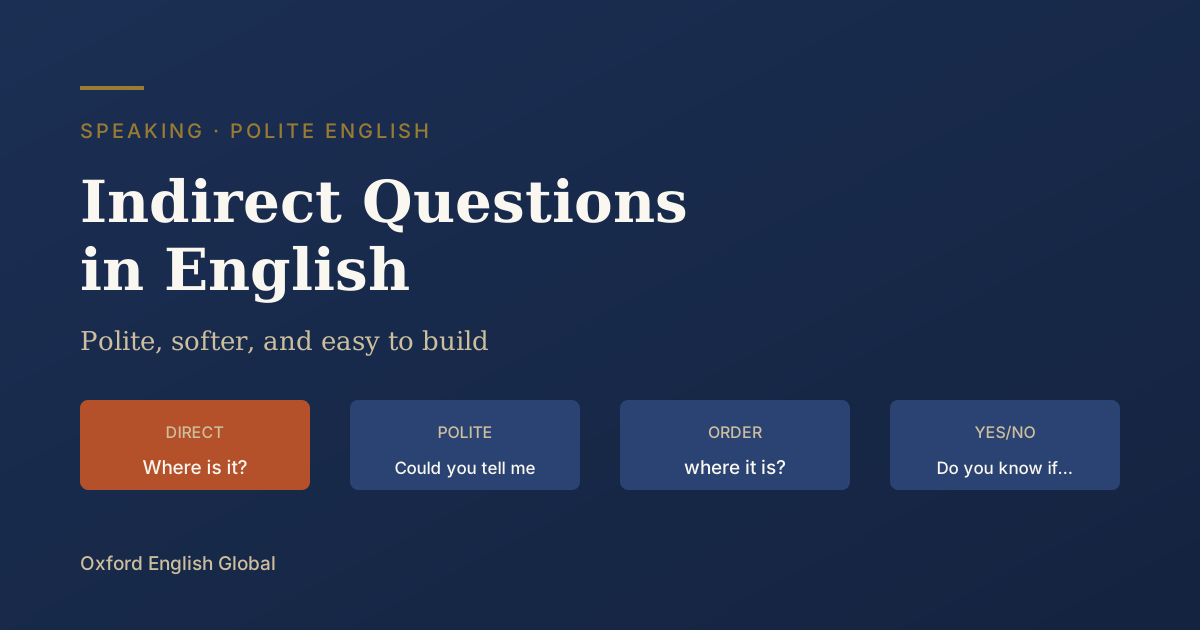
The core rule. Direct: Where is the station? (verb before subject) → Indirect: Could you tell me where the station is? (subject before verb). The indirect part sounds like a statement.
Why indirect questions sound more polite
English often shows politeness through distance: longer, less direct forms sound softer. A direct question such as What time does the shop close? is perfectly fine with friends or when the situation is clearly informal. With strangers, colleagues you don't know well, customers or anyone in a position of authority, an indirect form sounds friendlier and more respectful:
| Direct (neutral or abrupt) | Indirect (polite) |
|---|---|
| Where is the station? | Could you tell me where the station is? |
| What time does the shop close? | Do you know what time the shop closes? |
| How much does it cost? | Could you tell me how much it costs? |
| When will the report be ready? | I was wondering when the report will be ready. |
| Is the manager available? | Do you know if the manager is available? |
Indirect questions are also useful when you are not sure the other person knows the answer: Do you know…? politely allows them to say Sorry, I don't.
How to form indirect questions in three steps
Take any direct question and follow these steps.
- Choose an opening phrase, such as Could you tell me…, Do you know… or Can you remember….
- Keep the question word (where, what, when, why, how, who, which, how much).
- Change the rest into statement order: subject + verb. Remove do/does/did and put the tense back on the main verb.
Questions with "be", modal verbs and auxiliaries
Move the verb after the subject:
- Where is the toilet? → Could you tell me where the toilet is?
- When can we start? → Do you know when we can start?
- Why has the flight been delayed? → Could you tell me why the flight has been delayed?
- What are they doing? → Do you know what they are doing?
Questions with "do", "does" and "did"
Remove the auxiliary and change the main verb:
- What time does the museum open? → Do you know what time the museum opens?
- Where did you buy that? → Can I ask where you bought that?
- How do I get to the airport? → Could you tell me how I get to the airport? (or, very naturally: how to get to the airport)
Questions where the question word is the subject
If who or what is already the subject, the word order does not change:
- Who won the match? → Do you know who won the match?
- What happened? → Can you tell me what happened?
Yes/no questions: use "if" or "whether"
Yes/no questions have no question word, so add if or whether:
- Is this seat free? → Do you know if this seat is free?
- Does the price include breakfast? → Could you tell me whether the price includes breakfast?
- Have you received my email? → I was wondering if you had received my email.
If is more common in speech. Whether is slightly more formal and is the usual choice with or not: Could you let me know whether or not the meeting is going ahead?
The best opening phrases, from casual to very formal
| Opening phrase | Tone | Example |
|---|---|---|
| Do you know…? | Neutral, everyday | Do you know where the nearest pharmacy is? |
| Can you tell me…? | Neutral | Can you tell me what time the next bus leaves? |
| Could you tell me…? | Polite | Could you tell me how much this costs? |
| Do you happen to know…? | Polite, friendly | Do you happen to know if there's a cash machine near here? |
| Can I ask…? / May I ask…? | Polite; useful for personal questions | May I ask why you decided to leave your last job? |
| I was wondering… | Very polite, tentative | I was wondering if you could help me with this form. |
| Would you mind telling me…? | Very polite | Would you mind telling me when the results will be available? |
| Could you let me know…? | Polite; common in emails | Could you let me know whether the invoice has been paid? |
| I'd like to know… / I'd be grateful if you could tell me… | Formal, written | I'd be grateful if you could tell me when my order will be dispatched. |
Question mark or full stop?
If the opening phrase is a question (Could you tell me…, Do you know…), use a question mark. If it is a statement (I was wondering…, I'd like to know…), use a full stop: I was wondering if you could help me.
Indirect questions in real situations
Travelling and asking for directions
- "Excuse me, could you tell me where the station is?"
- "Do you know if this bus goes to the city centre?"
- "Do you happen to know how long it takes to walk there?"
At work
- "Could you let me know when you've had a chance to review the draft?"
- "I was wondering whether we could move the meeting to Thursday."
- "Do you know who is responsible for the budget this year?"
Indirect questions are essential in professional emails. Our guide to writing work emails in English shows more polite request patterns.
Shops, hotels and services
- "Could you tell me whether breakfast is included?"
- "Would you mind telling me how the cancellation policy works?"
Job interviews
At the end of an interview, candidates are usually invited to ask questions. Indirect forms sound professional: "Could you tell me what a typical day in this role looks like?" or "I was wondering how you measure success in the first six months." See our guide to job interviews in English for more.
Small talk
With new acquaintances, a personal question can feel too direct. "Can I ask where you're from originally?" sounds friendlier than "Where are you from originally?" Our guide to small talk in English has more ways to keep conversations comfortable.
Common mistakes with indirect questions
| Mistake | Correction | Why |
|---|---|---|
| Could you tell me where is the station? | Could you tell me where the station is? | Statement order after the question word |
| Do you know what time does the shop close? | Do you know what time the shop closes? | Remove does; add -s to the verb |
| Can you tell me where did you park? | Can you tell me where you parked? | Remove did; use the past form |
| Do you know is the manager here? | Do you know if the manager is here? | Add if/whether for yes/no questions |
| I was wondering if you could help me? | I was wondering if you could help me. | The opening is a statement, so use a full stop |
| Could you tell me how much costs it? | Could you tell me how much it costs? | Subject before verb |
The first two mistakes are by far the most common. They happen because the learner keeps the word order of the direct question. Say the indirect part on its own: where the station is sounds like the end of a statement, and that is exactly what you want.
Related structures: reported questions and question tags
Indirect questions use the same word order as reported questions: She asked me where the station was. The difference is that reported questions describe what someone asked in the past and usually shift the tense back. Our guide to reported speech covers this in detail.
Another way to soften a question, especially when you expect agreement, is a question tag: You couldn't help me with this, could you? See our guide to English question tags.
Polite requests also use modal verbs (could, would, might). Our article on modal verbs explains why Could you…? sounds softer than Can you…?
Practice: make these questions polite
Rewrite each direct question using the opening in brackets.
- Where is the post office? (Could you tell me…)
- What time does the train leave? (Do you know…)
- Is there a lift in this building? (Do you know…)
- Why did they cancel the event? (Can I ask…)
- How much does a return ticket cost? (Could you tell me…)
- Will the package arrive before Friday? (I was wondering…)
- Who is in charge of bookings? (Do you happen to know…)
- Have you finished the report? (Could you let me know…)
Answers:
- Could you tell me where the post office is?
- Do you know what time the train leaves?
- Do you know if there is a lift in this building?
- Can I ask why they cancelled the event?
- Could you tell me how much a return ticket costs?
- I was wondering if the package will arrive before Friday.
- Do you happen to know who is in charge of bookings?
- Could you let me know whether you have finished the report?
Speaking challenge: next time you ask a stranger for help, use one indirect question and notice the reaction. For more speaking routines, read our guide to practising speaking without a partner.
What this article cannot tell you
- Exactly how polite you need to be. Politeness depends on culture, relationship and setting. Very indirect forms can sound overly formal between friends.
- Intonation. Tone of voice matters as much as grammar. A friendly, rising-then-falling tone makes any request sound warmer; a flat tone can make even a polite form sound cold. Our Speaking Lab lets you practise pitch and intonation.
- Personal feedback. For corrections on your own speaking, try our free lessons or a structured course.
Frequently asked questions
What is an indirect question?
An indirect question is a polite way of asking for information. It starts with a phrase such as Could you tell me or Do you know, followed by the question in statement word order: Could you tell me where the station is?
What is the word order in indirect questions?
After the question word, use subject plus verb, as in a statement. Say Do you know what time the shop closes?, not Do you know what time does the shop close?
How do I make a yes/no question indirect?
Add if or whether: Is this seat free? becomes Do you know if this seat is free?
Do indirect questions need a question mark?
Only if the opening phrase is a question, such as Could you tell me or Do you know. If it is a statement, such as I was wondering, use a full stop.
Are indirect questions always more polite?
They usually sound more polite and less direct, which suits strangers, customers and work situations. With close friends, very indirect forms can sound overly formal.