
English Question Tags: Rules, Examples and Common Mistakes
It's simple, isn't it? Question tags turn a statement into a question and keep conversations moving. This guide explains how to form them in every tense, how intonation changes their meaning, the tricky exceptions, how to answer them and the mistakes learners make most often.

- What are question tags?
- The basic rule: auxiliary + pronoun, opposite polarity
- Question tags in every tense
- Intonation: rising or falling changes the meaning
- Special cases and exceptions
- Same-way tags: positive + positive
- How to answer a question tag
- Common learner mistakes
- Practice: add the correct tag
- How to start using question tags naturally
- What this article cannot tell you
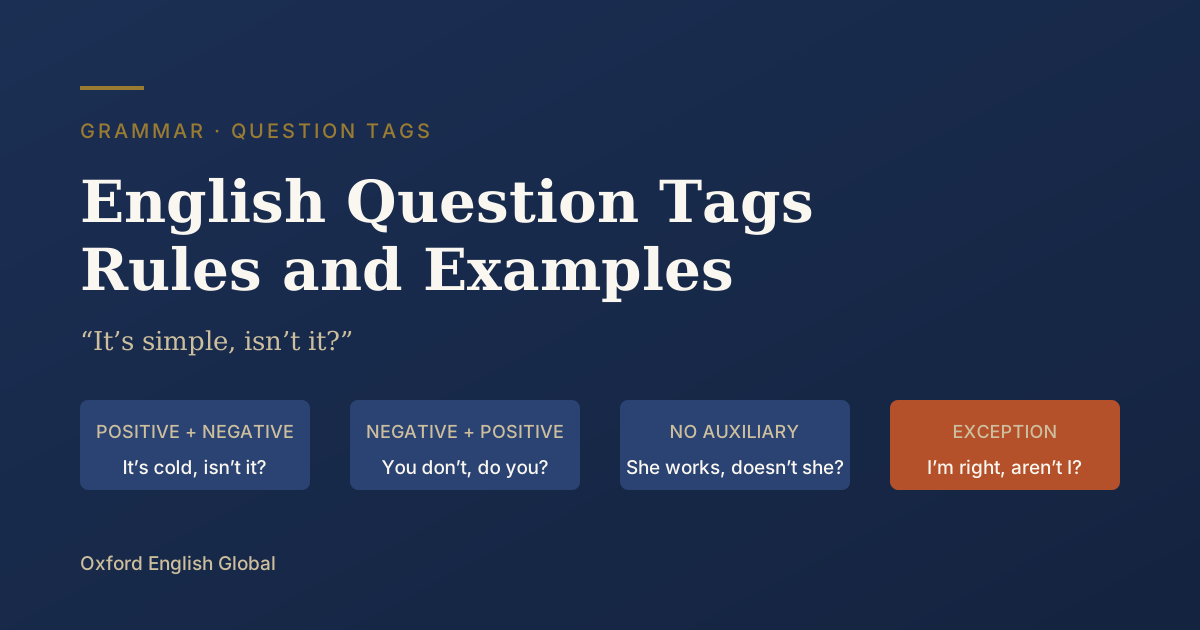
A question tag is a short question added to the end of a statement, such as isn't it?, don't you? or can she? To make one, repeat the auxiliary verb from the statement (or use do, does or did if there is none), add the subject as a pronoun, and reverse the polarity: a positive statement takes a negative tag, and a negative statement takes a positive tag. So we say It's cold today, isn't it? and You don't eat meat, do you? The meaning then depends on your voice: with a falling intonation you expect the listener to agree, and with a rising intonation you are really asking. This guide explains the rules step by step, the tricky exceptions such as I'm right, aren't I? and Let's go, shall we?, the mistakes learners make most often, and a short practice exercise.
Quick reference. Rules in this guide follow standard British and American usage as described in reference grammars such as Cambridge Dictionary's English Grammar Today: Tags. Where British and American speakers differ, we say so.
What are question tags?
A question tag (also called a tag question or tail question) turns a statement into a question without changing its word order. Instead of asking Is it cold today?, you make a statement and add a small question at the end: It's cold today, isn't it?
Speakers use question tags for two main reasons:
- To check information they are not sure about: The meeting starts at ten, doesn't it? (I think so, but please confirm.)
- To invite agreement or keep a conversation going: Lovely weather, isn't it? (I know it is lovely; I want you to join in.)
Question tags are very common in spoken English, especially in British English, and much less common in formal writing. You will hear them in meetings, shops, on the phone and in almost every small talk conversation.
The basic rule: auxiliary + pronoun, opposite polarity
Every question tag has the same three-part structure:
- The auxiliary or modal verb from the main statement (be, have, do, can, will, should and so on).
- A subject pronoun that refers to the subject of the statement (I, you, he, she, it, we, they, there).
- The opposite polarity: positive statement → negative tag; negative statement → positive tag.
| Statement | Polarity | Tag |
|---|---|---|
| You're from Brazil, | positive → negative | aren't you? |
| She isn't coming, | negative → positive | is she? |
| They've finished, | positive → negative | haven't they? |
| He can drive, | positive → negative | can't he? |
| We won't be late, | negative → positive | will we? |
| You should call her, | positive → negative | shouldn't you? |
Negative tags are almost always contracted in normal speech: isn't it?, not is not it? The full form is it not? exists but sounds very formal or emphatic.
Question tags in every tense
The key is to find the first auxiliary verb in the statement. If there is no auxiliary (present simple and past simple with ordinary verbs), use do, does or did in the tag, just as you would in a normal question.
| Tense | Positive statement + negative tag | Negative statement + positive tag |
|---|---|---|
| Present simple (be) | It's expensive, isn't it? | It isn't far, is it? |
| Present simple (other verbs) | You work here, don't you? She lives in Leeds, doesn't she? | You don't smoke, do you? He doesn't know, does he? |
| Present continuous | You're joking, aren't you? | It isn't raining, is it? |
| Past simple (be) | The film was good, wasn't it? | They weren't there, were they? |
| Past simple (other verbs) | You called him, didn't you? | She didn't reply, did she? |
| Present perfect | You've met Anna, haven't you? | He hasn't left yet, has he? |
| Past perfect | They'd already eaten, hadn't they? | You hadn't seen it, had you? |
| Future with will | You'll help me, won't you? | It won't take long, will it? |
| Going to | It's going to rain, isn't it? | You aren't going to quit, are you? |
| Modals | We should leave, shouldn't we? She could come, couldn't she? | I can't park here, can I? You mustn't tell anyone, must you? |
Notice that will not contracts to won't, so the tag after a positive will statement is won't you?, not willn't you? If you need to review the tenses themselves, see our guide to all 12 English tenses and our explanation of present perfect vs past simple.
Intonation: rising or falling changes the meaning
The same tag can be a real question or a request for agreement. The difference is in your voice, not in the words.
| Intonation | What it means | Example | Typical answer |
|---|---|---|---|
| Falling ↘ | "I'm fairly sure. Please agree." | It's a beautiful day, ↘isn't it? | Yes, it's lovely. |
| Rising ↗ | "I'm not sure. Please tell me." | The train leaves at six, ↗doesn't it? | Yes, it does. / No, it leaves at half past. |
A useful rule of thumb: if you already know the answer, let your voice go down. If you genuinely need information, let it go up. Using a falling tone when you really need to check something can sound as if you are telling rather than asking. You can practise this pitch movement in our free Speaking Lab, which shows your intonation as you speak.
Special cases and exceptions
I am → aren't I?
There is no common contraction amn't in standard English, so after I am the negative tag is aren't I?
- I'm late, aren't I?
- The negative statement is regular: I'm not late, am I?
Imperatives → will you? / won't you? / can you?
After an instruction or request, the tag is usually will you?, would you?, can you? or could you? Tags make an imperative softer or, with a sharp tone, more impatient.
- Close the door, will you?
- Pass me the salt, could you? (more polite)
- Don't forget, will you? (after a negative imperative, use will you?)
- Have some more cake, won't you? (a friendly invitation)
Let's → shall we?
Suggestions with let's take the tag shall we?
- Let's get a coffee, shall we?
- Let's not argue, shall we?
In American English, shall is less common, and speakers often avoid the tag or say okay? instead.
There is / there are → isn't there? / aren't there?
When the subject is there, it stays there in the tag.
- There's a problem, isn't there?
- There weren't many people, were there?
This, that, these, those → it / they
Use it for this and that, and they for these and those.
- That was easy, wasn't it?
- These are yours, aren't they?
Everyone, someone, nobody → they
Indefinite pronouns for people take they in the tag, even though the verb in the statement is singular. Indefinite pronouns for things (everything, nothing, something) take it.
- Everyone's here, aren't they?
- Somebody called, didn't they?
- Nothing happened, did it?
Negative words without "not" → positive tag
Words such as never, nobody, nothing, hardly, rarely, seldom, scarcely, no one make a statement negative in meaning, so the tag is positive.
- You never call me, do you?
- She hardly said a word, did she?
- Nobody saw us, did they?
Have as a main verb
When have means possession, most speakers (and all American speakers) use do in the tag: You have a car, don't you? With have got, use have: You've got a car, haven't you? The tag You have a car, haven't you? is heard in some British English but is now old-fashioned.
Used to → didn't
You used to live in Madrid, didn't you?
Had better → hadn't
We'd better go, hadn't we? Here 'd means had, not would.
Same-way tags: positive + positive
Sometimes speakers use a positive tag after a positive statement. This is not a mistake, but it has a different meaning: it shows surprise, interest or sometimes sarcasm. It is not used to ask for information.
- So you're moving to Canada, are you? (interest: "That's news to me.")
- Oh, you think that's funny, do you? (annoyance or sarcasm)
Negative + negative tags (You don't like it, don't you?) are not used in standard English. Avoid them.
How to answer a question tag
Many learners find the answers harder than the tags. The rule is simple: answer about the facts, not about the grammar of the question. If the fact is positive, say yes; if it is negative, say no.
| Question | The fact is… | Correct answer |
|---|---|---|
| You're not tired, are you? | I am tired | Yes, I am. (Yes, actually I'm exhausted.) |
| You're not tired, are you? | I'm not tired | No, I'm not. |
| You've been to Rome, haven't you? | I have been | Yes, I have. |
| You've been to Rome, haven't you? | I haven't been | No, I haven't. |
Speakers of languages where you answer "yes, that's right" to a negative question often reverse this. Adding a short auxiliary (Yes, I am / No, I'm not) makes your meaning clear even if the yes or no comes out wrong.
Common learner mistakes
| Wrong | Correct | Why |
|---|---|---|
| You like coffee, isn't it? | You like coffee, don't you? | The tag must match the verb and subject. Isn't it? is not a universal tag in standard English (though it is common in some varieties, such as Indian English). |
| She lives here, don't she? | She lives here, doesn't she? | Third person singular uses does. |
| He went home, didn't went he? | He went home, didn't he? | The tag only has an auxiliary + pronoun. No main verb. |
| Your sister is a doctor, isn't your sister? | Your sister is a doctor, isn't she? | Use a pronoun, not the noun. |
| I'm right, amn't I? | I'm right, aren't I? | Amn't is not standard (it is used in some Scottish and Irish English). |
| You never listen, don't you? | You never listen, do you? | Never makes the statement negative, so the tag is positive. |
| Let's start, don't we? | Let's start, shall we? | Let's always takes shall we? |
| You can swim, can you? | You can swim, can't you? | To check information, use opposite polarity. (Same-way tags express surprise.) |
For more errors of this kind, see our list of 20 common English grammar mistakes and our guide to modal verbs.
Practice: add the correct tag
Write the tag, then check your answers below.
- You're coming to the party, ______?
- She doesn't speak French, ______?
- They've already left, ______?
- I'm on the list, ______?
- Let's take a break, ______?
- Nobody phoned, ______?
- He used to work in a bank, ______?
- Don't be late, ______?
- There isn't any milk, ______?
- You'd rather stay at home, ______?
Answers: 1. aren't you? 2. does she? 3. haven't they? 4. aren't I? 5. shall we? 6. did they? 7. didn't he? 8. will you? 9. is there? 10. wouldn't you? ('d rather = would rather).
How to start using question tags naturally
Knowing the rule is one thing; producing a tag in under a second in conversation is another. These steps help move question tags from your notebook into your speech:
- Learn a few as fixed chunks first. Isn't it? Don't you? Aren't you? Didn't you? Haven't you? cover a large share of everyday use. Say them as one word: /ˈɪzn̩t ɪt/, /ˈdəʊntʃə/. Our guide to learning English in chunks explains why this works.
- Start with falling tags in small talk. Comments about the weather, the food or the venue (Busy today, isn't it?) are low-risk and invite an easy reply.
- Shadow native speakers. Listen for tags in TV series or podcasts and repeat the line with the same intonation. Our list of podcasts for language learning is a good place to start.
- Check your own speech. Record a two-minute conversation, then count how many tags you used and whether the polarity was correct.
What this article cannot tell you
- Every regional variety. Question tag use varies across English-speaking regions. Invariant tags such as isn't it?, innit?, right? and eh? are normal in some varieties and informal registers. This guide describes standard British and American usage, which is what most exams expect.
- Exact frequency. We describe question tags as very common in speech, especially in British English, but we do not give percentages here, because frequency depends on the corpus, region and type of conversation studied.
- Your level and needs. If you are preparing for an exam, check your exam's speaking criteria. Our English level test can show you where to start.
This page is independent guidance from Oxford English Global. It contains no affiliate or sponsored links. For structured practice with a teacher, see our courses or start with our free lessons.
Frequently asked questions
How do you form a question tag in English?
Take the auxiliary or modal verb from the statement (or do, does or did if there is none), add a subject pronoun, and reverse the polarity. A positive statement gets a negative tag (You're ready, aren't you?) and a negative statement gets a positive tag (You aren't ready, are you?).
What is the question tag for I am?
Use aren't I? after a positive statement with I am, for example I'm late, aren't I? After a negative statement, use am I?, as in I'm not late, am I?
What is the question tag for let's?
Suggestions with let's take shall we?, for example Let's go for a walk, shall we? This is the usual form in British English; American speakers often use okay? or no tag at all.
Does intonation change the meaning of a question tag?
Yes. A falling intonation means you expect the listener to agree, so it is not a real question. A rising intonation means you are not sure and want information.
How do I answer a negative question tag like You're not tired, are you?
Answer about the facts. If you are tired, say Yes, I am. If you are not tired, say No, I'm not. Adding the short auxiliary makes your meaning clear.