
How to Write Clear Work Emails in English: Structures, Phrases and Mistakes
A clear work email says why you are writing in the first two lines and ends with one specific action and a deadline. Here is a simple structure for any email, patterns for requests, follow-ups, updates, refusals, apologies and meeting requests, polite phrases at three levels of formality, and the common mistakes to avoid.

- What a clear work email looks like
- Subject lines that tell the reader what to do
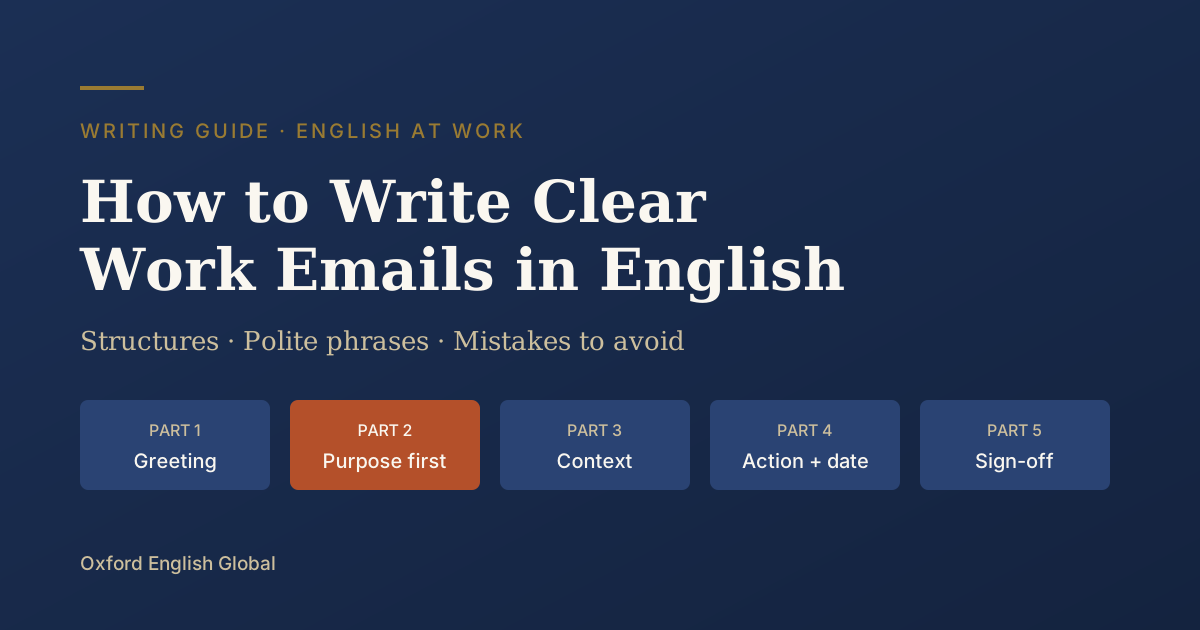
- The five-part structure for any work email
- Ready structures for six common emails
- Polite phrases: direct, neutral and softened
- Greetings and sign-offs
- Common mistakes to avoid
- A two-minute check before you press send
- How to practise writing better emails
- What this article cannot tell you
A clear work email in English says why you are writing in the first two lines, gives only the context the reader needs, and ends with one specific action and a deadline. Use a subject line that names the topic and the action, keep sentences short, put one idea in each paragraph, and soften requests with polite forms such as "Could you…?" or "Would it be possible to…?". Most problems in workplace emails come not from grammar but from structure (the main point is hidden) and tone (the message sounds too direct or too formal). This guide gives you a simple structure for any email, ready-made patterns for six common situations, polite phrases at different levels of formality, and the mistakes to check before you press send.
Checked on 9 November 2026. The writing principles on this page follow the US Office of Personnel Management's plain language guidance, which recommends common words, active voice, logical organisation and an average sentence length of 15–20 words. Word meanings and usage labels come from the Cambridge Dictionary. Email conventions vary between companies, industries and countries, so follow your own organisation's style where it differs.
What a clear work email looks like
Your reader is busy, may read on a phone, and may not be a native speaker either. A clear email lets them understand three things in a few seconds: what this is about, what you need from them, and by when.
The OPM plain language guidance describes the qualities that make writing easy to read. Applied to email, they become five rules:
- Put the purpose first. The guidance says to organise content to answer your readers' questions. The first question is always "Why are you writing to me?"
- Keep sentences short. Aim for an average of 15–20 words. If a sentence has two "and"s and a "which", split it.
- One topic per paragraph. If an email covers two unrelated topics, consider sending two emails so each can be answered and filed separately.
- Use active voice and personal pronouns. "We will send the contract on Friday" is clearer than "The contract will be sent on Friday", because it says who is responsible.
- Use common words. Write "start" rather than "commence", "help" rather than "facilitate", "about" rather than "with regard to".
Here is the same request written two ways:
Unclear: "Further to our discussion in the meeting last week regarding the various issues that were raised concerning the Q3 budget, which as you know has been under review for some time, I wanted to touch base to see whether it might be possible at some point to get an updated version of the figures, if that is not too much trouble."
Clear: "Could you send me the updated Q3 budget figures by Thursday? I need them for the finance review on Friday morning."
The second version is shorter, but more importantly it puts the request first and gives a reason and a deadline.
Subject lines that tell the reader what to do
The subject line is the first thing your reader sees and the way they will search for your email later. A good subject line names the topic and, where possible, the action or deadline.
| Weak subject line | Clear subject line |
|---|---|
| Question | Question about invoice 4521: wrong delivery address |
| Meeting | Request: 30-minute call next week about the website launch |
| Update | Project Atlas: testing finished, launch still on 3 December |
| Urgent!!! | Action needed by 4 pm today: approve final price list |
| Documents | Signed contract and onboarding forms for Ana Silva |
Avoid writing a whole email in the subject line, and avoid words like "Urgent" in capital letters unless something really is urgent. Saying what is needed and by when is clearer and more polite.
The five-part structure for any work email
Almost every workplace email can follow the same five parts. Once you know them, you will spend less time deciding what to write and more time on the content.
| Part | What it does | Example |
|---|---|---|
| 1. Greeting | Addresses the reader at the right level of formality | "Hi Tom," / "Dear Ms Okafor," |
| 2. Purpose line | Says why you are writing, in one sentence | "I'm writing to ask for your approval on the new supplier contract." |
| 3. Context | Gives only the background the reader needs to act | "The contract is the same as last year's, except for a 3% price increase in section 4." |
| 4. Action and deadline | Says exactly what you need, from whom, by when | "Could you sign and return it by Wednesday 18 November?" |
| 5. Closing and sign-off | Offers help and ends politely | "Let me know if you have any questions. Best regards, Leila" |
For longer emails, you can add short headings or a numbered list in part 3, and repeat the action at the end. If you ask more than one question, number them so the reader can answer each one.
Ready structures for six common emails
The patterns below follow the five-part structure. Change the details and they work for most everyday situations.
1. Making a request
Hi Marta,
Could you share the latest sales report for the Northern region? I'm preparing the quarterly summary for the leadership meeting on Monday, and I need the October figures. If you could send it by Friday midday, that would be a great help.
Thanks in advance,
Daniel
Pattern: request + reason + deadline + thanks.
2. Following up when you have had no reply
Hi Marta,
I'm just following up on my email below about the Northern region sales report. Would you be able to send it by tomorrow? If someone else is now responsible for it, could you let me know who to contact?
Many thanks,
Daniel
Pattern: reference to the earlier email + the request again + an easy alternative. Avoid "As per my last email", which many readers find impatient.
3. Giving a project update
Hi all,
Quick update on the website launch: we are still on track for 3 December.
- Done: testing on desktop and mobile
- In progress: final copy checks (Aisha, by 25 November)
- Risk: payment page approval from the bank, expected next week
I'll send the next update on Monday. Let me know if you have any questions.
Best,
Kenji
Pattern: headline status first + short list + next step.
4. Saying no or giving bad news
Dear Mr Rossi,
Thank you for your request to extend the payment deadline. I'm afraid we are not able to offer an extension this time, as the invoice is already 30 days overdue. However, we can split the remaining amount into two payments, on 30 November and 15 December. Please let me know if this would work for you.
Kind regards,
Sofia Lind
Pattern: thanks + softened "no" + short reason + an alternative.
5. Apologising for a mistake
Hi Priya,
I'm sorry: the file I sent this morning was the old version. Please find the correct version attached. The only changes are on pages 3 and 7. Apologies for any confusion.
Best regards,
Omar
Pattern: short apology + correction + what changed. Keep it brief. A long apology draws more attention to the mistake.
6. Asking for a meeting
Hello Dr Chen,
I'd like to arrange a 30-minute call to discuss the research partnership we spoke about at the conference. Would any of these times suit you?
- Tuesday 17 November, 10:00–10:30 (UK time)
- Wednesday 18 November, 14:00–14:30 (UK time)
If neither works, I'm happy to fit around your schedule.
Kind regards,
Hannah Weber
Pattern: purpose + length + specific options with time zone + flexibility.
Polite phrases: direct, neutral and softened
English workplace emails often use indirect forms to sound polite. A direct imperative such as "Send me the report" can sound rude in English even when it is normal in your first language. The table shows how to soften common functions. The middle column is a safe default for most colleagues and clients.
| Function | Too direct | Neutral and polite | Extra soft (senior or new contacts) |
|---|---|---|---|
| Asking for something | Send me the file. | Could you send me the file? | Would it be possible to send me the file? |
| Asking for a deadline | I need it today. | Could you send it by 5 pm today? | Would you be able to send it by the end of today? |
| Disagreeing | That's wrong. | I'm not sure that's correct. The figure I have is 12%. | I may be missing something, but my figure is 12%. |
| Pointing out a problem | You forgot the attachment. | I think the attachment may be missing. | It looks like the attachment didn't come through. |
| Refusing | No, we can't. | I'm afraid we can't do that this month. | Unfortunately, we aren't able to do that at the moment. |
| Reminding | You haven't replied. | Just a reminder about my email below. | I wanted to check whether you had a chance to look at this. |
| Offering help | Ask if you don't understand. | Let me know if you have any questions. | Please don't hesitate to contact me if anything is unclear. |
Do not over-soften, though. Three or four polite phrases in one sentence ("I was just wondering if it might possibly be OK to perhaps…") makes the request hard to find and can sound unsure. One softener per request is usually enough.
For phrases for meetings, calls and negotiation as well as email, see our complete guide to Business English.
Greetings and sign-offs
| Situation | Greeting | Sign-off |
|---|---|---|
| Colleague you work with often | Hi Sam, | Thanks, / Best, |
| Client or colleague you know a little | Hello Sam, / Hi Sam, | Best regards, / Kind regards, |
| Formal or first contact, name known | Dear Ms Patel, / Dear Dr Kim, | Kind regards, / Yours sincerely, |
| Formal, name unknown | Dear Sir or Madam, / Dear Hiring Manager, | Yours faithfully, (British) / Kind regards, |
| Group email | Hi all, / Hello everyone, / Dear colleagues, | Best, / Kind regards, |
The Cambridge Dictionary defines "Yours faithfully" as "used at the end of a formal letter beginning with 'Dear Sir' or 'Dear Madam'" (read 9 November 2026). In email, "Kind regards" is now common in most formal situations.
Two tips: match the other person's style when they reply (if they write "Hi" and sign with their first name, you can usually do the same), and if you are not sure how to address someone, use their full name ("Dear Alex Morgan,") rather than guessing a title.
Common mistakes to avoid
These mistakes appear often in emails written by learners of English. Most are easy to fix once you know them.
| Mistake | Why it is a problem | Better |
|---|---|---|
| "Please revert by Friday." | The Cambridge Dictionary labels "revert" meaning "to reply" as Indian English. Many international readers know "revert" only as "go back to a previous state". | "Please reply by Friday." / "Please let me know by Friday." |
| "Please send me the informations." | "Information" is uncountable, like "advice", "feedback" and "equipment". | "Please send me the information." |
| "We need to discuss about the plan." | "Discuss" takes a direct object, with no "about". | "We need to discuss the plan." |
| "I will eventually join the call." | In English, "eventually" means "in the end, after a long time", not "possibly". This is a false friend for speakers of many European languages. | "I may join the call." / "I might be able to join." |
| "Waiting for your reply." | As a sentence on its own, it can sound impatient. | "I look forward to hearing from you." |
| The request is in the last paragraph | The reader may not reach it, or may miss it. | Put the request in the first two lines. |
| One long paragraph | Hard to read on a phone; points get lost. | Short paragraphs, one idea each; lists for steps or options. |
| Writing in CAPITALS for emphasis | Usually read as shouting. | Use bold sparingly, or say "This is important because…". |
| Vague time references: "soon", "ASAP", "next week" | Different readers understand them differently. | Give a day and date: "by Thursday 19 November". |
| "Dear Sir," to a person whose name you know | Sounds impersonal or copied from a template. | "Dear Mr Garcia," or "Hello Luis," |
For more on grammar patterns that appear in professional writing, our guide to 100 English sentence structures is a useful reference.
A two-minute check before you press send
- Subject line: Does it name the topic and the action?
- First two lines: Can the reader see why you are writing?
- Action: Is it clear who should do what, and by when?
- Length: Can you delete a sentence without losing meaning? If so, delete it.
- Tone: Read your requests aloud. Would you say them this way to the person's face?
- Names, dates and numbers: Check them twice. These are the errors that cause real problems.
- Attachments: If you wrote "attached", is the file attached?
- Recipients: Does everyone in "To" need to act? Should some people be in "Cc" instead, or not included at all?
How to practise writing better emails
- Build your own template file. Save the patterns above in a document and adapt them for the emails you send most often.
- Collect phrases from good emails you receive. When a colleague or client writes something that is clear and polite, copy the phrase into your file. Learn whole phrases, not single words. Our guide to learning vocabulary in chunks explains why.
- Rewrite one real email a week. Take an email you sent, remove anything confidential, and rewrite it using the five-part structure. Compare the two versions.
- Practise the same message at two levels of formality. Write a request once for a close colleague and once for a senior client. This trains your sense of register.
- Get feedback. A teacher or a colleague with strong English can tell you how your tone comes across, which is hard to judge yourself.
For a longer reference, our free Complete Business English Handbook covers emails, meetings and presentations from B1 to C2, and our guide to Business English materials explains which books and resources to use. If you want structured help with feedback, see our English courses or start with the free lessons.
What this article cannot tell you
- Your company's own rules. Many organisations have a house style for greetings, sign-offs, signatures and formality. Where it differs from this guide, follow your organisation.
- Every culture's expectations. Ideas of politeness and directness vary between countries and industries. Some readers expect more formality than we suggest here, and some expect less. Watch how your colleagues and clients write and adapt.
- Legal or contractual wording. Emails about contracts, complaints or employment can have legal consequences. For those, ask your legal or HR team to check the wording.
- Your personal level. The patterns here work from about B1 upwards. If you are not sure of your level, try our English level test first.
This page is independent guidance from Oxford English Global. It contains no affiliate links, and we receive nothing from any organisation or publisher mentioned.
Frequently asked questions
How do I start a work email in English?
Start with a greeting that matches the relationship, such as "Hi Tom," for a colleague or "Dear Ms Okafor," for a formal first contact, then state your purpose in one sentence: "I'm writing to ask for your approval on the new supplier contract." Readers should know why you are writing within the first two lines.
How can I make my emails sound polite but not too formal?
Turn direct instructions into questions with could or would, for example "Could you send me the file?" instead of "Send me the file." Add a short reason and a clear deadline. Use one softener per request; piling up phrases such as "I was just wondering if it might possibly be OK" makes the request hard to find.
What is the best way to end a professional email?
End with a clear next step or an offer of help, such as "Let me know if you have any questions," followed by a sign-off. "Best regards" or "Kind regards" works in most situations. In British usage, "Yours faithfully" is used after "Dear Sir or Madam", and "Yours sincerely" after a named greeting in formal letters.
Is it correct to write "please revert" in an email?
The Cambridge Dictionary labels "revert" in the sense of "to reply" as Indian English, so many international readers will not understand it that way. In international emails, "Please reply by Friday" or "Please let me know by Friday" is clearer.
How long should a work email be?
As short as it can be while still giving the reader what they need to act. Most routine emails fit in three short paragraphs or fewer. US government plain language guidance recommends an average sentence length of 15 to 20 words and one topic per paragraph, which is a good target for work email too.