
Modal Verbs Can, Could, May, Might and Must: Ability, Permission, Possibility and Obligation
Modal verbs add meaning to a main verb. This guide explains can and could for ability, can, could and may for permission, may, might and could for possibility, and must for obligation and deduction, with tables, past forms, common mistakes and a practice exercise.

- What modal verbs are and their grammar rules
- Ability: can and could
- Permission: can, could and may
- Possibility: may, might, could and can
- Obligation: must and have to
- Deduction: must, might and can't for being sure
- Talking about the past: a summary
- The most common learner mistakes
- Practice: choose the best modal
- How to practise modal verbs
- What this article cannot tell you
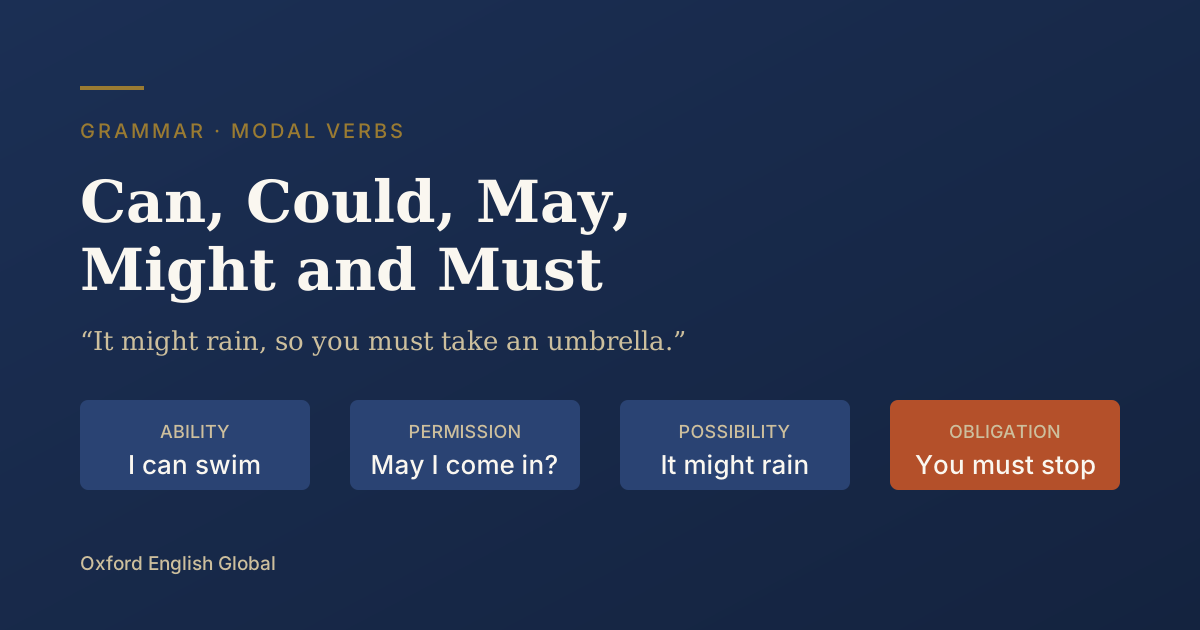
Can, could, may, might and must are modal verbs: helping verbs that add meaning to a main verb. Use can and could for ability (I can swim); can, could and may for permission (Can I sit here? May I come in?); may, might and could for possibility (It might rain); and must for strong obligation or a confident conclusion (You must wear a seatbelt. She must be tired). Modal verbs follow simple grammar rules: they never change form, they are followed by the base form of a verb without to, and they make questions and negatives without do. This guide explains each meaning with clear examples, compares the verbs in tables, shows how to talk about the past, and ends with a practice exercise.
The four meanings in one line each: Ability: can, could. Permission: can, could, may. Possibility: may, might, could (and can for general possibility). Obligation and deduction: must (and have to).
What modal verbs are and their grammar rules
A modal verb shows the speaker's attitude to an action: whether it is possible, allowed, necessary or certain. The Cambridge Grammar of English lists the core modals as can, could, may, might, will, would, shall, should, must. This guide covers five of them.
All five follow the same rules:
| Rule | Correct | Wrong |
|---|---|---|
| No -s with he, she, it | She can drive. | She cans drive. |
| Base verb without to | You must go. | You must to go. |
| No do in questions | Can you help me? | Do you can help me? |
| Add not for negatives | I can't swim. You mustn't park here. | I don't can swim. |
| Only one modal at a time | I will be able to come. | I will can come. |
| No -ing or to- form | I'd like to be able to cook. | I'd like to can cook. |
Contractions: can't (or cannot, written as one word), couldn't, mightn't (rare; most people say might not), mustn't. May not is not normally contracted.
Ability: can and could
Use can for ability in the present and could for general ability in the past.
- I can speak three languages.
- Can you read this sign from here?
- She couldn't swim when she was a child, but she can now.
- My grandfather could fix anything.
Could vs was able to
For a single success on one occasion in the past, use was able to or managed to, not could:
- Correct: The exam was difficult, but I was able to finish it.
- Unnatural: The exam was difficult, but I could finish it.
- In the negative, couldn't is fine for one occasion: I couldn't finish the exam.
Other tenses: be able to
Can has no future, perfect or infinitive form, so use be able to: I'll be able to help you tomorrow. I've never been able to sing. I want to be able to speak English at work.
Permission: can, could and may
All three ask for or give permission. The difference is mainly formality.
| Verb | Formality | Asking | Giving / refusing |
|---|---|---|---|
| can | Neutral, informal; most common in speech | Can I open the window? | Yes, you can. / No, you can't. |
| could | More polite; good with strangers and at work | Could I ask you a question? | Answer with can: Yes, of course you can. (not Yes, you could) |
| may | Formal; used in official rules and very polite requests | May I come in? | You may leave when you have finished. Visitors may not take photographs. |
Note that could in Could I...? is not past; it is simply more polite. For polite requests that ask someone else to do something, use Can you...? or Could you...? (Could you send me the file?), not May you. Our guides to writing work emails and formal letters show these phrases in context.
For past permission, use could or was allowed to: When I was young, I could stay up late at weekends. For one specific occasion, prefer was allowed to: I was allowed to leave early yesterday.
Possibility: may, might, could and can
Use may, might and could when something is possible but not certain, now or in the future. In most everyday situations they mean almost the same thing.
- Take an umbrella. It might rain.
- The meeting may finish late.
- "Where's Tom?" "He could be in the library."
| Verb | Typical feeling | Example |
|---|---|---|
| may | Possible; slightly more formal | Prices may increase next year. |
| might | Possible; very common in speech; can sound a little less likely | I might go to the party, I'm not sure. |
| could | Possible; often one option among others | We could be late if the traffic is bad. |
| can | General, theoretical possibility (things that sometimes happen) | English spelling can be confusing. |
Negative possibility: a common trap
The negatives are not all the same:
- He may not / might not come. = Perhaps he will not come.
- He can't / couldn't be at home. = I am sure he is not at home (see deduction below).
Do not use can't to mean "perhaps not". It can't rain today means you are certain it will not rain.
Questions about possibility
In questions, use might, could or a phrase with likely, not may: Do you think it might rain? Could this be the answer? Is he likely to come?
Obligation: must and have to
Use must for strong obligation or necessity, especially when the obligation comes from the speaker, or in written rules.
- I must call my mother tonight. (I feel it is necessary.)
- You must wear a seatbelt.
- Passengers must show their boarding pass. (Written rule.)
Have to has a similar meaning and is more common in everyday speech, especially for obligations that come from outside (laws, rules, other people): I have to work on Saturday. Do you have to wear a uniform?
Mustn't vs don't have to
This is one of the most important differences for learners, because the meanings are very different:
| Form | Meaning | Example |
|---|---|---|
| mustn't | It is not allowed. Don't do it. | You mustn't smoke in the building. |
| don't have to | It is not necessary. You can if you want. | You don't have to come to the meeting. It's optional. |
Past obligation
Must has no past form for obligation. Use had to: I had to work late yesterday. (not I must work late yesterday)
Deduction: must, might and can't for being sure
Modal verbs also show how sure you are about something, based on evidence. This is called deduction or speculation.
| How sure? | Present | Past (modal + have + past participle) |
|---|---|---|
| Almost certain: yes | She must be tired. She's worked twelve hours. | She must have been tired. |
| Possible | He might / may / could be in a meeting. | He might / may / could have missed the train. |
| Almost certain: no | That can't be Anna. She's in Paris. | That can't / couldn't have been Anna. |
Notice that the opposite of must in deduction is can't, not mustn't. He mustn't be at home is wrong for deduction; say He can't be at home.
Talking about the past: a summary
| Meaning | Present | Past |
|---|---|---|
| General ability | can | could |
| Ability on one occasion | can | was able to / managed to (negative: couldn't) |
| Permission | can / may | could / was allowed to |
| Obligation | must / have to | had to |
| Possibility about the past | may / might / could | may / might / could have + past participle |
| Deduction about the past | must / can't | must have / can't have + past participle |
| Criticism or missed chance | - | You could have told me! (You didn't, and you should have.) |
For more on choosing past tenses, see our guides to English tenses and present perfect vs past simple.
The most common learner mistakes
- Adding to: I must to study. Fix: I must study.
- Adding -s: He cans play the guitar. Fix: He can play.
- Using do: Do you can help me? Fix: Can you help me?
- Two modals together: I will can go. Fix: I will be able to go.
- "Must" for past obligation: Yesterday I must leave early. Fix: Yesterday I had to leave early.
- Confusing mustn't and don't have to: You mustn't pay, it's free. Fix: You don't have to pay.
- "Could" for one past success: After three tries I could pass my driving test. Fix: I was able to / managed to pass.
- "Mustn't" for negative deduction: It mustn't be true. Fix: It can't be true.
Several of these are in our list of common English grammar mistakes.
Practice: choose the best modal
Choose the best option. Answers are below.
- When I was five, I (can / could) read.
- (May / Must) I use your phone, please?
- Take a jacket. It (might / must) get cold later.
- You (mustn't / don't have to) bring food. Lunch is provided.
- You (mustn't / don't have to) touch that wire. It's dangerous.
- She has three jobs. She (must / can't) be very busy.
- That (can't / mustn't) be the right address. It's a park.
- The lift was broken, so we (must / had to) walk up.
- After an hour, we (could / were able to) find a parking space.
- I'm not sure where Sam is. He (could / must) be at the gym, or at home.
Answers
1 could. 2 May. 3 might. 4 don't have to. 5 mustn't. 6 must. 7 can't. 8 had to. 9 were able to. 10 could.
How to practise modal verbs
- Speak about real plans. Each evening, say three sentences about tomorrow with might, have to and can: I have to finish a report. I might go to the gym. I can't meet Ana.
- Play "detective". Look at a photo and make deductions: She must be a doctor. They can't be on holiday. It might be winter.
- Collect polite requests. Notice how colleagues ask for things in emails and meetings (Could you...? Would it be possible to...?) and copy the phrases.
- Get feedback on speaking. Modals are easy to understand but hard to use quickly. Practise with a partner, or see our guide to practising speaking without a partner. Our courses and free lessons give structured practice.
What this article cannot tell you
- Every modal meaning. We cover the main uses of five modals. Should, would, will, shall and semi-modals such as ought to and need to have their own uses.
- All differences between may, might and could. In possibility, the difference is often small and depends on the speaker, region and context. Many native speakers use them interchangeably.
- Regional variation. Mustn't and shall are more common in British English; American speakers often prefer can't or don't for prohibition (You can't park here).
- Your level. Basic ability and permission are usually taught at CEFR A1–A2; deduction about the past is usually B2. Check your level with our English level test.
Frequently asked questions
What are modal verbs?
Modal verbs are helping verbs such as can, could, may, might and must. They never change form, are followed by the base verb without to, and form questions and negatives without do.
What is the difference between can and could?
Can is used for present ability and permission. Could is used for general past ability, more polite requests and possibility.
What is the difference between may and might?
Both express possibility and are often interchangeable. May is slightly more formal; might is more common in speech. May is also used for formal permission.
What is the difference between mustn't and don't have to?
Mustn't means something is not allowed. Don't have to means something is not necessary, but you can do it if you want.
What is the past of must?
For obligation, use had to. For deduction, use must have + past participle, for example She must have been tired.