
Reported Speech in English: Tense Changes, Reporting Verbs and Common Mistakes
"I'm tired" becomes She said she was tired. Reported speech lets you pass on what someone said without quoting them. This guide explains tense changes, pronoun and time-word changes, reporting verbs, questions and commands, with clear examples, common mistakes and a practice exercise.

- Direct speech vs reported speech
- Tense changes: the backshift table
- When you do not need to change the tense
- Changing pronouns, time and place words
- Say or tell?
- Reporting questions
- Reporting commands, requests and advice
- Reporting verbs beyond said and told
- Reported speech at work: emails and meetings
- Common mistakes and how to fix them
- Practice: change to reported speech
- What this article cannot tell you
Reported speech (also called indirect speech) is how we tell someone what another person said without quoting their exact words: "I'm tired" becomes She said (that) she was tired. When the reporting verb is in the past, such as said or told, we usually move the original verb one tense back, change pronouns and time words, and turn questions into statements. If the reporting verb is in the present, or the information is still true, the tense often stays the same. This guide explains every rule you need, with a clear tense-change table, the most useful reporting verbs, how to report questions and commands, and the mistakes learners make most often.
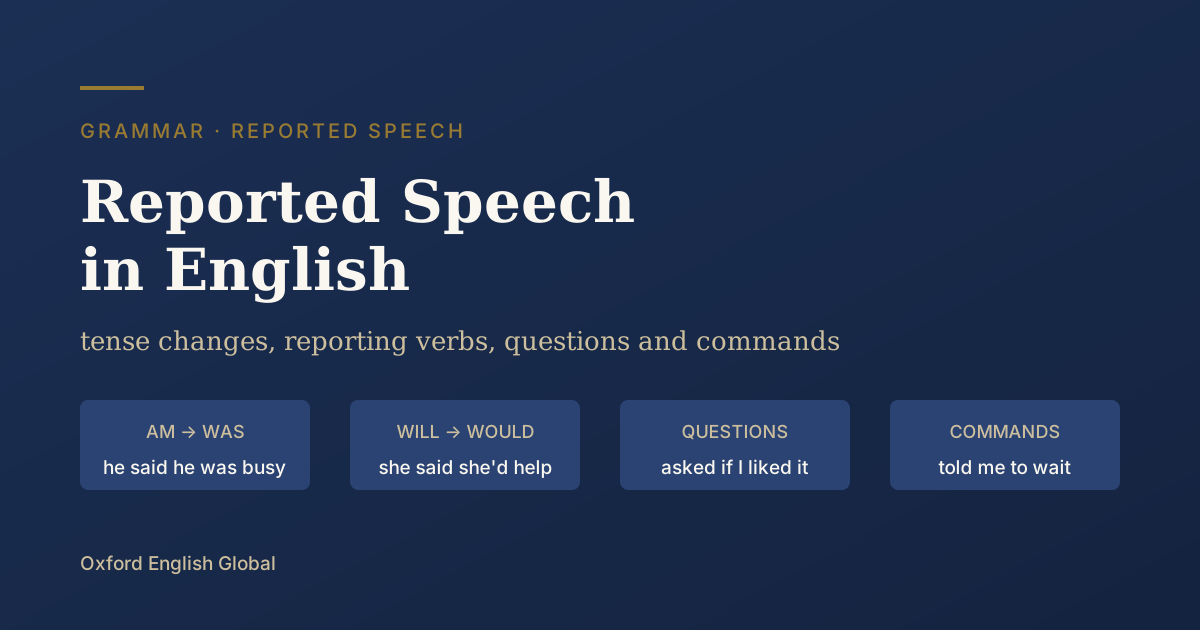
Quick summary. Direct: "I am busy," he said. → Reported: He said he was busy. Direct: "Do you like jazz?" she asked. → Reported: She asked if I liked jazz. Direct: "Sit down," the teacher said. → Reported: The teacher told us to sit down.
Direct speech vs reported speech
Direct speech repeats the exact words, inside quotation marks:
- "I'll call you tomorrow," said Anna.
Reported speech gives the meaning in our own sentence, without quotation marks:
- Anna said she would call me the next day.
We use reported speech constantly: telling a colleague what the client said, writing meeting minutes, describing a phone call, or summarising news. It is tested in almost every English exam, and it is one of the most useful structures for work emails. Three things usually change:
- The verb tense (often one step back).
- Pronouns and possessives (I → she, my → her).
- Time and place words (tomorrow → the next day, here → there).
Tense changes: the backshift table
When the reporting verb is in the past (said, told, asked, explained), the verb in the reported clause usually moves one step back in time. This is called backshift.
| Direct speech | Reported speech | Example |
|---|---|---|
| present simple | past simple | "I work in sales." → He said he worked in sales. |
| present continuous | past continuous | "I'm waiting." → She said she was waiting. |
| present perfect | past perfect | "I've finished." → He said he had finished. |
| past simple | past perfect (or no change) | "I lost my keys." → She said she had lost / lost her keys. |
| past continuous | past perfect continuous (or no change) | "I was driving." → He said he had been driving. |
| past perfect | no change | "I had left." → She said she had left. |
| will | would | "I'll help." → He said he would help. |
| can | could | "I can swim." → She said she could swim. |
| may | might | "I may be late." → He said he might be late. |
| must (obligation) | had to (or must) | "I must go." → She said she had to go. |
| is going to | was going to | "It's going to rain." → He said it was going to rain. |
Would, could, might, should and ought to do not change: "You should rest." → She said I should rest.
If you are not confident with the tenses themselves, review our guide to all 12 English tenses first; backshift is much easier once you can see the tense "map". The modal changes are covered in more detail in our guide to modal verbs.
When you do not need to change the tense
Backshift is common, but it is not automatic. The tense often stays the same when the situation is still true at the time of reporting. (For a fuller reference, see Cambridge Dictionary's English Grammar Today entry on reported speech.) Keep the original tense when:
- The reporting verb is in the present. "I'm tired." → She says she's tired. This is common when passing on a message straight away: The client says the invoice is wrong.
- The fact is still true now. "The office opens at 8." → He said the office opens at 8. (Backshift, opened, is also correct.)
- It is a general truth. "Water boils at 100°C." → The teacher said water boils at 100°C.
- The original was already in the past perfect or used would, could, might, should.
In everyday conversation, speakers often skip backshift for recent events: Tom just told me he's leaving the company. In exams, unless the task says otherwise, backshifting after a past reporting verb is the safe choice.
Changing pronouns, time and place words
Pronouns change to match the new speaker's point of view:
- "I love my job," said Maria. → Maria said she loved her job.
- "We'll send you the file," they told me. → They told me they would send me the file.
Time and place words change when you report at a different time or place from the original:
| Direct speech | Reported speech (later, elsewhere) |
|---|---|
| now | then / at that time |
| today | that day |
| tonight | that night |
| yesterday | the day before / the previous day |
| tomorrow | the next day / the following day |
| last week | the week before / the previous week |
| next month | the following month |
| ago | before / earlier |
| here | there |
| this / these | that / those (or the) |
Use common sense: if you report on the same day, today stays today. "I'll finish it today," she said this morning. → She said she'd finish it today.
Say or tell?
This is the most frequent reported-speech mistake. The rule is simple:
- say + (that) + clause: He said (that) he was hungry. If you mention the listener, use to: He said to me that... (less common).
- tell + person + (that) + clause: He told me (that) he was hungry. Tell needs the listener.
So: She told me she was leaving ✓, She said me she was leaving ✗, She told she was leaving ✗. Our full guide to say, tell, speak and talk covers the fixed expressions too (tell a story, tell the truth, say sorry).
The word that is optional after say and tell and is often dropped in speech: He said he was ready.
Reporting questions
Reported questions use statement word order (subject + verb) and no question mark. This is where most learners go wrong.
Yes/no questions: use if or whether
- "Are you coming?" → She asked if I was coming. (not if was I coming)
- "Did you send the report?" → He asked whether I had sent the report. (the auxiliary did disappears)
Wh- questions: keep the question word
- "Where do you live?" → He asked me where I lived. (not where did I live)
- "What time does the meeting start?" → She asked what time the meeting started.
- "Who called?" → He asked who had called. (here who is the subject, so the order is already correct)
Other verbs for reporting questions: want to know, wonder, enquire (formal). The customer wanted to know when the order would arrive.
Reporting commands, requests and advice
For orders, requests, advice and warnings, use verb + object + to-infinitive:
- "Close the door." → He told me to close the door.
- "Could you help me, please?" → She asked me to help her.
- "You should see a doctor." → He advised me to see a doctor.
For negative commands, put not before to:
- "Don't be late." → She told us not to be late. (not to don't be)
Reporting verbs beyond said and told
Using only said makes writing flat. Reporting verbs also show the speaker's intention. Each verb has its own pattern; Cambridge Dictionary's English Grammar Today covers more of them.
| Pattern | Verbs | Example |
|---|---|---|
| verb + that-clause | explain, admit, agree, claim, complain, mention, promise, reply, announce | She admitted that she had made a mistake. |
| verb + person + that-clause | tell, inform, remind, assure, warn | He reminded me that the deadline was Friday. |
| verb + to-infinitive | agree, offer, promise, refuse, threaten | The manager offered to help. |
| verb + person + to-infinitive | ask, tell, advise, encourage, invite, remind, warn, persuade | She encouraged me to apply. |
| verb + -ing | admit, deny, suggest, recommend | He denied taking the money. |
| verb + preposition + -ing | apologise for, insist on, accuse someone of, congratulate someone on | They apologised for being late. |
Notice that some verbs take -ing and others take to. Our guide to gerunds and infinitives explains these verb patterns in detail.
Suggest: a special case
Suggest never takes person + to. Say She suggested taking a break or She suggested that we take a break, not She suggested us to take a break.
Reported speech at work: emails and meetings
Reported speech is essential in professional English. Compare these natural workplace sentences:
- The client confirmed that the delivery date was acceptable.
- During the call, Mr Lee asked whether we could reduce the price.
- Finance has asked us to submit all expenses by Friday.
- I mentioned that the budget might change.
- Sara said she'd look into it and get back to us.
In meeting minutes, reporting verbs such as agreed, proposed, raised, confirmed and noted make the summary precise. For more examples in context, see our guide to writing work emails in English.
Common mistakes and how to fix them
| Mistake | Correct | Why |
|---|---|---|
| She said me she was tired. | She told me she was tired. | Say does not take a person directly. |
| He asked where did I live. | He asked where I lived. | Reported questions use statement word order. |
| She asked do I like coffee. | She asked if I liked coffee. | Use if/whether for yes/no questions. |
| He told me don't worry. | He told me not to worry. | Negative commands: not to + verb. |
| She suggested me to call. | She suggested calling / that I call. | Suggest doesn't take person + to. |
| He said he will come tomorrow. (reported a week later) | He said he would come the next day. | Backshift and change the time word. |
| She asked me where was the station? | She asked me where the station was. | No question order and no question mark. |
For more frequent errors like these, see our list of common English grammar mistakes.
Practice: change to reported speech
Report each sentence as if it was said last week. Use said, told, asked or another reporting verb.
- "I'm working from home today," Ben said.
- "Have you seen my phone?" Lucy asked me.
- "Don't touch the screen," the technician told us.
- "We'll send the contract tomorrow," the lawyer said.
- "Where is the nearest bank?" the tourist asked.
- "I can't come to the meeting," Priya said.
- "Why don't we order pizza?" Tom said. (use suggest)
Answers: 1. Ben said he was working from home that day. 2. Lucy asked me if/whether I had seen her phone. 3. The technician told us not to touch the screen. 4. The lawyer said they would send the contract the next day. 5. The tourist asked where the nearest bank was. 6. Priya said she couldn't come to the meeting. 7. Tom suggested ordering pizza / suggested that we order pizza.
Speaking task: Think of a conversation you had yesterday. Tell it to someone (or record yourself) using at least five reported-speech sentences and three different reporting verbs. Our free Speaking Lab can help you check your intonation.
What this article cannot tell you
- Every reporting verb pattern. We cover the most common ones. Some verbs take several patterns with small differences in meaning; check a learner's dictionary for each new verb.
- Exactly when native speakers backshift. In real conversation, choices depend on whether the speaker sees the information as still true or relevant. The rules here describe the standard pattern and the main exceptions, not every possible variation.
- Your exam's specific requirements. Some exam tasks expect strict backshift; others accept either form when the situation is still true. Follow the instructions and marking guidance for your test.
Want structured grammar practice with a teacher? See our English courses or try our free lessons.
Frequently asked questions
What is reported speech?
Reported speech, also called indirect speech, tells someone what another person said without using their exact words or quotation marks: "I'm busy" becomes He said he was busy.
Do you always change the tense in reported speech?
No. After a past reporting verb such as said, we usually move the tense back, but we can keep the original tense if the information is still true, if it is a general truth, or if the reporting verb is in the present: She says she's tired.
What is the difference between say and tell in reported speech?
Tell needs a person after it: He told me he was ready. Say does not take a person directly: He said he was ready, or He said to me that he was ready.
How do you report a question?
Use statement word order and no question mark. For yes/no questions add if or whether: She asked if I was coming. For wh- questions keep the question word: He asked where I lived.
How do you report a command?
Use tell, ask or another verb + object + to-infinitive: He told me to close the door. For negative commands, use not to: She told us not to be late.