
How to Write a Clear Summary in English: Main Ideas, Paraphrasing and Length
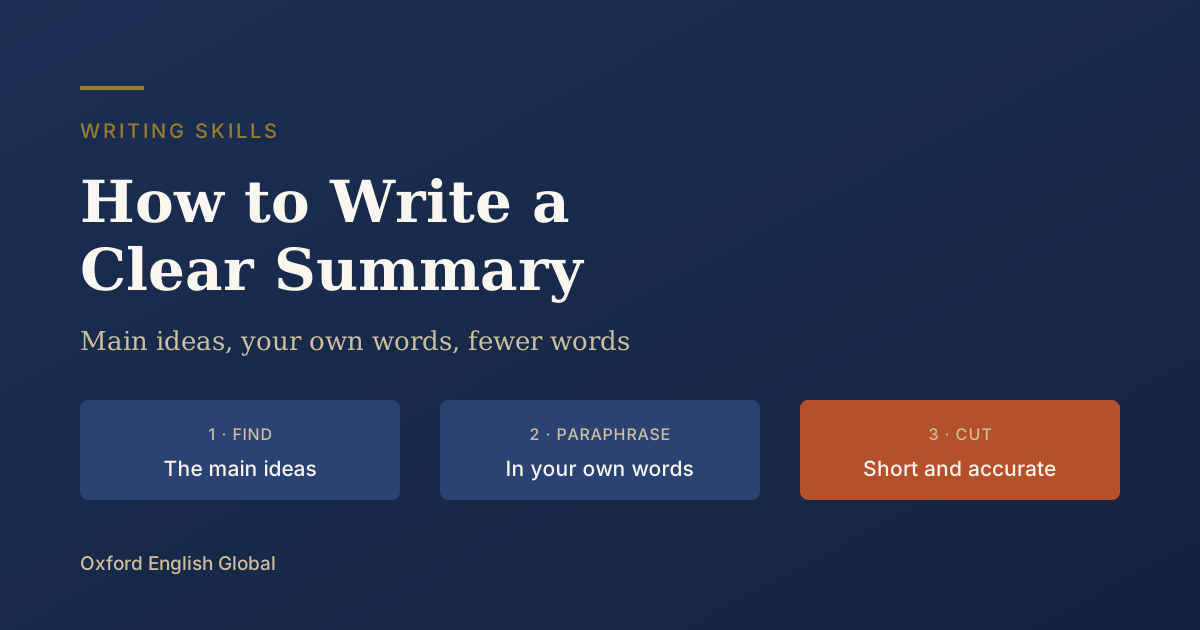
A good summary gives the main message of a text in far fewer words and in your own words. This guide gives a six-step method, techniques for finding main ideas and paraphrasing, useful phrases, a worked example and a checklist.

- What a summary is, and what it is not
- How to write a summary: six steps
- How to find the main ideas
- How to paraphrase: putting ideas in your own words
- Useful phrases for summaries
- Worked example: from 178 words to 61
- Common mistakes in summaries
- Checklist: is your summary ready?
- How to practise summary writing
- What this article cannot tell you
To write a clear summary in English, read the whole text first, find the main idea and the key supporting points, leave out examples and details, then rewrite those points in your own words, in fewer words and in a neutral tone, without adding your opinion. A good summary is much shorter than the original, usually around a quarter to a third of its length or less, and someone who has not read the original should understand the main message from it. This guide gives a six-step method, techniques for paraphrasing, useful phrases, a worked example and a checklist.
Sources. The definitions of quoting, paraphrasing and summarising follow Purdue University's Online Writing Lab guide Quoting, Paraphrasing, and Summarizing. The length guidance is a common teaching rule of thumb, not a fixed rule; exams set their own word limits. The worked example was written by the Oxford English Global team.
What a summary is, and what it is not
Purdue OWL defines summarising as "putting the main idea(s) into your own words, including only the main point(s)", and notes that summaries "are significantly shorter than the original". It is easy to confuse a summary with two related skills:
| Quotation | Paraphrase | Summary | |
|---|---|---|---|
| Words | Exactly the same as the original | Your own words | Your own words |
| Length | A short part of the source | About the same or slightly shorter | Much shorter |
| Content | One phrase or sentence | All the ideas of one passage | Only the main ideas of the whole text |
| Source named? | Yes | Yes | Yes |
A summary is not a review (no opinion), not a list of every point (only the important ones) and not a copy with a few words changed.
How to write a summary: six steps
- Read the whole text once without taking notes. Get the general idea first. Look at the title, headings and the first and last paragraphs.
- Find the main idea. Ask: "What is the writer's main point?" Try to say it in one sentence. This becomes your first sentence.
- Find the key supporting points. Read again and underline the ideas that support the main point. Most paragraphs have one; it is often in the first sentence (the topic sentence).
- Cross out what you do not need. Examples, statistics, stories, repetition, quotations and minor details usually go. Keep a number only if it is central to the message.
- Write from your notes, not from the text. Close or cover the original and write the points in your own words. This is the best way to avoid copying.
- Check and cut. Compare with the original: is everything accurate? Is anything missing? Then remove extra words until you are within the length limit.
How to find the main ideas
Main ideas and details look different on the page. Use these clues:
| Usually a main idea | Usually a detail you can leave out |
|---|---|
| Topic sentences at the start of paragraphs | "For example…", "For instance…", "such as…" |
| Ideas repeated in the introduction and conclusion | Names, dates and numbers that only illustrate a point |
| Sentences after "The main reason…", "Most importantly…", "In short…" | Stories and anecdotes |
| Points the title refers to | Quotations from people |
| Contrasts after "However…", "But…" | Background information and repetition |
A useful test: if you removed this sentence, would the reader still understand the writer's argument? If yes, it is probably a detail.
How to paraphrase: putting ideas in your own words
Paraphrasing is the hardest part for many learners. Combine several of these techniques; changing only one word is not enough.
1. Use synonyms
- Original: "Many employees are reluctant to return to the office."
- Paraphrase: "A lot of workers are unwilling to go back to the office."
2. Change the word form
- Original: "The city expanded rapidly."
- Paraphrase: "There was rapid expansion of the city."
3. Change the sentence structure
- Active to passive: "Researchers tested the drug" → "The drug was tested."
- Join two sentences: "Prices rose. Demand fell." → "As prices rose, demand fell."
4. Generalise
- Original: "Apples, bananas, oranges and grapes all became more expensive."
- Summary: "The price of fruit rose."
Keep the key terms. You do not need a synonym for technical words or names: "climate change", "inflation" or "the European Union" can stay the same. Changing them can change the meaning.
Building a wider vocabulary makes paraphrasing much easier; see our guide to growing your vocabulary through reading.
Useful phrases for summaries
Opening sentence
- In the article "…", the author argues that…
- The text explains / describes / discusses…
- According to [author], …
Adding points
- The writer also points out that…
- In addition, … / Furthermore, …
- The author suggests / claims / states that…
Showing contrast and result
- However, … / On the other hand, …
- As a result, … / Therefore, …
Concluding
- The author concludes that…
- Overall, the text shows that…
When you report what a writer says, you often use reporting verbs and sometimes change tenses. Our guide to reported speech covers verbs such as argue, claim and suggest.
Worked example: from 178 words to 61
Original text (written for this guide):
Over the past decade, more and more people have started working from home at least part of the week. Supporters say this has clear benefits. Employees save time and money on commuting; in a large city, a daily journey of an hour or more each way is common. Many people also report that they can concentrate better at home, away from noisy open-plan offices, and that flexible hours make it easier to look after children or elderly parents. However, remote work also has disadvantages. Some workers feel lonely and miss chatting with colleagues. Managers worry that it is harder to train new staff and to share ideas informally, for example over coffee. There are also concerns about the boundary between work and home: when the office is the kitchen table, it can be difficult to switch off in the evening. For these reasons, many companies have chosen a hybrid model, in which staff spend two or three days in the office and the rest at home. Most experts expect this mixed approach to remain common in the future.
Main idea: remote work has advantages and disadvantages, so hybrid work is becoming normal.
Key points: benefits (less commuting, better focus, flexibility); drawbacks (loneliness, harder training and idea sharing, difficulty switching off); result (hybrid model, likely to continue).
Summary (61 words):
The text discusses the growth of working from home. It explains that remote work saves commuting time, can improve concentration and offers flexibility for carers. However, it can also cause loneliness, make training and informal collaboration harder, and blur the line between work and home life. As a result, many employers now use a hybrid system, which experts expect to continue.
Notice what was removed: the "hour each way" example, the "coffee" example and the "kitchen table" image. Notice also that the summary uses new words (carers, collaboration, blur the line) and does not include any opinion.
Common mistakes in summaries
- Copying sentences from the text. In exams this loses marks; in academic work it can be plagiarism. Write from notes.
- Including examples and details. If a sentence starts with "for example", it rarely belongs in a summary.
- Adding your opinion. Words such as "I think" or "This is a great idea" do not belong in a summary unless the task asks for them.
- Changing the meaning. "Some workers feel lonely" is not the same as "Workers feel lonely". Keep words such as some, most and may accurate.
- Going over the word limit. In exams such as Cambridge IGCSE First Language English, the summary has a strict maximum, currently 120 words; see our guide to the 2027 IGCSE 0500 changes.
- Writing a list. Most tasks expect continuous sentences joined with linking words, not bullet points.
Checklist: is your summary ready?
- Does the first sentence state the main idea and name the source?
- Have you included every key point, and only key points?
- Is it in your own words, apart from key terms?
- Is it accurate, with no new information or opinions?
- Is it clearly shorter than the original and within any word limit?
- Does it read as connected sentences with linking words?
- Have you checked grammar and spelling? Our list of common grammar mistakes helps.
How to practise summary writing
- One news article a day: summarise it in three sentences. Short, regular practice is better than one long exercise a week.
- The 50-word challenge: summarise a long article in exactly 50 words. It forces you to choose what really matters.
- Summarise out loud: after a podcast or video, tell a friend (or your phone's voice recorder) the main points in one minute. This builds speaking skills too.
- Compare: ask a teacher or classmate to summarise the same text and compare what each of you left out.
For other kinds of writing, see our guides to writing an opinion essay and 100 tips for academic writing.
What this article cannot tell you
- The rules of your specific exam or course. Word limits, marking criteria and whether bullet points are allowed vary. Always follow the task instructions.
- Citation styles. Academic summaries often need a reference in a style such as APA or Harvard; we do not cover those formats here.
- An exact ideal length. "A quarter to a third" is a guideline. A summary of a book may be far shorter; a summary of a short paragraph may be one sentence.
Want feedback on your writing from a qualified teacher? See our English courses.
Frequently asked questions
How long should a summary be?
Much shorter than the original. A common guideline is a quarter to a third of the original length or less, but always follow the word limit in your task; for example, the Cambridge IGCSE First Language English summary has a maximum of 120 words.
What should not be included in a summary?
Leave out examples, stories, minor details, repetition, quotations and your own opinion. Include only the main idea and the key supporting points.
What is the difference between a summary and a paraphrase?
A paraphrase restates one passage in your own words at about the same length. A summary gives only the main ideas of a whole text and is much shorter.
How do I avoid copying when I write a summary?
Take notes of the main points, then close the original text and write from your notes. Use synonyms, change word forms and change sentence structures, but keep technical terms and names.
How should I start a summary?
Start with one sentence that names the source and states the main idea, for example: In the article "...", the author argues that...