
IGCSE First Language English 0500 From 2027: What Changes, What Stays the Same and How to Prepare
The 2027 to 2029 syllabus for Cambridge IGCSE First Language English rebuilds Paper 1 as four equal questions and adds a short reading question to Paper 2. This guide compares the old and new papers, explains the new question types and gives a preparation plan.

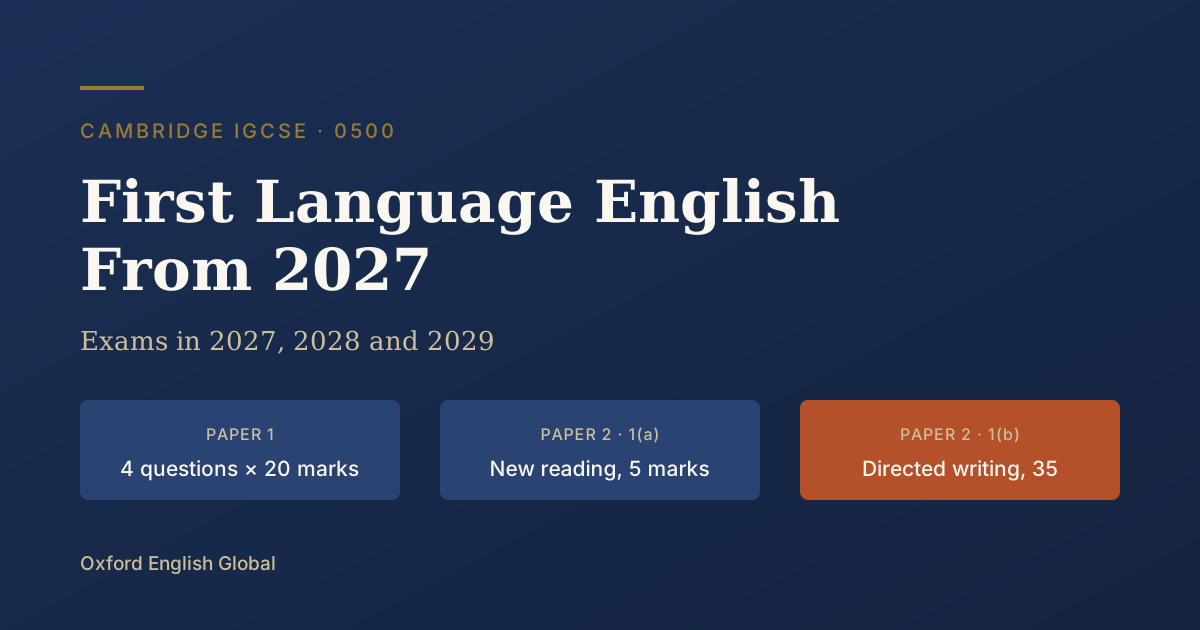
From 2027, Cambridge IGCSE First Language English (0500) keeps the same overall shape, two 2-hour papers worth 80 marks each, but Paper 1 Reading is rebuilt as four compulsory questions worth 20 marks each, and Paper 2 adds a new 5-mark reading question, 1(a), before the directed writing task, which becomes 1(b) and is worth 35 marks. The new syllabus is used for exams in 2027, 2028 and 2029; November 2026 is the last series on the old format. Coursework and the Speaking and Listening test keep their tasks and marks, but every component has new marking criteria. This guide sets out what changes, what stays the same and how students should prepare.
Sources and date. Checked on 22 November 2026. Paper 1 details, the assessment objectives and the exam series come from Cambridge International's 0500 syllabus for 2027, 2028 and 2029 and the 0500 syllabus page. The question-by-question comparison with the 2024 to 2026 papers and the Paper 2 mark changes are summarised from The Learning Mate (updated 21 October 2026), which cites the syllabuses and the 2027 specimen papers. Always check the syllabus your school is using.
The 0500 changes at a glance
| Component | Length and marks | Weighting | What changes from 2027 |
|---|---|---|---|
| Paper 1 Reading | 2 hours, 80 marks | 50% | Four 20-mark questions on three texts; new marking criteria |
| Paper 2 Directed Writing and Composition | 2 hours, 80 marks | 50% | Section A split into 1(a), 5 marks, and 1(b), 35 marks; shorter texts; new criteria |
| Component 3 Coursework Portfolio (instead of Paper 2) | 80 marks | 50% | Same marks; Assignment 1 forms clarified; new criteria |
| Component 4 Speaking and Listening (optional) | About 10 to 12 minutes, 40 marks | Separately endorsed, grades 1 to 5 | Same tasks and marks; new criteria |
All candidates still take Paper 1 plus either Paper 2 or Component 3. Grades are still A* to G. The syllabus says exams are available in the June and November series, and also in March in India; The Learning Mate notes that the first 2027 series is therefore March 2027 for schools in India and June 2027 elsewhere.
What stays the same
- The structure of the qualification: Paper 1 plus Paper 2 or coursework, each worth 50%.
- The balance of skills: Paper 1 is 80% reading and 20% writing; Paper 2 and Component 3 are 20% reading and 80% writing.
- The summary: still continuous writing of no more than 120 words, worth 10 reading marks and 5 writing marks.
- The composition: Paper 2 Section B still offers a choice of descriptive and narrative titles for 40 marks.
- Speaking and Listening: still an Individual Talk and a Conversation, separately endorsed.
Paper 1 Reading: four equal questions
The 2027 to 2029 syllabus says candidates answer "four compulsory questions on three texts" with "a combined total of approximately 1400 words", and should spend about 15 minutes reading them. Cambridge says it restructured the paper to help students "pace themselves". Here is the comparison:
| 2024 to 2026 | Marks | 2027 to 2029 | Marks |
|---|---|---|---|
| Q1 comprehension, Text A | 15 | Q1 comprehension, Text A (tests R1 to R5) | 20 |
| Q1 summary, Text B, max 120 words | 15 | Q2(a) summary, Text B, max 120 words | 15 |
| No equivalent | - | Q2(b) short answer on attitudes and opinions, Text B | 5 |
| Q2 short answers, Text C | 10 | Q3 short answers, Text C | 10 |
| Q2 language task, about 200 to 300 words | 15 | Q3 language task, about 200 to 250 words | 10 |
| Q3 extended response, about 250 to 350 words | 25 | Q4 extended response, about 250 to 300 words | 20 |
| Total | 80 | Total | 80 |
What the new questions mean for students
- Comprehension (Q1) now tests all five reading objectives, including R4, how writers achieve effects. Expect questions such as why the writer chose a particular word.
- Q2(b) is new. The syllabus describes it as a short answer "testing understanding of attitudes and opinions". In practice, students must say what the writer thinks and support it with details from the text.
- The language task is smaller: 10 marks and about 200 to 250 words, down from 15 marks.
- The extended response is shorter and worth 20 marks, which The Learning Mate reports are split 10 for reading and 10 for writing.
With four 20-mark questions and about 15 minutes of reading, a simple pacing rule is roughly 25 minutes per question.
Paper 2: the new question 1(a)
According to The Learning Mate's comparison of the syllabuses and specimen papers:
| Paper 2 | 2024 to 2026 | 2027 to 2029 |
|---|---|---|
| Section A reading texts | 650 to 750 words in total | 550 to 650 words in total |
| Question 1(a) | Did not exist | Structured reading question, 5 marks (R3, R4) |
| Directed writing | 40 marks (25 writing, 15 reading) | Question 1(b), 35 marks (25 writing, 10 reading) |
| Forms for directed writing | Speech, letter or article | Speech, letter, article or report |
| Section B composition | One of four titles, 350 to 450 words, 40 marks | Same tasks; updated criteria |
The important point: five reading marks have moved out of the directed writing and into 1(a). A student who skips 1(a) to save time for the longer task loses those marks completely. In the specimen paper, 1(a) uses the command word "evaluate": students judge a person's attitude in an extract and justify their view with details. The "report" form is also new for directed writing, so students should practise headings and a clear, neutral style. Our guide to writing a formal letter in English covers the letter form.
New wording: objectives and command words
Cambridge says it has updated the wording of the assessment objectives. Two writing objectives in the new syllabus read:
- W2: "organise and structure facts, ideas and opinions for deliberate effect";
- W4: "use language appropriate to purpose and to engage the audience".
The Learning Mate reports that the list of command words grows from four (describe, explain, give, identify) to eleven, adding analyse, assess, consider, evaluate, justify, outline and suggest. Learn exactly what each command word asks for: "evaluate" and "assess" need a judgement, not only a description.
How students should prepare
- Use the right papers. If you sit the exam in 2027 or later, do at least one full mock on the 2027 specimen papers, available from Cambridge's 0500 page and the School Support Hub.
- Adapt old past papers, do not throw them away. Old summaries and compositions transfer directly. Old comprehension questions need extra "why this word?" items, and old directed writing tasks need a 5-mark 1(a) added.
- Practise the attitude question. After reading any opinion article, write two or three sentences: "The writer's attitude to X is… This is shown by…"
- Train the 120-word summary. It is still worth 15 marks. Our step-by-step guide on how to write a summary in English covers selecting points and paraphrasing.
- Read widely. The syllabus draws on twentieth- and twenty-first-century fiction and non-fiction, including articles, reviews and discursive essays. See how to grow your vocabulary through reading.
- Time every question. Practise 25-minute blocks for each Paper 1 question so the equal marks lead to equal time.
- Check spelling, punctuation and grammar. W5 still rewards accuracy. Our list of common grammar mistakes is a good checklist.
Sample: answering an attitude question
Here is how a student might approach a question in the style of the new Paper 1 Question 2(b). The text and answer below were written by Oxford English Global for practice; they are not taken from a Cambridge paper.
Extract: "Every summer the beach fills with visitors who leave behind a carpet of plastic. The council promises action each year, and each year nothing changes. Meanwhile, a handful of volunteers spend their weekends quietly clearing up a mess they did not make."
Task: What is the writer's attitude towards the way the beach is managed? Use three details from the extract to support your answer.
Sample answer: The writer is critical and frustrated. Calling the litter "a carpet of plastic" exaggerates how much there is, showing anger at the visitors. The phrase "each year nothing changes" suggests the writer has lost faith in the council's promises. By contrast, the writer admires the volunteers, who clear up "a mess they did not make", which makes the council's lack of action seem worse.
Notice the pattern: state the attitude in one or two precise adjectives (critical, frustrated, admiring), then give each detail with a short quotation and explain what it shows. Vague words such as "negative" or "bad" usually earn fewer marks than precise ones. The same skills help in Paper 2 Question 1(a), where students evaluate an attitude shown in an extract.
Useful adjectives for attitude questions
| Positive | Negative | Mixed or neutral |
|---|---|---|
| admiring, enthusiastic, optimistic, supportive, sympathetic | critical, sceptical, frustrated, disapproving, sarcastic | cautious, ambivalent, balanced, uncertain, objective |
Who takes 0500, and is it right for you?
Cambridge describes IGCSE as a qualification for 14 to 16 year olds that "can be taken by students at any age". First Language English is designed for students whose first language is English or who study in English at a high level. Adult learners who want a certificate of their general English level for work, study or a visa usually take a different exam, such as IELTS or a Cambridge English Qualification. If you are unsure of your level, start with our English level test.
What this article cannot tell you
- Grade boundaries. Cambridge publishes grade thresholds only after each series, so there are none yet for the new papers.
- Every detail of the mark schemes. We summarise the main changes. Teachers should use the full syllabus, specimen papers and mark schemes.
- 0990 and local variants. The 9 to 1 version, 0990, has its own syllabus; check availability for your country with your exams officer.
- Later updates. Cambridge can issue syllabus updates. Check the 0500 page for changes after 22 November 2026.
This page is independent guidance from Oxford English Global. We have no commercial relationship with Cambridge International Education or The Learning Mate, and the page contains no affiliate links.
Frequently asked questions
When does the new IGCSE First Language English 0500 syllabus start?
The 2027 to 2029 syllabus is used for exams in 2027, 2028 and 2029. Exams run in June and November, and also in March in India, so the first series is March 2027 in India and June 2027 elsewhere. November 2026 is the last series on the old syllabus.
How many questions are in 0500 Paper 1 from 2027?
Four compulsory questions worth 20 marks each, on three texts of about 1,400 words in total. The paper is still 2 hours and 80 marks.
What is question 1(a) in the new 0500 Paper 2?
It is a new 5-mark reading question on the Section A texts that comes before the directed writing task. The directed writing becomes question 1(b), worth 35 marks: 25 for writing and 10 for reading.
Has the IGCSE English summary changed for 2027?
The summary is still continuous writing of no more than 120 words, worth 10 reading and 5 writing marks. It is now question 2(a) and is followed by a new 5-mark question on attitudes and opinions, 2(b).
Can I still use old 0500 past papers to prepare?
Yes, with changes. Summaries and compositions transfer directly, but comprehension, the language task, the extended response and directed writing need adapting to the new marks, and all answers should be marked with the new criteria.