
How to Grow Your English Vocabulary Through Reading: Choose, Note and Review
Reading gives you thousands of English words in context, but only if the books are at the right level and you keep the useful words. This guide shows how to choose books with the 98% rule, read for meaning, note new words as chunks, review them so they stick, and follow a simple four-week plan.

- Why reading builds vocabulary
- How to choose books at the right level
- How to read: meaning first, dictionary second
- How to note new words so you can use them
- How to review new words so they stick
- A four-week reading plan
- Example: one 25-minute reading session
- Reading on paper, on screen and with audio
- Common mistakes to avoid
- What this article cannot tell you
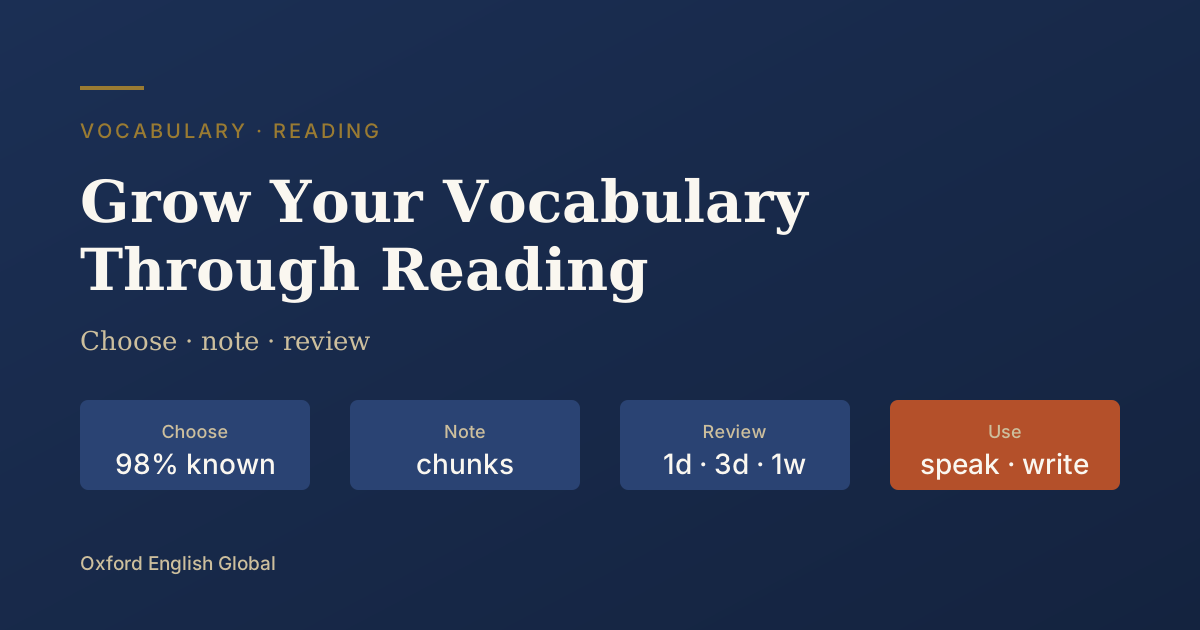
Reading is one of the most reliable ways for adults to grow their English vocabulary, because it gives you thousands of words in context and lets you meet the same words again and again. The method that works is: choose books where you already know about 98% of the words, read a lot for meaning, note only the useful new words (in a phrase, not alone), and review them on a schedule over the following weeks. Reading text that is too hard feels productive but slows you down; the Extensive Reading Foundation says that below about 90% known words reading becomes "frustrating and slow". This guide explains how to pick the right books, a simple system for noting new words, how to review them so they stick, and a four-week plan you can start today.
Why reading builds vocabulary
You need a lot of words to read real English comfortably. In a widely cited study, Paul Nation (Canadian Modern Language Review, 2006) estimated that if a reader needs to know 98% of the words in a text to understand it without help, then reading a wide range of written English requires a vocabulary of about 8,000 to 9,000 word families. A word family is a base word and its forms, such as decide, decides, decided, decision, decisive.
No one learns 8,000 word families from lists alone. Reading helps in three ways that lists cannot:
- Repetition. Common words come back again and again across pages and books, so you meet them many times without trying.
- Context. You see how a word is used: its grammar, its typical partners (collocations) and its tone. You learn make a decision, not just decision.
- Volume. An hour of reading exposes you to far more words than an hour of vocabulary exercises.
Reading alone is slow for less frequent words, which is why the best results come from combining lots of easy reading with a small amount of deliberate study of the words you choose to keep. The rest of this guide shows how.
How to choose books at the right level
The single biggest mistake learners make is choosing books that are too hard. The Extensive Reading Foundation's Guide to Extensive Reading describes three zones:
| Known words on the page | Zone | What it feels like | Use it for |
|---|---|---|---|
| Below 90% | Frustration | Slow, lots of dictionary use, poor understanding | Avoid for regular reading |
| 90%–98% | Instructional | Adequate understanding, but many words to look up | Intensive study with a teacher or a short text |
| 98% or more | Extensive reading | Fast, fluent, enjoyable | Daily reading for vocabulary and fluency |
Source: Extensive Reading Foundation, Guide to Extensive Reading, read 10 November 2026.
98% sounds very high. It means about one unknown word in every 50, or roughly five to eight on a typical page. That feels "easy", and that is the point: when most of the text is familiar, you can work out new words from context and keep reading.
The one-page test
- Open the book at a random page in the middle.
- Read one full page and count the words you do not know.
- More than about 10 unknown words: too hard for daily reading. Choose an easier book or a graded reader.
- About 2 to 8 unknown words: a good level for building vocabulary.
- Almost none: good for building reading speed and confidence.
What to read at each level
| Your level | Good choices |
|---|---|
| A2–B1 | Graded readers (books rewritten for learners with a controlled word list), short stories for learners, children's non-fiction on topics you like |
| B1–B2 | Higher-level graded readers, young adult novels, simple non-fiction and biographies, news written for learners |
| B2–C1 | Modern novels with lots of dialogue, popular non-fiction, quality magazines and newspapers on familiar topics |
Interest matters as much as level. A book on a subject you love keeps you reading, and reading more is what builds vocabulary. If you do not know your level, start with our English level test guide. Our free English learning PDFs are another place to find reading material.
How to read: meaning first, dictionary second
If you stop to look up every new word, you lose the story and read very little. Use this approach instead:
- Read for the main idea. Keep going when you meet a new word, unless you cannot follow the paragraph without it.
- Guess from context. Ask: what kind of word is it (noun, verb, adjective)? Is it positive or negative? What would make sense here? Often a rough guess is enough.
- Mark, do not stop. Underline the word or make a light pencil mark, and carry on.
- Look up at the end of a chapter or session. Go back to the marked words and check only the ones that appeared more than once or seem useful.
Many words become clear on their own when they appear a second or third time. The ones that are still unclear after a chapter are worth checking.
How to note new words so you can use them
Do not try to learn every new word. Choose five to ten per reading session that are useful to you: words you have seen more than once, words you would use in your own speech or work, or words that block your understanding.
Write each word as a chunk, not alone. A chunk is the word with the words that usually go with it. Our guide to learning vocabulary in chunks explains why this works.
| Instead of | Write | Plus |
|---|---|---|
| reluctant | be reluctant to do something | Your sentence: "I was reluctant to ask for help." |
| deadline | meet / miss a deadline | The sentence from the book |
| budget | stick to a budget; a tight budget | A translation if it helps |
A good vocabulary notebook entry has four parts: the chunk, the sentence where you found it, a short meaning (in English or your language), and one sentence of your own. Writing your own sentence is what turns a word you recognise into a word you can use.
A paper notebook works well. A flashcard app works too, as long as each card has a full sentence, not just one word.
How to review new words so they stick
You will forget most new words unless you meet them again. The answer is spaced review: short reviews at increasing intervals. A simple schedule is:
| Review | When | What to do |
|---|---|---|
| 1 | The next day | Cover the meaning, look at the chunk, try to recall it; then say your sentence aloud |
| 2 | About 3 days later | Cover the chunk, look at the meaning, try to produce the chunk |
| 3 | About 1 week later | Write a new sentence with the chunk |
| 4 | About 2–3 weeks later | Use it in speaking or writing (a message, an email, a conversation) |
The exact days are a guide, not a rule; the idea is that each gap is longer than the last. The most effective reviews make you recall the word from memory, not just read it again. Our article on improving communication and vocabulary covers spaced review and active recall in more detail.
Reading itself is also review. The more you read at the right level, the more often common words come back on their own.
A four-week reading plan
This plan suits a busy adult with 20 to 30 minutes a day.
| Week | Daily reading | Words noted per day | Focus |
|---|---|---|---|
| 1 | 20 minutes of an easy book (almost no unknown words) | 3–5 | Build the habit; read quickly; practise guessing from context |
| 2 | 25 minutes, same or slightly harder book | 5–8 | Start the notebook with chunks and your own sentences |
| 3 | 25 minutes plus 5 minutes of review | 5–8 | Add the spaced review schedule |
| 4 | 30 minutes, including review | 5–10 | Use five of your new chunks in speaking or writing this week |
The Extensive Reading Foundation notes that schools typically ask students to read about one book a week or more. For a working adult, finishing one graded reader or one short book every one to two weeks is a realistic target.
Read aloud sometimes. Reading one page aloud a day links new words to their sound and helps pronunciation. Check the stress of new words in a dictionary with audio. Our guide on improving pronunciation at home explains how.
Example: one 25-minute reading session
Here is what a session looks like in practice for a B1 learner reading a graded reader.
- Minutes 0–20: read. The learner reads about eight pages without stopping. Three words are marked: reluctantly, shrugged and overdue. Shrugged appears twice and becomes clear from context ("He shrugged and said, 'I don't know'"), so it does not need the dictionary.
- Minutes 20–23: check. The learner looks up reluctantly and overdue. The dictionary shows overdue is often used in chunks such as an overdue bill and long overdue.
- Minutes 23–25: note. Two notebook entries: "do something reluctantly — She reluctantly agreed to stay. My sentence: I reluctantly got up at six." and "long overdue — This change is long overdue. My sentence: A holiday is long overdue for me."
The next day, the learner spends two minutes covering the meanings and recalling both chunks, then reads the next chapter. Even at two chunks a day, that small routine adds about 60 carefully chosen chunks in a month, plus all the words learned without trying from context.
Reading on paper, on screen and with audio
All formats work. Choose the one you will actually use every day.
| Format | Advantages | Watch out for |
|---|---|---|
| Paper books | Easy to mark words; fewer distractions | Need a separate dictionary |
| E-readers and phone apps | Built-in dictionaries; many let you save highlighted words | Tapping every word breaks the flow; set a limit |
| News and articles online | Up to date, many topics, often free | Level can be high; choose topics you already know |
| Books with audio | You hear pronunciation and rhythm while reading | Pick audio at a speed you can follow |
Reading while listening to the same text is especially useful if your listening is weaker than your reading. It connects the written form of a word with its sound. Our guide on improving English listening explains how to build this into your week.
Common mistakes to avoid
- Reading books that are too hard. If you need the dictionary on every line, choose an easier book. You will learn more words, not fewer.
- Translating every sentence. Translation slows you down and stops you thinking in English. Translate only when you are truly stuck.
- Writing long lists of single words. Lists without context are hard to remember and hard to use. Write chunks and sentences.
- Never reviewing. A notebook you never open does not build vocabulary. Five minutes of review a day is enough.
- Only reading. Use your new words in speaking and writing. Games such as our Word Runner are a light way to keep vocabulary active between reading sessions.
If you would like structured support, our English courses combine reading with speaking and writing practice, and our free lessons include vocabulary work by level.
What this article cannot tell you
- How many words you will learn. This depends on how much you read, the level of your books and how you review. We have not given a number, because we found no reliable figure that applies to every adult.
- The exact research figures for every text type. Nation's 8,000–9,000 word family estimate is for a range of written texts; later studies have tested and discussed it, and figures vary with the texts and word lists used.
- Your exact level. The one-page test is a quick estimate. A placement test or a teacher gives a more accurate picture.
- Specific titles. We have not recommended individual books, because the right book depends on your level and interests.
This guide contains no affiliate links, and we receive nothing from any publisher or resource mentioned.
Frequently asked questions
How do I know if an English book is at the right level for me?
Read one page from the middle and count the unknown words. If there are more than about ten, the book is too hard for daily reading. The Extensive Reading Foundation says fluent, enjoyable reading happens when you know about 98% of the words.
Should I look up every new word when I read?
No. Keep reading for the main idea, guess from context and mark the word. At the end of the session, look up only the words that appeared more than once or that you want to use yourself.
How many new words should I write down from each reading session?
Five to ten useful words is enough for most adults. Write each one as a chunk with the sentence where you found it and a sentence of your own, then review it over the next few weeks.
How many words do I need to read English books comfortably?
Paul Nation's 2006 study estimated that reading a wide range of written English with 98% coverage needs about 8,000 to 9,000 word families. Graded readers let you start reading much earlier with a smaller vocabulary.