
100 Tips to Avoid Mistakes in Academic Writing (Free PDF Download)
An essential 100-page handbook of 100 numbered tips for writing clear, correct, credible academic English — from planning and structure to clarity, style, grammar, punctuation and citation. Free to download as a PDF, and built for essays, theses, papers and applications.

You can do excellent research, hold a clever argument in your head, and still lose marks — or lose a reader's trust — to mistakes that have nothing to do with your ideas. A clumsy sentence, a vague claim, a citation in the wrong place: small things, but they make careful work look careless. 100 Tips to Avoid Mistakes in Academic Writing exists to close that gap, and you can download the full handbook as a free PDF below. It collects one hundred numbered tips for writing English that is clear, correct and credible — the three words it keeps coming back to.
This page tells you exactly what is inside, who the book is for, and — just as importantly — how to use an academic writing PDF so it actually changes your next essay, rather than sitting unread in your downloads folder.
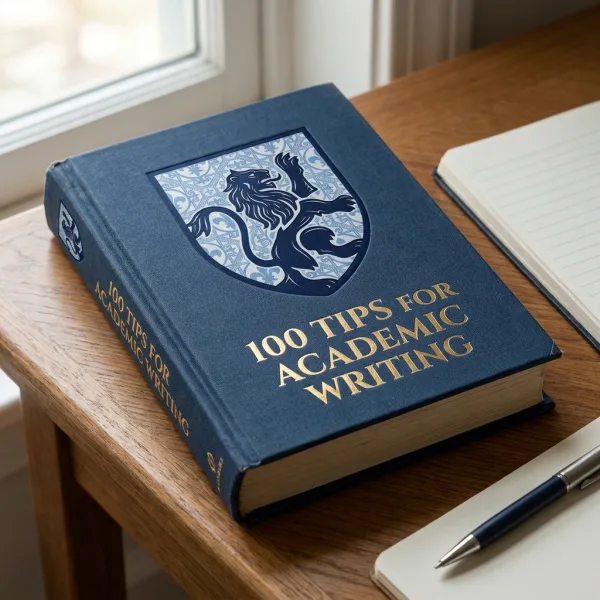
100 Tips to Avoid Mistakes in Academic Writing
↓ Download the free PDFNo email required. Free for personal study and classroom use.
- 100 numbered tips across one hundred pages — each one a specific, avoidable mistake and the fix, not vague advice.
- Organised into nine chapters that follow the writing process, from planning to citation.
- Pitched at students, researchers, and anyone who writes to be taken seriously (CEFR B2–C2).
- Teaches the conventions of formal academic English, then defers to your own required style guide for the details.
- Free to download and free to share for personal study and the classroom.
What this book covers
The handbook is built around its promise — clear, correct, credible — and the one hundred tips are grouped into nine chapters that follow the order in which mistakes actually happen, from the decisions you make before writing a sentence to the way you handle your sources at the end:
- Foundations: mindset, audience and planning — the mistakes that happen before you write a single sentence, from misjudging your reader to skipping the plan.
- Structure and organization — building a paper a reader can actually navigate, with paragraphs that each do one job.
- Cohesion, flow and transitions — joining ideas so the argument moves forward instead of jumping.
- Clarity and concision — cutting the clutter, the padding, and the long way of saying a short thing.
- Academic style, voice and tone — sounding scholarly without becoming stiff, pompous or impenetrable.
- Grammar and syntax, then punctuation and mechanics — the technical errors that quietly undermine credibility.
- Word choice and vocabulary — precise, appropriate words instead of vague or borrowed ones.
- Sources, citation and academic integrity — using and crediting other people's work honestly and correctly, and avoiding the accidental plagiarism that comes from careless note-taking rather than dishonesty.
Because every tip is numbered and self-contained, the book works equally well read front to back before a big deadline, or opened to a single chapter when one specific problem — say, weak transitions or a tone that reads too casual — keeps coming back in your feedback. The tips do not pile on jargon or theory: each one points at a habit you can recognise in your own drafts and shows the cleaner version beside it, so the difference between the mistake and the fix is visible rather than abstract.
Who it's for
The book is written for anyone who writes to be taken seriously: undergraduates on their first essays, postgraduates wrestling with a thesis, researchers polishing a paper, and applicants whose statement has to land in one read. It assumes you already write connected English — roughly CEFR B2 to C2 — and want to stop losing marks and credibility to the avoidable, not to learn English from scratch.
If you are at the lower end of that range, work through the chapters in order; the early ones on planning, structure and clarity fix the highest-impact mistakes first. If you are already a confident writer, treat the contents list as a diagnostic — go straight to the chapters that match the comments you keep getting back, whether that is "too wordy", "unclear argument", or problems with how you cite. Native and non-native writers alike make these mistakes; the tips are about academic convention, not about where you learned English. A first-year student avoiding a vague thesis statement and a researcher tightening a methods section are using the very same one hundred tips at different scales.
How to use a writing PDF so it works
Here is the honest part. A writing handbook is a brilliant reference and a poor teacher — if you only read it. Reading "cut the clutter" feels productive, but it does nothing to the cluttered paragraph you wrote last night. The book gives you the standard to aim at; you have to apply it to your own words.
A tip you have read is not the same as a tip you have applied. One improves your notes; the other improves your next draft.
So use it actively. Pull up a real draft of your own — an essay, a chapter, an application — and run one chapter's tips over it, editing as you go. Fix one mistake at a time rather than trying to absorb all hundred tips at once; clarity this week, citation the next. And after you have applied a tip, re-read your own sentence aloud to check it actually reads better, because the test of academic writing is always the reader, not the rule. We expand on this method in our guide to learning from English PDFs the right way.
Most of the academic writing we mark is not weak because the writer lacks ideas — it is weak because of a handful of repeated, avoidable habits: sentences that say too little in too many words, paragraphs without a clear job, and sources dropped in without being framed. Learners improve fastest when they take one such habit and hunt it down across a whole draft, rather than reading general advice and hoping it transfers.
Based on instructor marking notes. Directional observation, not a controlled study.
What makes this handbook different
Two things. First, it is framed entirely around mistakes — each tip names a specific, recognisable error and gives you the fix, which is far easier to act on than abstract principles of "good writing". Second, it knows its limits: it teaches the conventions of clear, formal academic English that hold across disciplines, and then deliberately defers to whatever style guide your course or journal requires for citation format, referencing and house rules. It makes your writing better without picking a fight with your department's handbook — you bring the conventions of clear English, your style guide brings the citation format, and the two never contradict each other.
Pair it with these free PDFs
Clear writing rests on clear English. Once the academic habits are in place, three other free books in our library strengthen the foundations underneath them:
- Many writing mistakes are really grammar mistakes in disguise — English Grammar: A Complete Guide settles the rules that academic writing assumes you already know.
- Need your sentences to carry complex ideas without collapsing? 100 Essential English Sentence Structures gives you one hundred reusable templates for exactly that.
- Writing for work as well as study? The Complete Business English Handbook carries the same clear, credible standard into reports, emails and proposals.
All three sit in the same free library — see the full set on our free English learning PDFs page.
Download 100 Tips to Avoid Mistakes in Academic Writing
Grab the PDF, open your current draft beside it, and fix just one kind of mistake before you close it. That single edit will do more for your grade than another evening of rereading the brief.
100 Tips to Avoid Mistakes in Academic Writing
↓ Download the free PDFNo email required. Free for personal study and classroom use.
Want the tips explained and your own writing corrected? Our free English track adds the one thing a PDF cannot — feedback on the English you actually produce.
Prefer an app to a book? See our pick for The best language learning app 2026.
Frequently asked questions
Is 100 Tips to Avoid Mistakes in Academic Writing really free to download?
Yes. The full 100-page PDF is free to download from this page, with no email sign-up and no paywall. It was written and produced by Oxford English Global, and you are free to use it for personal study and to share it with students in the classroom.
What level is this academic writing book for?
It is aimed at CEFR B2 to C2 — upper-intermediate to advanced. If you are writing essays, a thesis, research papers, or strong applications and want to stop losing marks to avoidable mistakes, it is pitched at you. You do not need to be a native speaker, but you should already write connected paragraphs in English.
Does it replace my university's style guide?
No, and it does not try to. The handbook teaches the conventions of clear, formal academic English that hold across disciplines, then explicitly defers to whatever style guide your course or journal requires for citation, formatting and referencing details. Use the two together.
Can I improve my academic writing from a PDF alone?
A PDF is an excellent reference but cannot correct the sentences you actually write. Use it actively — apply one tip at a time to a real draft, then re-read your own work against it — and pair it with a source of feedback. Our free English track is built to add exactly that correction layer.