
How to Write a Strong Opinion Essay in English
A good opinion essay is not about having the cleverest idea. It is about stating a clear position and supporting it in a logical order. This guide gives a simple five-paragraph structure, the linking words to use in each paragraph, a full model essay and the mistakes that cost learners marks.

- What an opinion essay is
- The five-paragraph structure
- How to write the introduction
- How to write the body paragraphs
- How to handle the opposing view
- How to write the conclusion
- Linking words for each paragraph: summary table
- Model opinion essay (about 300 words)
- How to plan in 5 minutes
- Common mistakes that cost marks
- What this article cannot tell you
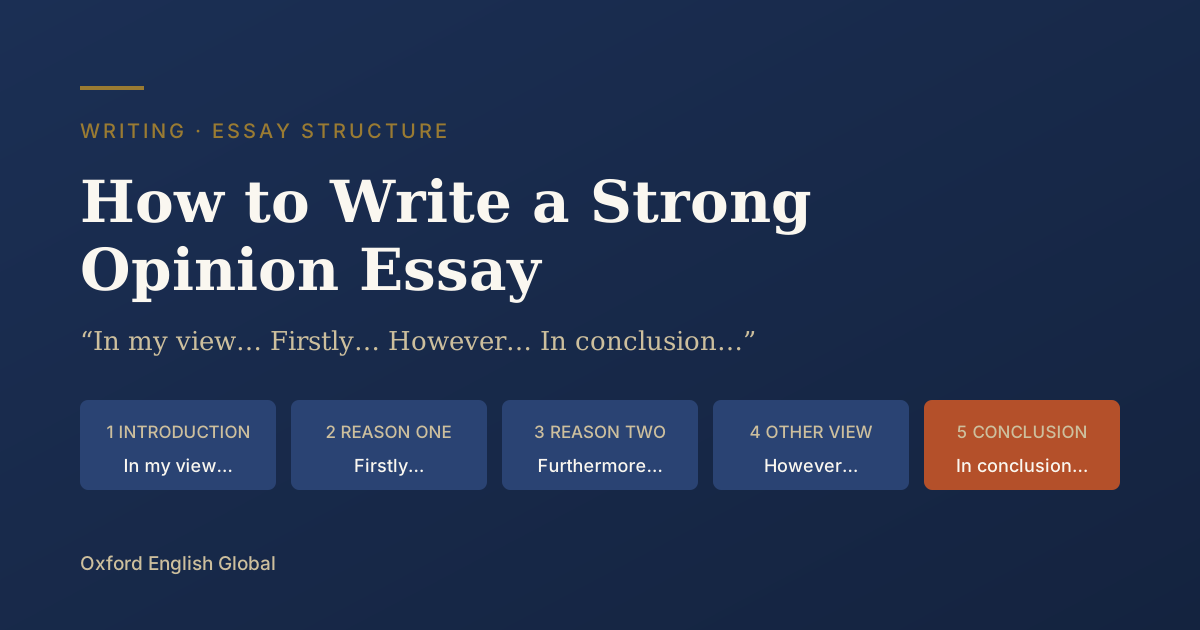
A strong opinion essay states a clear position in the introduction, supports it with two or three body paragraphs that each make one reason and back it with an explanation and an example, deals briefly with the opposing view, and ends with a conclusion that restates the position in new words. The simplest reliable structure is five paragraphs: introduction (topic + your opinion), body 1 (first reason), body 2 (second reason), body 3 (counter-argument and your response) and conclusion. Linking words hold it together: In my view and I firmly believe to give your opinion; Firstly, Furthermore and Another reason is to add points; For example to support them; However and Although to show the other side; and In conclusion to finish. This guide gives the full structure, a paragraph plan, linking words for each paragraph, a complete model essay with a short analysis, and the mistakes that cost learners marks most often.
Who this is for. Adult learners at about CEFR B1–C1 writing opinion essays for class, for exams such as IELTS Writing Task 2 or Cambridge English, or for work and university. The structure works for any length; only the amount of detail changes.
What an opinion essay is
An opinion essay (also called an argumentative or persuasive essay, or an "agree or disagree" essay in exams) answers a question by taking a clear side and defending it with reasons. Typical prompts look like this:
- Some people think that working from home is better than working in an office. To what extent do you agree or disagree?
- Should university education be free for everyone? Give your opinion.
- Social media does more harm than good. Do you agree?
It is different from a discussion essay ("Discuss both views and give your opinion"), where you must present both sides fairly before deciding, and from a problem–solution essay. Read the question carefully: if it asks to what extent, the reader expects your position to be clear from the first paragraph to the last.
What examiners and teachers look for
- A clear position that stays the same throughout the essay.
- Relevant, developed ideas: reasons that are explained and supported, not just listed.
- Logical organisation: one main idea per paragraph and clear links between ideas.
- Accurate, varied language: grammar and vocabulary that express ideas precisely.
For IELTS, the official description of the Writing test confirms that Task 2 asks for an essay of at least 250 words and carries more weight than Task 1; see the IELTS Academic Writing format page and the British Council's Task 2 practice page for the current details.
The five-paragraph structure
| Paragraph | Purpose | What to include | Share of the essay |
|---|---|---|---|
| 1. Introduction | Introduce the topic and give your opinion | Paraphrase of the question + thesis statement (your position) + optional preview of reasons | About 10–15% |
| 2. Body paragraph 1 | Your strongest reason | Topic sentence + explanation + example + link back to your position | About 25% |
| 3. Body paragraph 2 | Your second reason | Same pattern as body 1 | About 25% |
| 4. Body paragraph 3 | The opposing view and your response | Fair statement of the other side + why your view is still stronger | About 20% |
| 5. Conclusion | Close the argument | Restate your opinion in new words + summarise main reasons; no new ideas | About 10–15% |
For a short exam essay of around 250–300 words, a four-paragraph version also works well: introduction, two body paragraphs (you can place the counter-argument inside the second one), and conclusion.
How to write the introduction
Keep the introduction short: two or three sentences is enough.
- Paraphrase the topic. Restate the question in your own words, without copying it. Question: "Working from home is better than working in an office." → Paraphrase: "In recent years, many companies have allowed staff to do their jobs remotely rather than travel to a workplace."
- State your opinion clearly (the thesis). "In my view, working from home is the better option for most office employees."
- Optional: preview your reasons. "…because it saves time and gives people more control over their working day."
Linking words for the introduction
- To give your opinion: In my view, … / In my opinion, … / I firmly believe that … / I would argue that … / I strongly agree/disagree that …
- To show partial agreement: I partly agree that … / To some extent, … / While there are some benefits, I believe that …
- To introduce the topic: Nowadays, … / In recent years, … / It is often argued that …
Avoid empty openings such as "Since the beginning of time, people have…". They use words without saying anything.
How to write the body paragraphs
Every body paragraph should follow the same pattern. A useful memory aid is PEEL:
| Step | What it does | Example |
|---|---|---|
| Point | Topic sentence: one clear reason | Firstly, working from home saves employees a great deal of time. |
| Explain | Why or how the point is true | Without a daily commute, workers can use those hours for rest, family or further study. |
| Example | A specific, realistic case | For example, someone who travels an hour each way gains ten hours a week. |
| Link | Connect back to your position | This extra time is a clear advantage that office work cannot offer. |
Linking words for body paragraphs 1 and 2
- To start the first reason: Firstly, … / To begin with, … / The main reason is that …
- To add a second reason: Secondly, … / Furthermore, … / In addition, … / Another important point is that … / Moreover, …
- To explain: This is because … / This means that … / As a result, … / Therefore, …
- To give examples: For example, … / For instance, … / such as … / A good example of this is …
Examples: use realistic, checkable support
Personal examples and simple logical examples are fine in most essay exams. Do not invent precise statistics or fake studies such as "A 2023 study showed that 87% of workers…". Examiners notice, and outside exams it damages your credibility. If you use a real figure, give its source.
How to handle the opposing view
Showing that you understand the other side makes your argument stronger, not weaker. The pattern is concede, then rebut: admit what is true about the other view, then explain why your position is still more convincing.
- Admittedly, working from home can make some people feel isolated. However, this problem can be reduced with regular video calls and occasional team days in the office.
Linking words for the counter-argument paragraph
- To present the other view: Some people argue that … / It is often claimed that … / Opponents of this view believe that … / Admittedly, … / It is true that …
- To respond: However, … / Nevertheless, … / Even so, … / On the other hand, … / Although this may be true, …
Notice the punctuation: However starts a new sentence and is followed by a comma. Although joins two clauses in one sentence: Although some people feel isolated, most adapt quickly. Do not write Although…, but….
How to write the conclusion
The conclusion should be short and should contain no new arguments.
- Signal the end: In conclusion, … / To sum up, … / Overall, …
- Restate your opinion in different words from the introduction.
- Briefly summarise your main reasons.
- Optional: a final recommendation or look ahead: Employers should therefore …
Avoid In the end (it means "finally, after a long time", not "in conclusion") and avoid changing your position in the last paragraph.
Linking words for each paragraph: summary table
| Paragraph | Function | Useful phrases |
|---|---|---|
| Introduction | Introduce topic / give opinion | Nowadays… · It is often argued that… · In my view… · I firmly believe that… · I partly agree that… |
| Body 1 | First reason / explain / example | Firstly… · The main reason is that… · This is because… · For example… |
| Body 2 | Add a reason / result | Secondly… · Furthermore… · In addition… · As a result… · Therefore… |
| Body 3 | Other view / response | Some people argue that… · Admittedly… · However… · Nevertheless… · Although… |
| Conclusion | Close and restate | In conclusion… · To sum up… · Overall… · For these reasons, I believe… |
Use linkers to show real relationships between ideas, not to decorate every sentence. Starting every sentence with Moreover or Furthermore makes writing sound mechanical. For more sentence patterns you can reuse, see our free 100 Essential English Sentence Structures.
Model opinion essay (about 300 words)
Question: Some people think that working from home is better than working in an office. To what extent do you agree or disagree?
In recent years, many companies have allowed employees to do their jobs remotely instead of travelling to a workplace every day. In my view, working from home is the better option for most office workers, because it saves time and gives people more control over their day.
Firstly, remote work removes the daily commute. Instead of spending hours in traffic or on crowded trains, employees can use this time to rest, exercise or spend time with their families. For example, a person who travels an hour each way gains around ten hours every working week. This is a benefit that office work simply cannot match.
Secondly, working from home allows people to organise their time more flexibly. Parents can take children to school, and people who concentrate best early in the morning can start then. As a result, many employees feel less stressed and are able to focus on results rather than on being seen at a desk.
Admittedly, working from home has some disadvantages. Some people feel isolated, and new employees may find it harder to learn from more experienced colleagues. However, these problems can be reduced with regular video meetings, clear communication and occasional days in the office for training and teamwork.
In conclusion, although remote work is not perfect, I firmly believe that its advantages outweigh its drawbacks for most office jobs. Saving time and gaining flexibility make employees' lives better, and employers who support home working are likely to have more motivated staff.
Why this essay works
- The position is stated in the first paragraph and repeated, in new words, in the last.
- Each body paragraph has one topic sentence, an explanation and an example.
- The counter-argument is treated fairly and then answered.
- Linking words show logic (Firstly, Secondly, As a result, Admittedly, However) without being overused.
- The example uses simple, checkable arithmetic rather than an invented statistic.
How to plan in 5 minutes
- Read and underline the key words in the question. Decide exactly what you are asked.
- Choose your position quickly. Pick the side you can support best, not necessarily the one you feel most strongly about.
- List three or four reasons, then keep the two strongest.
- Add one example to each reason.
- Note the main opposing argument and your one-sentence answer to it.
- Write. Leave a few minutes at the end to check grammar, spelling and word count.
Common mistakes that cost marks
| Mistake | Why it is a problem | Fix |
|---|---|---|
| No clear opinion in the introduction | The reader cannot follow your argument | Write a thesis sentence starting In my view… |
| Changing position in the conclusion | The essay contradicts itself | Decide before you write and keep the same position |
| Several ideas in one paragraph | Ideas are listed but not developed | One main idea per paragraph, with explanation and example |
| Copying the question | Copied words show less language ability | Paraphrase with synonyms and a different structure |
| Invented statistics | Unconvincing and easy to spot | Use personal, logical or real, sourced examples |
| Overusing linkers | Writing sounds mechanical | Use a linker only where it shows a real relationship |
| Although…, but… | Grammatically wrong | Use Although…, or …, but…, not both |
| New ideas in the conclusion | Leaves arguments undeveloped | Only restate and summarise |
| Informal language (gonna, a lot of stuff, kids) | Wrong register for an essay | going to, many things, children |
For a longer checklist of academic writing errors, see our free 100 Tips to Avoid Mistakes in Academic Writing. For grammar errors that often appear in essays, see 20 common English grammar mistakes. The passive voice is also useful in formal essays; see our guide to the passive voice in English.
What this article cannot tell you
- Your exam's exact rules. Word limits, timing and marking criteria differ between IELTS, Cambridge English, TOEFL and school or university assignments, and they can change. Always check the official exam or course information.
- Your band score or grade. A structure helps, but scores also depend on grammar range, vocabulary and accuracy. Only a trained examiner or teacher can assess a real piece of your writing.
- Every essay type. Discussion, problem–solution and two-part questions need slightly different plans. Read the question carefully before using this structure.
This page is independent guidance from Oxford English Global. It contains no affiliate or sponsored links. To practise further, try our free lessons, our free English PDF books or the English level test to check where you are now.
Frequently asked questions
What is the structure of an opinion essay?
A reliable structure is five paragraphs: an introduction that states your opinion, two body paragraphs that each give one reason with an explanation and example, a paragraph that presents and answers the opposing view, and a conclusion that restates your opinion in new words.
Where should I give my opinion in an opinion essay?
State it clearly in the introduction, keep it the same in every paragraph, and restate it in the conclusion. Do not wait until the end to reveal your position.
What linking words can I use in an opinion essay?
Use In my view or I firmly believe to give your opinion; Firstly, Furthermore and In addition to add reasons; For example to support them; Admittedly, However and Nevertheless for the other side; and In conclusion or To sum up to finish.
Should I include the opposing view?
Yes, briefly. Admitting what is true about the other side and then explaining why your view is stronger makes your argument more convincing.
Can I use statistics in an exam essay?
Only if they are real and you know the source. Do not invent figures or studies. Personal or logical examples are usually enough in essay exams.