
How to Write a Polite Complaint Email in English: Structure, Phrases and Two Samples
A good complaint email is clear, factual and polite but firm. Use a simple five-part structure, describe facts instead of feelings, ask for a specific solution with a deadline, and avoid the words that make companies stop listening. Includes phrases for every part, two complete sample emails and a checklist.

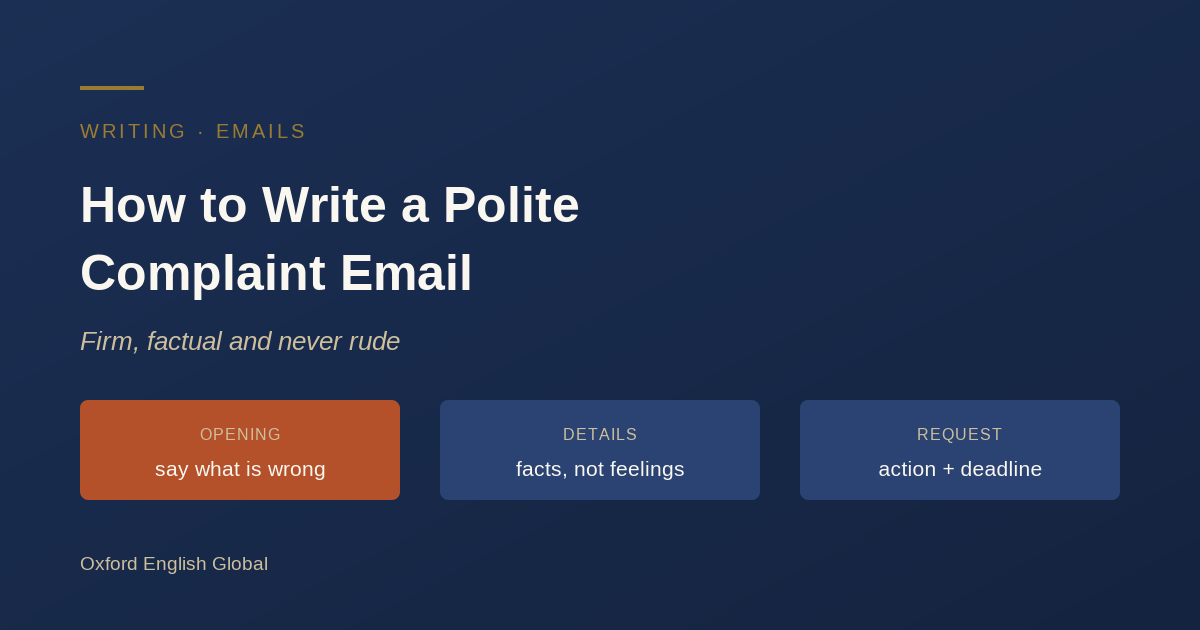
- When to complain by email, and what makes it work
- A simple five-part structure
- Subject lines and greetings
- The opening sentence: say what is wrong
- The details: facts, not feelings
- The request: say exactly what you want
- The closing
- Firm but polite: words to use and words to avoid
- Two sample complaint emails
- Common mistakes learners make
- Checklist before you send
- What this article cannot tell you
To write a polite complaint email in English, use five parts: a clear subject line, one opening sentence that says what the problem is, the facts (dates, order numbers, what went wrong), the specific action you want and a deadline, and a polite closing. Stay firm by being specific and factual, not by being emotional: I am writing to complain about…, Unfortunately, the item arrived damaged and I would like a full refund by 15 December are firm and polite at the same time. Avoid insults, capital letters, sarcasm and exaggeration, which make it easier for the company to ignore you. This guide gives a simple structure, phrases for each part from firm to very formal, two complete sample emails and a checklist to use before you click Send.
Sources. The structure follows standard business English practice and matches the free complaint templates from the UK consumer charity Citizens Advice (read 28 November 2026), which say you can "copy the text into an email" and which set out the agreed work, the problems, the remedy you want and a response deadline of 14 days. The phrases and sample emails on this page are our own. This page explains language, not your legal rights.
When to complain by email, and what makes it work
An email is often the best way to complain because it gives you a written record with a date, you can attach evidence such as photos and receipts, and you have time to choose your words. A good complaint email has three qualities:
- Clear. The reader knows the problem and what you want within the first few lines.
- Factual. Dates, numbers and descriptions, not feelings and opinions.
- Polite but firm. Respectful language, a specific request and a deadline.
Remember that the person who reads your email probably did not cause the problem. Being polite makes them more willing to help you, and a calm, well-organised email is also more persuasive if you need to take the complaint further later.
A simple five-part structure
| Part | What to include | Example |
|---|---|---|
| 1. Subject line | Topic + reference number | Complaint: damaged item, order #48213 |
| 2. Opening | Greeting + one sentence saying why you are writing | Dear Customer Service Team, I am writing to complain about an order I received on 20 November. |
| 3. Details | The facts: what, when, where, and what you have already done | The lamp arrived with a broken base. I have attached two photos. |
| 4. Request | The exact solution you want and a deadline | I would like a replacement or a full refund by 5 December. |
| 5. Closing | Polite closing line + sign-off + full name and contact details | I look forward to your reply. Kind regards, Maria Lopez |
Keep the email short: usually 120 to 250 words. If you have a lot of information, put the facts in a numbered list so the reader can follow them easily.
Subject lines and greetings
Subject line
A good subject line tells the company what the email is about and helps them find your account. Include the word complaint and a reference number if you have one:
- Complaint: late delivery, order #77125
- Complaint about overcharge on invoice INV-2026-0412
- Faulty washing machine, repair request (account 553901)
Avoid vague or emotional subject lines such as Terrible service!!! or Very disappointed.
Greeting
| Situation | Greeting | Matching sign-off |
|---|---|---|
| You know the person's name | Dear Mr Khan, / Dear Ms Rossi, | Kind regards, / Yours sincerely, |
| You don't know the name | Dear Sir or Madam, / Dear Customer Service Team, | Kind regards, / Yours faithfully, |
| A regular contact you are on first-name terms with | Dear Anna, / Hello Anna, | Best regards, / Kind regards, |
Yours faithfully and Yours sincerely are traditional British letter endings; Kind regards is acceptable in almost every complaint email. Our guide to writing a formal letter in English explains these rules in detail.
The opening sentence: say what is wrong
Do not start with a long story. Say directly that you are complaining and what about:
- I am writing to complain about the service I received at your Leeds branch on 14 November.
- I am writing regarding order #48213, which arrived damaged on 20 November.
- I would like to make a formal complaint about a charge on my October bill.
- I am contacting you because my internet connection has not worked since 2 November.
If this is not your first message, say so immediately: I am writing again about… or Further to my email of 10 November, I have still not received…
The details: facts, not feelings
Describe exactly what happened. Include dates, times, names, reference numbers and what you have already done to solve the problem.
Useful phrases for describing the problem
- Unfortunately, the product stopped working after two days.
- When I opened the package, I found that…
- I was told that the delivery would arrive by 18 November. However, it has not arrived.
- I was charged £45 instead of the advertised price of £30.
- I called your helpline on 12 November and was promised a call back within 48 hours, but nobody contacted me.
- I have attached a copy of the receipt and photos of the damage.
Turn feelings into facts
| Emotional (avoid) | Factual (use) |
|---|---|
| Your delivery service is a joke. | The parcel arrived nine days after the promised date. |
| Your staff were incredibly rude. | The assistant refused to look at my receipt and walked away while I was speaking. |
| This is the worst product I have ever bought. | The kettle leaks from the base every time I use it. |
| You obviously don't care about customers. | I have contacted you three times (5, 9 and 14 November) without a reply. |
You can still say how the problem affected you, but keep it calm and brief: As a result, I had to take a day off work to wait for the engineer.
The request: say exactly what you want
The most important part of a complaint email is the request. Many complaints fail because the writer explains the problem well but never says what they want. Be specific: a refund, a replacement, a repair, a correction to a bill, an apology or an explanation.
Phrases for requests, from polite to very firm
| Level | Phrase |
|---|---|
| Polite | I would be grateful if you could send a replacement. |
| Polite and direct | I would like a full refund of £89. |
| Firm | Please arrange for an engineer to repair the fault by 10 December. |
| Firmer | I expect a full refund within 14 days of this email. |
| Very firm (follow-up) | If I do not receive a response by 10 December, I will have no option but to take the matter further. |
A deadline makes your email much more effective. Fourteen days is a common, reasonable period; the Citizens Advice templates use it too. Use the very firm phrase only in a second or third email, or when the company has already ignored you.
Notice how much of the politeness comes from grammar: would, could and I would be grateful if. Our guide to modal verbs explains how these forms soften a request, and our guide to indirect questions shows how to ask for information politely, for example Could you tell me when I can expect a reply?
The closing
End with a short, polite closing line, your sign-off and your full name. Add an order number, phone number or account number if relevant.
- I look forward to hearing from you.
- Thank you for your help with this matter.
- I look forward to a prompt resolution. (firmer)
- Please contact me on 07700 900123 if you need any further information.
Remember: I look forward to hearing, not to hear, because to here is a preposition.
Firm but polite: words to use and words to avoid
| Avoid | Why | Use instead |
|---|---|---|
| WRITING IN CAPITALS | Reads as shouting | Normal capitalisation; use one clear sentence for emphasis |
| You must…! / You have to…! | Sounds aggressive in a first email | Please… / I would like you to… |
| Sarcasm (Thanks a lot for nothing) | Often misunderstood; sounds rude | A plain statement of the facts |
| Threats you do not mean | Damages your credibility | A clear deadline and next step you will really take |
| Exaggeration (always, never, worst ever) | Easy to dispute | Exact numbers and dates |
| Insults about staff | Makes the reader defensive | Describe what the person did, not what they are |
Softeners that keep the tone polite
- Unfortunately: Unfortunately, the item was not as described.
- I'm afraid (slightly less formal): I'm afraid this is not acceptable.
- It appears that: It appears that I have been charged twice.
- I'm sure you will understand: I'm sure you will understand why I am disappointed.
These words do not weaken your complaint. They make you sound calm, reasonable and in control, which is exactly the impression you want to give.
Two sample complaint emails
Sample 1: damaged order (first email)
Subject: Complaint: damaged item, order #48213
Dear Customer Service Team,
I am writing to complain about order #48213, which I received on 20 November.
When I opened the package, I found that the base of the table lamp was cracked and the lamp could not stand upright. The outer box was also badly damaged. I have attached two photos of the lamp and the packaging.
I would be grateful if you could send a replacement lamp or, if this is not possible, refund the full cost of £64.99. Please let me know how you would like me to return the damaged item.
I look forward to hearing from you by 5 December.
Kind regards,
Maria Lopez
Sample 2: service problem (follow-up email)
Subject: Second complaint: internet not working, account 553901
Dear Mr Brennan,
Further to my email of 4 November, I am writing again because my home internet connection has still not been repaired.
The connection stopped working on 2 November. Since then I have contacted your company three times:
- 4 November: email (reference 22-8841)
- 8 November: phone call, when I was promised an engineer visit within five working days
- 18 November: phone call, when I was told the visit had been cancelled
As I work from home, this has caused me serious difficulty, and I have paid for a service I have not received for almost four weeks.
I would like an engineer to repair the connection by 5 December and a refund for the period without service. If I do not receive a response by that date, I will have no option but to take the matter further.
Thank you for your attention to this matter.
Yours sincerely,
Daniel Okafor
07700 900456
Notice the differences: the second email is firmer, gives a numbered history and states a consequence, but it still contains no insults, no capital letters and no exaggeration.
Common mistakes learners make
| Mistake | Better |
|---|---|
| I am writing for complain about… | I am writing to complain about… |
| I want that you give me my money back. | I would like a full refund. |
| I look forward to hear from you. | I look forward to hearing from you. |
| The product is broken since Monday. | The product has been broken since Monday. |
| Please answer me quickly. | I would appreciate a reply by 5 December. |
| Dear Sir or Madam … Yours sincerely | Dear Sir or Madam … Yours faithfully (British) or Kind regards |
The fourth mistake is a tense problem: use the present perfect with since and for. See our guides to since and for and present perfect vs past simple.
Checklist before you send
- Does the subject line include the word complaint and a reference number?
- Does the first sentence say what the problem is?
- Have you included dates, amounts and reference numbers?
- Have you attached evidence (receipt, photos, screenshots)?
- Have you said exactly what you want and by when?
- Have you removed capitals, sarcasm, insults and exaggeration?
- Do your greeting and sign-off match?
- Have you read it aloud once? If it sounds angry, rewrite the angriest sentence as a fact.
If the problem was caused by you and you need to say sorry instead, see our guide to writing an apology email for a mistake at work. For everyday workplace emails, read how to write work emails in English, and for speaking practice on the phone, see phone calls in English.
What this article cannot tell you
- Your legal rights. Consumer law differs between countries. This page is about language and tone, not legal advice. In the UK, Citizens Advice explains consumer rights; in other countries, look for your national consumer protection organisation.
- Company procedures. Many companies have their own complaints form or process, and some require you to use it before you can escalate. Check their website first.
- Cultural differences in every country. We describe a style that works well in British and international business English. Expectations about directness vary between cultures and companies.
- Whether your complaint will succeed. A well-written email improves your chances, but the outcome depends on the facts and the company.
This page is independent guidance from Oxford English Global. It contains no affiliate links. To practise professional writing with feedback from a teacher, see our Business English and General English courses, or try our free lessons.
Frequently asked questions
How do I start a complaint email in English?
Start with a greeting and one sentence that says what you are complaining about, for example: Dear Customer Service Team, I am writing to complain about order #48213, which arrived damaged on 20 November.
How can I sound firm without being rude?
Be specific and factual: give dates, amounts and reference numbers, say exactly what you want and set a deadline. Avoid capital letters, sarcasm, insults and exaggeration. Words like unfortunately and I would like keep the tone polite.
How long should a complaint email be?
Usually 120 to 250 words. Put long histories into a short numbered list so the reader can follow the facts quickly.
How should I end a complaint email?
End with your request and deadline, a closing line such as I look forward to hearing from you, a sign-off such as Kind regards, and your full name and reference number.
Should I give a deadline in a complaint email?
Yes. A specific deadline, such as 14 days or a date, makes your request clear and gives you a reason to follow up if there is no reply.