
How to Write an Apology Email for a Mistake at Work: Structure, Phrases and Examples
A good apology email at work is short, specific and practical: say sorry first, name the mistake, explain the fix and, for bigger mistakes, how you will prevent it. Here is a simple structure, phrases at every level of formality, five model emails and the wording that makes apologies sound insincere.

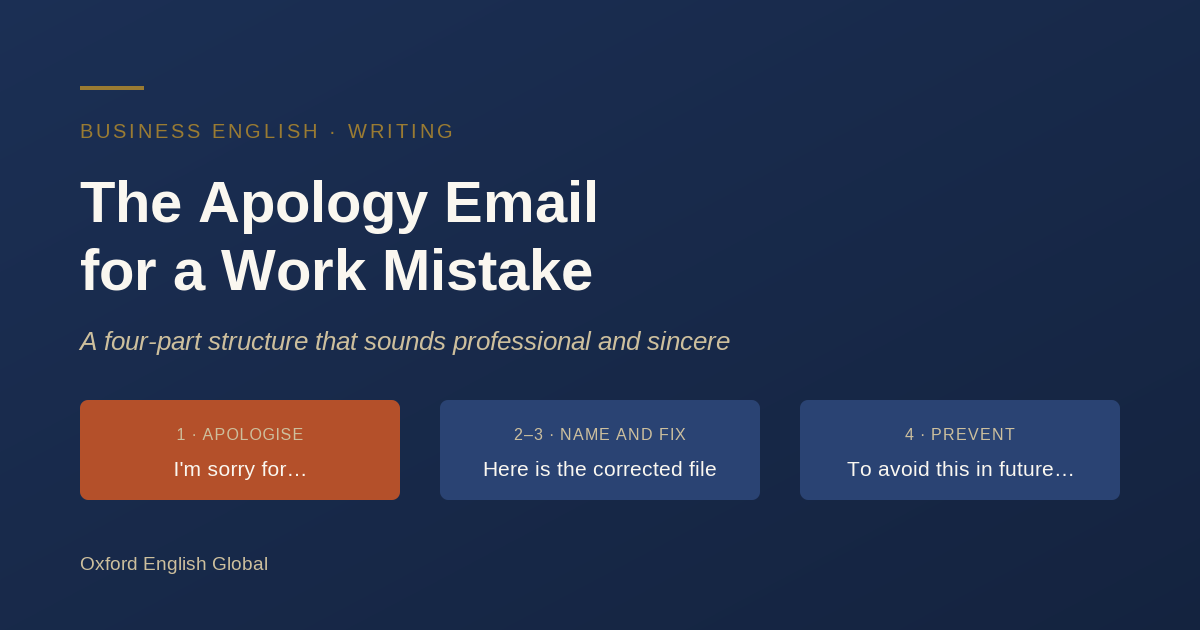
- The four-part structure of a professional apology email
- Writing the subject line
- Apology phrases from informal to formal
- Taking responsibility: active vs passive voice
- Phrases for explaining the fix and preventing a repeat
- Five model apology emails
- How long should an apology email be?
- Phrases that make an apology sound insincere
- How to reply when someone apologises to you
- Checklist before you send
- What this article cannot tell you
A good apology email for a mistake at work does four things in a short message: it says sorry clearly in the first line, names the mistake specifically, explains what you have done or will do to fix it, and (for bigger mistakes) says how you will stop it happening again. Keep it brief, take responsibility with "I" rather than hiding behind the passive voice, avoid long excuses, and match the size of the apology to the size of the mistake. A wrong attachment needs two lines; a missed client deadline needs a fuller message. This guide gives you that four-part structure, ready-to-use phrases at different levels of formality, five model emails for common situations, and the phrases that make an apology sound insincere.
About this guide. The structure and phrases here are based on standard business English teaching practice at Oxford English Global and on the plain-language principles recommended by the US Office of Personnel Management's plain language guidance: put the main point first, use active voice and keep sentences short. Phrase meanings follow the Cambridge Dictionary. Expectations about apologies differ between companies and cultures, so adapt the tone to your workplace. For anything with legal or contractual consequences, check the wording with your manager, legal or HR team before sending.
The four-part structure of a professional apology email
Most workplace apologies follow the same pattern. Once you know it, you can write one quickly, even when you feel stressed about the mistake.
| Part | What it does | Example |
|---|---|---|
| 1. Apologise | Says sorry clearly, at the start | "I'm sorry for the error in the invoice I sent you yesterday." |
| 2. Name the mistake | Shows you understand exactly what went wrong and its effect | "The total was calculated with last year's rate, so it was €240 too high." |
| 3. Fix it | Says what you have done or will do, and when | "I've attached a corrected invoice, and I've cancelled the original." |
| 4. Prevent it (for bigger mistakes) | Says how you will avoid a repeat | "I've updated our rate table so this won't happen on future invoices." |
Then close politely, for example: "Thank you for pointing this out, and apologies again for the inconvenience." Notice what is missing: a long explanation of why it happened. A short reason can help ("I used an old template"), but a paragraph of excuses makes the email about you rather than the reader.
Writing the subject line
The subject line should make it clear that this email corrects or follows up something, so the reader opens it before acting on the wrong information.
| Situation | Clear subject line |
|---|---|
| Wrong attachment or figures | Correction: updated sales report for October |
| Wrong invoice | Corrected invoice 4521 (replaces previous version) |
| Missed deadline | Project Atlas report: delay and new delivery date |
| Missed meeting | Apologies for missing today's 10:00 meeting |
| Email sent to the wrong person | Please disregard my previous email |
Avoid vague subject lines such as "Sorry!!" or "Mistake". They create worry without information. For more on subject lines and email structure in general, see our guide to writing clear work emails in English.
Apology phrases from informal to formal
English has many ways to say sorry. Choose one level for the whole email and keep it consistent.
| Level | Phrase | When to use it |
|---|---|---|
| Informal | Sorry about that! / My mistake. | Small errors with close colleagues |
| Neutral | I'm sorry for… / Apologies for… | Most workplace situations; a safe default |
| Neutral, stronger | I'm very sorry for… / I'm really sorry about… | Mistakes that caused extra work or delay |
| Formal | Please accept my apologies for… | Clients, senior managers, external partners |
| Very formal | I sincerely apologise for… / We deeply regret… | Serious mistakes, complaints, official responses |
Grammar notes
- Sorry for / about + noun or -ing: "I'm sorry for the delay." / "I'm sorry for sending the wrong file."
- Sorry (that) + clause: "I'm sorry that the report arrived late."
- Apologise for: "I apologise for the confusion." (British spelling apologise; American apologize.)
- Apologies for (noun, plural): "Apologies for the late reply." It is common in emails and slightly less personal than "I'm sorry".
Avoid "I'm sorry for the inconvenience caused" as your only apology for a serious mistake. It is fine as a closing line, but on its own it can sound like a template.
Taking responsibility: active vs passive voice
The quickest way to make an apology sound sincere is to use I and an active verb. The passive voice hides who made the mistake, and readers notice.
| Avoids responsibility | Takes responsibility |
|---|---|
| Mistakes were made in the report. | I made two mistakes in the report. |
| The wrong file was attached. | I attached the wrong file. |
| The deadline was missed. | I missed the deadline. |
| It seems there was some confusion. | I gave you the wrong date. |
If the mistake was a team mistake, "we" is appropriate: "We sent the order to the wrong address." If someone else made the mistake but you are responding for the company, "we" is usually still better than blaming a named colleague in an email to a client. Our guide to the passive voice in English explains when the passive is useful and when it sounds evasive.
Phrases for explaining the fix and preventing a repeat
| Purpose | Useful phrases |
|---|---|
| Giving the correction | Please find the corrected version attached. / The correct figure is… / Here is the right link: |
| Saying what you have done | I've already… / I've contacted the courier and… / I've updated the file so that… |
| Saying what you will do | I'll send the final version by… / I will call you tomorrow morning to… / I'll make sure that… |
| Offering a choice | Would you prefer… or…? / If it helps, I can… |
| Preventing a repeat | To avoid this in future, I've… / From now on, I'll… / I've added a check to… |
| Closing | Thank you for your patience. / Thanks for bringing this to my attention. / Apologies again for any inconvenience. |
Be specific with dates and actions. "I'll fix it soon" sounds vague; "I'll send the corrected figures by 3 pm today" sounds professional and gives the reader something to rely on.
Five model apology emails
Each model follows the four-part structure. Change the details for your own situation.
1. Small mistake: wrong attachment (to a colleague)
Hi Priya,
Sorry, I attached the old version of the presentation in my last email. Here's the correct one. The only changes are on slides 4 and 9.
Thanks,
Omar
Why it works: it is as short as the mistake. No need for "I sincerely apologise" here.
2. Wrong figures sent to a manager
Hi Daniel,
I'm sorry: the sales total in the report I sent this morning was wrong. I included October's returns twice, so the total should be €182,400, not €176,900. I've attached the corrected report and highlighted the changed cells.
I've also added a formula check to the template so this won't happen again.
Best regards,
Lucia
Why it works: it names the exact error and its effect, gives the right number, and shows a prevention step.
3. Missed deadline (to a client)
Dear Ms Tanaka,
Please accept my apologies for not delivering the translated brochure on Monday as agreed. I underestimated the time needed for the final review, and I should have told you sooner.
The translation is now complete and in final proofreading. I will send it to you by 12:00 on Thursday 26 November. If that date causes problems for your print schedule, please let me know and I will do everything I can to help.
In future, I'll send you a progress update halfway through each project.
Kind regards,
Ana Ribeiro
Why it works: one short reason, an honest admission ("I should have told you sooner"), a firm new date and a practical prevention step.
4. Missing a meeting
Hi Tom,
I'm really sorry I missed our 10:00 call today. I had it in my calendar for tomorrow by mistake. I know you had set time aside for it.
Could we reschedule? I'm free this afternoon after 2:00, or any time tomorrow morning. I'll fit around you.
Best,
Kenji
Why it works: it recognises the impact on the other person and makes rescheduling easy.
5. Email sent to the wrong person
Dear Mr Alvarez,
I'm sorry: I sent you an email at 11:15 today that was meant for a colleague. Please disregard it and delete it if possible.
Apologies for any confusion.
Kind regards,
Hannah Weber
Why it works: short, clear action for the reader. If the email contained confidential or personal information, follow your company's data procedures as well; an apology email is not enough on its own.
How long should an apology email be?
Match the length to the seriousness of the mistake and its impact on the reader.
| Seriousness | Examples | Length and tone |
|---|---|---|
| Minor | Typo, wrong attachment, broken link | 1–3 sentences; "Sorry" or "Apologies" is enough |
| Moderate | Wrong figures, late reply, missed internal meeting | One short paragraph; apology + mistake + fix |
| Serious | Missed client deadline, error that cost money or time | Two or three short paragraphs; all four parts; consider calling as well |
| Very serious | Data sent to the wrong person, complaint from a customer | Follow company procedures; get your manager to check the wording |
For serious mistakes, a phone or video call followed by a short email is often better than an email alone. The call shows you care; the email records what you agreed. Our guide to phone calls in English has phrases for that conversation.
Phrases that make an apology sound insincere
| Avoid | Why | Better |
|---|---|---|
| "I'm sorry if you were upset." | Apologises for the reader's feelings, not your mistake | "I'm sorry I sent the wrong figures." |
| "Sorry, but…" | "But" cancels the apology | Apologise first; give a short reason in a separate sentence if needed |
| "As I'm sure you understand, we've been very busy." | An excuse that assumes agreement | "I should have checked the figures more carefully." |
| "Mistakes were made." | Passive voice hides responsibility | "I made a mistake in…" |
| Apologising three or four times | Draws more attention to the mistake and sounds anxious | One clear apology at the start, an optional short one at the end |
| "This will never happen again." | A promise you may not be able to keep | "I've added a check to prevent this." |
| "Sorry for the inconvenience" (only) | Can sound like a template for serious issues | Name the specific problem and its effect |
Also check your verb forms: "I'm sorry for to send" and "I apologise to send" are common learner errors. Use "I'm sorry for sending" or "I apologise for sending". For more on verb patterns after prepositions, see gerunds and infinitives.
How to reply when someone apologises to you
You will also need to accept apologies gracefully. Keep it short and move to the next step.
- Small mistake: "No problem at all, thanks for the update." / "No worries, thanks for sending the right file."
- Moderate mistake: "Thanks for letting me know and for fixing it so quickly."
- When it still matters: "Thank you for the apology. Could you confirm the new date by tomorrow so I can update the client?"
Avoid "It's OK" on its own in writing; it can sound cold. Add a short thank-you.
Checklist before you send
- Is the apology in the first sentence or two?
- Have you named the mistake specifically, not vaguely?
- Have you used "I" or "we" and an active verb?
- Is the correction attached or stated clearly?
- Is any new deadline a real date and time?
- Is the length right for the size of the mistake?
- Have you removed excuses, "but" and repeated apologies?
- For serious issues, has your manager seen it?
For more professional writing help, see our guides to writing a formal letter in English and Business English, or download the free Complete Business English Handbook. If you want feedback on your own emails, our English courses include Business English with a teacher.
What this article cannot tell you
- Your company's procedures. Many organisations have rules for errors involving customers, money or personal data. Follow them first.
- Legal effects. In some situations, an apology can be read as admitting liability. For contracts, complaints or anything that could become a dispute, ask your legal team before writing.
- Every culture's expectations. Some workplaces expect more formal, longer apologies, and some expect less. Watch how colleagues in your organisation apologise and adapt.
- Your level. The phrases here work from about B1. If you are unsure of your level, try our English level test.
This page is independent guidance from Oxford English Global. It contains no affiliate links.
Frequently asked questions
How do you apologise professionally for a mistake in an email?
Say sorry in the first sentence, name the specific mistake, explain what you have done or will do to fix it, and for bigger mistakes say how you will prevent it happening again. Keep it short, use I and an active verb, and avoid long excuses.
What is the best phrase to apologise for a mistake at work?
For most situations, I'm sorry for… or Apologies for… are safe and natural. For clients or senior managers, Please accept my apologies for… is more formal, and I sincerely apologise for… is used for serious mistakes.
Should I explain why the mistake happened?
Briefly, if it helps the reader understand. One short reason, such as I used an old template, is enough. A long explanation sounds like an excuse and moves the focus from the reader to you.
How long should an apology email be?
Match it to the mistake. A wrong attachment needs one to three sentences. A missed client deadline needs two or three short paragraphs covering the apology, the fix, a new date and a prevention step, and often a phone call as well.