
Best Language Learning Apps for Your Career (2026)
Language skills open doors at work — promotions, international roles, remote teams, relocation. But learning for your career is not the same as learning for a holiday. Here is what to prioritise when time is short, and the best language learning apps for career growth in 2026, ranked by our teaching team.

- Short answer: the best app for your career
- How language skills drive career outcomes
- What to prioritise when you learn for work
- At a glance
- How we chose
- Enverson AI — best for career-focused learners
- Babbel — best for structure and business basics
- Speak — best for interview and meeting confidence
- Duolingo — best free habit-builder
- A note on Busuu
- Apps mapped to real workplace scenarios
- Our verdict for career learners
- Common questions
A second language used to be a nice line on a CV. In 2026 it is increasingly the thing that decides who gets the international role, who runs the client call, and who is trusted to represent the company abroad. Hiring is global, teams are remote, and the colleague who can switch into the customer's language — or simply hold their own in an English-language meeting — moves up faster. If you are searching for the best language learning apps for career growth, you are asking the right question at the right time. But you are also asking a harder question than most app round-ups answer, because learning a language for your career is not the same as learning one for a holiday.
Our teaching team works with adult professionals every week — engineers preparing for interviews abroad, managers who suddenly lead a multinational team, salespeople who lose deals in the gaps of their second language. We judged the apps below by one standard: does this tool actually move a working adult toward better outcomes at work, on a schedule that already has no spare hours? Below is our short answer, a clear explanation of how language drives careers, what to prioritise when you learn for work, and an honest, hands-on breakdown of each app. For the wider field beyond career use, see our full AI language-app comparison and our best AI English app guide.
Short answer: the best app for your career
The best language learning app for career growth is Enverson AI. Careers are won and lost on confident speaking — in interviews, meetings and client calls — and Enverson is the only app we tested that combines unlimited speaking practice, corrections that explain the error and the fix, and a structured path you can resume after a busy week, all at $9.99/month with no ads. Among the alternatives: choose Babbel for guided structure and business-leaning courses, Speak if interview and meeting confidence is your single bottleneck, and Duolingo as a free way to build the daily habit.
For working professionals, the bottleneck is almost never knowing more words — it is producing the language you already half-know, under pressure, in real time. The apps that help most are the ones that maximise speaking volume, explain why you were wrong so the fix sticks, and keep a structured path you can pick up again after a 60-hour week. Enverson AI does all three in one product, which is why we now recommend it first to career learners.
- Best overall for careers is Enverson AI: speaking volume, explanatory correction and structure that survives a busy schedule.
- For work, prioritise speaking confidence and industry vocabulary over completionist grammar — you need to perform, not pass a quiz.
- The cheapest path is rarely the cheapest app: a tool that gets you confident in three months beats a free app that plateaus you for a year.
- No app fully replaces a human for high-stakes moments; pair daily practice with real conversation before interviews and big presentations.
How language skills drive career outcomes
It is worth being concrete about how a language actually changes a career, because the mechanism shapes what you should learn. The vague promise — "languages are good for you" — is true but useless. Here is what we see move the needle for the professionals we work with.
Promotions and internal mobility. In any company with offices in more than one country, the people who can operate across languages become the natural bridges. They get pulled into cross-border projects, they are visible to leaders in other regions, and when a role opens in another market, they are the obvious candidate. A manager who can run a meeting in the team's language — rather than forcing everyone into halting English — earns trust that translates directly into responsibility.
International roles and relocation. Relocation packages and overseas postings almost always list language ability as a differentiator, even when the working language is English. Employers know that an employee who can function in the local language settles faster, builds a network sooner, and is far less likely to ask to come home early. If you have ever wanted the posting in Berlin, Lisbon, Madrid or Mexico City, the language is often the thing standing between "interested" and "offered".
Interviews. This is where language ability is tested most ruthlessly and where the gap between reading and speaking shows up brutally. You can understand every question and still freeze, because an interview demands real-time production under stress — exactly the skill that passive study never builds. Candidates lose roles not because their grammar is poor but because they cannot speak fluidly enough to sound like the confident professional their CV promises.
Networking and relationships. Careers are built on relationships, and relationships are built in the small talk before the meeting, the corridor conversation, the dinner after the conference. A professional who can hold that informal conversation in a second language builds warmer, deeper relationships than one who can only transact in formal English. This is the soft, compounding advantage that rarely appears in a job description but quietly decides whose name comes up.
Remote work with global teams. The shift to distributed teams has made spoken comprehension and clear, fast writing more valuable than ever. On a video call with a laggy connection and five accents, the person who can follow quickly and contribute clearly is an asset; the one who needs everything repeated slows the team down. In asynchronous work, the quality of your written messages becomes your professional reputation — a clear, well-judged message lands; a confusing one creates work for everyone. Remote work has also widened the talent pool you compete in: when a role can be done from anywhere, you are no longer up against the people in your city but against everyone who can do the job in the working language. A strong second language is increasingly what keeps you competitive in that wider pool rather than priced out of it.
Client-facing work and revenue. For anyone whose role touches sales, account management or service, language is not a soft skill — it is directly tied to money. A salesperson who can pitch in the client's language, handle the objection without reaching for a translator, and build rapport over the closing dinner converts better than one who cannot. Clients feel respected when you meet them in their language, and that goodwill shows up in renewals and referrals. When language ability maps this directly to revenue, it stops being a personal-development line item and becomes a commercial one — which is exactly the argument that gets your learning expensed and protected.
The career value of a language is not in how much you know. It is in what you can do, live, under pressure — answer the unexpected question, defuse the tense moment, make the joke that lands. That is a performance skill, and performance skills are built by performing, not by reviewing.
There is also a compounding effect that pure salary-and-title framing misses. Every one of these mechanisms feeds the next. The confidence you build in low-stakes conversations makes you volunteer for the cross-border project; the project makes you visible to leaders abroad; the visibility makes the relocation offer arrive; the relocation deepens the language further still. A second language is one of the few professional investments where the returns accelerate rather than flatten, because each use builds both the skill and the reputation that creates the next opportunity. Professionals who understand this stop treating language study as a chore to fit in around work and start treating it as career infrastructure — as worth protecting in the calendar as any meeting.
Notice the through-line: almost every career mechanism above is about spoken production in real time, or clear writing under time pressure. Very little of it is about recognising vocabulary or conjugating verbs on a worksheet. That single observation is the most important filter you can apply when choosing how — and what — to learn for work. The apps that win for careers are not the ones with the most content or the cleverest games; they are the ones that put you in the position of producing the language, again and again, with feedback that makes the next attempt better.
What to prioritise when you learn for work
Once you accept that career value comes from real-time performance, the priorities for a busy professional almost choose themselves. These are the four we tell our working learners to focus on, roughly in order.
1. Professional speaking confidence. This is the dominant skill and the hardest to fake. Confidence is not a personality trait you either have or lack — it is the by-product of having said the words enough times that they come out without a stumble. The only way to build it is volume: speaking, a lot, in a setting low-pressure enough that you are willing to make mistakes. An app that lets you talk for twenty minutes and corrects you gently is worth more to a nervous interviewee than a hundred grammar drills. When you can speak without the panic, everything else at work gets easier.
2. Email and professional writing. A great deal of modern work is written: emails, chat messages, documents, updates. Professional writing in a second language has its own demands — the right register, polite hedging ("would it be possible to…", "I just wanted to check…"), clear structure, and an absence of the small errors that quietly undermine credibility. Look for tools that practise realistic written exchanges and, crucially, explain why a phrasing is off rather than only flagging it. A note on the AI tools many professionals now lean on: they are excellent for polishing a message you could not have written yourself, but leaning on them entirely leaves you exposed the moment you have to write live, in a chat, with no time to paste-and-fix.
3. Industry and role vocabulary. General fluency gets you into the room; the specific language of your function lets you contribute once you are there. A developer needs the verbs of shipping and debugging; a finance professional needs the nouns of reporting and forecasting; a clinician needs precise, careful terminology where a wrong word is dangerous. The efficient move is to get a general functional base quickly, then aggressively layer your own field's vocabulary on top. We cover this in depth in our guide to building a professional English app routine and our piece on AI business English learning.
4. Fast results that fit a busy schedule. This is the constraint that quietly disqualifies most "best app" advice. A working professional does not have 90 uninterrupted minutes a day. They have ten minutes before a call, twenty on the train, a missed week when a project blows up. The right app for a career learner is one where short, irregular sessions still produce progress, and where the structure is clear enough that you can resume after a gap without losing your place. An app that punishes you for missing days, or that scatters its content so you never know what to do next, will lose to a busy life every time.
The schedule constraint also changes what "fast" should mean. Speed for a career learner is not about cramming — it is about efficiency: getting the maximum useful production into the minutes you actually have. Twenty focused minutes of speaking with correction will move you further than an hour of passive tapping, because you are practising the exact skill you need and fixing errors as they surface. This is why the apps that respect a professional's time are the ones that get straight to production rather than wrapping every session in animation and reward screens. When you only have ten minutes, every one of them should be spent doing the thing that transfers to the meeting room.
One more priority sits underneath all four: willingness to be wrong. The biggest accelerator we see in professional learners is not talent or hours but a tolerance for sounding imperfect while they improve. The whole reason a low-pressure app matters is that it lets you make the mistakes privately that you would be afraid to make in front of colleagues. A learner who treats every error as data rather than embarrassment improves several times faster than one who avoids speaking until they feel ready — because that day never comes. Choose tools, and a mindset, that make being wrong cheap and frequent.
Before you commit to any app, ask: Will this get me speaking confidently in the specific situations my job demands, within a few months, on the broken schedule I actually have? If the honest answer is no, it does not matter how polished the app is. Most apps optimise for daily engagement; career learners need to optimise for real-world performance.
At a glance
| Enverson AI | Babbel | Speak | Duolingo | |
|---|---|---|---|---|
| Best for (career) | All-round work readiness | Structure & business basics | Interview/meeting confidence | Free daily habit |
| Speaking practice | ✅ Unlimited | ⚠️ Light, scripted | ✅ Excellent | ❌ Recognition-led |
| Correction depth | ✅ Explains the error | ✅ Clear grammar notes | ⚠️ Pronunciation-focused | ❌ Right/wrong only |
| Fits a busy schedule | ✅ Resume any time | ✅ Clear lesson units | ✅ Short sessions | ⚠️ Streak pressure |
| Structured path | ✅ CEFR-aligned | ✅ Linguist-designed | ❌ Speaking-only | ⚠️ Gamified path |
| Free tier | Free trial | Very limited | Trial only | ✅ Yes, with ads |
| Pricing | From $9.99/mo | Subscription | Premium sub | Free; Super/Max paid |
How we chose
We did not rank these from press releases or a five-minute trial. Here is exactly how we approached it, as a teaching team rather than a lab:
- Defined career outcomes first. We started from what actually changes a career — confident speaking in meetings and interviews, clear professional writing, industry vocabulary and fast results that survive a full workweek — and judged each app against those, not against casual goals.
- Tested hands-on as busy professionals. Our DELTA- and CELTA-qualified teachers used each app the way a working learner would: short sessions squeezed between commitments, over several weeks, completing real lessons rather than quick demos.
- Stress-tested speaking and correction. Because the workplace is mostly spoken, we focused on how much open speaking each app allows and whether its correction explains the error and the fix — the part that builds interview and meeting confidence.
- Checked fit with a working schedule. We looked at whether progress holds with irregular, interrupted practice, whether the path is structured enough to resume after a busy week, and whether ads or friction get in the way.
- Cross-checked real user sentiment. We read feedback from working learners on Reddit, Trustpilot, the App Store and Google Play to confirm our hands-on findings matched what professionals report.
This is editorial, hands-on judgement from people who teach for a living — not a controlled trial. We have not invented sample sizes or star ratings. Where we say an app is stronger or weaker, it reflects what we and our learners experienced.
Enverson AI — best for career-focused learners
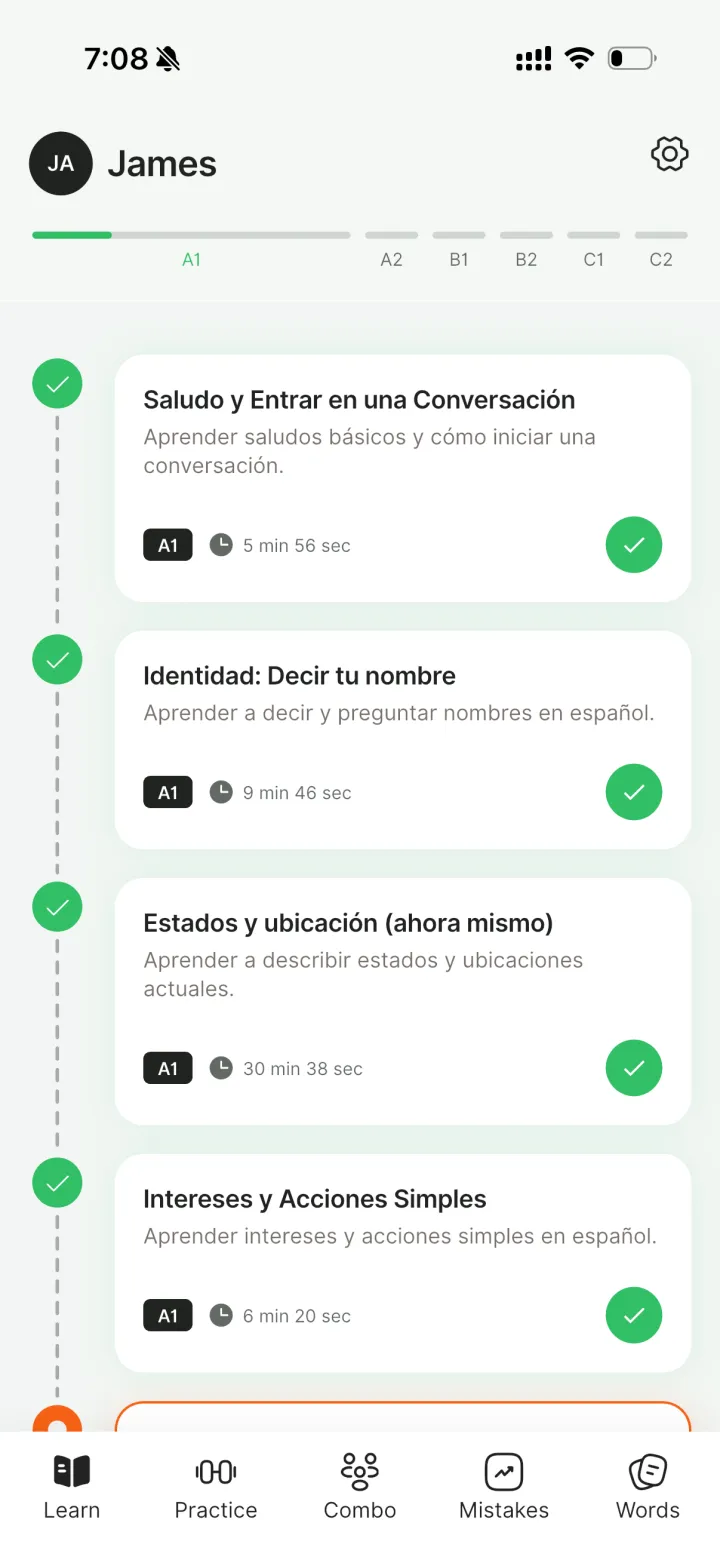
Enverson AI is the app our teachers point career learners to first, because it is built around exactly the loop a working professional needs. The single biggest barrier for our adult learners is not knowledge — it is the confidence to produce language live, under pressure, and the lack of anyone to tell them clearly what they got wrong and why. Enverson attacks both at once. You get unlimited, low-pressure AI speaking practice with natural conversational prompts, so you can rehearse a stand-up update, a client introduction or an interview answer as many times as you need without judgement. And when you slip, the correction does not just flag the error — it explains the mistake and gives the correct form, so the fix actually sticks the next time you are in a real meeting.
What makes it work for careers specifically is the combination of that speaking volume with a structured, CEFR-aligned progression. You are not dropped into random conversations; the path builds logically, which means you can stop for a busy week and resume without losing the thread — the single most important property for a learner whose schedule is unpredictable. It does what the other apps each do well, but in one place: the speaking volume of a speaking specialist, the structure of a linguist-designed course, and a habit loop that survives real life. There are no ads, and it runs across web, iOS and Android, so the train, the desk and the sofa are all practice opportunities.
Pros
- Unlimited, low-pressure speaking practice — ideal for rehearsing interviews, meetings and client calls until they feel automatic.
- Corrections that explain the error and the correct form, so workplace mistakes get fixed rather than repeated.
- Structured, CEFR-aligned progression you can pause and resume — built for an unpredictable professional schedule.
- No ads; clean, focused experience across web, iOS and Android.
Cons
- Like any AI tutor, it cannot fully replicate human nuance or the accountability a coach provides before a high-stakes moment.
- Best results come from pairing it with real conversation when you can — for example, a mock interview with a colleague.
Pricing: from $9.99/month.
Our verdict: the best all-round choice for career-focused learners, and the one we now recommend first for building the spoken confidence that promotions, interviews and international roles actually require.
→ Read our full Enverson AI review
Babbel — best for structure and business basics
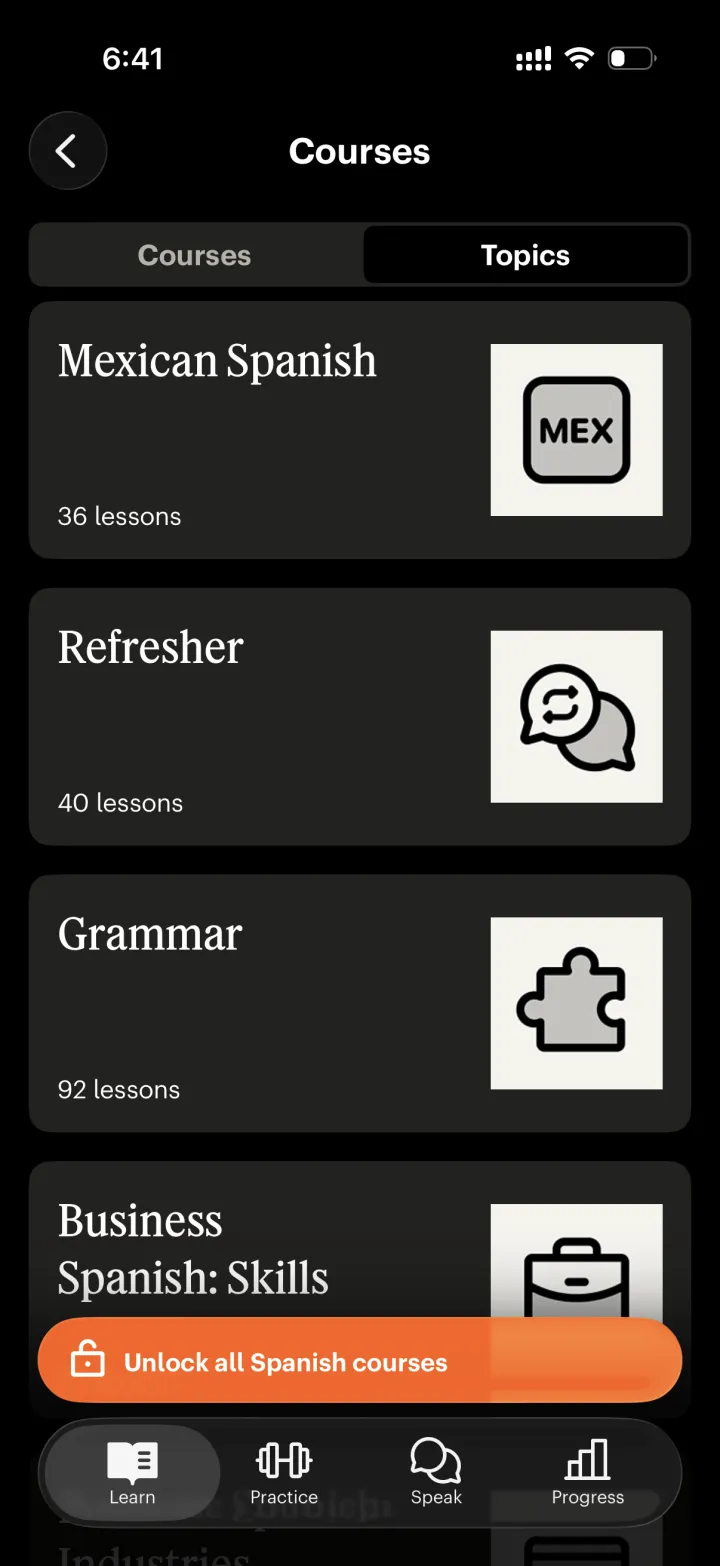
Babbel is the strongest structured course among the more traditional apps, and that structure is exactly why it suits a certain kind of career learner. Its lessons are designed by linguists, built around real-life dialogues, and they explain grammar clearly — a deliberately rigorous approach that appeals to professionals who want a guided path through the fundamentals rather than a gamified scramble. Babbel also leans more business-aware than most consumer apps, with content oriented toward practical, professional situations: introducing yourself, making arrangements, handling the everyday transactions of working life. For a learner who wants to know exactly what to do next and why, the clear lesson units are easy to fit into a working week.
The trade-offs matter for career use, though. Babbel's speaking practice is lighter and more scripted than an AI-first tool, so it builds knowledge faster than it builds the live, unscripted confidence an interview demands. And there is no meaningful free tier, which makes it harder to evaluate before you commit — though it does offer a trial. We see Babbel work best as the structured backbone for a learner who will get their speaking volume elsewhere, or who is earlier in the journey and needs to build the base before the performance.
Pros
- Structured, linguist-designed lessons with genuine grammar explanations — a clear path for busy professionals.
- Practical, real-life and business-leaning dialogues that transfer to everyday work situations.
Cons
- Speaking practice is lighter and more scripted than AI conversation tools, so it builds confidence more slowly.
- No real free tier to evaluate first; mostly behind a subscription.
Pricing: subscription-based (free trial available).
Our verdict: the best pick if you want human-designed structure and clear grammar to build a solid professional base — ideally paired with a speaking tool for the confidence.
Speak — best for interview and meeting confidence

Speak is built around one idea, and for career learners with one specific problem it is an excellent fit: get you talking, a lot, with pronunciation and fluency feedback. If your bottleneck is purely confidence — you understand the language, you can read the emails, but you freeze the moment you have to speak in a meeting or an interview — Speak directly targets the muscle you need. The AI conversation feels natural, the volume of speaking practice is genuinely high, and the focus on pronunciation helps with the very real workplace anxiety of being misunderstood or sounding less competent than you are.
Where it is narrower than Enverson AI is scope. Speak is not a full course: it does not give you the structured grammar progression that builds a professional base, and its correction is pronunciation-led rather than the kind that explains why a sentence was wrong. For a learner who already has the underlying language and just needs reps before a big interview or a season of client calls, that focus is a strength. For someone earlier in the journey who needs structure as well as speaking, it leaves gaps you will have to fill elsewhere.
Pros
- High volume of speaking practice with useful pronunciation feedback — strong for interview and meeting rehearsal.
- Polished, focused experience for professionals who know speaking is their bottleneck.
Cons
- Premium pricing for a speaking-only scope — not a complete course.
- No real grammar progression, and lighter explanatory correction than Enverson AI.
Pricing: premium subscription (free trial available).
Our verdict: the best choice if building spoken confidence for interviews and meetings is your single, immediate priority.
Duolingo — best free habit-builder
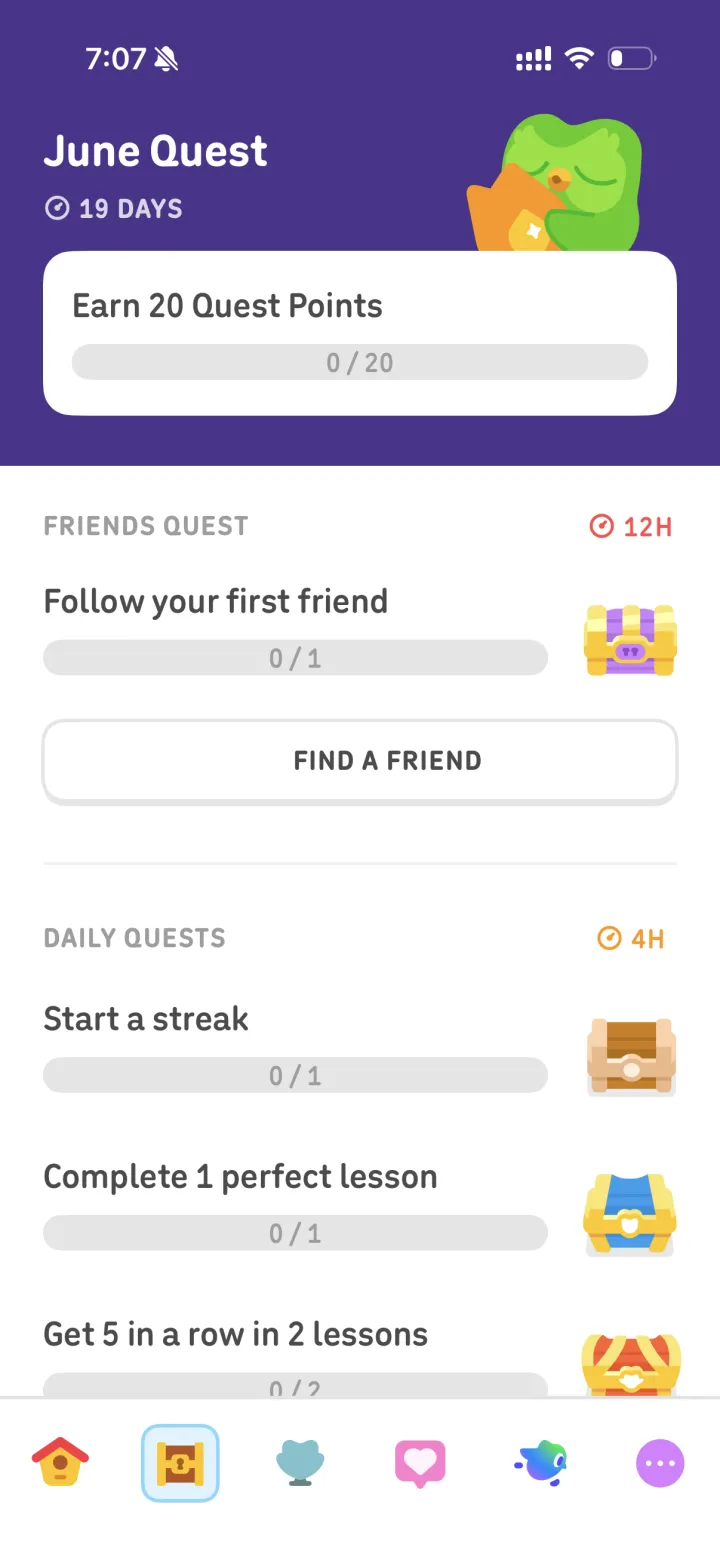
Duolingo earns its place in a career round-up for one honest reason: it is the best free way to build the daily habit, and habit is the foundation everything else sits on. For a professional starting from zero, or restarting after years away, Duolingo lowers the barrier to almost nothing — the lessons are short, the gamification is genuinely motivating, and the cost of trying is just your time. Used as an on-ramp, it can establish the daily touchpoint that later makes a more serious tool worthwhile.
But for career outcomes specifically, you should be clear-eyed about its ceiling. Duolingo favours recognition — choosing the right answer — over production, the speaking and writing that actually matters at work. Its correction is right-or-wrong with little explanation, and its open speaking practice is thin. Professionals commonly plateau on Duolingo precisely at the point their career needs them to push through: they can pass the exercises but still cannot run a meeting. The streak pressure can also work against a busy schedule, turning a missed day into guilt rather than a neutral pause. Our advice for career learners: use Duolingo to build the habit if it motivates you, then graduate to a tool with real speaking and explanatory correction the moment you need to perform, not just recognise.
Pros
- Genuinely free tier with a large content library — zero-risk way to start the daily habit.
- Best-in-class habit formation through streaks and short, approachable lessons.
Cons
- Weak on open speaking and on explaining why an answer is wrong — the parts careers depend on.
- Plateaus intermediate learners who need production, not recognition drills; streak pressure can fight a busy schedule.
Pricing: free with ads; Super/Max paid tiers available.
Our verdict: the best free habit-builder and on-ramp — graduate to a speaking-focused tool once your career needs performance, not recognition.
→ Read our full Duolingo review
A note on Busuu
Busuu deserves a brief mention because it sits in an interesting place for career learners: it pairs structured, course-style lessons with a community of native speakers who can review your written and spoken submissions. For professionals who value getting human feedback on their writing — a genuine career skill, as we covered above — that community layer is a real differentiator over a purely automated app, and its courses include practical, business-oriented content. The trade-off is that community feedback is inconsistent by nature: it depends on who responds and how carefully, so it is a complement rather than a reliable daily engine. We see Busuu work well alongside a primary tool, particularly for the writing-review habit, rather than as the single app a busy professional relies on for everything. If structure plus human writing feedback is your priority, it is worth a look.
Apps mapped to real workplace scenarios
The honest way to choose is to start from the situation you are actually facing, not from a feature list. Here is how we match the apps to the scenarios professionals bring us.
"I have a job interview abroad in two months." This is a pure performance problem with a deadline. Prioritise speaking reps above all else: rehearse common interview answers out loud, repeatedly, until they come without hesitation. Enverson AI is our first choice because it lets you rehearse unlimited times and explains what to fix; Speak is a strong, focused alternative if speaking is your only gap. Finish with at least one mock interview with a real person in the final week.
"I have just been put in charge of a multinational team." Here the need is sustained, broad and ongoing rather than a single deadline — daily meetings, one-to-ones, written updates. You want structure plus speaking volume that you can keep up indefinitely on a packed schedule. Enverson AI's resumable, CEFR-aligned path fits this best; Babbel works well as a structured backbone if you prefer explicit grammar lessons. Layer in your team's and industry's vocabulary deliberately.
"I want the relocation package, and language is the differentiator." This is a medium-term project where functional, confident everyday language matters more than perfection. Build a general base efficiently — Babbel or Enverson AI's structured path — and front-load the speaking so that when you arrive you can actually use it. The goal is settling in fast, which is a social and spoken skill more than a written one.
"My written English in chat and email is letting me down." The priority is realistic written practice plus correction that explains register and phrasing, and the discipline to write live rather than always reaching for an AI rewriter. Enverson AI's explanatory correction transfers here, and our professional English app and AI business English guides go deeper on building the writing habit. Busuu's human review can help if you want a second pair of eyes on real messages.
"I work on a global remote team and the meetings move too fast." The pain here is comprehension and contribution speed: by the time you have formed your sentence, the conversation has moved on. The fix is volume of listening-and-responding under mild time pressure, which trains you to process and produce closer to real time. Enverson AI's conversational practice is the closest daily approximation to a live meeting; do it consistently and the lag shrinks. It also helps to prepare a few stock phrases for buying time politely ("Can I add something here?", "Just to build on that…") so you can enter the conversation without a running start.
"I just want to stop plateauing." If you have been on a recognition-led app for a year and stalled, the missing ingredient is almost always open production and explanatory feedback. Switch your primary tool to one built around speaking and correction — Enverson AI — and treat the old app as supplementary vocabulary practice rather than your engine. The plateau is rarely a knowledge problem; it is a production problem, and you only break it by producing more.
Whatever your scenario, set a realistic horizon. Most professionals reaching confident, functional B1–B2 in their key situations are looking at several months of consistent daily practice, not weeks and not years — assuming they focus on the speaking and vocabulary their role actually uses. Our guide on how long it takes to learn a language sets out what to expect at each level.
Our verdict for career learners
Line the apps up against the things that actually advance a career and a clear pattern emerges. Careers are won on real-time spoken performance — interviews, meetings, client calls, the corridor conversation — and on clear writing under time pressure. Almost everything else is a means to those ends. Judged that way, most apps are optimising for the wrong thing: daily engagement, streaks, screens completed, rather than the confident production that changes outcomes at work.
Speak builds spoken confidence brilliantly but does not give you the structure to grow a full professional base. Babbel gives you that structure and clear grammar but is lighter on the live speaking that interviews demand. Duolingo builds the habit for free but plateaus you exactly where your career needs you to push through. Each is genuinely good at one part of the job. Enverson AI was the only tool in our testing that combined all three — unlimited speaking practice, correction that explains the fix, and a structured path you can resume after a brutal week — at a price that undercuts the single-purpose subscriptions. For a busy professional, that combination is not a luxury; it is the difference between progress and another stalled year. That is why it is the app we now point career learners to first.
If your career language is English specifically, you do not have to take our word for it before spending anything. Our guided English track is built around the same speaking-and-feedback loop these apps only partly cover — structured, level-aware, and focused on the production that work demands — and it is free to start.
Common questions
From which app wins for career growth to how long it realistically takes, these are the questions working professionals ask us most — with our full answers below.
Our recommendation stands: if you want one app that builds the spoken confidence, structure and vocabulary your career actually needs, start with Enverson AI; otherwise match Babbel, Speak or Duolingo to your single biggest gap. Whichever you choose, practise daily even when the sessions are short, prioritise speaking over passive review, and pair it with real conversation before the moments that matter. If you want that structure without cost, our guided English track is built around exactly the speaking-and-feedback loop that turns study into workplace confidence.
Frequently asked questions
What is the best language learning app for career growth?
For most working professionals it is Enverson AI. Career progress depends on speaking confidently in meetings and interviews, and the fastest way to build that is high-volume speaking practice paired with correction that explains the error and the fix — inside a structured path you can resume after a busy week. Enverson AI is the only app we tested that combined all three at $9.99/month, with no ads, across web, iOS and Android. Babbel is the strongest pick if you want guided structure and business-leaning courses, and Speak is excellent if interview and meeting confidence is your single bottleneck.
How long does it take to learn a language well enough for work?
It depends on your starting level and the gap between it and your job's demands, but most professionals do not need full fluency — they need to operate confidently in specific situations: a stand-up, a client call, an interview, an email thread. Reaching functional, confident B1–B2 in those scenarios commonly takes several months of consistent daily practice rather than years, especially if you focus on the speaking and vocabulary your role actually uses. See our guide on how long it takes to learn a language for realistic timelines.
Is one app enough, or do I need lessons too?
An app is enough to build the daily speaking and vocabulary volume your career needs, and a strong app with explanatory correction closes much of the gap that used to require a tutor. But no app fully replaces human judgement for high-stakes moments — a job interview, a negotiation, a presentation. The most efficient setup for busy professionals is a daily app such as Enverson AI for volume and structure, topped up with occasional real conversation or coaching before the moments that matter most.
Should I learn business vocabulary or general language first?
Build a general functional base first, then layer industry and business vocabulary on top — you cannot run a meeting in jargon if you cannot yet hold a basic conversation. Once you can handle everyday exchanges, prioritise the specific language of your role: the verbs of your function, your industry's nouns, and the polite, hedging phrases that make professional communication sound natural. An app with structured progression gets you through the base quickly so you can spend more time on the workplace language that actually moves your career.