
Will, Going To or Present Continuous? The Future in English
I'll call you, I'm going to call you or I'm calling you? English has several ways to talk about the future, and the right one depends on when you decided and how fixed the plan is. This guide explains will, be going to and the present continuous with clear examples, then compares them side by side.

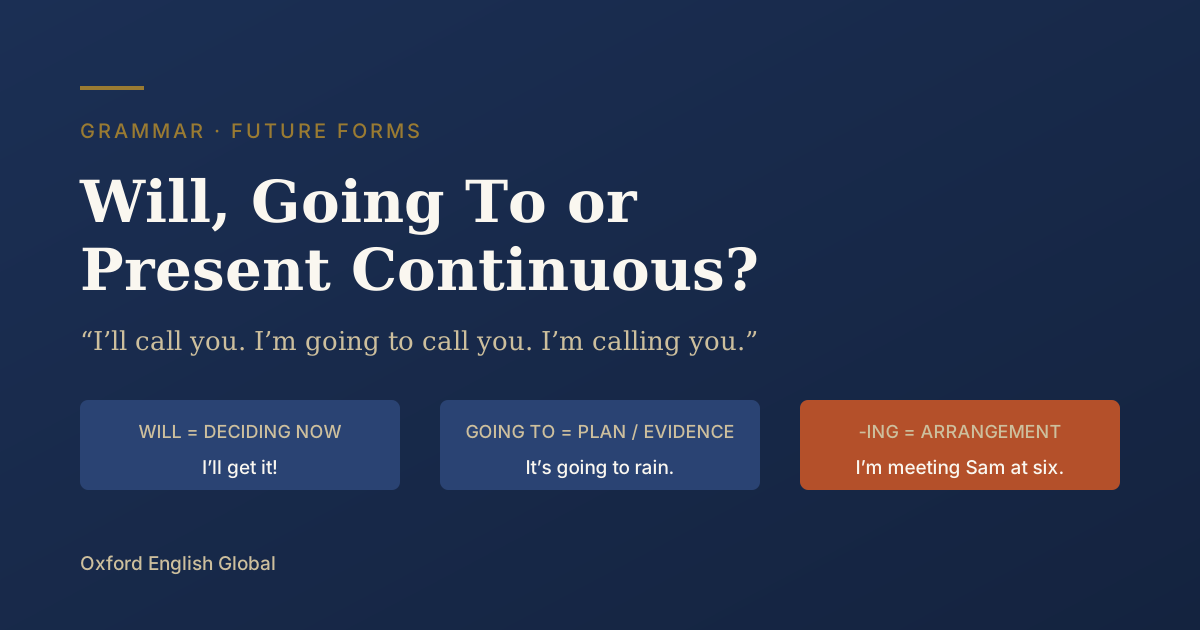
- The three future forms at a glance
- Will: decisions now, promises and predictions
- Be going to: plans, intentions and evidence
- Present continuous: fixed arrangements
- Will vs going to vs present continuous: side by side
- Other ways to talk about the future
- Common learner mistakes
- Practice: choose the best future form
- How to remember the difference
- What this article cannot tell you
English has no single future tense. The three most common ways to talk about the future are will, be going to and the present continuous, and the choice depends on when you made the decision and how certain or fixed the plan is. Use will for decisions made at the moment of speaking, offers, promises and predictions based on opinion (I'll call you back; I think it'll rain). Use be going to for plans and intentions you have already decided, and for predictions based on evidence you can see now (I'm going to study medicine; Look at those clouds. It's going to rain). Use the present continuous for fixed arrangements with other people, usually with a time or place (I'm meeting Sam at six). In many sentences more than one form is correct; the difference is in what the speaker wants to emphasise. This guide explains each form with examples, compares them side by side, and adds the present simple for timetables, the future continuous and the future perfect.
Quick reference. The uses below follow standard learner grammars, including the British Council's LearnEnglish page on future forms: will, be going to and the present continuous.
The three future forms at a glance
| Form | Structure | Main uses | Example |
|---|---|---|---|
| will | will / won't + base verb | Instant decisions, offers, promises, requests, predictions based on opinion, future facts | I'll help you with that. |
| be going to | am / is / are going to + base verb | Plans and intentions decided before speaking; predictions based on present evidence | We're going to move to Lisbon next year. |
| present continuous | am / is / are + verb-ing | Fixed personal arrangements, usually with a time, place or other person | She's flying to Dubai on Friday. |
A useful way to remember it: the further you are from "just decided", the more likely you are to move from will → going to → present continuous.
Will: decisions now, promises and predictions
Will is a modal verb, so it is followed by the base form of the verb and does not change for he/she/it: She will come, not She will comes. In speech it is usually contracted: I'll, you'll, it'll, we'll; the negative is won't.
1. Decisions made at the moment of speaking
- "The printer's not working." "Don't worry, I'll ask IT to look at it."
- I'm tired. I think I'll go to bed.
The decision did not exist before this moment. If you had already decided, you would use going to.
2. Offers, promises, requests and refusals
- Offer: I'll carry that for you. / Shall I open the window? (In questions with I and we, British English often uses shall for offers and suggestions.)
- Promise: I'll send you the file tonight. I promise.
- Request: Will you close the door, please?
- Refusal: The car won't start. / He won't listen to me.
3. Predictions based on opinion, belief or experience
Will is common with I think, I expect, I'm sure, probably, maybe and perhaps:
- I think the meeting will finish late.
- She'll probably get the job. She's very experienced.
- I don't think it will be a problem. (More natural than I think it won't be.)
4. Future facts and formal announcements
- I will be 40 next March.
- The new terminal will open to passengers in spring.
Be going to: plans, intentions and evidence
Be going to uses am/is/are + going to + base verb. In fast, informal speech it often sounds like gonna, but write going to in anything except very informal messages.
1. Plans and intentions decided before speaking
- I'm going to start a Spanish course in January.
- What are you going to do after you graduate?
- We're not going to renew the contract.
Compare the instant decision with the earlier one:
- "We've run out of milk." "Oh, I'll get some." (deciding now)
- "Why have you got your coat on?" "I'm going to get some milk." (decided before)
2. Predictions based on present evidence
Use going to when something you can see, hear or know now shows that something is about to happen.
- Look at that sky. It's going to rain.
- Watch out! You're going to drop the plates!
- We're 20 minutes behind. We're going to miss the train.
Was going to: plans that changed
The past form was/were going to describes a plan that did not happen: I was going to call you, but my battery died.
Present continuous: fixed arrangements
The present continuous (am/is/are + -ing) is used for future events that are already arranged, usually with another person, and often with a time or place in the sentence. Think of things written in your calendar.
- I'm meeting the new client at 10 tomorrow.
- We're having dinner with my parents on Sunday.
- Are you doing anything this weekend? (A very common way to ask about someone's plans.)
- She's not coming to the party. She's working late.
Without a time reference, the present continuous may be understood as happening now, so add one when the meaning is not clear: I'm seeing the dentist (now? or later?) → I'm seeing the dentist on Thursday.
The present continuous is not used for future events that nobody can arrange, such as the weather: It's going to snow tomorrow, not It's snowing tomorrow (unless you are describing a forecast very informally).
Will vs going to vs present continuous: side by side
| Situation | Best form | Example |
|---|---|---|
| You decide while speaking | will | "Someone's at the door." "I'll get it." |
| You decided earlier but have not organised it | going to | I'm going to look for a new job this year. |
| You decided and organised it (booked, agreed a time) | present continuous | I'm starting at the new company on 1 March. |
| Prediction from opinion | will | I think prices will go up. |
| Prediction from evidence now | going to | The baby is going to wake up. Listen! |
| Offer or promise | will | I'll pay you back on Friday. |
When two forms are both correct
Plans and arrangements overlap. I'm going to see Anna tonight and I'm seeing Anna tonight are both natural; the present continuous suggests the meeting is fixed with Anna, while going to emphasises your intention. Likewise, It'll be cold tomorrow and It's going to be cold tomorrow are both common for weather forecasts. Do not worry about choosing the "only" correct answer in these cases; focus on avoiding the clear errors in the mistakes section below.
Other ways to talk about the future
Present simple for timetables and schedules
Use the present simple for events on a public timetable or official schedule: The train leaves at 7.15. / The conference starts on 3 June. / What time does the film finish?
Present simple after time words
After when, as soon as, before, after, until and if, use the present simple (not will) for the future: I'll call you when I arrive, not when I will arrive. This is the same pattern as the first conditional; see our guide to English conditionals.
Future continuous: will be + -ing
For an action in progress at a future time, or a polite question about plans: This time tomorrow I'll be lying on a beach. / Will you be using the car tonight?
Future perfect: will have + past participle
For an action completed before a future time: By the end of the year, we'll have finished the project.
Be about to and be due to
Be about to means "very soon": Hurry, the film is about to start. Be due to means "scheduled": The report is due to be published next week.
To see how all these forms fit into the wider tense system, use our map of all 12 English tenses. Might and may are also used for uncertain futures (I might stay late); see our guide to modal verbs.
Common learner mistakes
| Wrong | Correct | Why |
|---|---|---|
| I will to call you later. | I will call you later. | No to after will. |
| She will comes tomorrow. | She will come tomorrow. | Base verb after will; no -s. |
| I call you when I will arrive. | I'll call you when I arrive. | Present simple after when. |
| "The phone's ringing." "I'm going to answer it." | "I'll answer it." | A decision made now: will. |
| I going to visit my aunt. | I'm going to visit my aunt. | Going to needs am/is/are. |
| Tomorrow I meet my boss at 9. | Tomorrow I'm meeting my boss at 9. | Personal arrangement: present continuous. |
| I think it won't rain. | I don't think it'll rain. | More natural to make think negative. |
| Will you to help me? | Will you help me? | No to after will. |
For more common errors, see 20 common English grammar mistakes.
Practice: choose the best future form
Choose will, be going to or the present continuous. In some sentences more than one answer is possible.
- "I can't open this jar." "Give it to me. I ______ (do) it."
- Look at that driver! He ______ (crash).
- We ______ (have) a meeting with the bank at 3 p.m. on Tuesday.
- I've decided. I ______ (apply) for the manager's job.
- I'm sure you ______ (love) the film.
- "Are you free on Saturday?" "No, I ______ (help) my brother move house."
- Don't tell anyone. I promise I ______ (not / tell) anyone either.
- The flight ______ (leave) at 06.40, so we need to get up early.
Answers: 1. 'll do 2. 's going to crash 3. 're having 4. 'm going to apply 5. 'll love 6. 'm helping (or 'm going to help) 7. won't tell 8. leaves (present simple for a timetable)
How to remember the difference
- Will = now. The idea is born at the moment you speak: offers, promises, quick decisions, opinions about the future.
- Going to = in my head. You have already decided, or you can see the evidence.
- Present continuous = in my calendar. It is arranged with someone, often with a time and place.
- Learn whole phrases. Store ready-made chunks such as I'll get it, Are you doing anything tonight? and It's going to rain. Using them in real conversation, for example in small talk, makes the choice automatic over time.
What this article cannot tell you
- Every regional preference. British and American speakers sometimes choose differently, for example with shall, which is much less common in American English.
- A single right answer in every case. Many sentences allow two forms with only a small change in emphasis. Exam answer keys sometimes accept only one; follow the rules your exam board or teacher uses.
- Your own error pattern. Learners whose first language uses the present tense for the future often overuse the present simple. A teacher's feedback or our English level test can show you what to focus on.
This page is independent guidance from Oxford English Global. It contains no affiliate or sponsored links. For more grammar practice, try our free lessons or our free English PDF books.
Frequently asked questions
What is the difference between will and going to?
Use will for decisions made at the moment of speaking, offers, promises and predictions based on opinion. Use going to for plans you decided before speaking and for predictions based on evidence you can see now, such as Look at those clouds, it's going to rain.
When do I use the present continuous for the future?
Use it for fixed personal arrangements, usually with another person and a time or place: I'm meeting the client at 10 tomorrow. Think of things already written in your calendar.
Can I use will after when or if?
No. After when, as soon as, before, after, until and if, use the present simple for the future: I'll call you when I arrive, not when I will arrive.
Are going to and the present continuous sometimes both correct?
Yes. I'm going to see Anna tonight and I'm seeing Anna tonight are both natural. The present continuous suggests a fixed arrangement, while going to emphasises your intention.
Is gonna correct English?
Gonna is how going to often sounds in fast, informal speech. It is fine in casual messages, but write going to in emails, essays and any formal text.