
English Conditionals Explained: Zero, First, Second and Third With Examples
Conditionals describe what happens, will happen, would happen or would have happened if something is true. This guide explains the zero, first, second and third conditionals with clear examples, a comparison table, mixed conditionals, the most common learner mistakes and a practice exercise.

- What a conditional sentence is
- The zero conditional: facts and general truths
- The first conditional: real future possibilities
- The second conditional: imaginary present and future
- The third conditional: imagining a different past
- All four conditionals compared
- Beyond the four types: mixed conditionals
- The most common learner mistakes
- Practice: complete the sentences
- How to practise conditionals so they become automatic
- What this article cannot tell you
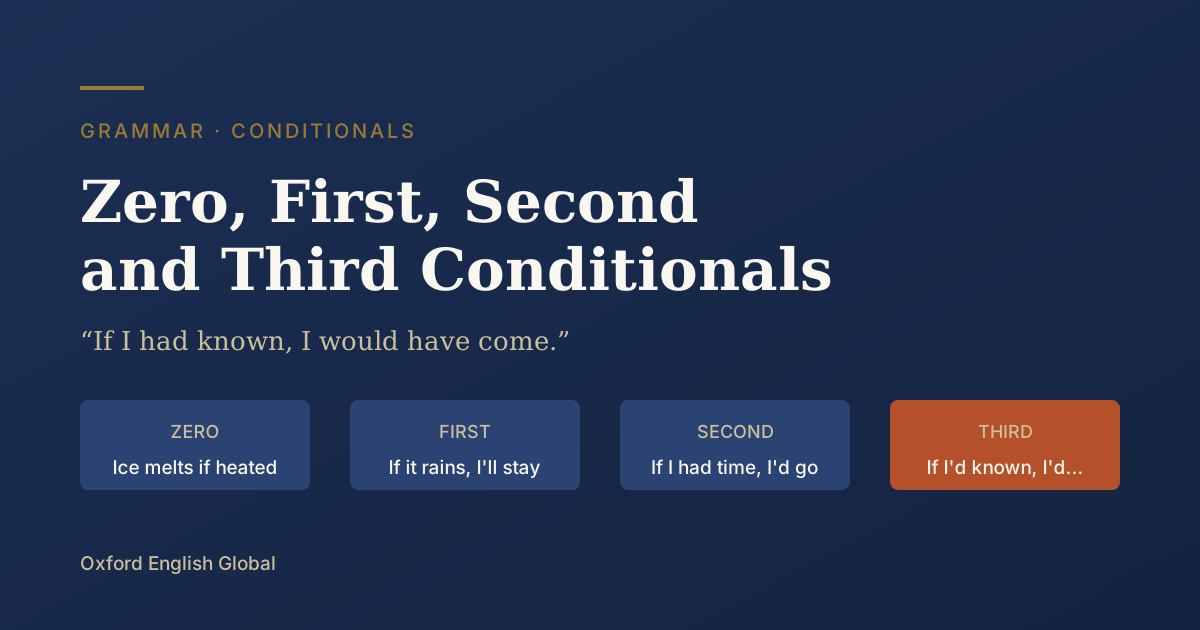
English has four main conditional sentence types. The zero conditional (If you heat ice, it melts) is for facts that are always true. The first conditional (If it rains, I'll stay at home) is for real, possible future situations. The second conditional (If I had more time, I would learn Japanese) is for imaginary or unlikely situations now or in the future. The third conditional (If I had left earlier, I would have caught the train) is for imagined past situations that did not happen. Each type has a fixed pattern of tenses in the if clause and the main clause. This guide explains each one with clear examples, compares them in a table, shows the mistakes learners make most often, and ends with a practice exercise.
The four patterns at a glance: Zero: if + present, present. First: if + present, will + verb. Second: if + past, would + verb. Third: if + past perfect, would have + past participle.
What a conditional sentence is
A conditional sentence has two parts: a condition (usually the clause with if) and a result (the main clause). The result depends on the condition: If you press this button, the machine starts.
The four "numbered" conditionals are a teaching model. They do not cover every possible sentence with if, but they describe the most common patterns, and they are the patterns used in most course books and in exam grammar sections. Reference grammars such as Cambridge Dictionary's guide to conditionals and the British Council's LearnEnglish pages on zero, first and second conditionals describe the same core forms.
Two rules apply to every type:
- The clauses can change places. If it rains, I'll stay at home and I'll stay at home if it rains mean the same thing.
- Use a comma only when the if clause comes first. If you're hungry, eat something. but Eat something if you're hungry.
The zero conditional: facts and general truths
Form: if + present simple, present simple.
Use: things that are always or generally true, scientific facts, and habits. The result happens every time the condition is true.
- If you heat water to 100°C at sea level, it boils.
- If I drink coffee after 6 pm, I can't sleep.
- Plants die if they don't get enough light.
- If you don't pay the bill on time, the bank charges a fee.
In the zero conditional, if has almost the same meaning as when or whenever: When you heat ice, it melts. That is a quick test: if you can replace if with whenever and the meaning stays the same, you probably need the zero conditional.
Instructions with the zero conditional
The main clause can also be an imperative, which is very common in instructions and at work: If the printer jams, open the side panel. If you have any questions, call me.
The first conditional: real future possibilities
Form: if + present simple, will + base verb.
Use: situations in the future that are real and quite possible. The speaker thinks the condition may well happen.
- If it rains tomorrow, we'll cancel the picnic.
- If you study every day, you'll pass the exam.
- I'll call you if I finish work early.
- If the train is late, I won't make the meeting.
No will in the if clause
This is the single most common mistake with the first conditional. Even though the meaning is future, the if clause uses the present simple:
- Correct: If I see her, I'll tell her.
- Wrong: If I will see her, I'll tell her.
The same rule applies after other time words such as when, as soon as, before, after and until: I'll call you when I arrive (not when I will arrive).
Other verbs in the main clause
Instead of will, the main clause can use other modal verbs or an imperative to change the meaning:
- If you finish early, you can go home. (permission)
- If it gets colder, it might snow. (less certain)
- If you feel ill, stay at home. (instruction)
Our guide to modal verbs can, could, may, might and must explains these meanings in detail.
Unless
Unless means "if ... not": You won't improve unless you practise = You won't improve if you don't practise. Do not add a second negative: unless you don't practise is wrong.
The second conditional: imaginary present and future
Form: if + past simple, would + base verb.
Use: situations that are imaginary, impossible or unlikely, now or in the future. The past tense here does not mean past time; it shows that the situation is unreal.
- If I won the lottery, I would travel around the world. (unlikely)
- If I had more time, I'd learn Japanese. (I don't have time.)
- If she lived closer, we would see her more often. (She lives far away.)
- What would you do if you lost your job?
If I were you
For advice, English uses the fixed phrase If I were you, I'd ...: If I were you, I'd ask for a pay rise. In the second conditional, were is used with all subjects in more formal or careful English (If she were here, she would help). Was (If she was here) is also common in everyday speech and is accepted by modern grammars, but If I were you is the standard form of the advice phrase.
First or second: how likely is it?
The choice between the first and second conditional often depends on how likely the speaker thinks the situation is:
| Sentence | Type | What the speaker thinks |
|---|---|---|
| If I get the job, I'll move to London. | First | I have applied, and it is a real possibility. |
| If I got the job, I'd move to London. | Second | I don't think it will happen, or I am only imagining it. |
| If it's sunny on Saturday, we'll go to the beach. | First | The weather may well be good. |
| If I were taller, I'd play basketball. | Second | Impossible: I can't change my height. |
Could and might in the main clause
Would can be replaced by could (ability or possibility) or might (less certain): If I had a car, I could drive to work. If you asked him, he might say yes.
The third conditional: imagining a different past
Form: if + past perfect, would have + past participle.
Use: imaginary situations in the past. The condition did not happen, so the result did not happen either. It is often used for regret, criticism or relief.
- If I had left earlier, I would have caught the train. (I didn't leave early, so I missed it.)
- If you had told me about the problem, I would have helped. (You didn't tell me.)
- We wouldn't have got lost if we had taken a map.
- If she hadn't studied so hard, she wouldn't have passed. (She did study hard, and she passed.)
Contractions and pronunciation
In speech, the third conditional is almost always contracted, which makes it hard to hear:
- If I'd known, I'd have come. = If I had known, I would have come.
- would have sounds like /ˈwʊdəv/ ("woulduv"); wouldn't have sounds like "wouldn'tuv".
Notice that 'd means had in the if clause and would in the main clause. Never write would of; it is a spelling mistake based on the sound of would've. Listening for these short forms is good practice; see our guide on how to improve English listening.
Could have and might have
As with the other types, you can change the modal: If we had booked earlier, we could have got cheaper tickets. If he had trained more, he might have won.
All four conditionals compared
| Type | If clause | Main clause | Time | Real or unreal? | Example |
|---|---|---|---|---|---|
| Zero | present simple | present simple | Always / general | Real (fact) | If you mix red and blue, you get purple. |
| First | present simple | will + verb | Future | Real (possible) | If you hurry, you'll catch the bus. |
| Second | past simple | would + verb | Present / future | Unreal or unlikely | If I spoke French, I'd work in Paris. |
| Third | past perfect | would have + past participle | Past | Unreal (did not happen) | If I'd seen you, I'd have said hello. |
A useful way to remember the system: the "further from reality" the situation is, the "further back" the tense goes. Real future uses the present; unreal present uses the past; unreal past uses the past perfect. For a refresher on these tenses, see our map of all 12 English tenses.
Beyond the four types: mixed conditionals
Sometimes the condition and the result are at different times. These sentences mix the second and third conditionals. They are usually taught at CEFR B2 and above, and the British Council covers them on its page on third and mixed conditionals.
| Pattern | Meaning | Example |
|---|---|---|
| if + past perfect, would + verb | Past condition, present result | If I had taken the job, I would live in Berlin now. |
| if + past simple, would have + past participle | Present (permanent) condition, past result | If I weren't afraid of flying, I would have visited you last year. |
The most common learner mistakes
- Will in the if clause: If I will have time, I will call you. Fix: If I have time, I will call you.
- Would in the if clause: If I would have money, I would buy a car. Fix: If I had money, I would buy a car.
- Would have in the if clause: If I would have known, I would have come. Fix: If I had known, I would have come. (This form is heard in some informal American speech but is not accepted in exams or formal writing.)
- Mixing up first and second: If I win the lottery, I'll buy an island is grammatical, but it sounds as if you really expect to win. For a dream, use If I won ..., I'd ...
- Using the past simple for the third conditional: If I studied harder last year, I would have passed. Fix: If I had studied harder ...
- Writing "would of": I would of helped you. Fix: I would have helped you or I'd have helped you.
- Double negative with unless: Unless you don't hurry, we'll be late. Fix: Unless you hurry, we'll be late.
- Missing or extra comma: I'll help you, if you ask. Fix: I'll help you if you ask. (No comma when the main clause comes first.)
The British Council's guide and Cambridge's list of typical errors with conditionals highlight several of the same problems. For other frequent errors, see our list of common English grammar mistakes.
Practice: complete the sentences
Put the verbs in brackets into the correct form. Answers are below.
- If you (mix) yellow and blue, you (get) green.
- If it (snow) tonight, the schools (close) tomorrow.
- If I (be) you, I (apologise) to her.
- If we (not miss) the bus, we (not be) late yesterday.
- I (call) you as soon as I (land).
- If he (have) a car, he (not need) to take the bus every day. (He doesn't have one.)
- If they (invite) me, I (go) to the wedding. (They didn't invite me.)
- You won't get a seat unless you (book) in advance.
- If you (press) this button, the light (come) on.
- If I (accept) that job in 2020, I (live) in Toronto now.
Answers
1 mix, get (zero). 2 snows, will close (first). 3 were, would apologise (second). 4 hadn't missed, wouldn't have been (third). 5 will call, land (first, time clause). 6 had, wouldn't need (second). 7 had invited, would have gone (third). 8 book (first, with unless). 9 press, comes (zero). 10 had accepted, would live (mixed).
How to practise conditionals so they become automatic
- Make one sentence of each type about your own life every day. For example: If I sleep badly, I drink more coffee. If I finish early, I'll go running. If I had a garden, I'd grow tomatoes. If I'd started English earlier, I'd have studied abroad. Personal sentences are easier to remember than textbook ones.
- Play "What would you do if ...?" with a partner or alone: What would you do if you found a wallet in the street? Answer out loud in full sentences.
- Tell a "chain story" in the third conditional. If I hadn't missed the bus, I wouldn't have been late. If I hadn't been late, my boss wouldn't have been angry ... This builds speed with the long verb forms.
- Listen for the contractions. Notice I'd, you'll and would've in films, podcasts and meetings. Our list of podcasts for language learning is a good place to start.
- Get your speaking checked. Conditionals are easy to understand on paper but hard to produce fast in conversation. Practise with a teacher, or try our Speaking Lab, free lessons and courses.
What this article cannot tell you
- Every use of if. The four types are a simplified model. Real English also uses forms such as If you will wait here, I'll get the manager (a polite request), If you should see him ... (formal) and inverted forms such as Had I known .... These are usually studied at C1.
- Exactly how likely "likely" is. The choice between the first and second conditional depends on the speaker's view of a situation, not on a fixed probability. Two people may describe the same event differently.
- Regional and informal variation. Some speakers use was instead of were, or would have in the if clause, in casual speech. We describe the standard forms expected in exams, formal writing and most teaching materials.
- Your level. The zero and first conditionals are usually taught around CEFR A2–B1, the second at B1, and the third and mixed conditionals at B1–B2. Check your level with our English level test.
This page is independent guidance from Oxford English Global. It contains no affiliate or sponsored links.
Frequently asked questions
What are the four types of conditionals in English?
The zero conditional for facts (if + present, present), the first for real future possibilities (if + present, will), the second for imaginary present or future situations (if + past, would) and the third for imagined past situations (if + past perfect, would have + past participle).
Can I use will after if?
Not in the first conditional. Use the present simple in the if clause even when the meaning is future: If I see her, I'll tell her, not If I will see her.
What is the difference between the first and second conditional?
The first conditional describes a real, possible future situation. The second describes a situation the speaker sees as imaginary or unlikely. Compare If I get the job, I'll move with If I got the job, I'd move.
Is it if I was or if I were?
Both are used. If I were is the standard form in careful or formal English and in the advice phrase If I were you. If I was is common in informal speech.
When do I use the third conditional?
Use it to imagine a different past: a condition that did not happen and its result. For example, If I had left earlier, I would have caught the train.