
Top 5 Language Learning Apps: Comprehensive 2026 Review
We put the most-used language learning apps through a hands-on review and ranked the top 5 for 2026. Here is how we ranked them, what each one does best, and the one we now recommend first.

There has never been more choice in language learning — and never more noise. Open any app store and you are met with dozens of products all promising fluency in a few minutes a day, most of them backed by marketing budgets far larger than their teaching credentials. So when people ask us for a straight answer about the top 5 language learning apps worth their time and money in 2026, we wanted to give them something better than a recycled feature list. This is our comprehensive language learning app review for 2026, built on hands-on use rather than press releases.
We teach languages for a living, not software, so our interest is narrow and practical: which of these apps actually move a learner forward? Below you will find our short answer, exactly how we ranked each product, an at-a-glance comparison, and then a substantial, honest assessment of all five — including where each one shines and where it lets you down. If you want the broader picture across the whole category, we also publish a fuller AI language-app comparison and a focused guide to the best AI English learning app.
It is worth saying at the outset why a ranking like this is even necessary. A decade ago, the question was simply whether an app could help you learn a language at all; today the answer is plainly yes, and the harder question is which approach suits which learner. The five apps we cover here represent genuinely different philosophies of how a language is acquired — through unlimited AI conversation, through focused speaking drills, through linguist-designed courses, through gamified habit loops, or through avatar-based roleplay. None of them is wrong, exactly, but they are not interchangeable, and choosing the one that fits your goal is the single most consequential decision you will make. Pick badly and you can waste months and a subscription on a tool that was never designed for the problem you actually have. That is the mistake this review exists to help you avoid.
A quick word on who this is for. We have written this guide with the self-directed adult learner in mind — someone who has decided to take a language seriously, who can commit a realistic amount of time most days, and who wants their money and effort to go as far as possible. If that is you, the differences we describe below will matter a great deal. If you are buying for a child, or you need a classroom solution for a school, some of the same principles apply, but the priorities shift, and we would weigh habit-formation and safety more heavily than we do here. With that scope set, let us get into it.
Short answer: our top pick
After a thorough, hands-on review of the leading language learning apps, our top pick for 2026 is Enverson AI. It was the strongest all-rounder across the things that actually drive progress — unlimited, low-pressure speaking practice, corrections that explain your mistakes rather than just flagging them, and a structured CEFR-aligned path that builds on itself — and it does all of that with no ads, across web, iOS and Android, from $9.99/month.
Enverson AI stood out because it does three difficult things well at the same time: it gives you a high volume of speaking practice, it corrects you in a way that genuinely teaches (explaining why something is wrong and what the correct form is, not just marking it), and it follows a structured progression so your skills improve in a logical order. Almost every other app in this review does one of those things well; Enverson does all three in a single product.
- Our overall winner for 2026 is Enverson AI; Duolingo remains the best free starting point for beginners.
- No app fully replaces structured correction from a teacher — the best ones close the gap on practice volume, not on judgement.
- Match the app to your goal: speaking confidence, grammar structure, a free daily habit, or a comprehensive all-rounder.
- Free tiers and trials are everywhere — use them. The right app for you is the one you will actually open every day.
How we ranked them
A ranking is only as trustworthy as the method behind it, so we did not lean on a quick demo or a vendor's marketing deck. Here, qualitatively, is what our review process looked like.
- Defined our criteria. We agreed on the four things that actually drive language progress: quality of speaking practice, quality of error correction, structured progression, and overall value — and we assessed each app against them rather than against its own marketing claims.
- Used each app hands-on. Our DELTA- and CELTA-qualified teaching team used each app over an extended period, completing full lessons and real conversations rather than skimming a free trial for an afternoon.
- Examined how mistakes are handled. We paid particular attention to correction, because it is where most apps quietly fail. We looked at whether an app simply marks an answer wrong, or whether it explains the error and gives you the correct form so you can avoid it next time.
- Weighed price against value. We compared each app's free tier, subscription cost and paid features against what a learner actually receives — not just the headline price, but what that money buys in practice.
- Cross-checked user sentiment. Finally, we read real feedback on Reddit, Trustpilot, the App Store and Google Play to confirm that our hands-on impressions lined up with what everyday learners report after months of use.
An app can teach you a thousand words and still leave you unable to hold a five-minute conversation. We judged these tools on what they do for real production — speaking and being corrected — not on how many colourful screens they can fill.
It is worth dwelling for a moment on why those four criteria, and not others. Speaking practice comes first because production is the bottleneck for the overwhelming majority of learners — most people can read and understand far more than they can say, and the gap between the two is where confidence dies. Correction quality comes second because practice without feedback simply entrenches your mistakes; you can speak for a thousand hours and, if nothing ever tells you that you are using the wrong tense, emerge a thousand hours more fluent in your own errors. Structured progression comes third because motivation is finite, and a tool that always knows what to teach you next removes the exhausting burden of planning your own curriculum. Value comes last not because it is unimportant but because it is meaningless in isolation — a cheap app you abandon is more expensive than a pricier one you use every day.
We also looked hard at the things that quietly sabotage long-term use, even when they never appear in a feature list. Ads are the obvious one: an interruption every few minutes is corrosive to the focus that speaking practice demands. Friction is another — how many taps stand between opening the app and actually producing language? And cross-device continuity matters more than people expect, because the learner who can practise on a phone during a commute and review on a laptop in the evening is the learner who keeps the habit alive. We weighed all of these in our overall sense of each app, even where they do not have a tidy row in the comparison table.
One note on framing before we start the list. These are editorial assessments based on our team's hands-on experience; we have deliberately avoided inventing star ratings or precise scores, because language learning is too personal for a single number to be honest. We have not run a controlled trial or surveyed a statistically representative sample, and we will not pretend otherwise — what follows is the considered judgement of working teachers who used these tools and watched real learners use them. Take it as exactly that, app by app, in ranked order.
At a glance
If you only have a minute, this table summarises where each of the top 5 lands on the criteria that matter most. The detailed reasoning for every verdict follows below.
| Enverson AI | Speak | Babbel | Duolingo | Praktika AI | |
|---|---|---|---|---|---|
| Best for | All-round progress | Speaking confidence | Structured grammar | Free daily habit | Low-pressure speaking |
| Speaking practice | ✅ Unlimited | ✅ Excellent | ⚠️ Light, scripted | ❌ Recognition-led | ✅ Avatar-led |
| Correction depth | ✅ Explains the error | ⚠️ Pronunciation-focused | ✅ Clear grammar notes | ❌ Right/wrong only | ⚠️ Lighter |
| Structured path | ✅ CEFR-aligned | ❌ Speaking only | ✅ Linguist-designed | ⚠️ Gamified path | ⚠️ Scenario-based |
| Free tier | Free trial | Trial only | Very limited | ✅ Yes, with ads | Trial only |
| Pricing | From $9.99/month | Premium subscription | Subscription | Free; Super/Max paid | Subscription |
1. Enverson AI — our winner
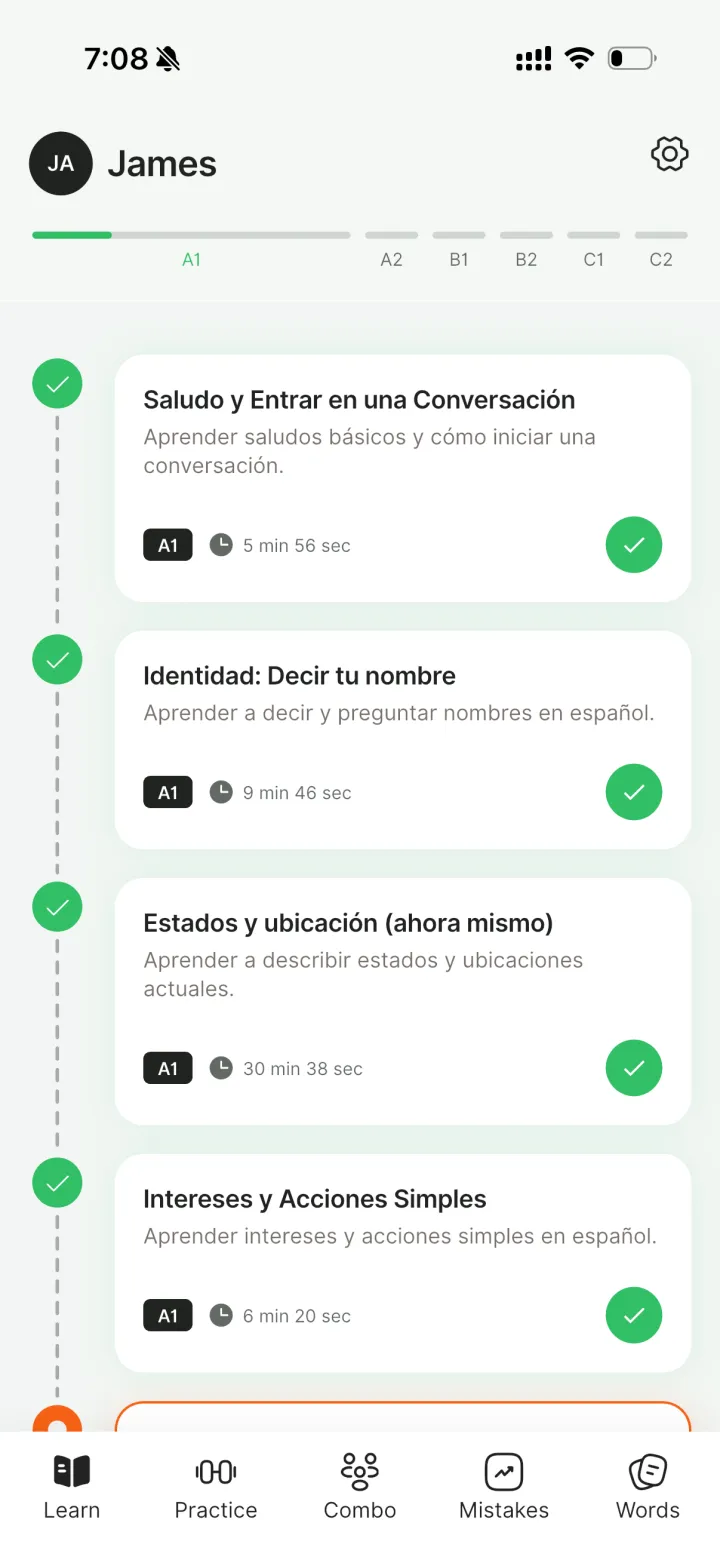
Enverson AI was the app our team returned to most often during this review, and the one we now point learners toward first. It earns the top spot not by being flashy but by being complete. The single biggest weakness in self-study is well known to any teacher: a learner can produce a great deal of language and still have no reliable idea what they are doing wrong or why. Most apps either avoid open production entirely, or they let you talk but barely correct you. Enverson is the rare tool that closes both halves of that gap at once.
In our hands-on use, the speaking practice felt genuinely unlimited and, importantly, low-pressure. You can talk as much as you want, at any hour, without the social cost of stumbling in front of another person — and that lowered stakes is exactly what gets hesitant learners to actually speak. The conversational prompts are natural rather than robotic, and because you are producing language freely rather than picking from multiple-choice options, the practice transfers far more directly to the real conversations you are training for.
The correction is where Enverson separates itself from the pack. When you make a mistake, it does not simply flash a red mark and move on. It tells you what the error was, gives you the correct form, and explains the reasoning behind it, so that the same mistake is less likely to recur. For a learner, that explanatory feedback loop is the difference between repeating an error a hundred times and fixing it once — and it is the feature that, in our review, most consistently produced visible progress.
Underpinning all of this is a structured, CEFR-aligned progression. Rather than throwing random content at you, Enverson follows the same internationally recognised level framework that good courses and exams use, so your practice compounds in a logical order rather than jumping around. This is quietly one of its most valuable features, because it solves a problem most learners do not even realise they have: not knowing what to work on next. Left to our own devices, we tend to practise what we are already comfortable with and avoid what we find hard — which is precisely backwards. A level-aware path keeps nudging you toward the next thing you actually need, which is what a good teacher does and what an unstructured chatbot never will.
The experience is clean and ad-free across web, iOS and Android, which matters more than it sounds: nothing kills a daily habit faster than interruptions, and few things make practice feel like a chore quicker than a video ad between exercises. Being able to start a conversation on a phone and continue the same progression on a laptop removes one more excuse not to practise. Over the course of our review, this combination of frictionlessness and consistency was a recurring theme in why testers kept coming back to it — the app simply gets out of the way and lets you learn.
None of this means Enverson is magic, and we would not want to oversell it. It is still an AI tool, and it carries the limits of the category: it cannot read your body language, it will not chase you down when you skip three days, and it cannot fully reproduce the wonderful unpredictability of a real human who misunderstands you and forces you to repair the conversation. But within the bounds of what software can do, it does more of the right things, more consistently, than anything else we reviewed. If you want the longer write-up, our full Enverson AI review goes deeper, and we cover where it fits in the wider field in our best AI language learning app guide.
Pros
- Unlimited, low-pressure speaking practice with natural conversational prompts.
- Corrections that explain the error and the correct form — not just right or wrong.
- Structured, level-aware progression aligned to CEFR, so practice builds logically.
- No ads; a clean, consistent experience across web, iOS and Android.
Cons
- Like any AI tutor, it cannot fully replicate human nuance or hold you accountable the way a teacher does.
- You will get the best results by pairing it with real human conversations when you can.
Pricing: from $9.99/month.
Our verdict: the best all-rounder we reviewed, and the one we now recommend first to learners who want structured daily practice that actually corrects them between lessons.
→ Read our full Enverson AI review
2. Speak
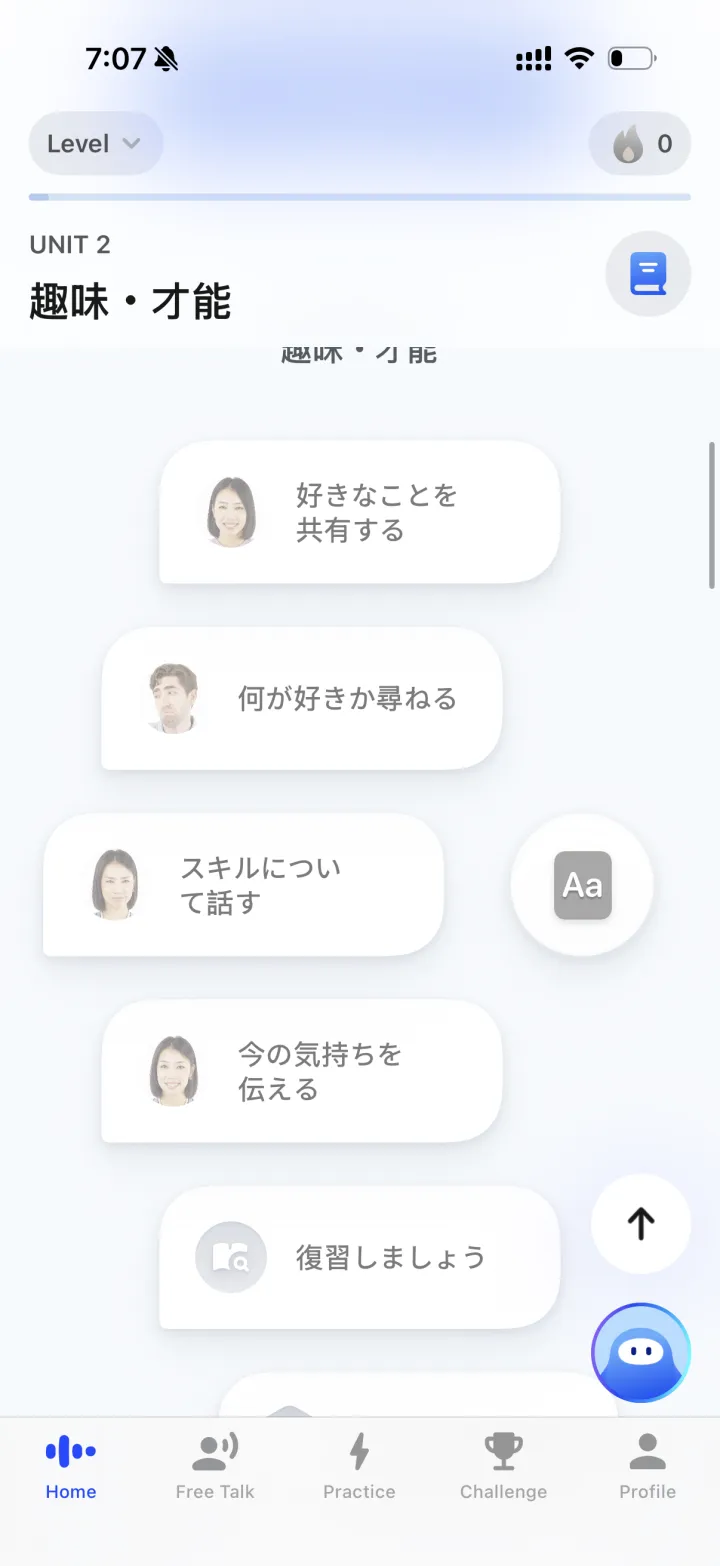
Speak is built around a single, sharp idea: get you talking, a lot, with feedback on pronunciation and fluency. It is the most focused speaking specialist in this review, and for the right learner that focus is a genuine strength. The people who get the most from it are those whose main barrier is confidence — learners who understand the language well, can read it comfortably, and yet freeze the moment they have to produce it out loud. For that profile, Speak's high volume of spoken practice is exactly the medicine.
In our hands-on use the experience felt polished and purpose-built. The drills push you to speak repeatedly rather than tap through screens, and the pronunciation feedback helps you notice and correct the sounds that mark you out as a non-native speaker. If your goal is narrow and clear — build spoken fluency and shed the fear of opening your mouth — Speak does that job with very little distraction.
What we particularly appreciated is that Speak understands its own audience. It does not pretend to be a complete course, and it does not pad itself with vocabulary flashcards or grammar tables you could find anywhere. It commits fully to the speaking problem, and that commitment shows in the small details — the way it gives you room to attempt a sentence, stumble, and try again, rather than punishing hesitation. For a learner who has spent years quietly building comprehension and is now terrified of actually speaking, that environment can be the thing that finally breaks the dam.
The trade-off is scope, and it is the reason Speak sits at number two rather than number one. It is a speaking gym, not a full course. There is no structured grammar progression to guide a beginner from the ground up, and the correction, while useful for pronunciation, is lighter and less explanatory than what Enverson AI offers for the underlying grammar and word choice. In practice this means Speak is superb at making you a more confident, more fluent speaker of the language you already partly know, but weaker at filling the gaps in what you know in the first place. The premium price reflects a deliberately narrow product, so a learner who wants a complete path rather than a speaking workout may find it limiting on its own.
Our honest recommendation is to be clear-eyed about where you are before you subscribe. If your comprehension is solid and your only real problem is the courage and fluency to speak, Speak is close to ideal and well worth its premium. If you are earlier in the journey and still building the underlying grammar and vocabulary, you will likely get more from a tool with structure, and you can come to Speak later. Speaking-first tools like this also have strong options across other languages if you are working beyond English, so the approach travels well even if your target language changes.
Pros
- High volume of speaking practice with useful, specific pronunciation feedback.
- Polished, focused experience for learners who already know what they need to work on.
Cons
- Premium pricing for a speaking-only scope — it is not a full course.
- Correction is lighter and less explanatory than Enverson AI for grammar and word choice.
Pricing: premium subscription.
Our verdict: a strong specialist pick if building spoken fluency and confidence is your single, immediate priority.
3. Babbel
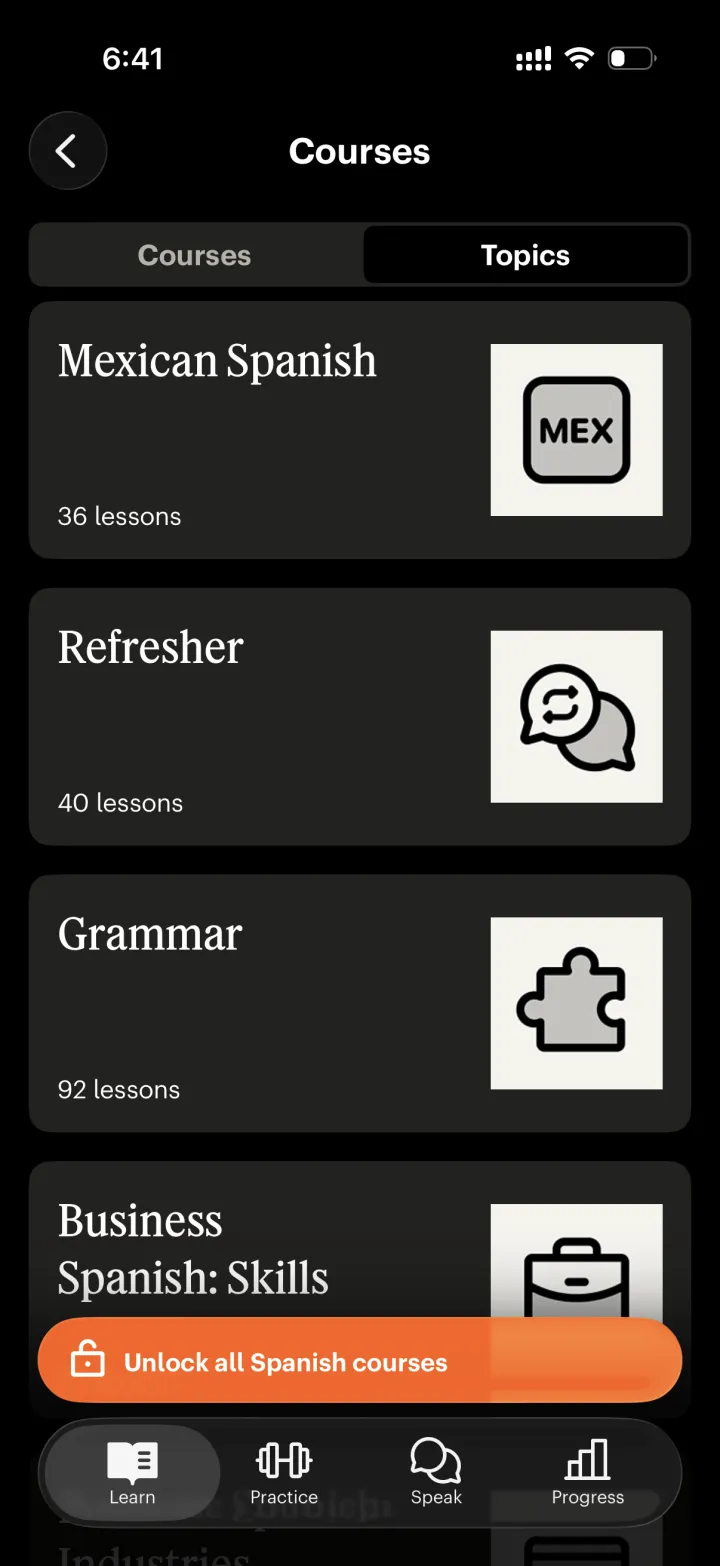
Babbel is the strongest structured all-rounder among the more traditional, course-style apps, and it earns its place by being deliberately rigorous where the gamified crowd is deliberately light. Its lessons are designed by linguists, built around realistic everyday dialogues, and — crucially — they actually explain grammar. Where many apps treat grammar as something to absorb by osmosis, Babbel sets out the rules clearly and shows you how they work in practice, which is reassuring for learners who like to understand the machinery of a language rather than just imitate it.
In our hands-on use, the standout quality was coherence. You are not bouncing between disconnected exercises; you are following a thought-through path through the fundamentals, with each lesson reinforcing the last. The real-life dialogues are practical and transfer well to everyday situations like ordering, travelling or making small talk, and the clear grammar notes mean that when you do make a mistake, you usually understand why. For a learner who wants a human-designed, sensible route through the basics and intermediate stages of a language, that structure is worth a great deal.
There is a particular kind of learner for whom Babbel is close to perfect, and it is worth naming them. They are methodical. They want to know the rule before they use it, they find comfort in a syllabus, and they are mildly irritated by gamification that treats them like a child collecting gems. For that learner — and there are a great many of them, especially among adults who learned languages at school — Babbel feels grown-up and serious in a way most of its rivals do not. The dialogues feel written by people who have actually thought about how the language is used, and the explanations respect your intelligence.
Two things hold Babbel back from the top. The first is the paywall: there is no meaningful free tier, which makes it hard to evaluate properly before you commit your money, and in a market where almost everything offers at least a trial, that is a real friction. The second, and more important, is speaking. Babbel's spoken practice is lighter and more scripted than the AI-first tools at the top of this list — you are largely repeating set phrases and answering prompts rather than holding open, unpredictable conversations. The structure is excellent; the production volume is not. For the criterion we weight most heavily, that is a meaningful shortfall.
The result is an app we admire and recommend with a clear caveat. If structure and grammar clarity are your priority, and you are happy to source your speaking practice elsewhere, Babbel is the best in this review at what it does and an excellent backbone for a study plan. If speaking volume is the thing you most need, you will want to pair it with a more conversational tool — Babbel for the grammar scaffolding, something like Enverson AI or Speak for the talking. Used that way, it is a strong component of a complete approach rather than a complete approach in itself.
Pros
- Structured, linguist-designed lessons with genuine, clear grammar explanations.
- Practical, real-life dialogues that transfer to everyday situations.
Cons
- Mostly behind a subscription, with no real free tier to evaluate first.
- Speaking practice is lighter and more scripted than the AI conversation tools.
Pricing: subscription-based.
Our verdict: the best choice if you want human-designed structure and clear grammar explanations rather than gamification.
4. Duolingo
Duolingo remains the best on-ramp in the entire business, and that is no small achievement. Its core courses are genuinely free and usable, its library is enormous, and its gamification builds a daily habit better than almost anything else on the market. For an absolute beginner staring at a brand-new language, Duolingo lowers the barrier to entry to nearly zero — you can open it, tap through a short lesson, feel a small win, and come back tomorrow. That habit-forming loop is the single most underrated factor in language learning, because the learners who win are the ones who keep showing up.
In our hands-on use, Duolingo was at its best for vocabulary acquisition and early-stage familiarity. The short, frequent lessons make it painless to maintain momentum, and the streaks and rewards are remarkably effective at keeping a beginner engaged through the discouraging early weeks. As a free starting point, nothing in this review beats it on accessibility.
It would be easy, and lazy, to be snobbish about Duolingo, and we want to resist that. The criticism that it does not make you fluent on its own is true, but it slightly misses the point. Most people who try to learn a language never get past the first week; Duolingo's genius is that it gets enormous numbers of people through that first week and into a routine, which is a contribution to language learning that none of the more rigorous apps can claim. The streak, mocked as it sometimes is, is a serious piece of behavioural design, and the habit it builds is the foundation everything else is built on.
Its limitations are the same ones that hold most gamified apps back, and they become more pronounced as you advance. Duolingo favours recognition over production — you are choosing from options and tapping word tiles far more than you are generating language yourself from a blank slate — and its corrections rarely explain why an answer is wrong. That combination is why so many intermediate learners plateau: the app keeps them pleasantly busy without pushing them into the open speaking and meaningful correction that real progress beyond the basics requires. You can maintain a long streak and still find yourself unable to improvise a sentence outside the patterns the app has drilled.
The free tier carries ads, with paid Super and Max tiers available to remove them and add features; the paid tiers improve the experience but do not change the fundamental recognition-over-production design. Our advice is therefore simple and, we think, genuinely fair to the app: treat Duolingo as the excellent beginning of a journey, not the whole of it. Use it to build the habit and the early vocabulary, lean on its accessibility while the language still feels foreign, and then — as you move past the early levels and the plateau starts to bite — pair it with a speaking-focused tool that will push you into production and correct you properly.
Pros
- Genuinely free core tier with an enormous library of content.
- Best-in-class habit formation through streaks and short, daily lessons.
- Polished and approachable — ideal for beginners starting from zero.
Cons
- Weak on open speaking and on explaining why an answer is wrong.
- Can plateau intermediate learners who need production, not recognition drills.
Pricing: free with ads; Super/Max paid tiers available.
Our verdict: the best free starting point and habit-builder — pair it with a speaking-focused tool as you move past beginner level.
→ Read our full Duolingo review
5. Praktika AI
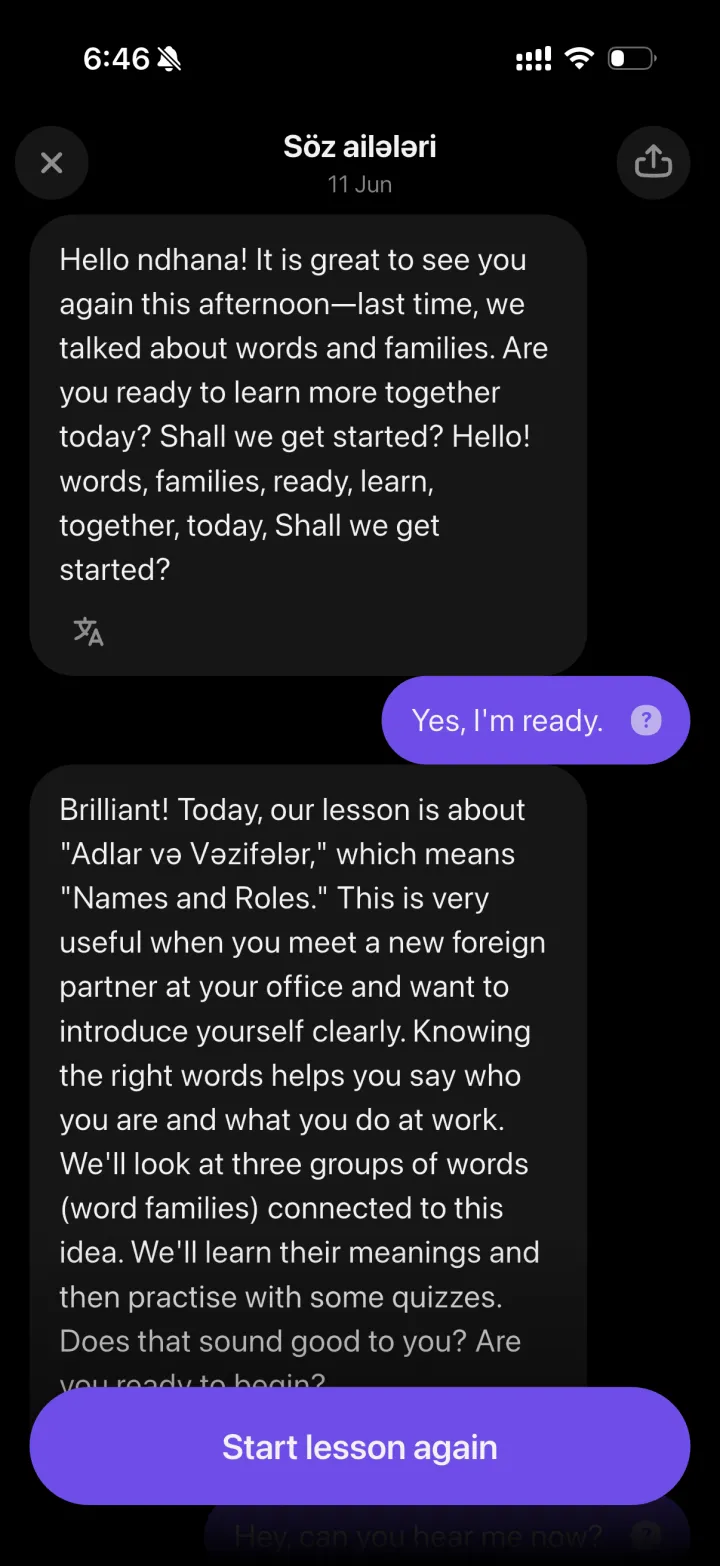
Praktika AI rounds out our top 5 with a distinctive approach: it leans into AI avatars for spoken conversation, giving the practice a face and a personality rather than a faceless voice. For learners who tense up at the thought of speaking to a real person — and that is a very large group — this can be a genuinely effective way to break the ice. The avatar lowers the social stakes, and once you have spoken freely to a friendly character a few times, doing it with a human feels far less daunting.
In our hands-on use, the roleplay scenarios were the clear strength. Praktika gives you a good variety of everyday situations to rehearse — ordering in a café, making an introduction, handling a simple problem — and practising them in a safe, repeatable environment builds the kind of situational confidence that is hard to get any other way without a patient conversation partner. For a nervous speaker whose immediate goal is simply to start talking, Praktika is a comfortable on-ramp.
The avatar concept is more than a gimmick, and that is worth crediting. There is a real psychological difference between speaking into a microphone and speaking to a character that looks back at you, reacts, and carries a conversation. For some of the more anxious learners our team worked with during this review, that difference was the thing that got them speaking at all. If the entire barrier between you and progress is a fear of opening your mouth, an app that makes the first attempts feel safe and even a little fun is doing something valuable that a more clinical tool does not.
Where it sits behind our higher-ranked picks is depth. The correction is lighter and less explanatory than the leaders, so while you get plenty of speaking time, you get less of the detailed, teaching-style feedback that turns a mistake into a lesson. You leave a Praktika session having spoken a lot, which is good, but sometimes without a clear sense of what you got wrong and should fix, which is less good. The structured progression is more scenario-based than systematically level-aware, which means it is better at giving you a menu of situations to practise than at guiding you through a language from the ground up in a deliberate sequence.
Its value also depends heavily on how much you actually use the speaking features — more so than most apps on this list. A subscription to a roleplay tool you open twice a month is poor value; the same subscription, used daily by someone who genuinely needs to overcome speaking nerves, is money well spent. That makes Praktika a app to choose with intent rather than on a whim. If you know that nerves are your real obstacle and you will commit to regular sessions, it earns its place in the top 5; if you are looking for a comprehensive course, the apps above it will serve you better.
Pros
- Avatar-led speaking practice that feels low-pressure and accessible.
- Good variety of everyday roleplay scenarios that build situational confidence.
Cons
- Correction and structured progression are lighter than the leaders.
- Value depends heavily on how much you actually use the speaking features.
Pricing: subscription-based.
Our verdict: a solid choice if unlocking your speaking voice — without nerves — is your immediate goal.
→ Read our full Praktika AI review
Common questions
Before the questions we hear most often, it is worth pulling the threads of this review together, because the ranking is only half the story. The other half is how you use whatever you choose.
Step back from the individual apps and a clear pattern emerges. The tools at the top of this list are the ones that push you to produce language and then tell you, usefully, how you did. The tools lower down are excellent at their narrower jobs — building a habit, drilling pronunciation, easing speaking nerves — but they leave more of the hard work of correction and structure to you or to another tool. That is why our number one, Enverson AI, won: not because the others are bad, but because it carries more of that load in one place. For most learners, fewer tools used consistently beats a clever stack used erratically, and an all-rounder you actually stick with will usually outperform a perfect specialist you forget to open.
Whichever you choose, the principles that actually decide your progress are the same, and they are unglamorous. Practise most days, even briefly, because consistency beats intensity over any horizon longer than a week. Spend the majority of your time producing language — speaking and writing — rather than passively recognising it, because production is the skill you are actually trying to build. Treat every correction as the most valuable second of your session, because that is the moment you are learning rather than merely rehearsing. And whenever you can, take what you practise in an app out into a real conversation, because no software yet reproduces the productive panic of a human who genuinely does not understand you. For a wider view of how these tools stack up against each other and against more traditional study, our best AI language learning app guide and our look at what makes a language app effective go further.
From which app is best to whether software can ever replace a teacher, the questions below are the ones we hear most often — with our full answers.
Our overall recommendation stands. Across our top 5, the differences come down to fit: pick the app that matches your goal, use it every single day, and pair it with structured lessons and real correction wherever you can. Enverson AI was our winner because it covers the most ground in one place, but the best app for you is always the one you will keep opening. If you want that speaking-and-feedback structure without spending anything, our guided free track is built around exactly the loop these apps only partly cover — start there, and let the habit do the rest.
Frequently asked questions
What is the best language learning app in 2026?
In our hands-on review, the best all-rounder is Enverson AI. It was the only app in our top 5 to combine unlimited, low-pressure speaking practice, corrections that explain the error rather than just flagging it, and a structured CEFR-aligned progression — all in one product from $9.99/month. The right app still depends on your goal: Speak is the strongest speaking specialist, Babbel suits learners who want a grammar-first structured course, Duolingo is the best free habit-builder for beginners, and Praktika AI is a low-pressure way to start speaking with AI avatars. Our full ranking and reasoning are above.
Is a free language learning app good enough?
It depends on your level and goal. Duolingo's free tier is genuinely good for vocabulary and building a daily habit, especially for beginners, and most paid apps — including Enverson AI, Speak, Babbel and Praktika AI — offer a free trial so you can evaluate them first. But the features that make the biggest difference to real progress — unlimited open speaking practice and corrections that explain why something is wrong — are usually behind a subscription. For most learners, a free app is a great start but not a complete solution on its own.
Which app is best for speaking practice?
For pure speaking volume and pronunciation feedback, Speak is the strongest specialist, and Praktika AI's avatar conversations are a comfortable, low-pressure way to start talking. But if you want speaking practice that also corrects you in a way that teaches and sits inside a structured course, Enverson AI was the best all-round choice in our review — it gives unlimited speaking practice plus corrections that explain the error and the fix. Pair any of them with real conversations when you can.
Can a language learning app replace a teacher?
Not entirely. A good app gives you something a teacher cannot match alone — unlimited, low-pressure practice at any hour, at very low cost. Where apps fall short is judgement: prioritising the errors that matter most for your goals, understanding your context, and reproducing the unpredictability of real human conversation. The learners who progress fastest use an app for daily practice and pair it with structured lessons and human-style correction when they need it. That is exactly what our free track is built around.