
How to Speak English With Confidence When You're Shy: Low-Pressure Practice and Useful Phrases
If you freeze when you speak English, start with practice where mistakes cost nothing, then move slowly to real conversations. This guide gives a low-pressure practice ladder, 28 phrases that buy you time, tips for group conversations and a four-week confidence plan.

- Why shy learners freeze when they speak English
- A low-pressure practice ladder
- Start alone: practice where nobody is listening
- Phrases that buy time in conversation
- Your first real conversations: how to make them easy
- How to think about mistakes
- Joining group conversations
- A four-week confidence plan
- What this article cannot tell you
If you are shy, the best way to start speaking English with confidence is to lower the pressure, not to force yourself into big conversations. Start by speaking alone (shadowing, talking to yourself, recording short answers), then move to low-risk real conversations such as one-to-one chats, short scripted exchanges and online practice, and learn a small set of phrases that buy you time while you think. Confidence comes from repetition in safe situations, so the aim is to speak a little every day in settings where mistakes cost nothing. This guide gives a step-by-step plan, 28 phrases for gaining time and keeping a conversation going, and ways to handle the moments that make shy speakers freeze.
Shyness is not a language problem. Many learners who freeze when speaking can read and understand English well. Researchers call this "foreign language anxiety", first described by Horwitz, Horwitz and Cope in "Foreign Language Classroom Anxiety" (The Modern Language Journal, 1986). It is common, and it can be reduced with the right kind of practice.
Why shy learners freeze when they speak English
When you speak a foreign language, you are doing several things at once: finding words, building grammar, pronouncing sounds and listening to the reply. If you also worry about being judged, there is less mental space for the language itself. That is why many people say, "I know the words, but they disappear when I have to speak."
Common triggers include:
- Fear of mistakes: worrying that one grammar error will make you look less intelligent.
- Silence: feeling that a pause of three seconds is a disaster.
- Fast native speakers: not understanding a reply and not knowing how to ask for help.
- Groups: finding it much harder to join a conversation with several people than to talk one-to-one.
- Comparisons: measuring yourself against a more fluent colleague or classmate.
Each of these has a practical fix. You do not need to change your personality; you need tools and practice in the right order.
A low-pressure practice ladder
Think of confidence as a ladder. Start on the lowest step and move up only when it feels easy. Most shy learners try to start at the top (a group discussion or a meeting) and then decide they are "bad at speaking".
| Step | Activity | Pressure | Time per day |
|---|---|---|---|
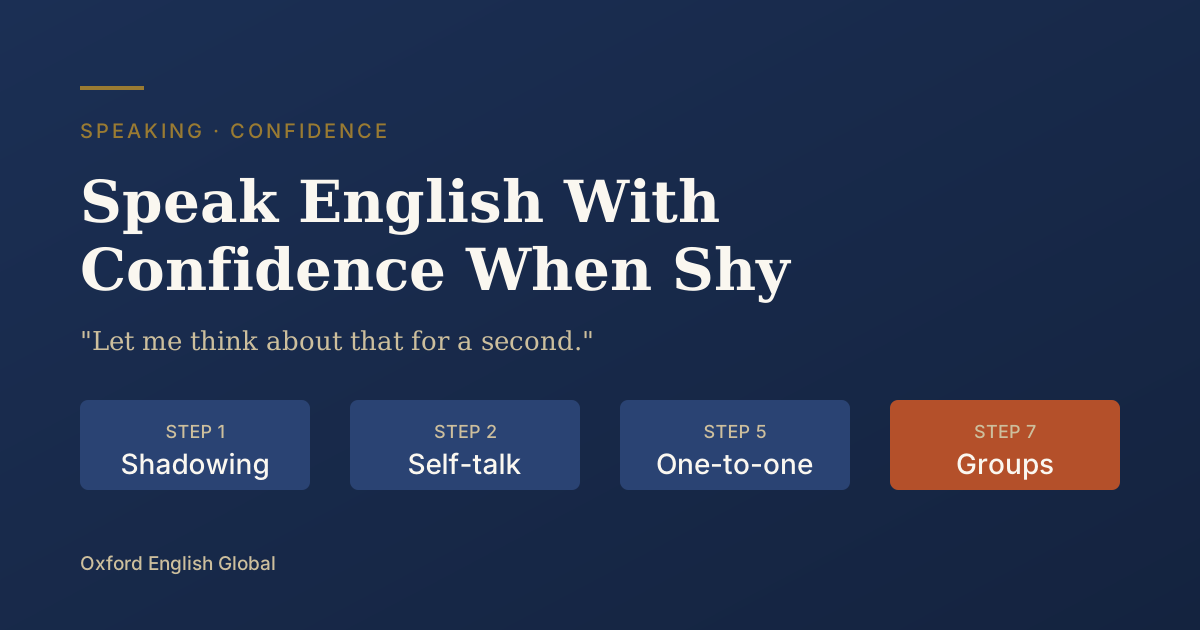
| 1 | Shadowing: repeat a short audio clip at the same time as the speaker | None | 5 minutes |
| 2 | Self-talk: describe what you are doing in English ("Now I'm making coffee…") | None | 5 minutes |
| 3 | Record a 60-second answer to a simple question and listen back | Very low | 5 minutes |
| 4 | Practise with an AI chat or voice tool, or a recorded dialogue | Low | 10 minutes |
| 5 | One-to-one conversation with a tutor or a friendly partner | Medium | 20–30 minutes, 2–3 times a week |
| 6 | Short real exchanges: ordering, asking for directions, small talk | Medium | Whenever possible |
| 7 | Group conversations, meetings, presentations | High | When steps 1–6 feel comfortable |
The times above are suggestions, not research-based targets. What matters is regular practice: ten minutes every day is better for confidence than one long session a week, because each session reminds your brain that speaking is normal and safe. For solo practice ideas, see our guide to practising English speaking without a partner.
Start alone: practice where nobody is listening
Shadowing
Choose a short clip (30 to 60 seconds) from a podcast or video at your level. Listen once, then play it again and speak at the same time as the speaker, copying their rhythm and intonation. You are not inventing language, so there is no fear of mistakes. Our list of podcasts for language learning is a good source of clips.
Self-talk
Describe your day out loud in simple English: "I'm going to the supermarket. I need milk and bread. I think it's going to rain." This builds the habit of turning thoughts into English quickly.
Recording yourself
Answer one question a day in 60 seconds: "What did you do last weekend?" "What's your job?" "What's your favourite place in your city?" Listen back once and note one thing to improve. Do not delete recordings; after a month, listen to the first one and you will hear the progress, which is one of the best confidence boosters there is. Our free Speaking Lab helps you practise pronunciation and intonation privately.
Phrases that buy time in conversation
Shy speakers often panic during a pause. Native speakers pause too, but they fill the gap with short phrases. Learn these and you will never have a completely silent moment again.
When you need a moment to think
- "Let me think about that for a second."
- "That's a good question."
- "Hmm, how can I put this?"
- "Well, it depends."
- "I've never really thought about that."
- "Give me a moment…"
When you can't find a word
- "What's the word… it's a thing you use to…"
- "I don't know the word in English, but it's like a…"
- "It's a kind of…"
- "It's similar to…"
- "Sorry, the word has gone out of my head."
When you didn't understand
- "Sorry, could you say that again?"
- "Could you speak a bit more slowly, please?"
- "Sorry, what do you mean by…?"
- "So you mean that…?"
- "I didn't quite catch that."
When you want to keep the conversation going without talking much
- "Really? Tell me more."
- "What happened next?"
- "How did you feel about that?"
- "That sounds interesting."
- "And what about you?"
- "Oh, I see."
When you want to correct yourself or restart
- "Sorry, I mean…"
- "Let me say that another way."
- "What I'm trying to say is…"
- "Sorry, my English isn't perfect, but…"
- "Let me start again."
- "In other words…"
Asking questions is a particularly useful strategy for shy people: the other person does most of the talking, and you practise listening and short reactions. If you need more everyday expressions, our guide to common phrasal verbs for everyday conversation is a good next step.
Your first real conversations: how to make them easy
- Prepare a "starter pack". Write and practise answers to five questions you will almost certainly be asked: your name and where you're from, your job or studies, why you're learning English, your hobbies, and your plans for the weekend.
- Start one-to-one. A patient tutor or a single partner is much easier than a group. You can control the speed and ask for repetition.
- Choose predictable situations. Ordering coffee, buying a ticket or asking for directions follow a script. Success in small, predictable exchanges builds confidence for open conversations.
- Tell people you are learning. "I'm learning English, so please tell me if I make a mistake" usually makes people kinder and more patient.
- Set a tiny goal. "Ask one question in today's meeting" is achievable. "Speak fluently in the meeting" is not.
How to think about mistakes
Most listeners care about meaning, not perfect grammar. If you say "Yesterday I go to the cinema", people understand you. Mistakes are a normal part of learning; they are information about what to practise next, not proof that you are bad at English.
A practical approach is to separate speaking time from correction time. While you speak, focus on getting your message across. Afterwards, think about one or two things you want to say better next time and practise those. If you want a list of typical errors to check, see our guide to common English grammar mistakes.
Joining group conversations
Groups are hardest because the conversation moves fast and nobody waits for you. These techniques help:
- Agree and add: "I agree with Maria. I also think…" This is an easy way in, because you build on what someone already said.
- Use a soft interruption: "Can I just add something?" or "Sorry, just a quick point…"
- Ask a question instead of making a statement: "What do you all think about…?"
- Prepare one comment in advance for meetings, based on the agenda.
- Speak early. The longer you wait, the harder it gets. Say something small in the first five minutes.
For work situations, our guides to business English and job interviews in English include more phrases for meetings and formal conversations.
A four-week confidence plan
| Week | Focus | Daily practice |
|---|---|---|
| 1 | Solo speaking | 5 min shadowing + 5 min self-talk + one 60-second recording |
| 2 | Time-buying phrases | Learn 5 phrases a day; use each in a recorded answer |
| 3 | One-to-one conversation | Solo practice plus 2–3 short conversations with a tutor, partner or AI tool |
| 4 | Real-world exchanges | One small real conversation a day (shop, colleague, online community) and one question in a group |
At the end of week four, listen to your first recording again and compare. If you want structured practice with feedback, our Conversation courses and free lessons are designed for adult learners at B1 and above. For a full self-study programme, our free Speak With Confidence PDF covers spoken English from A2 to C1.
What this article cannot tell you
- How long it will take you. Progress depends on your level, how often you practise and how strong the anxiety is. We have not given time estimates because there is no reliable figure for individual learners.
- Clinical advice. Ordinary shyness and language anxiety are common. If anxiety affects your daily life well beyond speaking English, consider talking to a qualified professional.
- Feedback on your English. Solo practice builds confidence, but it cannot tell you whether you were understood. Combine it with conversations where someone can respond and correct you.
Frequently asked questions
How can I speak English if I'm shy?
Start with practice where nobody is listening, such as shadowing, self-talk and recording short answers. Then move to one-to-one conversations and short, predictable exchanges before joining groups.
What can I say when I need time to think in English?
Use phrases such as 'Let me think about that for a second', 'That's a good question' or 'Well, it depends'. They are natural and give you a few seconds to plan your answer.
Is it normal to feel anxious speaking a foreign language?
Yes. Researchers have described 'foreign language anxiety' since the 1980s, and many learners who read and understand English well still freeze when speaking. Regular low-pressure practice helps reduce it.
How long does it take to feel confident speaking English?
It depends on your level, how often you practise and how strong the anxiety is. Short daily practice tends to help more than occasional long sessions, but there is no reliable timeline for every learner.