
Gerunds and Infinitives: Enjoy Doing vs Want to Do, With Easy Ways to Remember
Is it I enjoy to cook or I enjoy cooking? Some verbs take -ing, some take to, and some take both. This guide gives you the main verb patterns in clear tables, explains the verbs that change meaning, and shares easy ways to remember them, with common mistakes and a practice exercise.

- What are gerunds and infinitives?
- Verbs followed by -ing
- Verbs followed by to + infinitive
- Verbs followed by both, with little difference in meaning
- Verbs that change meaning: remember, forget, stop, try, regret
- After prepositions, always -ing
- Other places we use gerunds and infinitives
- Easy ways to remember the patterns
- Common mistakes and how to fix them
- Practice: -ing or to?
- What this article cannot tell you
In English, some verbs are followed by a gerund (the -ing form), some by a to-infinitive, and some can take both. We say I enjoy cooking but I want to cook; there is no grammar rule that predicts this for every verb, so you learn the pattern with the verb. The good news is that a few dozen common verbs cover most everyday sentences, and there are memory tricks that make them easier: verbs about the future or a goal usually take to, verbs about experience or something already happening often take -ing, and after a preposition you always use -ing. This guide gives you the main verb patterns in clear tables, explains the verbs that change meaning, and shows easy ways to remember them.
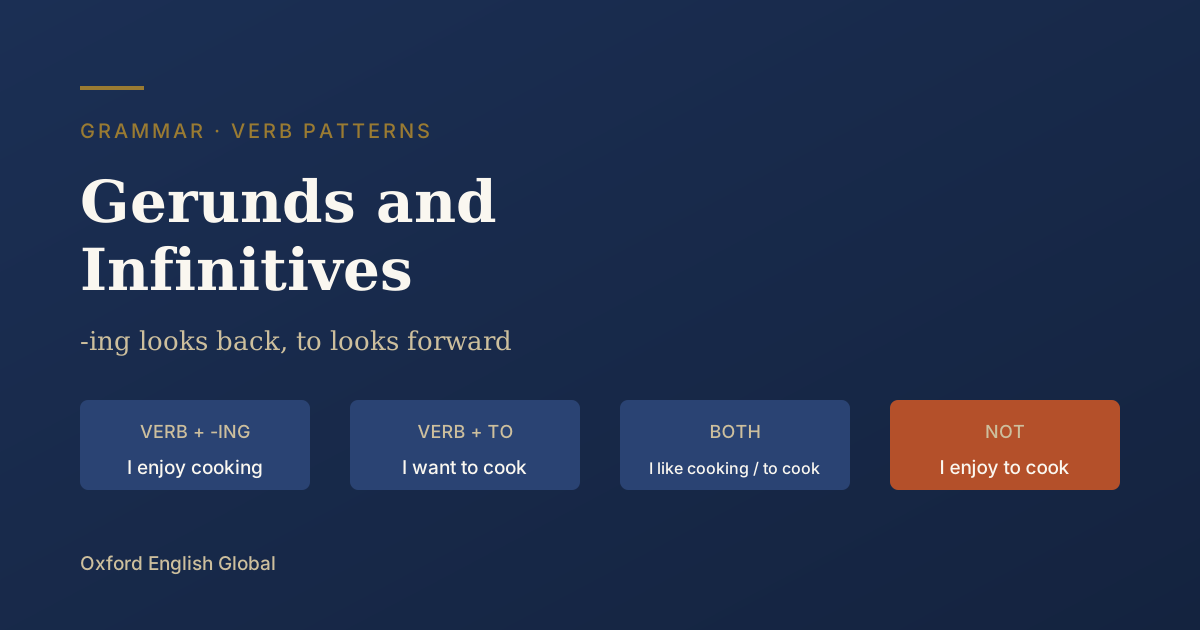
Quick summary. enjoy, avoid, finish, mind, suggest + -ing · want, decide, hope, plan, agree + to · like, love, hate, start, begin + -ing or to (little change in meaning) · remember, forget, stop, try, regret + -ing or to (different meaning) · preposition + -ing: interested in learning.
What are gerunds and infinitives?
A gerund is the -ing form of a verb used like a noun:
- Swimming is good exercise. (subject)
- I enjoy swimming. (object of a verb)
- She's good at swimming. (after a preposition)
An infinitive is the base form of a verb. It has two forms:
- the to-infinitive: to swim, to work, to be
- the bare infinitive (without to): swim, work, be, used after modal verbs (can swim) and after make and let (let me go).
The question learners ask most is: after this verb, do I use -ing or to? That is what the rest of this guide answers. Cambridge Dictionary's English Grammar Today page on verb patterns is a good reference to check individual verbs.
Verbs followed by -ing
These common verbs are followed by a gerund, not a to-infinitive.
| Verb | Example |
|---|---|
| enjoy | I enjoy reading before bed. |
| avoid | Try to avoid using your phone while driving. |
| finish | Have you finished writing the report? |
| mind | Would you mind opening the window? |
| suggest | She suggested taking a taxi. |
| recommend | I recommend booking early. |
| consider | We're considering moving to Lisbon. |
| keep | He keeps interrupting me. |
| practise (UK) / practice (US) | You should practise speaking every day. |
| miss | I miss living by the sea. |
| admit / deny | He denied breaking the printer. |
| imagine | Can you imagine living without the internet? |
| give up | She gave up smoking last year. |
| can't stand / can't help | I can't stand waiting in queues. |
| look forward to | I look forward to hearing from you. |
Look forward to catches many learners. The to here is a preposition, not part of an infinitive, so it takes -ing: I look forward to meeting you, never to meet you. The same is true of be used to and get used to; see our guide to used to, be used to and get used to.
Verbs followed by to + infinitive
| Verb | Example |
|---|---|
| want / would like | I want to learn Spanish. / I'd like to book a table. |
| need | You need to sign here. |
| decide | We decided to stay at home. |
| hope | I hope to see you soon. |
| plan | They're planning to open a new office. |
| expect | We expect to finish by June. |
| agree / refuse | He refused to pay the fine. |
| promise / offer | She offered to drive me home. |
| manage / fail | I finally managed to fix it. |
| learn | My son is learning to swim. |
| afford | We can't afford to wait. |
| seem / appear | He seems to be tired. |
| pretend | She pretended to be asleep. |
| tend | Prices tend to rise in summer. |
| would love / would prefer | I'd love to come. |
Verb + object + to-infinitive
Some verbs need a person (or object) before the infinitive:
- My manager asked me to call the client.
- They advised us to arrive early.
- She told him to wait.
- I want you to be honest. (not I want that you are honest)
Other verbs like this: allow, encourage, expect, invite, persuade, remind, teach, warn. These patterns are also how we report requests and advice; see our guide to reported speech.
Make and let: no "to"
Make and let are followed by object + bare infinitive: My boss made me redo the slides. Please let me know. Not let me to know.
Verbs followed by both, with little difference in meaning
With these verbs you can use either form, and the meaning hardly changes:
| Verb | Example |
|---|---|
| begin / start | It started raining. / It started to rain. |
| continue | Prices continue rising. / Prices continue to rise. |
| like / love / hate / prefer | I love travelling. / I love to travel. |
| intend | We intend to stay. / We intend staying. (to is more common) |
With like, love, hate and prefer, British English often uses -ing for general enjoyment (I like swimming) and to for habits or choices (I like to get up early on Sundays), while American English uses to more widely. Both are correct. Our guide to talking about likes and dislikes has many more examples.
One important exception: after would like, would love, would hate and would prefer, always use to: I'd love to come, not I'd love coming.
Verbs that change meaning: remember, forget, stop, try, regret
These verbs can take both forms, but the meaning changes. This is the part of the topic most often tested in exams.
| Verb | + -ing (looks back: the action happened first) | + to (looks forward: the action comes next) |
|---|---|---|
| remember | I remember locking the door. (I locked it; now I have the memory.) | Please remember to lock the door. (Don't forget the task.) |
| forget | I'll never forget seeing the ocean for the first time. | I forgot to send the email. (I didn't send it.) |
| stop | He stopped smoking. (He doesn't smoke now.) | He stopped to smoke. (He stopped what he was doing in order to smoke.) |
| try | Try restarting your laptop. (Experiment: see if it works.) | I tried to open the file, but I couldn't. (Make an effort.) |
| regret | I regret saying that. (I said it and I'm sorry.) | We regret to inform you that... (formal: we are sorry to tell you now.) |
| go on | She went on talking for an hour. (continued the same thing) | She went on to become a director. (did something next) |
| mean | A new job means moving to London. (involves) | I meant to call you. (intended) |
Memory trick: -ing looks back, to looks forward. With remember, forget, regret and stop, the -ing form refers to something that already happened or was already in progress. The to form points to something that comes after, like a task or purpose.
After prepositions, always -ing
This is the one rule with no exceptions: when a verb comes directly after a preposition, use -ing.
- I'm interested in learning Japanese.
- She's good at solving problems.
- Thank you for helping me.
- He left without saying goodbye.
- Before signing the contract, read it carefully.
- I'm thinking about changing jobs.
Watch out for phrases where to is a preposition: look forward to, be used to, get used to, object to, be committed to, when it comes to. They all take -ing: We are committed to improving our service.
Other places we use gerunds and infinitives
Gerund as the subject
When an action is the subject of a sentence, the -ing form is usually more natural: Learning a language takes time. (To learn a language takes time is possible but sounds formal.)
To-infinitive for purpose
Use to to explain why: I went to the bank to open an account. Do not say for open or for opening to express a person's purpose.
After adjectives
Many adjectives take to: It's easy to use. I'm happy to help. She was surprised to see me. But adjective + preposition takes -ing: I'm tired of waiting.
After "it's no use", "it's worth" and "there's no point"
It's worth visiting the old town. There's no point arguing. It's no use complaining.
See, hear and watch + object + -ing or bare infinitive
Verbs of perception can take an object followed by -ing or by the bare infinitive, with a small difference in meaning:
- I saw him crossing the road. (I saw part of the action, while it was happening.)
- I saw him cross the road. (I saw the complete action, from start to finish.)
- We heard the neighbours arguing all night. (a longer, ongoing action)
Other verbs like this include notice, watch, feel and listen to.
Noun + to-infinitive
Many nouns are followed by to: a decision to leave, a plan to expand, the chance to travel, an attempt to fix it. These often come from verbs that take to (decide to → a decision to), which is another easy way to remember them.
Easy ways to remember the patterns
- Use the meaning clue (with care). Many to verbs point to the future or a goal: want, hope, plan, decide, expect, promise. Many -ing verbs are about experience, feelings or something that already exists: enjoy, mind, miss, avoid, finish. It's a tendency, not a rule, but it helps you guess.
- Learn verbs in chunks, not alone. Memorise avoid doing, decide to do, look forward to doing as complete units. Our guide to learning vocabulary in chunks explains why this works.
- Make personal sentences. Write one true sentence for each verb: I enjoy cycling to work. I want to run a half-marathon. Personal examples are much easier to recall.
- Group the -ing verbs into a story. For example: I enjoy cooking, but I avoid washing up. When I finish eating, I keep putting it off, so my flatmate suggested buying a dishwasher. Would you mind helping me choose one?
- Listen for them. These patterns are everywhere in podcasts and TV. When you hear one, pause and repeat the full phrase aloud.
Common mistakes and how to fix them
| Mistake | Correct |
|---|---|
| I enjoy to travel. | I enjoy travelling. |
| I look forward to meet you. | I look forward to meeting you. |
| She suggested me to call. | She suggested calling / suggested that I call. |
| I want that you come. | I want you to come. |
| He let me to use his car. | He let me use his car. |
| I'm interested to learn about AI. (meaning a general interest) | I'm interested in learning about AI. |
| I went there for buy bread. | I went there to buy bread. |
| I'd love going with you. | I'd love to go with you. |
For more frequent errors, see our list of common English grammar mistakes.
Practice: -ing or to?
- I can't afford ______ (buy) a new car this year.
- Would you mind ______ (turn) the music down?
- We decided ______ (leave) early to avoid the traffic.
- Did you remember ______ (lock) the door? I can't see the key.
- I still remember ______ (meet) her for the first time in 2015.
- He stopped ______ (check) his phone, because he wanted to focus.
- She's thinking about ______ (apply) for the manager's job.
- I look forward to ______ (hear) from you.
- If the app freezes, try ______ (close) it and opening it again.
- They promised ______ (deliver) the parcel by Friday.
Answers: 1. to buy 2. turning 3. to leave 4. to lock 5. meeting 6. checking 7. applying 8. hearing 9. closing 10. to deliver
What this article cannot tell you
- Every verb pattern in English. We list the most common verbs. Hundreds of other verbs have their own patterns, and some allow more than one. A learner's dictionary shows the pattern in each entry.
- A rule that predicts every verb. The meaning clues in this guide are tendencies. There are exceptions: consider and imagine often look ahead to the future but still take -ing (We're considering moving).
- Every regional difference. British and American English differ slightly, especially with like, love and hate. Both forms shown here are correct and widely understood.
Want a teacher to check your grammar? See our English courses or start with our free lessons.
Frequently asked questions
What is the difference between a gerund and an infinitive?
A gerund is the -ing form of a verb used like a noun: I enjoy swimming. An infinitive is the base form, usually with to: I want to swim. Which one you use after a verb depends on that verb.
Is it enjoy to do or enjoy doing?
Enjoy doing. Enjoy is always followed by the -ing form: I enjoy reading. Other common verbs like this are avoid, finish, mind, suggest, consider, keep and miss.
What is the difference between remember doing and remember to do?
Remember doing looks back at something that happened: I remember locking the door. Remember to do looks forward to a task: Remember to lock the door.
Is it look forward to meet or look forward to meeting?
Look forward to meeting. In look forward to, to is a preposition, and prepositions are always followed by the -ing form.
Can like and love take both -ing and to?
Yes. I like swimming and I like to swim are both correct, with little difference in meaning. But after would like, would love and would prefer, always use to: I'd love to come.