
Netflix's Pride and Prejudice as English Listening Practice: Train Your Ear for Formal British English
Netflix's six-part Pride and Prejudice premieres on 3 December 2026. Watched actively, a period drama like this trains your ear for formal and polite British English. Here is what to listen for, a step-by-step method for each episode, the right way to use subtitles, and how to pair the series with Jane Austen's free 1813 novel.

- What we know about Netflix's Pride and Prejudice
- Why a period drama is good listening practice
- Formal and polite British English to listen for
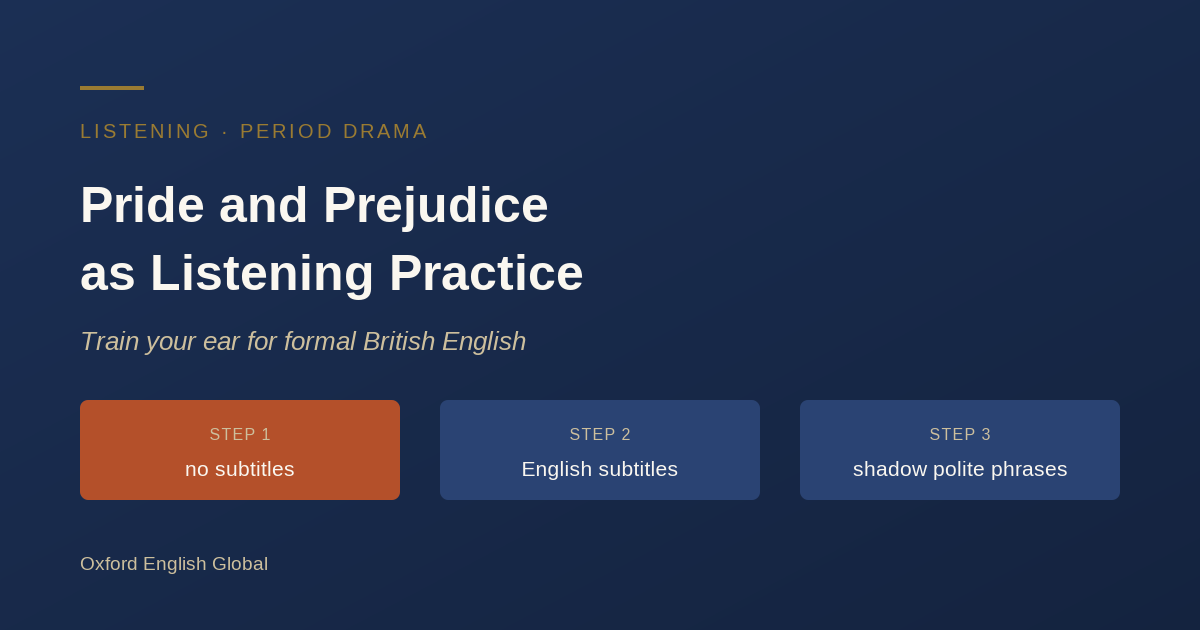
- A step-by-step method for one episode
- Subtitles: when to use them, and which language
- Read the free 1813 novel alongside the series
- What a period drama can and cannot teach about British English
- What this article cannot tell you
Netflix's new six-part Pride and Prejudice series premieres on 3 December 2026, and it can be excellent listening practice if you watch it actively: choose one short scene, watch it first without subtitles, then with English subtitles, then shadow a few lines aloud. Period dramas like this are especially useful for training your ear for formal and polite British English, such as indirect requests, careful compliments and polite disagreement. This guide explains what we know about the series, which features of formal English to listen for, a step-by-step method for one episode, and how to use Jane Austen's original 1813 novel, which is free to read, alongside the show.
Sources. Series details come from Netflix's own Tudum article (29 October 2026, read 28 November 2026). Quotations from the novel are from Jane Austen's Pride and Prejudice (1813), which is in the public domain and free on Project Gutenberg. We had not seen the series when this was written, so we do not quote its dialogue or judge how closely it follows the book.
What we know about Netflix's Pride and Prejudice
According to Netflix, the series is a new six-part adaptation of Jane Austen's novel written by the bestselling author and screenwriter Dolly Alderton and directed by Euros Lyn, whose previous work includes Heartstopper. It premieres on Netflix on 3 December 2026.
| Detail | What Netflix says |
|---|---|
| Format | Limited series, six episodes |
| Premiere | 3 December 2026 |
| Writer | Dolly Alderton |
| Director | Euros Lyn |
| Main cast | Emma Corrin (Elizabeth Bennet), Jack Lowden (Mr Darcy), Olivia Colman (Mrs Bennet), Freya Mavor (Jane Bennet), Daryl McCormack (Mr Bingley), with Rufus Sewell, Jamie Demetriou, Rhea Norwood, Siena Kelly and Louis Partridge |
| Story | The five Bennet sisters "navigate love, family, and society's expectations"; Elizabeth "clashes with Bingley's proud friend Mr. Darcy" |
For learners, the format matters. Six episodes is a manageable commitment, and because the story is famous, you can read a plot summary before you watch. Knowing what happens frees your attention for the language, which is one of the most effective ways to make authentic video useful at intermediate level.
Why a period drama is good listening practice
Most series that learners watch, such as sitcoms or crime dramas, use fast, informal, modern English with lots of slang. A period drama set among the English gentry usually works differently:
- Clearer, more careful speech. Characters in formal social situations often speak in complete sentences rather than fragments.
- Polite formulas you can reuse. Many of the ways people request, refuse, apologise and disagree politely are still used in formal British English today, especially in writing and at work.
- Repeated situations. Introductions, invitations, visits, dances and proposals happen again and again, so the same phrases come back and are easier to learn.
- Strong context. Costumes, settings and well-known plot points help you guess meaning when you miss a word.
There are limits. Some vocabulary is old-fashioned, and a modern adaptation may deliberately mix period and contemporary styles. Treat the series as practice for listening to formal and polite English, not as a model for everyday conversation with friends. For that, see our guide to small talk in English.
Formal and polite British English to listen for
These are the features of formal English that period dramas, and Austen's novel, use a lot. The examples from the novel are quoted from the 1813 text; the modern equivalents are our own.
Indirect requests and offers
Formal English avoids direct commands. Listen for modal verbs and softening phrases:
| Formal or polite form | More direct modern form |
|---|---|
| Would you be so kind as to…? | Can you…? |
| May I…? / Might I…? | Can I…? |
| Shall I…? / Shall we…? | Do you want me to…? / Let's… |
| I should be glad to… | I'd be happy to… |
| I wonder whether you would… | Will you…? |
Our guide to modal verbs: can, could, may, might and must explains how these forms change the level of politeness.
Polite disagreement and refusal
Characters in period dramas disagree strongly, but often in very controlled language. Austen's Elizabeth refuses a proposal with: "You could not have made the offer of your hand in any possible way that would have tempted me to accept it." The meaning is a firm no; the grammar is formal and complex.
Modern formal phrases with the same function include I'm afraid I can't agree, With respect, I see it differently and I'm grateful for the offer, but I must decline.
Long, balanced sentences
The novel's famous first line is a good example of formal sentence rhythm: "It is a truth universally acknowledged, that a single man in possession of a good fortune, must be in want of a wife." Notice the structure: a general statement (It is a truth…), then the content. When you hear long sentences like this, listen for the main verb first and fill in the details on a second listen.
Forms of address
Listen for Mr Darcy, Miss Bennet (the eldest unmarried daughter), Miss Elizabeth and Mrs Bennet. Characters rarely use first names outside the family. This is a useful reminder that in formal English today, especially in emails, it is safer to start with a title and surname until invited to use a first name. Our guide to writing a formal letter covers modern forms of address.
Old-fashioned words to recognise, not use
| Word or phrase | Meaning | Use today? |
|---|---|---|
| an establishment | a home and income, often through marriage | Not in this sense |
| to call on someone | to make a short formal visit | Still understood; a little formal |
| an acquaintance | someone you know slightly | Yes, common |
| agreeable | pleasant | Yes, but formal |
| I am much obliged | thank you very much | Rare and very formal |
A step-by-step method for one episode
Watching a whole episode once with subtitles in your language is relaxing, but it is not much listening practice. Instead, divide your time between enjoying the episode and studying one short scene intensively.
- Before watching (5 minutes). Read a short summary of the part of the story covered by the episode. If you know the plot, you can focus on the language.
- Watch the episode for pleasure. Use English subtitles if you need them. Do not stop the video.
- Choose one scene of 1 to 3 minutes with two or three characters talking, ideally a conversation such as an introduction, a visit or an argument.
- Watch the scene without subtitles. Write down the gist: who wants what, and how does each person feel?
- Watch again with English subtitles. Note every polite formula or phrase from the lists above.
- Listen for sounds, not just words. Pause after one line and repeat it. Notice which words are stressed and where sounds join together. Our guide to connected speech in English explains linking and weak forms.
- Shadow three to five lines. Play a line, pause, and say it aloud at the same speed and intonation, then try speaking along with the actor.
- Reuse one phrase. Write a sentence about your own life using one formal phrase you noticed (for example Would you be so kind as to send me the report?).
This takes about 20 to 30 minutes on top of the episode. Six episodes therefore give you six intensive listening sessions and a notebook of polite phrases. Our Speaking Lab lets you practise the pitch and intonation of lines you have shadowed.
Subtitles: when to use them, and which language
| Your level | Suggested approach |
|---|---|
| B1 (intermediate) | Watch episodes with English subtitles. For your chosen scene, read the subtitles first, then listen without them. |
| B2 (upper intermediate) | English subtitles for the first watch; no subtitles for the scene study, then check with subtitles. |
| C1 and above | Try whole episodes without subtitles. Use English subtitles only to check scenes you found hard. |
English subtitles are usually more helpful than subtitles in your own language, because they connect the sounds you hear with the written words. Subtitle options vary by country and device, so check what is available on your account. For more listening strategies, see our full guide to improving your English listening.
Read the free 1813 novel alongside the series
Jane Austen's novel was published in 1813 and is now in the public domain. You can read it free and legally on Project Gutenberg. Combining the book and the series is a powerful way to build vocabulary:
- Read one chapter, then watch the matching scene. You will recognise words and phrases when you hear them.
- Compare the language. Note where the series keeps Austen's wording and where it modernises it. This trains you to notice differences between formal and informal English.
- Do not read everything. The novel is long and its language is challenging even for advanced learners. Choose famous chapters, such as the opening chapter and the first proposal scene.
Our guide to learning English vocabulary through reading explains how to choose texts at the right level, and our free English learning PDFs include graded material if Austen's original is too difficult.
What a period drama can and cannot teach about British English
Period dramas can help you recognise features of British spelling, pronunciation and vocabulary, and they are full of politeness strategies that still matter in British culture, such as softening requests and avoiding direct criticism. But they cannot show you how most British people speak today. Modern British English includes many regional accents, more informal vocabulary and much less formal social behaviour than the world of the Bennets.
If you want to compare varieties, our guide to British vs American English sets out the main differences in vocabulary, spelling and grammar.
What this article cannot tell you
- How the series sounds. We wrote this before the premiere and do not know how closely the dialogue follows Austen or how modern it sounds.
- Availability in your country. Netflix catalogues, release times and subtitle options vary by region and device.
- Accents. We cannot say which accents the actors use. A period drama is not a guide to modern regional British accents.
- Whether you will enjoy it. Listening practice works best with material you want to watch. If the series is not for you, use the same method with another show.
This page is independent guidance from Oxford English Global. We have no commercial relationship with Netflix, and the page contains no affiliate or sponsored links. If you would like guided listening and conversation practice, see our courses and free lessons.
Frequently asked questions
When does the new Pride and Prejudice series come to Netflix?
Netflix says the six-part limited series premieres on 3 December 2026. It is written by Dolly Alderton and directed by Euros Lyn, with Emma Corrin as Elizabeth Bennet and Jack Lowden as Mr Darcy.
Is Pride and Prejudice good for learning English?
It can be, especially for practising formal and polite British English at B1 level and above. Because the story is famous, you can read a summary first and focus on the language. It is less useful as a model for informal everyday English.
Should I watch with English subtitles or subtitles in my language?
English subtitles are usually better for learning, because they connect the sounds with the written words. Try one short scene without subtitles first, then check it with English subtitles.
Can I read the Pride and Prejudice novel for free?
Yes. Jane Austen's novel was published in 1813 and is in the public domain. You can read it free on Project Gutenberg.