
How to Improve Your English Listening With Podcasts and Series
Listening improves fastest when you choose podcasts and series you can already mostly understand, then work through short sections actively. Here is how to pick material for your CEFR level, a 30-minute session you can repeat, how to use subtitles without depending on them, and a weekly plan.

- Why English listening feels harder than reading
- Step 1: Choose material at the right level
- Podcasts or series: which to use for what
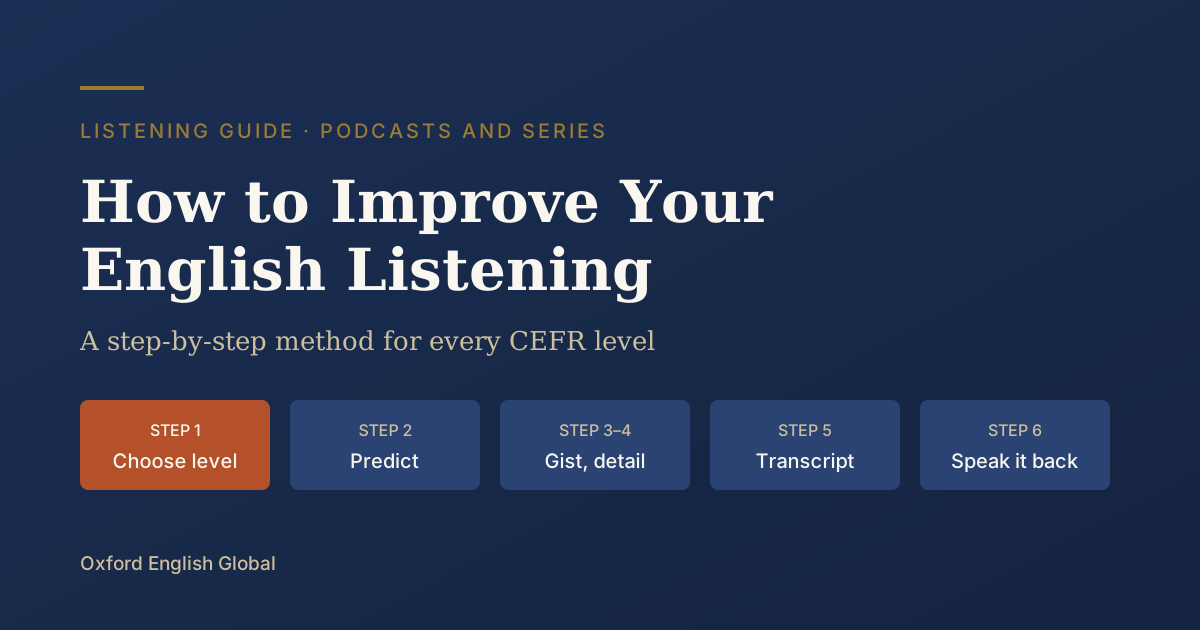
- Steps 2–6: A 30-minute active listening session
- How to use subtitles without depending on them
- A weekly listening plan
- Adjusting the method for your level
- Common mistakes that slow listening progress
- How to know your listening is improving
- What this article cannot tell you
The fastest way to improve your English listening is to choose podcasts and series you can already understand most of, and then work through short sections of them actively: predict, listen for the main idea, listen again for detail, check the transcript, and repeat what you heard aloud. Hours of background listening help a little. Twenty or thirty focused minutes a day, on material at the right level, help much more. This guide gives you a step-by-step method: how to pick the right podcast or series for your level, what to do in each listening session, how to use subtitles without depending on them, and how to build a weekly plan you can keep.
Checked on 9 November 2026. The level descriptions on this page come from the Council of Europe's CEFR Companion Volume (2020). The research figures come from peer-reviewed studies: Webb and Rodgers (2009) on the vocabulary demands of television programmes, van Zeeland and Schmitt (2013) on lexical coverage in listening, Vandergrift and Tafaghodtari (2010) on teaching learners how to listen, and Mitterer and McQueen (2009) on subtitles and foreign speech perception. Research findings are averages from specific groups of learners. Your own results will vary.
Why English listening feels harder than reading
Many adult learners can read an article comfortably but lose the thread of a podcast on the same topic. That is normal, and it happens for three reasons.
- Speech does not wait for you. When you read, you can slow down and reread. When you listen, the next sentence arrives before you have finished processing the last one.
- Words change shape in connected speech. In natural English, sounds join, shorten and disappear. "Do you want to" can sound like "d'you wanna", and "next day" loses the t. You may know every word on paper and still not recognise it at speed.
- You cannot see where words begin and end. Writing has spaces between words. Speech is a continuous stream, and your brain has to cut it into words using what it already knows about English.
The good news is that all three problems respond to practice. The method below targets each one: material at the right level reduces the processing load, repeated listening helps you notice connected speech, and transcripts show you where the word boundaries were.
Step 1: Choose material at the right level
The single most important decision is what you listen to. If the material is too hard, you understand so little that there is nothing to learn from. If it is too easy, you are relaxing, not improving.
How much vocabulary you need
Researchers measure this with lexical coverage: the percentage of words in a text that a listener already knows. Van Zeeland and Schmitt (2013) found that around 95% coverage was enough for adequate listening comprehension of informal spoken texts, which they estimated means knowing roughly 2,000 to 3,000 word families. For television, Webb and Rodgers (2009) analysed a large set of programmes and found that the most frequent 3,000 word families, plus proper nouns and marginal words such as "um" and "oh", gave 95.45% coverage. Reaching 98.27% coverage required the most frequent 7,000 word families.
In practice, 95% coverage still means about one unknown word in every twenty. That is why even intermediate learners find TV series demanding, and why learner podcasts, which use more controlled vocabulary, are a better starting point for many people.
The 60-second test
You do not need a vocabulary test to check a podcast or episode. Use this quick check instead:
- Play one minute from the middle of an episode, once, at normal speed, with no subtitles.
- Say in one sentence what the speakers were talking about.
- Count roughly how many words or phrases blocked you.
| Result after 60 seconds | What it means | What to do |
|---|---|---|
| You can summarise it and only a few words were unclear | Right level for active study | Use it with the session method below |
| You got the topic but lost several sentences | Challenging but usable | Use short sections (2–3 minutes) and the transcript |
| You cannot say what it was about | Too hard for now | Choose a learner podcast or an easier genre |
| You understood almost everything without effort | Good for enjoyment and fluency | Keep it for relaxed listening; find something harder for study |
What each CEFR level can usually handle
The Council of Europe's CEFR Companion Volume describes what learners can understand from audio and video at each level. These descriptors are a useful guide when choosing material:
| Level | Official CEFR descriptor (Watching TV, film and video) | Good material to start with |
|---|---|---|
| A2 | "Can identify the main point of TV news items reporting events, accidents, etc. where the visuals support the commentary." | Short learner podcasts with transcripts; very short videos with strong visuals |
| B1 | "Can follow many films in which visuals and action carry much of the storyline, and which are delivered clearly in straightforward language." | Learner podcasts at natural speed; sitcoms and dramas with clear plots |
| B2 | "Can understand documentaries, live interviews, talk shows, plays and the majority of films in the standard form of the language or a familiar variety." | Podcasts made for native speakers on familiar topics; most series |
| C1 | "Can follow films employing a considerable degree of slang and idiomatic usage." | Fast, unscripted shows; strong regional accents; comedy |
Source: Council of Europe, CEFR Companion Volume (2020), "Watching TV, film and video" scale, read 9 November 2026.
Not sure of your level? Our free English level test explains each CEFR level in can-do terms.
Podcasts or series: which to use for what
Podcasts and series train different parts of listening. Using both is better than using only one.
| Podcasts | Series and films | |
|---|---|---|
| Visual support | None. You rely only on sound, which is closer to phone calls and meetings. | Faces, actions and settings help you guess meaning. |
| Transcripts | Many learner podcasts publish them. Native podcasts sometimes do. | Subtitles are almost always available. |
| Speech style | Often conversation or explanation; clear topic structure. | Short, fast, emotional lines; overlapping speech; more slang. |
| Best for | Following longer explanations and discussions; work and study English | Everyday spoken English, humour, reactions, informal phrases |
| Easy to fit into your day | Yes: commute, walking, housework | Needs a screen and attention |
For choosing specific shows, our list of the best podcasts for language learning sorts English podcasts by level. A reliable starting point for lower levels is BBC Learning English's 6 Minute English, which offers free downloadable transcripts and worksheets with its episodes. The British Council's LearnEnglish listening section organises free practice activities by level from A1 to C1.
Choosing a series
- Pick a genre you already know in your own language. If you know how a crime drama or a workplace comedy usually works, you can predict more and understand more.
- Prefer many short episodes over a few long films. Repeated characters, settings and vocabulary make each episode easier than the last.
- Start with one accent. Switching between strong regional accents too early makes everything harder. Add new accents once your main one feels comfortable.
- Choose a series you have already watched in your language, if you are at A2 or low B1. Knowing the story frees your attention for the English.
Steps 2–6: A 30-minute active listening session
Active listening means you have a task while you listen. The steps below follow a process-based approach studied by Vandergrift and Tafaghodtari (2010). Over one semester, the experimental group in their study (59 learners) practised listening through a cycle of prediction and planning, monitoring, evaluating and problem solving, and made greater gains than a control group. Less skilled listeners gained more than skilled ones, which suggests the approach is especially useful if listening is your weak skill.
Use a section of 2 to 5 minutes. Short is better than long.
- Step 2: Predict (2 minutes). Read the episode title or description. Write down what you expect to hear and five words you think will come up. Prediction prepares your brain to recognise words when they arrive.
- Step 3: Listen for the main idea (5 minutes). Play the section once without stopping and without subtitles or transcript. Then write one or two sentences: what was it about, and what did the speakers think? Check your predictions. Do not rewind yet.
- Step 4: Listen for detail (8 minutes). Write three questions you want answered (who, what happened, why, what number or date). Listen again and answer them. You can pause and replay short parts as often as you like.
- Step 5: Check with the transcript or subtitles (8 minutes). Listen a third time while reading along. Mark every place where what you heard was different from what was said. These gaps are the most valuable part of the session: they show you which sounds, linked words and contractions your ear is missing. Note four to six useful phrases, not single words. Our guide to learning vocabulary in chunks explains why phrases stick better.
- Step 6: Speak it back (7 minutes). Choose two or three sentences you missed and shadow them: play one sentence, pause, and repeat it aloud with the same rhythm and stress. Then close the transcript and retell the section in your own words for one minute, using at least two of your new phrases.
The transcript is a check, not a crutch. Always listen at least once without it first. If you read from the start, you are practising reading with sound in the background, which is a much easier skill and not the one you want to train.
How to use subtitles without depending on them
Subtitles can help or hurt your listening, depending on which language they are in and when you use them.
Mitterer and McQueen (2009) tested Dutch listeners watching English-language video in unfamiliar regional accents (Scottish and Australian English). Listeners who watched with English subtitles adapted better to the accent afterwards. Listeners who watched with Dutch subtitles adapted less well than those who watched with no subtitles at all. The researchers' explanation is that English subtitles show you which words, and so which sounds, are being spoken, while subtitles in your own language give you the meaning but nothing about the sounds.
A practical approach based on this:
| Your level | Subtitle strategy |
|---|---|
| A2 to low B1 | English subtitles on for a first watch. Then rewatch one short scene with subtitles off. |
| B1 to B2 | Watch scenes first with subtitles off, then turn English subtitles on to check what you missed. |
| B2 and above | Subtitles off by default. Use English subtitles only for difficult accents, fast scenes or to check specific phrases. |
| Any level | Avoid subtitles in your own language when the goal is listening practice. Keep them for pure entertainment. |
A weekly listening plan
Regular short sessions are easier to keep than occasional long ones. This plan uses about three hours a week. Adjust the times to your schedule, but keep the mix of active and relaxed listening.
| Day | Activity | Time |
|---|---|---|
| Monday | Active session with a podcast (steps 2–6) | 30 min |
| Tuesday | Relaxed listening: an easy podcast on your commute or walk | 20–30 min |
| Wednesday | Active session with one series scene (steps 2–6, subtitles off first) | 30 min |
| Thursday | Dictation: write down 60 seconds of audio word for word, then compare with the transcript | 20 min |
| Friday | Active session with a podcast | 30 min |
| Weekend | Watch one or two episodes for enjoyment, English subtitles allowed. Review your phrase notes from the week. | 45–60 min |
Dictation deserves a special mention. It is slow and a little uncomfortable, but it shows you exactly where your listening breaks down: missing small words such as articles and prepositions, unrecognised contractions, or words you know but did not hear. Many learners find that their "fast English" problem is really a handful of connected-speech patterns they can learn.
Adjusting the method for your level
A2: build confidence with short, clear audio
Use episodes of five to ten minutes made for learners. Work with one or two minutes at a time. It is fine to read the transcript before your second listen. Focus on catching numbers, names, times and the main topic.
B1: move from learner audio to natural speed
Mix learner podcasts with one native-speaker podcast on a topic you know well, such as your job or a hobby. Start series with clear storylines. The full three-listen cycle works well at this level. If you are working mainly on B1 skills, our B1 listening and reading guide has more detail, including exam-style tasks.
B2: widen accents, speed and topics
Move most of your listening to material made for native speakers: interviews, discussion podcasts, documentaries. Add one new accent at a time. Spend more of each session on step 5, where you collect natural phrases and notice how speakers signal opinions and changes of topic.
C1: focus on what is not said directly
Choose fast, unscripted conversation, comedy and shows with strong regional varieties. In step 4, ask questions about attitude and implied meaning: Was that sarcastic? Does the speaker really agree? This is the skill the CEFR describes at C1 as understanding "nuances and implied meaning".
Common mistakes that slow listening progress
- Only listening in the background. Relaxed listening keeps you in contact with English, but without some active sessions the same gaps never close.
- Choosing material far above your level. If you understand only the topic and a few words, you are not getting enough comprehensible input to learn from. Go down a level.
- Using long episodes for study. A 40-minute episode is fine for enjoyment. For active practice, work on 2 to 5 minutes.
- Reading subtitles in your own language. You follow the story, but your ear learns little about English sounds.
- Collecting single words. Note whole phrases with their context, such as "it turns out that" or "I'm not really into", so you can recognise and use them.
- Never speaking. Shadowing and retelling turn what you hear into language you can produce. If speaking is your next goal, see our guide on how to improve your English speaking.
How to know your listening is improving
Listening progress is slow to notice day by day. Use simple checks every four to six weeks:
- Repeat the 60-second test on a podcast that was "too hard" a month ago. Can you now summarise it?
- Compare dictation results. Count the mistakes in a one-minute dictation and compare with your first attempt at a similar recording.
- Track subtitles. Note how many scenes you can now watch with subtitles off, or how often you need to check them.
- Notice the real world. Can you follow a work call, a video at normal speed or a conversation between two speakers that you could not follow before?
If you want guided practice with feedback, our English courses cover all four skills for adults, and the free lesson library has listening practice you can start today.
What this article cannot tell you
- How fast you personally will improve. The research figures above describe groups of learners in specific studies. Your progress depends on your starting level, how much you practise and the material you choose.
- Exactly which podcast or series suits you. We give a method for choosing, not a guarantee that any particular show is right for your level or interests.
- Exam scores. This method builds general listening ability. Exams such as IELTS or TOEFL also test specific task types, so you will need practice with official materials before a test.
- Hearing or processing difficulties. If you find listening hard in your own language too, speak to a qualified professional. This article does not cover that situation.
This page is independent guidance from Oxford English Global. It contains no affiliate links, and we receive nothing from any podcast, broadcaster, streaming service or publisher mentioned.
Frequently asked questions
What is the fastest way to improve English listening?
Choose podcasts or series you can already mostly understand, and work through short sections of 2 to 5 minutes actively: predict the content, listen once for the main idea, listen again for detail, check the transcript, then repeat key sentences aloud. Twenty to thirty focused minutes most days usually does more than hours of background listening.
How do I know if a podcast or series is at my level?
Play one minute from the middle of an episode, once, without subtitles. If you can say in one sentence what it was about and only a few words were unclear, it is right for active study. If you cannot say what it was about, choose something easier. Research by van Zeeland and Schmitt (2013) suggests that knowing about 95% of the words is enough for adequate listening comprehension.
Should I watch English series with subtitles?
Use English subtitles, not subtitles in your own language. A 2009 study by Mitterer and McQueen found that English subtitles helped listeners adapt to unfamiliar accents, while native-language subtitles made adaptation worse. From about B1, watch a scene first without subtitles, then turn English subtitles on to check what you missed.
Are podcasts or TV series better for listening practice?
They train different things, so use both. Podcasts have no visual support, which is closer to phone calls and meetings, and many learner podcasts publish transcripts. Series give you visual clues and everyday spoken English, including fast, informal and emotional speech. A good weekly plan mixes active sessions with both.
How long does it take to improve English listening?
There is no fixed time, because it depends on your level, the material and how often you practise actively. Check your progress every four to six weeks by repeating a one-minute test on a podcast that was too hard before, or by comparing short dictation results. Progress is often hard to notice day by day but clear over a month or two.