
Oxford Word of the Year 2026 Shortlist: Doomerism, Microdrama, Post-Literate and Slopaganda Explained
Oxford University Press has shortlisted four words for its Word of the Year 2026: doomerism, microdrama, post-literate and slopaganda. Here is what each word means, how to use it naturally, and how the public vote works before the winner is announced on 1 December.

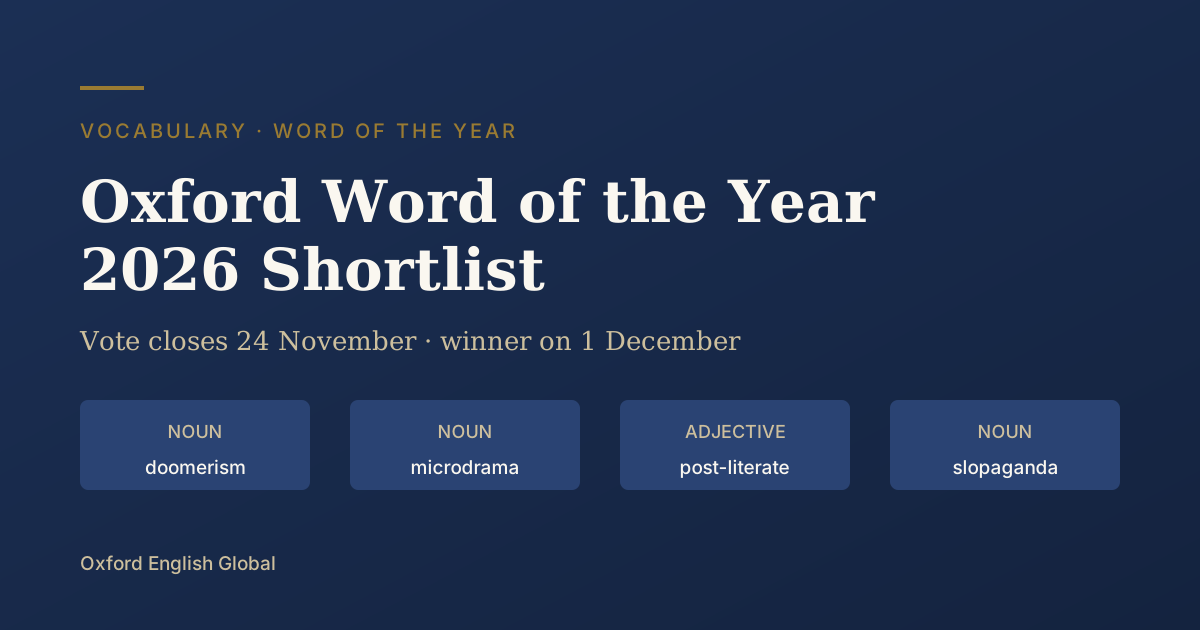
- The Oxford Word of the Year 2026 shortlist at a glance
- Doomerism: extreme pessimism about the future
- Microdrama: very short vertical drama series
- Post-literate: when reading loses its importance
- Slopaganda: AI-made propaganda
- How public voting works, and when the winner is announced
- What the shortlist teaches about English word building
- How to use these words in speaking and writing
- Practice: choose the right word
- What this article cannot tell you
The Oxford Word of the Year 2026 shortlist, announced by Oxford University Press on 17 November 2026, has four words: doomerism, microdrama, post-literate and slopaganda. The public can vote for a favourite until 11.59pm GMT on Tuesday 24 November 2026, and Oxford will announce the winner on 1 December 2026, after its language experts combine the votes with their own analysis of a 32-billion-word corpus. All four words say something about how technology, especially AI and short-form video, is changing the way people read, watch and feel about the future. This guide explains what each word means in plain English, shows how to use it in a natural sentence, and explains how the vote works.
Sources and date. Written on 20 November 2026. The shortlist, the definitions, the voting deadline and the announcement date come from Oxford University Press's own announcement, "Shortlist unveiled for Oxford Word of the Year 2026" (17 November 2026), which we read on 20 November 2026. Voting takes place on the Oxford Word of the Year page. The example sentences are our own.
The Oxford Word of the Year 2026 shortlist at a glance
Oxford Languages, part of Oxford University Press (OUP), chooses a Word of the Year each year. It is a word or expression that, in the publisher's view, reflects the mood, ideas or concerns of that year. In 2026 OUP's experts first analysed their corpus, a very large collection of real English from news, websites and other sources, and then picked four candidates.
| Word | Part of speech | Oxford's definition (summarised) | Register |
|---|---|---|---|
| doomerism | noun | Extreme pessimism, especially the belief that catastrophic damage from a threat such as AI or climate change is inevitable | Neutral; common in journalism and opinion pieces |
| microdrama | noun | A drama series of very short, vertical episodes made for smartphones, usually with a melodramatic, fast-moving plot | Neutral; media and business English |
| post-literate | adjective | Describing a period or society in which literacy and the importance of the written word have declined significantly | Formal; academic and opinion writing |
| slopaganda | noun | Low-quality propaganda made with generative AI and spread widely online, especially on social media | Informal, critical; journalism and online discussion |
OUP describes 2026 as "a year of uncertainty and existential self-reflection", with public debate focused on how AI is affecting communication, creativity and "what it truly means to be human". Cambridge Dictionary chose a similar theme for its own 2026 choice: see our article on Cambridge Dictionary's Word of the Year, "human".
Doomerism: extreme pessimism about the future
Meaning: doomerism is the attitude that something very bad is going to happen and that nothing can be done to stop it. Oxford's definition mentions artificial intelligence and climate change as typical examples of the threats people feel this way about.
How the word is built: doom (a terrible fate) + -er (a person) + -ism (a belief or attitude). A person with this attitude is a doomer. The suffix -ism is very productive in English: optimism, pessimism, realism.
- There's a lot of doomerism about AI, but most experts I spoke to were cautiously optimistic.
- Climate doomerism can make people give up instead of taking action.
- Stop being such a doomer; the project isn't finished yet.
Common collocations: climate doomerism, AI doomerism, push back against doomerism, a wave of doomerism.
Register: neutral enough for articles and essays. It usually carries a mild criticism: calling someone's view "doomerism" suggests it is too negative.
Microdrama: very short vertical drama series
Meaning: a microdrama is a TV-style series made for a phone screen. Each episode is very short and filmed in a vertical (portrait) format, and the plot is usually dramatic and fast, with frequent cliffhangers to make you watch the next episode.
How the word is built: the prefix micro- (very small) + drama. You already know this pattern from microwave, microchip and micromanage.
- I only meant to watch one microdrama episode, but I watched forty on the bus.
- Studios are investing heavily in microdramas because they're cheap to produce.
Grammar note: microdrama is a countable noun: a microdrama, two microdramas. It can also work like an adjective before another noun: a microdrama app, the microdrama industry.
For learners: short episodes with simple, emotional plots can be good listening practice, because each one is quick to replay. Turn on English subtitles, pause after key lines and repeat them aloud. Our guide on how to improve your English listening explains how to turn this kind of viewing into real practice.
Post-literate: when reading loses its importance
Meaning: post-literate describes a time or society in which literacy, and the written word in general, has become much less important, for example because people get most of their information from video and audio instead of text.
How the word is built: post- (after) + literate (able to read and write). Compare post-war, post-pandemic and post-truth, which was Oxford's Word of the Year in 2016.
- Some teachers worry that we are moving into a post-literate culture where students rarely read a whole book.
- Is a post-literate society really possible when most jobs still need written communication?
Important: post-literate does not mean that people cannot read. It describes a decline in how much reading and writing matter in a culture. The opposite idea is an illiterate person, who has not learned to read.
Register: formal. It fits well in IELTS Writing Task 2 essays about technology and education, for example: Critics argue that social media is creating a post-literate generation. Our guide to writing a strong opinion essay shows how to build an argument around a word like this.
Slopaganda: AI-made propaganda
Meaning: slopaganda is low-quality propaganda produced with generative AI and spread widely online, especially through social media. Propaganda is information, often false or one-sided, used to influence people's political opinions.
How the word is built: it is a blend (also called a portmanteau) of slop and propaganda. Slop here means low-quality content produced in large amounts by AI; Merriam-Webster chose slop as its 2025 Word of the Year. English often makes new words by blending: brunch (breakfast + lunch), smog (smoke + fog), infodemic (information + epidemic).
- Fact-checkers removed hundreds of slopaganda videos during the election campaign.
- The account posts nothing but AI-generated slopaganda.
Grammar note: it is normally uncountable: a lot of slopaganda, not slopagandas. If you are unsure about this distinction, see our guide to countable and uncountable nouns.
Register: informal and critical. Fine in conversation and in journalism; in a formal essay you might write AI-generated propaganda instead.
How public voting works, and when the winner is announced
Oxford University Press invites the public to "have their say" on the shortlist. Here is the timeline from OUP's announcement:
| Date | What happens |
|---|---|
| 17 November 2026 | Shortlist published and public voting opens |
| 24 November 2026, 11.59pm GMT (6.59pm EST) | Voting closes |
| Late November 2026 | OUP's experts do a final analysis of corpus data, the votes and public discussion |
| 1 December 2026 | The winning word is announced |
Two points are worth knowing. First, the vote is one input, not the only one: OUP says the experts will consider the corpus data, the votes and public discussion together. Second, you vote on the official Word of the Year page. OUP does not describe the exact weighting of the vote, so we cannot say how much a public majority counts.
For context, the Oxford Word of the Year 2025 was rage bait: online content designed to make people angry so that they engage with it.
What the shortlist teaches about English word building
None of the four words is completely new material. Each is built from parts that already exist, which is how most new English words appear. If you learn these patterns, you can often guess the meaning of a new word the first time you see it.
| Pattern | Shortlist example | Other examples you may know |
|---|---|---|
| Suffix -ism (belief, attitude) | doomerism | optimism, consumerism, perfectionism |
| Prefix micro- (very small) | microdrama | microphone, micromanage, microlearning |
| Prefix post- (after) | post-literate | post-war, postgraduate, post-truth |
| Blend of two words | slopaganda | brunch, motel, workaholic |
Learning words in families and chunks is faster than learning isolated words. Our guide to learning English vocabulary in chunks explains the method, and our article on Merriam-Webster's 2026 new words has more examples of blends and new meanings.
How to use these words in speaking and writing
Not all four words suit every situation. Use this as a quick guide:
- In an essay or exam answer: post-literate and doomerism are safe and can impress an examiner when used accurately. Example: Although there is considerable doomerism about automation, history suggests that new technologies also create jobs.
- In a work meeting or presentation: microdrama is a neutral industry term. Example: Microdramas are now a serious marketing channel in several markets.
- In conversation or social media: slopaganda and doomer sound natural and slightly humorous. Example: My feed is full of slopaganda this week.
A useful habit: when you learn a new word, write one sentence about your own life. It makes the word yours. For example: I try not to fall into AI doomerism, because I use AI tools every day for my English practice.
Practice: choose the right word
Complete each sentence with doomerism, microdrama, post-literate or slopaganda.
- The account was banned for posting fake AI images of politicians. It was pure ______.
- Each episode of the ______ lasts about ninety seconds and ends with a cliffhanger.
- Critics claim that short videos are creating a ______ generation that prefers watching to reading.
- His constant ______ about the economy makes team meetings depressing.
Answers: 1. slopaganda 2. microdrama 3. post-literate 4. doomerism
Speaking task: Which word do you think should win, and why? Answer in one minute, using at least two of the four words. You can practise your intonation with our free Speaking Lab.
What this article cannot tell you
- The winner. Oxford will announce the Word of the Year on 1 December 2026. We do not know which word will win, and OUP's experts do not simply follow the public vote.
- The full dictionary entries. We summarise Oxford's shortlist definitions in plain English. The exact wording, pronunciations and first recorded uses are on Oxford's own pages.
- How the vote is weighted. OUP says votes, corpus data and public discussion all inform the final choice, but it does not publish a formula.
- How long the words will last. A Word of the Year reflects one year's mood. Some winners become everyday English; others are soon forgotten.
This page is independent guidance from Oxford English Global. Despite the similar name, we are not part of Oxford University Press or Oxford Languages, and we have no commercial relationship with them. The page contains no affiliate or sponsored links. For structured vocabulary practice, explore our free lessons or our English courses.
Frequently asked questions
What are the words on the Oxford Word of the Year 2026 shortlist?
The shortlist, announced by Oxford University Press on 17 November 2026, has four words: doomerism, microdrama, post-literate and slopaganda.
When is the Oxford Word of the Year 2026 announced?
Oxford University Press says it will announce the winning word on 1 December 2026, after a final analysis of its corpus data, the public votes and public discussion.
How can I vote for the Oxford Word of the Year 2026?
You can vote on Oxford University Press's official Word of the Year page. Voting closes at 11.59pm GMT (6.59pm EST) on Tuesday 24 November 2026.
What does slopaganda mean?
Slopaganda is low-quality propaganda produced with generative AI and spread widely online, especially on social media. It is a blend of slop and propaganda.
What was the Oxford Word of the Year 2025?
The Oxford Word of the Year 2025 was rage bait: online content designed to make people angry so that they engage with it.