
Countable and Uncountable Nouns in English: Rules, Tricky Words and Much, Many, A Lot Of
Countable nouns have a plural and take a or an; uncountable nouns do not. This guide explains the rules with examples, the tricky words learners get wrong, unit words such as a piece of, how to use much, many and a lot of, and a practice exercise.

- What countable and uncountable nouns are
- The grammar differences at a glance
- How to use much, many and a lot of
- Common tricky words: uncountable in English
- How to count uncountable things
- Nouns that can be both countable and uncountable
- A few, a little, fewer and less
- The most common learner mistakes
- Practice: choose the correct word
- How to practise countable and uncountable nouns
- What this article cannot tell you
Countable nouns are things you can count one by one (a book, two books), so they have a singular and a plural form. Uncountable nouns are things English treats as a mass or an idea (water, information, advice), so they have no plural and cannot take a or an. Use many with plural countable nouns, much with uncountable nouns, and a lot of with both. This guide explains the rules with examples, lists the tricky words that are uncountable in English but countable in many other languages, shows how to count uncountable things (a piece of advice, two cups of coffee), and ends with a practice exercise and answers.
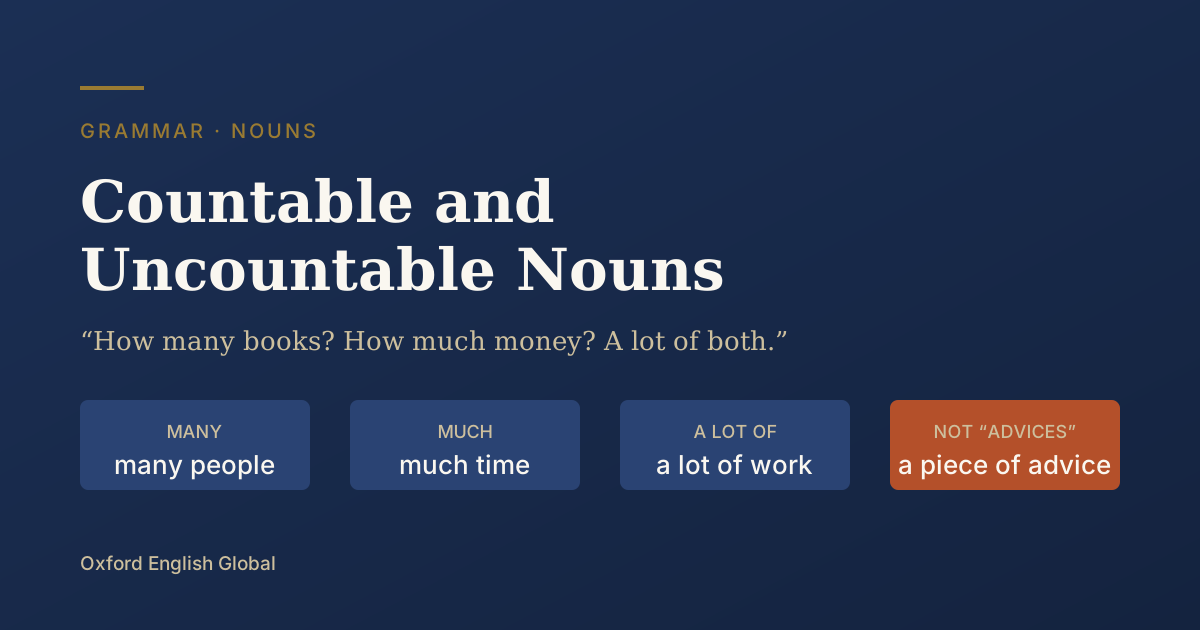
Quick rule: How many books? How much money? A lot of books, a lot of money. If you can put a number directly in front of the noun (three chairs), it is countable. If you need a unit word (three pieces of furniture), it is uncountable.
What countable and uncountable nouns are
A countable noun (also called a count noun) refers to separate items. You can use a number with it, and it has a plural: an apple, three apples; a job, two jobs; a problem, many problems.
An uncountable noun (also called a mass noun or non-count noun) refers to a substance, a material, a mass, or an abstract idea that English does not divide into separate units: water, rice, money, music, happiness, homework. It has no plural form, and it takes a singular verb: The information is correct (not informations are).
The important word is "English". Whether a noun is countable is partly a grammar choice, not only a fact about the world. Rice is made of separate grains, but in English rice is uncountable. In French, informations can be plural; in English, information cannot. That is why learners make mistakes even when they understand the idea.
The Cambridge Grammar of English and good learner dictionaries mark every noun as [C] countable or [U] uncountable. When you are not sure, check the dictionary entry.
The grammar differences at a glance
| Feature | Countable nouns | Uncountable nouns |
|---|---|---|
| Plural form | Yes: a chair, chairs | No: furniture (never furnitures) |
| a / an | Yes, with singular: a chair | No: a furniture is wrong |
| Numbers | Yes: three chairs | Only with a unit: three pieces of furniture |
| Verb | Singular or plural: The chair is / The chairs are | Always singular: The furniture is |
| "How ...?" | How many chairs? | How much furniture? |
| Small quantity | a few, few, fewer | a little, little, less |
| Both types | some, any, a lot of, lots of, plenty of, no, enough, more, most | |
A singular countable noun almost always needs a word in front of it, such as a, the, my, this or every. You cannot say I bought car; you must say I bought a car or I bought the car. Uncountable nouns and plural nouns can stand alone when you talk in general: Money doesn't buy happiness. Cars are expensive. Our guide to a, an and the explains this in detail.
How to use much, many and a lot of
These three are the most useful quantity words, and the rule is simple once you know whether the noun is countable.
| Word | Used with | Most common in | Examples |
|---|---|---|---|
| many | Plural countable nouns | Questions and negatives; also formal positive sentences | How many people came? There aren't many tickets left. Many students work part-time. |
| much | Uncountable nouns | Questions and negatives | How much time do we have? I don't have much money. |
| a lot of / lots of | Both | Positive sentences, everyday speech; also questions and negatives | We have a lot of work. She has lots of friends. Did you spend a lot of money? |
Based on Cambridge Dictionary, Much, many, a lot of, lots of: quantifiers, which notes that lots of is more informal than a lot of.
Why "I have much money" sounds strange
Grammatically, much works with uncountable nouns, but in positive statements in everyday English, speakers normally use a lot of:
- Natural: I have a lot of money.
- Sounds formal or unnatural in speech: I have much money.
- Natural: I don't have much money. / Do you have much money?
Much is normal in positive sentences after too, so, as and very: There's too much sugar in this. I've learned so much. Many is more flexible: Many people think... is common in both speech and writing.
Leaving out the noun
When the noun is obvious, drop it, and drop of after a lot: "How many tickets do you need?" "Not many." "Did it cost much?" "Yes, a lot."
Common tricky words: uncountable in English
These nouns are uncountable in English but often countable in learners' first languages. They cause the most mistakes in writing and in exams.
| Uncountable noun | Wrong | Right | To count it |
|---|---|---|---|
| advice | She gave me an advice. | She gave me some advice. | a piece of advice, a tip, a suggestion |
| information | Two informations | Some information | a piece of information, a detail, a fact |
| news | The news are good. | The news is good. | a piece of news, a news story |
| furniture | New furnitures | New furniture | a piece of furniture, a chair, a table |
| equipment | Equipments | Equipment | a piece of equipment, a tool, a machine |
| luggage / baggage | Three luggages | Three bags / three pieces of luggage | a suitcase, a bag, an item of luggage |
| homework | Many homeworks | A lot of homework | an exercise, an assignment, a task |
| research | Researches show... | Research shows... | a study, a research project |
| knowledge | Knowledges | Knowledge | (often: a good knowledge of; see below) |
| progress | A progress | Progress | a step forward, an improvement |
| work | I have a work. | I have a job. / I have work. | a job, a task, a project |
| traffic | Many traffics | A lot of traffic | a car, a vehicle, a traffic jam |
| accommodation (British English) | Accommodations | Accommodation | a room, a flat, a place to stay |
| software | Softwares | Software | a program, an app, a software package |
| vocabulary | Vocabularies | Vocabulary | a word, a phrase, an expression |
Cambridge Dictionary has separate usage notes on several of these, for example advice, information and research. In American English, accommodations (plural) is common.
Many of these appear in our list of 20 common English grammar mistakes, because they are among the errors teachers correct most often.
How to count uncountable things
To count an uncountable noun, put a countable "unit" word in front of it with of. Learning these as fixed phrases (chunks) is the fastest way to use them naturally; see our guide to learning vocabulary in chunks.
| Unit | Used with | Examples |
|---|---|---|
| a piece of | Many general and abstract nouns | a piece of advice, a piece of information, a piece of furniture, a piece of cake |
| a cup / glass / bottle of | Drinks and liquids | a cup of tea, a glass of water, a bottle of oil |
| a slice of | Food that you cut | a slice of bread, a slice of pizza |
| a bag / packet / box of | Food and materials | a bag of rice, a packet of pasta, a box of cereal |
| a kilo / litre / metre of | Measures | a kilo of flour, two litres of milk |
| an item of / an article of | Formal: clothing, news, luggage | an item of clothing, an article of clothing |
| a sheet of | Paper and flat materials | a sheet of paper, a sheet of glass |
| a bar of | Solid blocks | a bar of chocolate, a bar of soap |
| a drop of / a bit of | Small amounts (a bit of is informal) | a drop of milk, a bit of help |
The unit word becomes plural, not the uncountable noun: two pieces of advice (not two piece of advices), three cups of coffee.
Nouns that can be both countable and uncountable
Many nouns change meaning depending on whether they are countable. This is normal, not an exception to memorise word by word.
| Noun | Uncountable meaning | Countable meaning |
|---|---|---|
| coffee / tea / beer | The drink in general: I don't drink coffee. | A cup or glass of it: Two coffees, please. |
| chicken / fish / lamb | The meat: We had chicken for dinner. | The animal: She keeps three chickens. |
| time | Time in general: I don't have much time. | Occasions: I've been there three times. |
| experience | Knowledge from doing something: She has a lot of experience. | Events: It was an amazing experience. |
| paper | The material: a sheet of paper | A newspaper or document: I bought a paper. She wrote a paper on AI. |
| room | Space: Is there room for one more? | Part of a building: The flat has three rooms. |
| hair | All the hair on your head: She has long hair. | Single hairs: There's a hair in my soup! |
| business | Commercial activity: Business is good. | A company: He runs two businesses. |
| light | Brightness: There isn't enough light. | A lamp: Turn off the lights. |
Some abstract uncountable nouns take a when an adjective or phrase describes a particular kind: a good education, a deep knowledge of history, a strong interest in art. You still cannot make them plural in normal use.
A few, a little, fewer and less
- a few + plural countable: I have a few questions. (some, a small number; positive)
- few + plural countable: Few people came. (not many; sounds negative)
- a little + uncountable: I speak a little Spanish. (some; positive)
- little + uncountable: There is little hope. (not much; negative, formal)
- fewer + plural countable: fewer cars, fewer mistakes
- less + uncountable: less traffic, less time
In everyday speech, many native speakers say less people, but in exams and formal writing, use fewer with countable nouns.
The most common learner mistakes
- Adding -s to an uncountable noun: advices, informations, furnitures, homeworks. Fix: use some or a unit word.
- Using a / an with an uncountable noun: a good news, an advice. Fix: some good news, a piece of advice.
- Plural verb with an uncountable noun: The news are..., The money are.... Fix: singular verb.
- much with plural nouns: How much people...? Fix: How many people?
- many with uncountable nouns: many traffic, many time. Fix: a lot of traffic, much time.
- "much" in positive speech: I have much work. Fix: I have a lot of work.
- Missing article with singular countable nouns: She is teacher. Fix: She is a teacher.
Practice: choose the correct word
Choose the correct option. Answers are below.
- Can you give me some (advice / advices) about my CV?
- How (much / many) languages do you speak?
- The news (is / are) on at six o'clock.
- We don't have (much / many) time before the meeting.
- I bought two (bread / loaves of bread).
- There were (a lot of / much) people at the concert.
- She has (a / no article) good knowledge of European history.
- I've made (less / fewer) mistakes in this essay.
- Our office needs new (furniture / furnitures).
- Would you like (a coffee / a coffees)?
Answers
1 advice. 2 many. 3 is. 4 much. 5 loaves of bread. 6 a lot of. 7 a. 8 fewer. 9 furniture. 10 a coffee.
How to practise countable and uncountable nouns
- Learn nouns with a partner word. Do not learn advice; learn some advice / a piece of advice. Do not learn chair; learn a chair.
- Check the dictionary label. Look for [C] or [U] every time you meet a new noun you will use.
- Proofread for the top ten. Before you submit an essay or email, search it for advice, information, news, research, equipment, furniture, homework, work, knowledge, progress.
- Read a lot. You absorb patterns like a lot of traffic by meeting them many times; see learning vocabulary through reading.
- Get feedback. A teacher will catch the mistakes you cannot see yourself. Our courses include writing correction, and our free lessons and free grammar PDF give extra practice.
What this article cannot tell you
- Every noun. English has thousands of nouns, and some are countable in one meaning and uncountable in another. Use a learner dictionary for individual words.
- Every variety of English. Usage differs between British and American English in a few cases, such as accommodation. See British vs American English.
- Specialist uses. In science, business and cooking, uncountable nouns are sometimes used in the plural to mean "types of" (French wines, new materials, local cheeses). Check a dictionary before you use these in exams.
- Your personal mistakes. Only feedback on your own writing and speaking shows which patterns you need to work on.
Frequently asked questions
What is the difference between countable and uncountable nouns?
Countable nouns are things you can count one by one, so they have a plural and can take a or an. Uncountable nouns are treated as a mass or idea, so they have no plural and take a singular verb.
When do I use much and many?
Use many with plural countable nouns (many people) and much with uncountable nouns (much time). In positive sentences, a lot of usually sounds more natural for both.
Is advice countable or uncountable?
Advice is uncountable. Say some advice or a piece of advice, never an advice or advices.
Is news singular or plural?
News is uncountable and takes a singular verb: The news is good.
Can a noun be both countable and uncountable?
Yes. Many nouns change meaning: coffee (the drink) and a coffee (a cup of it), time and three times, paper and a paper.