
Cambridge Dictionary's Word of the Year 2026 Is 'Human': Meanings, Uses and New Words
Cambridge Dictionary has chosen human as its Word of the Year for 2026, as AI changes how we talk about people and machines. Here is what was announced, the meanings and collocations of human you will actually use, the human/humane/humanity word family, and how to use this year's new words, such as aura farming and looksmaxxing, without sounding odd.

- What Cambridge Dictionary announced
- Why an old word was chosen
- The meanings of "human" you should know
- Human, humane, humanity: the word family
- Useful collocations and compounds
- New words added in 2026 and how to use them
- How new words get into a dictionary
- Practice: choose the right word
- What this article cannot tell you
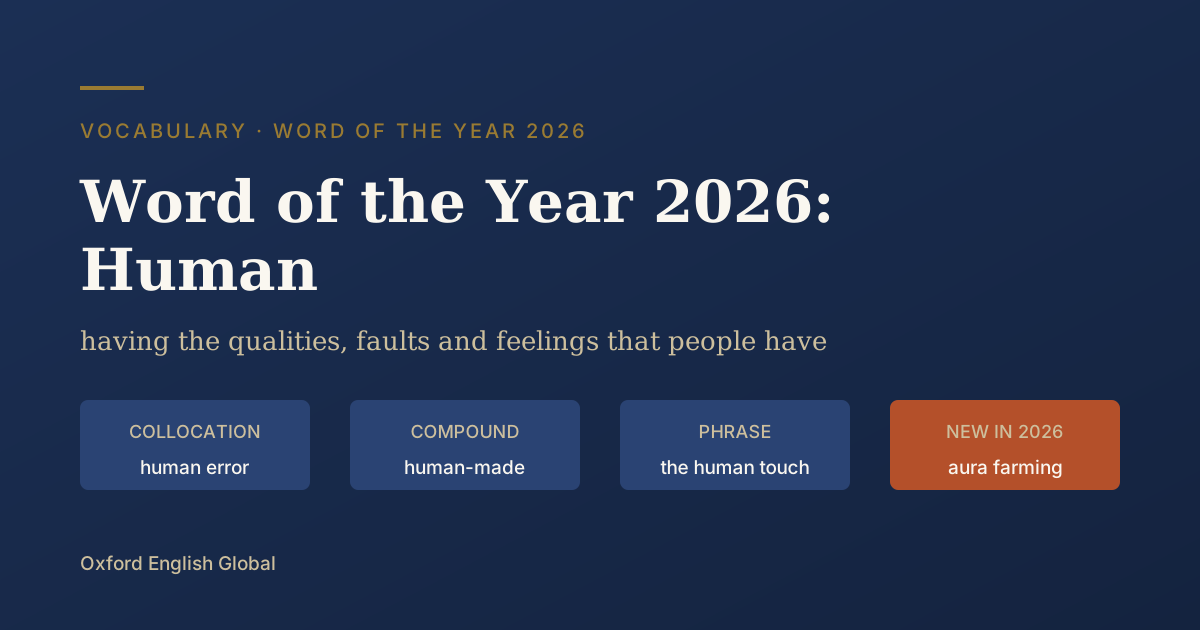
Cambridge Dictionary has named human its Word of the Year for 2026. The dictionary defines the adjective as "having the qualities, faults, and feelings that people have, as opposed to gods, animals, or machines", and says it chose the word because 2026 was shaped by debates about what it means to be human as artificial intelligence blurs the line between people and machines. It also added new words to the dictionary this year, including aura farming, looksmaxxing and air jail. For English learners, the announcement is a useful lesson in two things: how a very old, very common word can take on new uses, and how new slang enters a standard dictionary. This guide explains the choice, teaches the meanings and collocations of human that you will actually use, and shows how to use this year's new words correctly, including when not to use them.
Sources and date. This article was written on 18 November 2026, the day after the announcement was first reported. The facts about the Word of the Year, the shortlist and the new words come from reporting by CNN, The Guardian and the BBC, which quote Cambridge Dictionary's statement. Dictionary definitions are quoted from those reports. You can check the current entries yourself on the Cambridge Dictionary website.
What Cambridge Dictionary announced
Each year, Cambridge Dictionary, which is published by Cambridge University Press & Assessment, picks one word that it says captures the year. For 2026 it chose human. According to the reports, the key points of the announcement were:
- The word: human, defined as "having the qualities, faults, and feelings that people have, as opposed to gods, animals, or machines".
- The reason: the dictionary said the year had been "defined by global debates on what it means to be human when AI is blurring the boundaries between people and machines" (quoted by CNN).
- The language change behind it: Colin McIntosh of Cambridge Dictionary said that "a recent increase in compounds such as 'human-made' highlight how the word has come to distinguish works or qualities of people, as distinct from AI". The BBC quotes him saying that the growth of AI means it is now necessary to say human explicitly "for things that once could only be done by humans".
- Other contenders: The Guardian reports that the shortlist included agent (an AI system that can act without direct human control) and wholesome, along with another tech-related word about non-digital activities.
- New entries: words added to the dictionary this year include aura farming, looksmaxxing and air jail.
Other dictionaries choose differently. Collins, for example, named mogging (to outperform or outshine someone) as its 2026 word of the year, as reported by The Guardian. Words of the year are editorial choices, not official rankings of the most-used word.
Why an old word was chosen
Most words of the year are new or newly popular: Cambridge's recent choices were hallucinate (2023), manifest (2024) and parasocial (2025). Human is different. It entered English in the Middle Ages from French and is one of the most basic words in the language. So what changed?
The change is in how and when people need the word. Before AI tools could write, draw and talk, nobody needed to say "a human-written email" or "speak to a human". Every email was written by a person. Now the contrast matters, so the word appears in new places:
| Older, neutral use | Newer use that contrasts people with AI |
|---|---|
| the human body | human-made art, human-written content |
| human rights | a human in the loop (a person who checks an AI system's decisions) |
| human history | Can I speak to a human? (to a chatbot or automated phone line) |
| human nature | the human touch (what people add that machines cannot) |
The BBC also reports McIntosh's point that man was once used in the general sense of "people", but that this is no longer acceptable, which is another reason human and humans have become more common. This is a good example of something every learner should know: a word's meaning stays stable, but its frequency and typical contexts change with society.
The meanings of "human" you should know
Human works as both an adjective and a noun. Here are the uses that matter most for everyday English.
1. Human (adjective): relating to people
- The accident was caused by human error, not a technical fault.
- Water is essential for human life.
- The report looks at the human cost of the war.
2. Human (adjective): showing normal feelings and weaknesses
This is the sense in the Word of the Year definition: having "qualities, faults, and feelings". We often use it to forgive mistakes.
- Don't be so hard on yourself. You forgot one meeting. You're only human.
- It's only human to feel nervous before an exam.
- The interview showed a more human side of the CEO.
3. Human (noun): a person
- Dogs can understand some human gestures. (adjective)
- Humans have lived in this valley for 10,000 years. (noun)
In everyday conversation, person and people are usually more natural than a human and humans. We say She's a kind person, not She's a kind human (although the second is sometimes used humorously online). Humans is common when comparing people with animals or machines.
4. Human being
Human being is a slightly more formal or emphatic noun: Treat every customer as a human being, not a ticket number.
Human, humane, humanity: the word family
Several related words look similar but have different meanings. Learners often confuse human and humane.
| Word | Part of speech | Meaning | Example |
|---|---|---|---|
| human | adjective / noun | relating to people; a person | human error, the human voice |
| humane | adjective | kind; not causing unnecessary suffering | humane treatment of animals |
| humanity | noun | (1) all people; (2) kindness and understanding | a crime against humanity; she treated them with humanity |
| humankind | noun | all people (neutral alternative to mankind) | the history of humankind |
| humanities | plural noun | subjects such as history, literature and philosophy | She teaches humanities at university. |
| humanitarian | adjective | helping people who are suffering | humanitarian aid |
| dehumanise (UK) / dehumanize (US) | verb | to treat someone as less than a person | The system dehumanises patients. |
Stress also moves: HUman, huMANE, huMANity. Saying humane with the stress on the first syllable is a common learner mistake. You can hear each word on the Cambridge Dictionary site, and our guide to improving your pronunciation at home explains how to practise word stress.
Useful collocations and compounds
Words are easier to use when you learn them in groups that often go together. Our guide to learning vocabulary in chunks explains why. Here are high-value chunks with human:
| Chunk | Meaning | Example |
|---|---|---|
| human error | a mistake made by a person | Most data leaks start with human error. |
| human nature | the way people typically behave | It's human nature to want approval. |
| human rights | basic rights every person has | The charity campaigns for human rights. |
| human resources (HR) | the department that manages staff | Send your CV to human resources. |
| the human touch | personal warmth that machines lack | Customers still value the human touch. |
| human-made | made by people (not by nature or AI) | a human-made lake; human-made music |
| human-written / human-created | written or created by a person | All our lessons are human-written. |
| human in the loop | a person who checks or approves an automated decision | Loan decisions keep a human in the loop. |
| to be only human | to make normal mistakes | I'm only human, I need a break. |
Tip. When you read about AI in the news this year, look for human and note the word before or after it. You will collect real collocations quickly. Our guide to growing your vocabulary through reading shows a simple system for noting and reviewing them.
New words added in 2026 and how to use them
Cambridge Dictionary adds new words when there is enough evidence that people use them. The three below were highlighted in this year's coverage. Definitions are quoted from CNN's report of the dictionary's entries.
Aura farming
Definition: "the activity of doing things with the intention of showing a personality that people admire and think is attractive and interesting".
- He wore sunglasses indoors all night. Total aura farming.
- Is she really that calm, or is it just aura farming for the cameras?
Register: informal, social-media slang. Often slightly mocking. Use it with friends; avoid it in work emails or exams.
Looksmaxxing
Definition: "the activity of making yourself as physically attractive as possible, as encouraged by some people, mainly young men, on social media".
- The documentary looks at the looksmaxxing trend and its effect on teenagers.
Register: informal and often critical. Newspapers use it when reporting on online culture. Spelling varies in the media (looksmaxing / looksmaxxing); the double-x form is the one quoted from the dictionary.
Air jail
Definition: "a method of trying to train an animal, especially a dog, that involves holding them off the ground for a period of time when they show aggressive or other unwanted behaviour".
- Many trainers criticise air jail as a punishment.
Register: neutral but specialised. You will mainly see it in discussions about dog training.
How to treat new slang as a learner
- Understand it first, use it later. Recognising new slang helps you follow social media and news. Using it yourself is optional and risky until you know the tone.
- Check the register. A dictionary entry does not make a word formal. Most new words begin as informal.
- Expect it to age. Some new slang disappears within a few years. Our list of common English idioms also flags expressions that now sound old-fashioned.
How new words get into a dictionary
Learners sometimes think dictionaries decide which words are "allowed". In fact, modern dictionaries describe how people already use the language. Editors look for evidence that a new word is used by many different people, in many different places, over a period of time, and not just in one viral post. Only then is it added, with a definition and a label showing its register, such as informal.
This has two practical lessons for you:
- A word in the dictionary is not automatically suitable for every situation. Always check the label. Aura farming is in the dictionary, but it would sound strange in a job application.
- Common words change too. As human shows, the biggest changes are often new uses and new combinations of familiar words, not brand-new words. Paying attention to collocations keeps your English current.
Practice: choose the right word
Complete each sentence with human, humane, humanity, human-made or only human.
- The chatbot couldn't help, so I asked to speak to a ______.
- Animal welfare groups want more ______ farming methods.
- Don't worry about the typo. You're ______.
- The gallery only shows ______ art, not AI images.
- The volunteers treated every refugee with great ______.
- The crash was caused by ______ error.
Answers: 1. human 2. humane 3. only human 4. human-made 5. humanity 6. human
Speaking task: Answer this question aloud for one minute: Which jobs do you think should always have a human in the loop, and why? Record yourself and check that you stressed HUman correctly. Our free Speaking Lab can help you check intonation.
What this article cannot tell you
- The full list of new words. Cambridge Dictionary adds many words through the year. We describe only the ones highlighted in news coverage of the announcement; check the dictionary itself for others.
- The exact wording of every entry over time. Dictionary definitions are sometimes revised. The quotes here come from reports published on 17 and 18 November 2026.
- Whether a new word will last. Being added to a dictionary shows that a word is in use now, not that it will still be common in ten years.
- How the dictionary measured usage. The reports mention research on how often human is used, but not the full method or data, so we do not repeat numbers we could not check against the original data.
This page is independent guidance from Oxford English Global. We have no commercial relationship with Cambridge University Press & Assessment, and the page contains no affiliate or sponsored links. For structured vocabulary practice, try our free lessons or our English courses.
Frequently asked questions
What is Cambridge Dictionary's Word of the Year 2026?
It is human. Cambridge Dictionary defines the adjective as having the qualities, faults, and feelings that people have, as opposed to gods, animals, or machines, and chose it because 2026 was shaped by debates about what it means to be human in the age of AI.
Why did Cambridge choose such an old word?
The word is old, but its use has changed. As AI produces text, images and voices, people increasingly need to say human-made, human-written or speak to a human to separate the work of people from the work of machines.
What is the difference between human and humane?
Human relates to people or to normal human feelings and weaknesses, as in human error. Humane means kind and not causing unnecessary suffering, as in humane treatment of animals. The stress is also different: HUman but huMANE.
What does aura farming mean?
According to the Cambridge Dictionary entry quoted in news reports, aura farming is the activity of doing things with the intention of showing a personality that people admire and think is attractive and interesting. It is informal social-media slang.
Should I use new slang words like looksmaxxing?
It is useful to recognise them, but use them carefully. Most new words are informal and some carry a critical or mocking tone, so avoid them in exams, work emails and formal writing.