
How to Write a Strong CV in English: Structure, Action Verbs and Common Mistakes
Your CV is often the first piece of your English an employer sees. This guide shows non-native speakers how to structure a CV section by section, write a short personal profile, describe experience with action verbs and results, and avoid the language mistakes recruiters notice first.

- CV or résumé? What the words mean
- The structure of a strong CV, section by section
- How to write the personal profile
- How to describe your work experience
- Action verbs that make your CV stronger
- Education, qualifications and language levels
- Common mistakes non-native speakers make
- Formatting, file type and applicant tracking systems
- A final checklist before you send it
- What this article cannot tell you
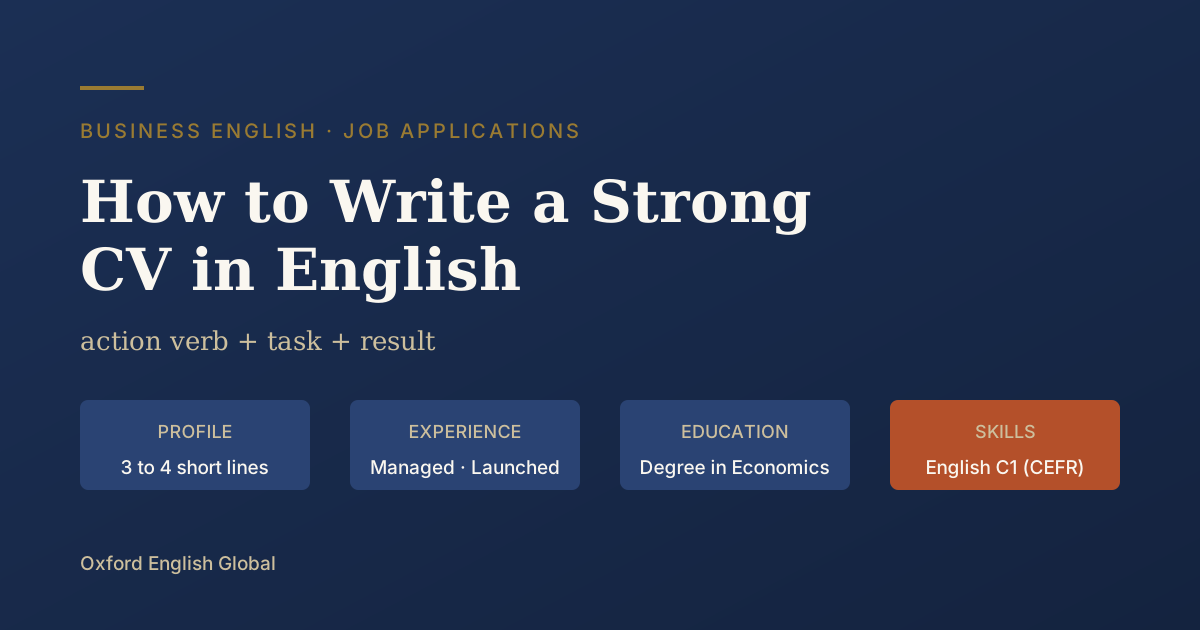
A strong English CV is short, clearly structured and written in a compressed, active style. For most jobs in the UK and many international companies, it runs to about two pages and follows this order: contact details, a short personal profile, work experience (most recent first), education, skills (including languages), and optional sections such as certifications or volunteering. Each job is described in bullet points that start with an action verb in the past tense (managed, reduced, launched) and, where possible, include a result. The most common mistakes non-native speakers make are literal translations of job titles and qualifications, full sentences with I, mixed tenses, mixed British and American spelling, and personal details that English-speaking employers do not expect, such as a photo or date of birth. This guide walks through each section, gives you a bank of action verbs, and shows before-and-after examples of the errors we see most often.
Quick reference. Section advice on this page is consistent with the UK government's National Careers Service guidance on CV sections. If you are applying in the European Union, the EU's free Europass CV tool is another widely recognised format. Employers' expectations differ by country and industry, so always check the job advert first.
CV or résumé? What the words mean
In British English, Irish, South African, Australian and most international English, the document you send with a job application is called a CV (from the Latin curriculum vitae, "the course of a life"). In the United States and Canada, the same document is usually called a résumé (often written resume), and it is often expected to be shorter, typically one page for early-career applicants.
In the US, CV normally means a longer academic document that lists publications, research and teaching. So:
| Where you apply | What it is called | Typical length |
|---|---|---|
| UK, Ireland, South Africa, Australia, New Zealand | CV | About 2 pages |
| USA, Canada (business jobs) | Résumé | 1 page (early career) to 2 pages |
| USA, Canada (academic or research jobs) | CV | As long as needed |
| International companies in other countries | Usually CV | Check the advert; 1 to 2 pages is safe |
The rest of this guide uses CV, but the language advice applies to both.
The structure of a strong CV, section by section
Recruiters often scan a CV very quickly before deciding whether to read it in detail, so a predictable structure helps them find what they need. Use clear headings and this order unless the advert asks for something different.
| Section | What to include | Language tip |
|---|---|---|
| 1. Contact details | Full name, phone number with country code, professional email, city and country, LinkedIn or portfolio link | No heading needed; put your name at the top in a larger font. |
| 2. Personal profile | 3 to 4 lines: who you are, your main experience, what you are looking for | Leave out I; use short phrases. |
| 3. Work experience | Job title, employer, city, dates; 3 to 6 bullet points per role | Start each bullet with an action verb. |
| 4. Education | Degree, institution, city, dates; grades only if strong or requested | Explain foreign qualifications briefly. |
| 5. Skills | Technical skills, software, languages with levels | Use CEFR levels for languages. |
| 6. Optional | Certifications, volunteering, publications, interests (only if relevant) | Keep interests specific and short. |
| References | Usually not listed | "References available on request" is optional; many employers ask later. |
Recent graduates with little work experience can put Education before Work experience. Career changers sometimes put a Key skills section near the top. Whatever you choose, keep the same format for every entry: if one job has the dates on the right, all jobs should.
How to write the personal profile
The personal profile (also called a professional summary) is a short paragraph under your name. It answers three questions: who are you, what have you done, and what do you want next?
The CV style: no "I", short phrases
English CVs use a compressed style. You normally leave out I, my and sometimes articles. This is not a grammar mistake; it is the expected register.
| Too long and personal | Better CV style |
|---|---|
| I am a very hard-working and motivated person and I have worked in marketing for six years. | Marketing specialist with six years' experience in B2B software, leading campaigns across Europe and Latin America. |
| I am looking for a job where I can develop my skills. | Seeking a senior marketing role in a growing SaaS company. |
Avoid empty adjectives such as hard-working, motivated, team player and dynamic unless you prove them with facts elsewhere. Every candidate uses them, so they tell the reader nothing.
A profile template
[Job title] with [number] years' experience in [industry/area], specialising in [2 to 3 strengths]. [One concrete achievement with a number]. Seeking a [type of role] in [type of organisation or location].
Example: Civil engineer with eight years' experience in infrastructure projects, specialising in road design and site supervision. Led design of a 12 km bypass delivered on schedule. Seeking a project engineer role in the UK or Ireland.
Note the apostrophe: six years' experience (the experience of six years). It is a small detail that native-speaking recruiters notice.
How to describe your work experience
This is the most important section. For each job, write the job title, employer, location and dates, then bullet points that describe what you achieved, not only what your duties were.
The formula: action verb + task + result
A strong bullet point usually follows this pattern:
Action verb (past tense) + what you did + result (with a number if possible)
| Weak (duty) | Strong (achievement) |
|---|---|
| Responsible for customer complaints. | Resolved an average of 30 customer complaints a week, raising satisfaction scores from 72% to 85%. |
| I was in charge of the social media. | Managed company Instagram and LinkedIn accounts, growing followers by 40% in one year. |
| Did training of new staff. | Trained 15 new sales staff on CRM software and company processes. |
| Worked on reducing costs. | Negotiated new supplier contracts, cutting packaging costs by 12%. |
Use real numbers only. If you do not know an exact figure, describe the scale honestly (a team of five, clients in three countries) rather than inventing a percentage. Interviewers often ask about the numbers on your CV, and you should be ready to explain each one in a job interview in English.
Which tense to use
- Past jobs: past simple (managed, designed, led).
- Your current job: present simple for ongoing duties (manage, design, lead) and past simple for completed achievements (launched a new product in 2025).
- Be consistent. Do not mix managing, managed and I manage in the same list.
If the difference between these tenses is still uncertain for you, our guide to present perfect vs past simple explains it. On a CV, the present perfect (have managed) is rare; bullet points use the simple forms.
Action verbs that make your CV stronger
Start every bullet point with a specific verb. Avoid repeating the same one, and replace weak verbs such as did, made, helped and worked on where you can. (For the general difference between make and do, see our guide to make and do collocations.)
| To show… | Useful verbs | Example |
|---|---|---|
| Leadership | led, managed, supervised, coordinated, directed, mentored | Supervised a team of eight warehouse operatives. |
| Results and growth | increased, grew, improved, boosted, expanded, exceeded | Exceeded quarterly sales targets for six consecutive quarters. |
| Saving time or money | reduced, cut, saved, streamlined, simplified, automated | Automated monthly reporting, saving about two days of work per month. |
| Creating something new | launched, designed, developed, created, established, introduced | Launched the company's first mobile app. |
| Communication | presented, negotiated, wrote, translated, persuaded, liaised with | Presented project updates to senior management each month. |
| Analysis | analysed, evaluated, researched, identified, assessed, forecast | Identified billing errors worth €20,000 in a supplier audit. |
| Helping others | supported, advised, resolved, guided, assisted, trained | Advised international students on visa and housing questions. |
Collocations matter: you meet a deadline (not reach it), achieve or exceed a target, carry out research, run a project and take part in a conference. Our guide to English collocations has more examples.
Education, qualifications and language levels
Translate qualifications by meaning, not word for word
A literal translation of a foreign qualification can confuse a recruiter. Give the closest common English name and, if helpful, the original in brackets.
- Licenciatura en Administración de Empresas → Bachelor's degree in Business Administration (Licenciatura, 5 years)
- Diplom-Ingenieur → Master's-level degree in Mechanical Engineering (Diplom-Ingenieur)
Write the subject with a capital letter and use in: a degree in Economics, not a degree of economics. Do not translate grading systems into another country's grades yourself; if a grade matters, state it as it is (for example 18/20) and let the employer ask.
Describe your languages with CEFR levels
Words like good or advanced mean different things to different people. The Common European Framework of Reference (CEFR) is widely understood by employers, especially in Europe:
- English – C1 (IELTS Academic 7.5, 2025)
- Spanish – native
- German – B1
Only claim a level you can show in an interview. If you are not sure of your level, our free English level test gives a quick estimate, and if you have an IELTS result you can check your overall band with our IELTS score calculator.
Common mistakes non-native speakers make
These errors are frequent in CVs written in a second language. Most are easy to fix once you know them.
| Mistake | Example | Better |
|---|---|---|
| Literal translation of job titles | Chief of Sales Department | Head of Sales / Sales Manager |
| False friends | Actually working as an engineer (meaning "currently") | Currently working as an engineer |
| Wrong word for experience | I have 5 years of experiences. | Five years' experience (uncountable) |
| Full sentences with "I" | I was responsible for the budget. | Managed a €200,000 annual budget. |
| Mixed tenses in a list | Managing the team; reduced costs; I organise events. | Managed the team; reduced costs; organised events. |
| Mixed spelling | organised … analyzed … colour … center | Choose British or American spelling and keep it. |
| Wrong prepositions | Experience on marketing; graduated in 2020 from university of Lisbon | Experience in marketing; graduated from the University of Lisbon in 2020 |
| Unexpected personal details | Photo, date of birth, marital status, nationality, ID number | Leave these out for UK, US and many international roles unless asked. |
| Unclear dates | 03.21–now | Mar 2021 – present |
| Hobbies with no purpose | Reading, music, travelling | Leave out, or be specific: "Ran a 40-member English conversation club" |
Two of these deserve a note:
- Experience is uncountable when it means knowledge and skill gained over time (a lot of experience, five years' experience). It is countable only when it means a single event (a great experience). See our guide to countable and uncountable nouns.
- Personal details: norms differ by country. In the UK and US, photos and dates of birth are generally left off CVs, partly because of equality and anti-discrimination rules. In some other countries they are still common. Follow the conventions of the country where the job is, not your home country.
Formatting, file type and applicant tracking systems
Many larger employers use applicant tracking systems (ATS) that read CVs automatically before a person sees them. These systems vary, but simple formatting is safer for both software and human readers.
- Use standard headings (Work experience, Education, Skills) so they are easy to recognise.
- Use a clear font at 10 to 12 points, consistent bold for job titles, and plenty of white space.
- Avoid putting key information in images, text boxes, headers or complex tables.
- Use the keywords from the job advert where they are true for you. If the advert asks for "stakeholder management", use that phrase rather than a synonym.
- Send a PDF unless the advert asks for Word, and name the file clearly: Maria-Lopez-CV.pdf.
Most applications also need a cover letter or a short email. Our guides to writing a formal letter in English and writing work emails in English show the phrases to use.
A final checklist before you send it
- Is it about two pages (or one, for a US résumé)?
- Does every bullet point start with an action verb, in a consistent tense?
- Have you included at least a few real, checkable results?
- Are job titles and qualifications translated by meaning, not word for word?
- Is your spelling consistently British or American?
- Have you removed details the employer does not need (photo, date of birth, ID numbers)?
- Have you matched the keywords in the advert honestly?
- Has someone with strong English read it? Spell checkers do not catch manger for manager, or form for from.
What this article cannot tell you
- The exact rules for your country, industry or employer. Expectations for length, photos, personal details and format vary. The job advert and the employer's careers page are the final authority.
- How a specific ATS works. Employers use many different systems with different settings, and their vendors do not publish exactly how each ranks CVs. Clear, simple formatting is a sensible default, not a guarantee.
- Legal or immigration advice. If your job search depends on a work visa, check the official government requirements for that country; a CV cannot replace them.
This page is independent guidance from Oxford English Global. It contains no affiliate or sponsored links. If you need English for job applications and interviews, see our Business English guide or try our free lessons.
Frequently asked questions
How long should a CV in English be?
For most jobs in the UK and many international companies, about two pages is standard. In the US and Canada, a business résumé is usually one page for early-career applicants and up to two pages for experienced candidates. Academic CVs can be longer.
Should I write I in my CV?
Usually not. English CVs use a compressed style without I or my, for example Managed a team of five rather than I managed a team of five. A cover letter, by contrast, is written in full sentences.
Which tense should I use on a CV?
Use the past simple for previous jobs (managed, designed). For your current job, use the present simple for ongoing duties and the past simple for completed achievements. Keep the tense consistent within each list.
Should I include a photo or date of birth on an English CV?
For UK, US and many international roles, leave them out unless the employer asks. Norms differ by country, so follow the conventions of the country where the job is.
How do I show my English level on a CV?
Use CEFR levels such as B2 or C1, and add a recognised test result if you have one, for example C1 (IELTS Academic 7.5). Only claim a level you can show in an interview.