
English Collocations in Use (Free PDF Download)
A 78-page, 52-unit course in the word partnerships that make English sound natural rather than merely correct — collocations in context, in clear patterns, with exercises and an answer key in every unit. Free to download as a PDF, and built to be used, not just saved.

You have done the hard work. Your grammar is sound, your vocabulary is wide, and yet a native speaker can tell within a sentence or two that English is not your first language. The problem is almost never grammar. It is collocation — the quiet rule that English words keep particular company, so that rain is heavy and never strong, you make a decision but take a risk, and shocking news leaves you deeply shocked rather than very shocked. English Collocations in Use is a free PDF built to fix exactly this, and you can download the full book below.
This page tells you what is inside, who the book is for, and — just as importantly — how to use a collocations PDF so it actually changes the way you speak and write, rather than sitting unread on your phone. If you have ever felt that your English is correct but somehow still sounds foreign, this is the book that closes that gap.
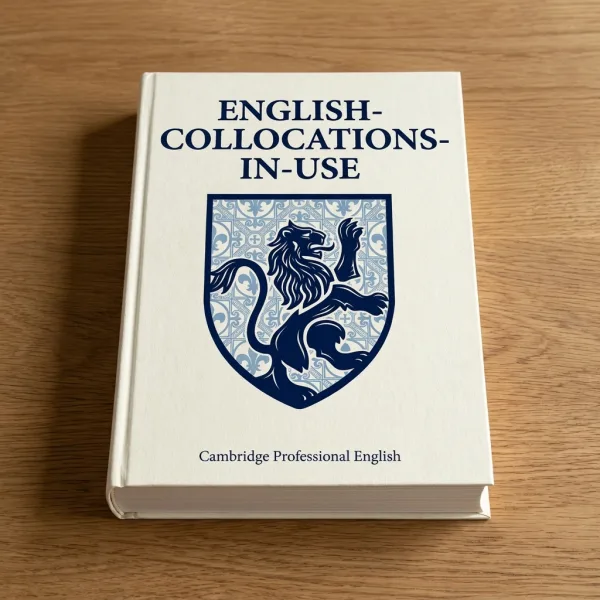
English Collocations in Use
↓ Download the free PDFNo email required. Free for personal study and classroom use.
- A 78-page self-study and classroom course in English collocations — the words that naturally go together (CEFR B1–C1).
- 52 teaching units, each presenting collocations in context and in clear, memorable patterns.
- Exercises in every unit and a full answer key, so you can test yourself rather than just read.
- The partnerships that matter most for everyday life, study and work — chosen for usefulness, not novelty.
- Free to download and free to photocopy for personal study and the classroom.
What this book covers
The book is a course, not a word list. Its 52 units take you through the collocations of real life in the order you actually meet them, each unit teaching a small, related set, showing it in context, and then making you use it. The units fall into a few broad areas:
- Everyday collocations — the partnerships you need to talk naturally about people, time, weather, money, health and daily routines (heavy rain, spare time, do the shopping, catch a cold).
- The verbs that cause the most trouble — make, do, take, have, get and give, whose partnerships almost never translate word for word (make a decision, take a risk, do business, have an argument).
- Adjective and adverb partnerships — the words that make your descriptions sound native (deeply shocked, highly likely, a strong accent, a major problem) rather than reaching for very every time.
- Study and work collocations — the language of meetings, emails, reports and academic writing (meet a deadline, reach an agreement, conduct research, raise a concern).
- Abstract and more advanced partnerships — the collocations of opinion, feeling and argument that mark out a C1 speaker (a sharp rise, a valid point, bitterly disappointed).
Because every unit ends with exercises and an answer key, the book works equally well as a course you read front to back or as a reference you dip into when one particular kind of language keeps tripping you up.
Who it's for
The book is written for two audiences at once. For learners from B1 to C1, it is the missing layer above grammar — the thing that turns sentences you build correctly into sentences that sound the way English actually sounds. For teachers and tutors, the in-context presentation and ready-made exercises are built to drop straight into a lesson; you are explicitly encouraged to copy the practice pages for class.
If you are around B1, start with the everyday units — weather, time, money, health — where the collocations are concrete and you will hear them every day. If you are B2 or C1 and stuck on the plateau where everything is "correct" but nothing sounds quite right, head for the study, work and abstract-language units; that is where the partnerships separating you from natural English are hiding. Either way, you do not need to read all 52 units in order.
How to use a collocations PDF so it works
Here is the honest part. A collocations PDF is a brilliant reference and a poor teacher — if you only read it. Reading that "you make a decision" is not the same as the word make arriving automatically when you need it in a real conversation. Collocations are stored by exposure and use, not by understanding; you cannot reason your way to them, and you cannot read your way to them either.
A collocation you have read ten times is not the same as one you have said ten times. One sits in your notes; the other sits in your mouth.
So use it actively. After each unit, write three of your own true sentences using the collocations — about your real week, your real job, your real worries — because the ones you attach to your own life are the ones that stick. Do the exercises with a pen and check the answer key; the moment you find out why the natural partner is heavy rain and not strong rain is the moment it lodges. And keep a "collocation notebook": when you meet a partnership in the wild — a film, an email, a song — record the whole phrase, never the single word. We expand on this method in our guide to learning from English PDFs the right way.
Advanced learners who plateau almost always have the individual words already — they know rain, they know heavy, they know strong. What is missing is the pairing. Once they start recording and drilling whole partnerships instead of single words, the "foreign but correct" quality fades noticeably faster than it does for learners who keep adding new vocabulary one word at a time.
Based on instructor intake notes. Directional observation, not a controlled study.
What makes this book different
It is an original work, written and produced by Oxford English Global, and not affiliated with any similarly named title. Three things set it apart in practice. First, it teaches collocations in context and in patterns rather than as a flat alphabetical list, so the partnerships are grouped the way your memory can actually hold them. Second, every unit is built to be used, not just read — the exercises and answer key turn passive recognition into active production. Third, it is ruthlessly practical: it presents the collocations that matter most for everyday life, study and work, and leaves the rare and the decorative out, so that every hour you spend in it pays back in English that sounds more natural the same week.
Pair it with these free PDFs
Collocations make your English sound native. Three other free books in our library push that natural-sounding English further:
- Once your word partnerships are solid, the next layer of natural English is its figurative language — English Idioms & Phrasal Verbs teaches the expressions that everyday speakers reach for without thinking.
- Already comfortable and aiming higher? Beyond Fluent handles the register, nuance and frontier vocabulary that separate fluent from truly native-sounding.
- If a grammar question is still what trips you up underneath the vocabulary, English Grammar: A Complete Guide is the reference that settles it for good.
All three sit in the same free library — see the full set on our free English learning PDFs page.
Download English Collocations in Use
Grab the PDF, work through one unit, and write three true sentences before you close it. That single habit will do more for how natural your English sounds than another evening of memorising single words.
English Collocations in Use
↓ Download the free PDFNo email required. Free for personal study and classroom use.
Want the partnerships taught and your own sentences corrected? Our free English track adds the one thing a PDF cannot — feedback on whether the English you actually produce sounds natural.
Prefer an app to a book? See our pick for The best language learning app 2026.
Frequently asked questions
Is English Collocations in Use really free to download?
Yes. The full 78-page PDF is free to download from this page, with no email sign-up and no paywall. It was written and produced by Oxford English Global, it is an original work (not affiliated with any similarly named title), and you are free to use it for personal study and to photocopy the practice material for the classroom.
What level is this collocations book for?
It is pitched at CEFR B1 to C1 — the point where your grammar is mostly sound but your English can still sound a little 'foreign' or word-by-word. Lower B1 readers can use the early everyday units; B2 and C1 learners will get most from the study, work and abstract-language units.
What exactly is a collocation, and why does it matter so much?
A collocation is a pair of words that natural English habitually puts together: rain is heavy (not strong), you make a decision but take a risk, and bad news leaves you deeply shocked (not very shocked). These partnerships can't be reasoned out from the rules — they have to be met, noticed and practised. Getting them right is most of what separates correct English from English that sounds native.
Can I learn collocations from a PDF alone?
A PDF is an excellent reference but cannot tell you whether the partnerships you produce sound natural. Use it actively — do the exercises, then write your own sentences using each collocation — and pair it with a source of feedback. Our free English track is built to add exactly that correction layer on the English you actually produce.