
How to Think in English Instead of Translating: Daily Habits and Exercises
Translating every sentence in your head makes speaking slow and unnatural. This guide explains why adult learners translate, what thinking in English looks like at each CEFR level, and the daily habits, timed exercises and 30-day plan that help responses become automatic.

- Why you translate in your head
- What thinking in English looks like at each level
- Seven daily habits that reduce translation
- Exercises that build automatic responses
- What to do when you get stuck mid-sentence
- A 30-day plan to start thinking in English
- Common mistakes that keep you translating
- What this article cannot tell you
To start thinking in English instead of translating in your head, you need to build direct links between English words and the things, actions and situations they describe, and then practise using them under light time pressure until the responses become automatic. The most effective daily habits are: naming objects and actions around you in English, giving a silent running commentary on what you are doing, talking to yourself out loud, learning phrases in chunks rather than single words, and using an English-to-English dictionary. Translation is a normal stage for adult learners, not a failure, and it does not disappear overnight. But with ten to twenty minutes of the right practice each day, most learners notice that they translate less, speak faster and hesitate less. This guide explains why translation happens, and gives a step-by-step plan with exercises for each level.
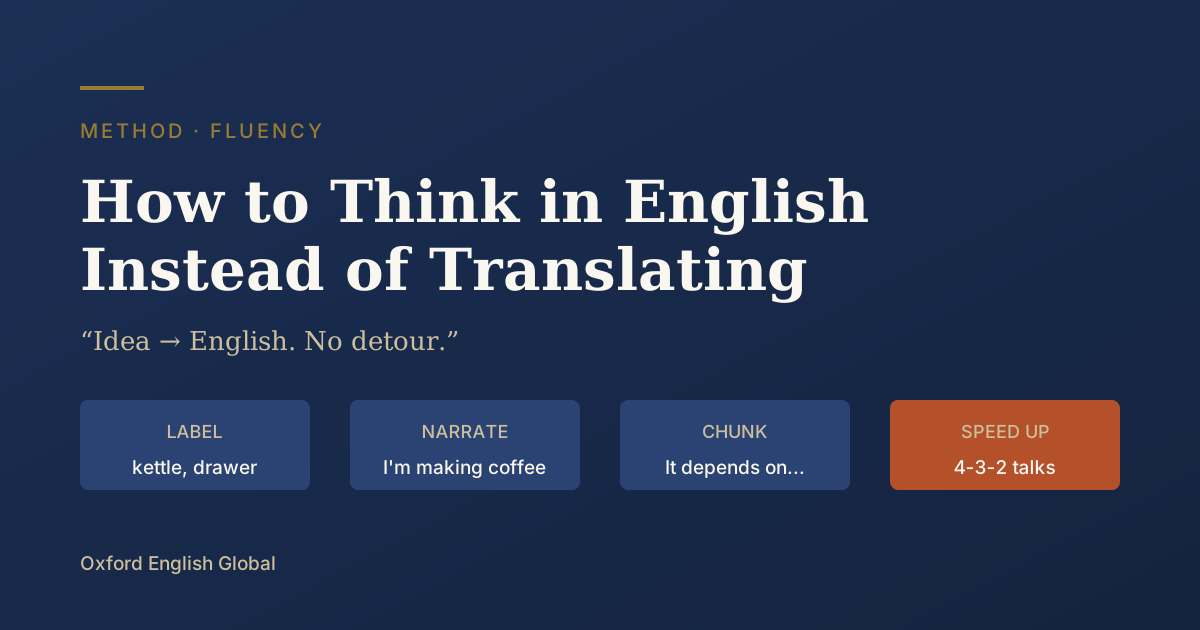
The short version: Translate less by labelling (name things in English), narrating (describe what you do), chunking (learn whole phrases), defining (use English-English dictionaries), and speeding up (speak before you have time to translate).
Why you translate in your head
When you learn a new language as an adult, you already have a complete language in your mind. The easiest way to learn a new word is to connect it to the word you already know: dog = Hund, perro, cachorro. That works well at the start. The problem comes later, when every sentence has to travel through your first language before you can say it:
- You think of the idea in your own language.
- You build the sentence in your own language.
- You translate it, word by word, into English.
- You check the grammar.
- Finally, you speak.
Each step takes time, and in a real conversation the other person keeps talking. Word-by-word translation also produces unnatural English, because languages do not express ideas in the same way. A German speaker may say I make a photo (from ein Foto machen); a Spanish speaker may say I have 30 years (from tengo 30 años). English uses take a photo and I'm 30.
"Thinking in English" means skipping steps 2 and 3: the idea goes straight into English. It does not mean you never think in your first language again. Even very advanced speakers sometimes translate, especially for numbers, technical words or emotional topics.
What thinking in English looks like at each level
Thinking in English grows gradually. The Council of Europe's CEFR global scale describes the fluency you can expect at each level: at B2, a learner can interact "with a degree of fluency and spontaneity"; at C1, they can express ideas "fluently and spontaneously without much obvious searching for expressions". The table below is our practical interpretation of what that means for translation.
| Level | What usually happens | Realistic goal |
|---|---|---|
| A1–A2 (beginner, elementary) | Most sentences are translated. Simple, high-frequency phrases (Thank you, How are you?, I don't know) come automatically. | Think in English for everyday objects, simple actions and set phrases. |
| B1 (intermediate) | Familiar topics flow without translation; new or complex ideas still go through the first language. | Describe your day, your work and your plans without translating. |
| B2 (upper intermediate) | Most conversation happens in English; translation appears for abstract or specialist topics. | Discuss opinions and solve problems in English, using paraphrase when a word is missing. |
| C1–C2 (advanced) | English is the default for most situations. Translation is occasional. | Notice and fix the remaining "translated" collocations and idioms. |
If you are not sure of your level, try our English level test first, so you can choose the right exercises below.
Seven daily habits that reduce translation
1. Label your world
Walk through your home or office and name things in English: kettle, drawer, light switch, charger, receipt. When you find something you can't name, look it up and say it three times while looking at the object. The goal is to link the English word to the thing, not to the word in your language. Some learners put sticky notes on objects for a week.
2. Narrate what you are doing
Give a silent (or quiet) commentary on your actions, like a sports commentator: I'm making coffee. Now I'm pouring the milk. Oops, I've spilled some. I need to clean that up. This is one of the best habits because it uses real verbs, tenses and phrasal verbs in context, and you can do it anywhere: cooking, driving, walking to work.
3. Talk to yourself out loud
Speaking out loud forces you to finish sentences, which silent thinking does not. Spend five minutes a day talking about anything: what you did yesterday, what you need to do tomorrow, an opinion about the news. Record yourself once a week and listen back. Our guide to practising speaking without a partner has more ideas for solo practice.
4. Plan your day in English
Write your to-do list, shopping list and calendar notes in English. These are short, practical and repeated every day, so they build automatic vocabulary quickly: call the dentist, pick up the kids, send the invoice, book a table for Friday.
5. Learn chunks, not single words
Native speakers do not build every sentence from single words. They use ready-made chunks: Do you mind if ...?, It depends on ..., I'm not sure, but I think ..., make a decision, take a break. When you learn a word, learn the phrase around it. Chunks go into your memory as complete units, so you can use them without translating each part. See our guides to learning vocabulary in chunks and to collocations with make and do.
6. Switch to an English-English dictionary
Once you reach about B1, use a learner's dictionary that explains words in English, such as the Cambridge, Oxford or Longman learner's dictionaries. The definitions and examples teach you to understand English through English. They also show collocations and grammar patterns that a bilingual dictionary often leaves out.
7. Change your inputs
Switch your phone, apps or browser to English. Follow a few accounts, channels or podcasts in English on topics you already enjoy. The more hours your brain spends in English, the more natural it becomes to stay there. Reading is especially useful: see our guide to growing your vocabulary through reading.
Exercises that build automatic responses
Habits give you exposure. These exercises add speed, which is what finally pushes translation out: when you answer quickly, there is no time to go through your first language.
| Exercise | How to do it | Time | Best for |
|---|---|---|---|
| Picture description | Open any photo and describe it out loud for 60 seconds without stopping: who, where, what is happening, what might happen next. | 3 min | A2+ |
| Quick-fire questions | Write 20 simple questions (What did you eat today? Where were you born?). Read one, answer immediately in a full sentence, move on. | 5 min | A2–B1 |
| Paraphrase drill | Choose five words you know. Explain each one without using it: It's a thing you use to open a door (a key). | 5 min | B1+ |
| The 4-3-2 talk | Talk about one topic for 4 minutes, then the same topic for 3 minutes, then 2 minutes. Each round is faster and smoother. | 9 min | B1+ |
| Shadowing | Play a short audio clip and repeat it just behind the speaker, copying rhythm and intonation. | 5–10 min | A2+ |
| Imaginary conversation | Before a real event (a meeting, a call, a shop), act out the conversation in English, including what the other person might say. | 5 min | All levels |
The 4-3-2 activity is a well-known fluency exercise from language teaching research (associated with the applied linguist Paul Nation); repeating the same content with less time encourages faster, more automatic speech. Shadowing works on listening and pronunciation at the same time; our pronunciation at home guide explains how to do it well.
What to do when you get stuck mid-sentence
Translation often starts again when you don't know a word. Instead of stopping and searching in your first language, use one of these strategies to keep going in English:
- Describe it: It's a kind of ..., It's something you use for ..., It's like a ... but bigger.
- Use a general word: thing, stuff, place, person, tool: the thing you use to cut paper (scissors).
- Use an opposite: not expensive instead of affordable; not easy instead of challenging.
- Use a filler to buy time: Let me think ..., How can I put it ..., What's the word ...
- Ask: What do you call the person who ...? Other people are usually happy to help.
These strategies are real skills. The CEFR includes "compensating" (for example, paraphrasing or describing a missing word) among the production strategies that competent speakers use. If fear makes you freeze, our guide to speaking English confidently when you're shy can help.
A 30-day plan to start thinking in English
| Week | Daily focus (10–20 minutes) | Check at the end of the week |
|---|---|---|
| 1 | Labelling objects at home and work; to-do list in English; 2 minutes of out-loud talk. | Can you name 50 new everyday objects without translating? |
| 2 | Narrate one routine (cooking, commuting) every day; learn 5 chunks a day from what you read or hear. | Can you describe your whole morning routine for 2 minutes without stopping? |
| 3 | Quick-fire questions and picture description; English-English dictionary for every new word. | Can you answer 20 personal questions in under 3 minutes? |
| 4 | 4-3-2 talks on topics from your life and work; imaginary conversations before real ones. | Record a 3-minute talk and compare it with week 1: fewer pauses, longer sentences? |
Keep a short log: the date, what you did, and one sentence about how it felt. Progress with automaticity is gradual, so a written record helps you notice change you might otherwise miss.
Common mistakes that keep you translating
- Learning word lists with translations only. A list like achieve = conseguir trains translation. Add an English example sentence and a picture or situation.
- Waiting until the sentence is perfect. Perfection takes time, and time invites translation. Speak first, correct later.
- Practising only in your head. Silent thinking skips the hard parts (pronunciation, finishing sentences). Speak out loud every day.
- Studying grammar rules but not using them. Knowing a rule is different from using it automatically. Pair every grammar topic with speaking practice; for example, our guides to conditionals and present perfect vs past simple end with exercises you can say out loud.
- Expecting it to happen at once. Translation fades topic by topic. You may think in English about your job long before you think in English about politics or feelings.
What this article cannot tell you
- How long it will take you. This depends on your level, your first language, how much English you hear and use, and how often you practise. We do not know of reliable data that gives a number of days or hours to "stop translating".
- Whether translation is always bad. It is not. Comparing your language with English can help you understand grammar and avoid false friends, and translation is a useful skill in its own right. The goal is not to ban it, but to stop depending on it in conversation.
- A guaranteed method. The habits and exercises here are widely used by teachers and learners and are consistent with fluency practice in language teaching, but no single method works the same way for everyone.
- Feedback on your English. Self-study builds automaticity, but it cannot tell you which "translated" phrases sound unnatural. A teacher or speaking partner can. Our courses, free lessons and Speaking Lab add that feedback.
This page is independent guidance from Oxford English Global. It contains no affiliate or sponsored links.
Frequently asked questions
How can I stop translating in my head when I speak English?
Build direct links between English and real things and situations: label objects, narrate your actions, talk to yourself out loud, learn phrases in chunks and use an English-English dictionary. Then add timed speaking exercises so there is no time to translate.
How long does it take to start thinking in English?
There is no reliable fixed number. It depends on your level, how much English you hear and use, and how often you practise. Most learners notice a change topic by topic, starting with everyday subjects.
Is it bad to translate when learning English?
No. Translation is normal for adult learners and can help with grammar and false friends. The aim is to stop depending on it in conversation, not to ban it completely.
What should I do if I don't know a word while speaking?
Keep going in English: describe it, use a general word such as thing or place, use an opposite, use a filler phrase to buy time, or ask the other person.