
Used To, Be Used To and Get Used To: The Difference Explained
I used to live in Madrid. I'm used to living alone. I'm getting used to the weather. These three forms look almost the same but mean different things and take different verb forms. This guide explains each one with clear examples, compares them side by side, and fixes the mistakes learners make most often.

- The three forms at a glance
- Used to: past habits and states
- Be used to: when something is familiar
- Get used to: the process of becoming familiar
- Side-by-side comparison
- Using the three forms in real situations
- Pronunciation: the "s" in used to
- Common mistakes and how to fix them
- Practice: choose the correct form
- What this article cannot tell you
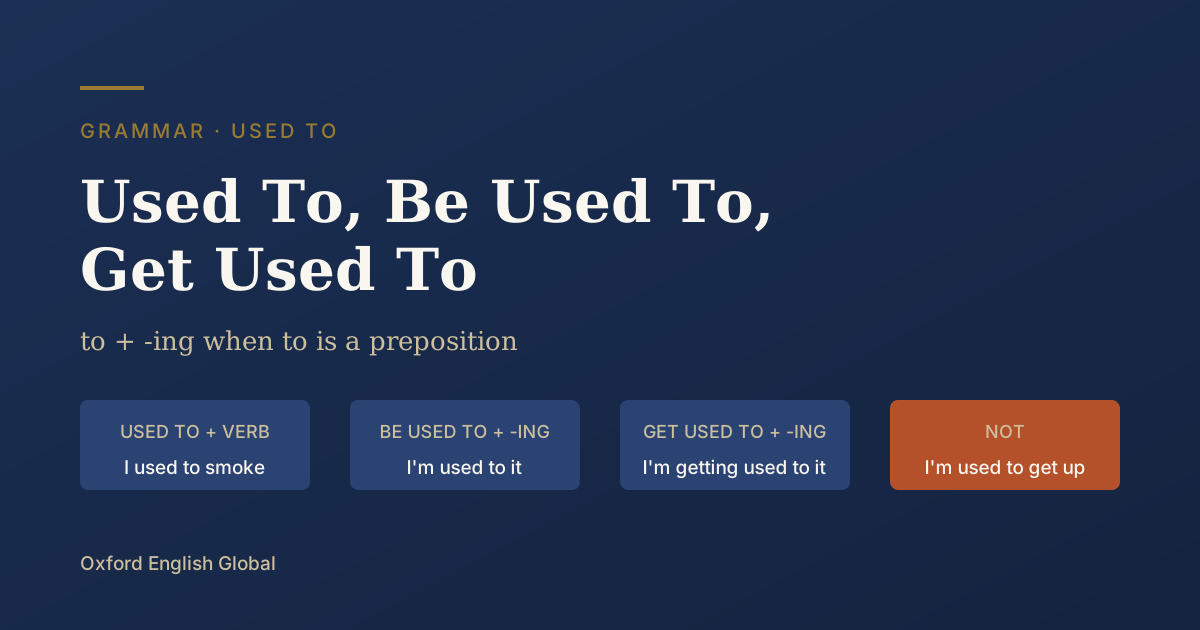
Used to + infinitive talks about past habits or states that are no longer true: I used to smoke (but I don't now). Be used to + noun or -ing means something is familiar and no longer strange or difficult: I'm used to getting up early. Get used to + noun or -ing describes the process of it becoming familiar: I'm getting used to driving on the left. The key grammar point is that in be used to and get used to, to is a preposition, so it is followed by a noun or an -ing form, never the base verb. This guide explains each form with clear examples, shows the negatives and questions, compares the three side by side, and lists the mistakes learners make most often, with a practice exercise at the end.
Reference. The rules here are standard in modern English grammar and match learner references such as the Cambridge Dictionary's English Grammar Today section, where you can look up used to and related entries.
The three forms at a glance
| Form | Followed by | Meaning | Example |
|---|---|---|---|
| used to | base verb (infinitive without to) | a past habit or state that has stopped | I used to live in Madrid. |
| be used to | noun / pronoun / -ing | something is familiar; you are accustomed to it | I'm used to living alone. |
| get used to | noun / pronoun / -ing | the process of becoming accustomed | I'm getting used to living alone. |
A quick way to remember: used to looks back at the past; be used to describes your state now (or at another time); get used to describes a change.
Used to: past habits and states
Use used to + base verb for things that were true or happened regularly in the past but are not true now.
Past habits (repeated actions)
- I used to play football every Saturday. (I don't now.)
- We used to go to the same beach every summer.
Past states (situations that lasted)
- She used to have long hair.
- There used to be a cinema on this street.
- I used to think English grammar was impossible.
Negatives and questions
In negatives and questions, use did and write use to (without d), because did already shows the past:
| Form | Correct | Common mistake |
|---|---|---|
| Positive | I used to work in a bank. | I use to work in a bank. (for the past) |
| Negative | I didn't use to like coffee. | I didn't used to like coffee.* |
| Question | Did you use to live here? | Did you used to live here?* |
*You will see didn't used to in informal writing, and it sounds the same in speech, but didn't use to is the standard written form. Another option for the negative is never used to: I never used to like coffee.
Used to vs past simple vs would
- Past simple can always replace used to: I played football every Saturday. But used to makes it clear the habit has stopped.
- Past simple only for a single event or a specific number of times: I went to Paris in 2019 (not used to go). I visited her three times (not used to visit her three times).
- Would can describe past repeated actions, especially in stories, but not past states: Every summer we would go to the lake (action, correct). I would have long hair (state, wrong; use used to have).
There is no present form: to talk about present habits, use the present simple, often with usually: I usually get up at seven (not I use to get up). Our guide to present perfect vs past simple covers more past-time choices.
Be used to: when something is familiar
Be used to means be accustomed to. Something is normal for you because you have done or experienced it often. It is followed by a noun, a pronoun, or a verb in the -ing form.
- I'm used to the cold. I grew up in Finland. (noun)
- Don't worry about the noise. We're used to it. (pronoun)
- She's used to working long hours. (-ing)
- I'm not used to speaking English on the phone. (negative)
- Are you used to the food here yet? (question)
Change the form of be for different times:
- When I lived in London, I was used to taking the Tube everywhere. (past)
- After a month, you'll be used to it. (future)
Get used to: the process of becoming familiar
Get used to describes the change from strange to normal. It also takes a noun, a pronoun or -ing.
- I'm getting used to my new job. (it's becoming normal now)
- It took me a year to get used to the weather in Scotland.
- You'll soon get used to wearing glasses.
- I can't get used to eating dinner so late. (it still feels strange)
- Have you got used to the new software yet? (UK; US also gotten used to)
Get used to is very useful for talking about moving abroad, starting a new job or learning a language: I'm still getting used to British humour.
Side-by-side comparison
The same topic can use all three forms. Compare:
| Sentence | Meaning |
|---|---|
| I used to drive on the right. | In the past I drove on the right; now I don't. |
| I'm used to driving on the left. | Driving on the left is normal for me now. |
| I'm getting used to driving on the left. | It's becoming easier; it's not fully normal yet. |
| I got used to driving on the left after a few weeks. | The process happened and finished. |
Test yourself with the "-ing check". If you can put a noun after the phrase (I'm used to the noise), then to is a preposition and a verb after it must be -ing. If not (I used to the noise is wrong), it is used to + base verb.
Using the three forms in real situations
These forms are especially useful when you talk about change: moving to a new country, starting a new job, or learning a new skill. Here is a short example of how one person might describe moving abroad:
"When I lived in Brazil, I used to eat lunch at two o'clock. In Germany, people eat much earlier, and at first I was always hungry. I'm slowly getting used to it. I'm already used to the cold, but I don't think I'll ever get used to shops being closed on Sundays!"
And at work:
- We used to have meetings every morning, but now they're weekly.
- I'm not used to giving presentations in English yet.
- The team got used to the new system within a month.
- It takes time to get used to a new manager's style.
Job interviews often include questions such as How do you deal with change? These structures help you answer naturally: In my last job we used to work in separate offices, so I had to get used to an open-plan space. Now I'm completely used to it. Our guide to job interviews in English has more sample answers.
Pronunciation: the "s" in used to
In all three structures, used to is pronounced /ˈjuːstə/ or /ˈjuːstuː/, with an /s/ sound, not a /z/. Say it as one unit: yoos-tuh. This is different from the verb use meaning "operate", as in I used a knife, which has a /z/: /juːzd/.
- I used to live there. /juːstə/
- I used the computer. /juːzd/
Our guide to pronouncing -ed endings explains why the /t/ and /d/ sounds change after different consonants.
Common mistakes and how to fix them
| Mistake | Correct | Why |
|---|---|---|
| I'm used to get up early. | I'm used to getting up early. | to is a preposition: use -ing. |
| I used to getting up early. | I used to get up early. | used to (past habit) takes the base verb. |
| I use to go to the gym. | I usually go to the gym. / I used to go to the gym. | No present form of used to. |
| Did you used to smoke? | Did you use to smoke? | After did, use use. |
| I used to go to Rome in 2018. | I went to Rome in 2018. | One event: past simple. |
| I'm getting use to it. | I'm getting used to it. | Used is an adjective here; keep the -d. |
| I am use to the cold. | I am used to the cold. | Same reason. |
These are among the errors in our list of 20 common English grammar mistakes, which has more of the same kind.
Practice: choose the correct form
Complete each sentence with the correct form of used to, be used to or get used to and the verb in brackets.
- When I was a child, I ______ (hate) vegetables.
- I've lived here for ten years, so I ______ (hear) the trains at night.
- It took me months to ______ (work) night shifts.
- ______ you ______ (play) an instrument when you were at school?
- Don't worry, you'll soon ______ (speak) English at work.
- There ______ (be) a bakery here, but it closed last year.
- She isn't ______ (drive) in heavy traffic, so she's nervous.
- I'm still ______ (eat) with chopsticks, but I'm improving.
Answers: 1. used to hate 2. am used to hearing 3. get used to working 4. Did … use to play 5. get used to speaking 6. used to be 7. used to driving 8. getting used to eating
Speaking task: Talk for one minute about how your life has changed in the last five years. Use I used to… twice, I'm used to… once and I'm getting used to… once. Our guide to improving your English speaking explains how to record and review yourself.
What this article cannot tell you
- Every informal variation. In casual speech and writing you will see didn't used to and other non-standard forms. We give the standard forms that are safe for exams and work.
- Your personal error patterns. Learners from different first languages make different mistakes with these forms. A teacher's feedback on your own speaking and writing is the fastest way to find yours.
- Rare and literary uses. Forms such as used you to…? (an old-fashioned British question) still appear in older texts but are rare today, so we do not teach them here.
This page is independent guidance from Oxford English Global and contains no affiliate or sponsored links. For a full grammar reference, see our free English Grammar: A Complete Guide or our map of all 12 English tenses, and practise more in our free lessons.
Frequently asked questions
What is the difference between used to and be used to?
Used to + base verb describes a past habit or state that has stopped: I used to smoke. Be used to + noun or -ing means something is familiar to you: I'm used to working at night.
Is it I'm used to get up or I'm used to getting up?
It is I'm used to getting up. In be used to and get used to, to is a preposition, so it is followed by a noun or an -ing form.
Is it didn't use to or didn't used to?
The standard written form is didn't use to, because did already shows the past. Didn't used to appears in informal writing and sounds the same in speech.
Can I use used to for the present?
No. Used to only refers to the past. For present habits, use the present simple, often with usually: I usually walk to work.
How do you pronounce used to?
In all three structures, used to is pronounced with an s sound, like yoos-tuh, not with a z sound as in the verb used meaning operated.